Showing posts with label war crimes. Show all posts

Thursday, August 31, 2017

Saudi-led war on Yemen contributes to cholera outbreak, killing ~2,000 & affecting 500,000+

AFP
Yemen cholera cases soar past half-million: WHO


Cholera is believed to have affected more than 500,000 people and killed nearly 2,000 since late April, the World Health Organization said Monday.

A full 503,484 suspected cases and 1,975 deaths are attributable to the outbreak that erupted last than four months ago in the war-ravaged country, a WHO overview showed.

The UN health agency said the speed at which the deadly waterborne disease was spreading had slowed significantly since early July, but warned that it was still affecting an estimated 5,000 people each day.

The collapse of Yemen's infrastructure after more than two years of war between the Saudi-backed government and Shiite rebels who control the capital Sanaa has allowed the country's cholera epidemic to swell to the largest in the world.

WHO warned that the disease had spread rapidly due to deteriorating hygiene and sanitation conditions, with millions of people cut off from clean water across the country.

"Yemen's health workers are operating in impossible conditions," WHO chief Tedros Adhanom Ghebreyesus said in a statement.

"Thousands of people are sick, but there are not enough hospitals, not enough medicines, not enough clean water," he said, also lamenting that many of the doctors and nurses needed to rein in the outbreak had not been paid for nearly a year.

"They must be paid their wages so that they can continue to save lives," he said.

WHO said that it and its partners were "working around the clock" to support the national efforts to halt the outbreak, adding that more than 99 percent of people who contract cholera in Yemen can survive if they can access health services.

More than 15 million people in the country have no access to basic healthcare.

Tedros called on all sides in Yemen's conflict, which has killed more than 8,300 people since March 2015, to urgently seek a political solution.

"The people of Yemen cannot bear it much longer - they need peace to rebuild their lives and their country," he said.


*Photo courtesy of AFP 

Monday, October 31, 2016

US continues to arm KSA for war on Yemen, despite massive civilian casualties

New York Times
Saudi Arabia Kills Civilians, the US Looks the Other Way


In the span of four days earlier this month, the Saudi Arabia-led coalition in Yemen bombed a Doctors Without Borders-supported hospital, killing 19 people; a school, where 10 children, some as young as 8, died; and a vital bridge over which United Nations food supplies traveled, punishing millions.

In a war that has seen reports of human rights violations committed by every side, these three attacks stand out. But the Obama administration says these strikes, like previous ones that killed thousands of civilians since last March, will have no effect on the American support that is crucial for Saudi Arabia’s air war.

On the night of Aug. 11, coalition warplanes bombed the main bridge on the road from Hodeidah, along the Red Sea coast, to Sana, the capital. When it didn’t fully collapse, they returned the next day to destroy the bridge.

More than 14 million Yemenis suffer dangerous levels of food insecurity — a figure that dwarfs that of any other country in conflict, worsened by a Saudi-led and American-supported blockade. One in three children under the age of 5 reportedly suffers from acute malnutrition. An estimated 90 percent of food that the United Nation’s World Food Program transports to Sana traveled across the destroyed bridge.

An Obama administration official told me on the condition of anonymity that the United States included the bridge on a no-strike list of vital infrastructure, explicitly informing the Saudis that it was “critical to responding to the humanitarian crisis in Yemen.” And yet the Saudi-led coalition obliterated the structure, either intentionally disregarding humanitarian considerations and the wishes of the United States, or out of sheer incompetence.

On Aug. 14, coalition airstrikes hit the school in the Saada governorate, a stronghold of the Houthi rebels. Saudi officials said the Houthis were running a training facility there for child soldiers. The United Nations’ child welfare agency said it was a religious school.

A day later, warplanes attacked the hospital supported by Doctors Without Borders, or M.S.F., for its French name, Médecins Sans Frontières. It was the fourth coalition attack on a facility of the doctors’ group since October. At least 19 people were killed, including an M.S.F. staffer.

M.S.F. said its hospitals’ coordinates had been shared with all parties to the conflict, including the Saudis. The hospital should have already been on no-strike lists that the United States and Saudi Arabia insist the coalition maintains.

The American assistance for Saudi Arabia that Mr. Obama authorized last March includes aerial refueling for coalition jets, intelligence and targeting assistance. American tankers offload fuel to any coalition jet, no matter its target. This support comes on top of more than $100 billion in arms deals with Saudi Arabia between 2010 and 2015, and recent deals made explicitly to “replenish” stockpiles spent in Yemen.

At the United Nations, Saudi Arabia and its allies have blocked investigations into the Yemen conflict and complained when the Security Council considered a resolution aimed at protecting Yemeni civilians. Saudi Arabia has also warned aid workers to leave much of Yemen, ominously presaging M.S.F.’s Aug. 18 decision to pull out of two governorates in the country’s north because of the coalition’s “indiscriminate bombings.” Without the group’s presence, it will be more difficult to know the toll of future strikes in these areas.

In June, Saudi Arabia threatened to cut its funding to the United Nations after Secretary General Ban Ki-moon included the coalition on a list of violators of children’s rights. While criticizing the Saudis for their bullying, Mr. Ban’s office has also been accommodating out of a belief that it can’t afford to lose Saudi money.

The Saudis are not the only negative force in Yemen. The Houthis and their allies loyal to former President Ali Abdullah Saleh have waged a cynical war, and are responsible for human rights violations. But it is difficult to see what possible progress can be made when Saudi Arabia routinely bombs civilian sites.

Many in Washington see support for the Saudi-led coalition as necessary for maintaining American-Saudi relations after the nuclear deal with Iran last year. Saudi Arabia has used this leeway to carry out its Yemen campaign with abandon. Each fatal strike and subsequent implausible Saudi denial should test the limits of the Obama administration’s support.

Instead, a spokesman for United States Central Command, which oversees American operations in the Middle East including support for the coalition, told me last week that the United States is not conducting a single investigation into civilian casualties in Yemen.

The recent uptick in airstrikes and fighting across Yemen follows the collapse of United Nations-brokered peace talks that were being held in Kuwait. The possibility of a resumption of full-scale war and all the suffering that accompanies it could have been an opportunity for the Obama administration to reflect on its axiomatic support for the Saudi coalition. But even after last week’s string of outrageous bombings, the White House has still not done that.
\
The Obama administration has in recent days insisted that it wants all sides in Yemen’s war to stop fighting. But as American tankers wait to refuel American-made fighter jets, loaded with American-made bombs destined for Yemen, the White House evidently doesn’t realize that it is waging a war.

Friday, September 30, 2016

Over 1/3 of Saudi air raids on Yemen hit civilian sites

The Guardian
One in three Saudi air raids on Yemen hit civilian sites, data shows 
Pressure on UK and US roles in war set to increase as survey shows school buildings and hospitals among targets


More than one-third of all Saudi-led air raids on Yemen have hit civilian sites, such as school buildings, hospitals, markets, mosques and economic infrastructure, according to the most comprehensive survey of the conflict.

The findings, revealed by the Guardian on Friday, contrast with claims by the Saudi government, backed by its US and British allies, that Riyadh is seeking to minimise civilian casualties.

The survey, conducted by the Yemen Data Project, a group of academics, human rights organisers and activists, will add to mounting pressure in the UK and the US on the Saudi-led coalition, which is facing accusations of breaching international humanitarian law.

It will refocus attention on UK arms sales to Saudi Arabia, worth more than £3.3bn since the air campaign began, and the role of British military personnel attached to the Saudi command and control centre, from which air operations are being mounted. Two British parliamentary committees have called for the suspension of such sales until a credible and independent inquiry has been conducted.
 
Saudi Arabia disputed the Yemen Data Project figures, describing them as “vastly exaggerated”, and challenged the accuracy of the methodology, saying somewhere such as a school building might have been a school a year ago, but was now being used by rebel fighters.

The independent and non-partisan survey, based on open-source data, including research on the ground, records more than 8,600 air attacks between March 2015, when the Saudi-led campaign began, and the end of August this year. Of these, 3,577 were listed as having hit military sites and 3,158 struck non-military sites.

Where it could not be established whether a location attacked was civilian or military, the strikes were classified as unknown, of which there are 1,882 incidents.

Saudi Arabia intervened in March 2015 to support the Yemeni government against Iran-backed Houthi rebels in control of the capital, Sana’a. The UN has put the death toll of the 18-month war at more than 10,000, with 3,799 of them being civilians. 

Human rights organisations in Yemen have documented repeated violations by the Houthis, including the use of landmines and indiscriminate shelling. Human Rights Watch noted this year that Yemeni civilians had “suffered serious laws of war violations by all sides.”

The Yemen Data Project has chosen to focus exclusively on the impact of the air campaign, rather than fighting on the ground, citing the difficulty of gaining access to frontline fighting and impartial information.

One of the most problematic findings of the survey for Saudi Arabia is the number of reported repeat attacks. While some attacks on civilian sites can be explained away as mistakes or being the location of military camps in densely populated areas such as Sana’a, repeated strikes on school buildings and hospitals will add to demands for an independent investigation.

One school building in Dhubab, Taiz governorate, has been hit nine times, according to the data. A market in Sirwah, Marib governorate, has been struck 24 times.
The UK’s shadow defence secretary, Clive Lewis, said of the survey: “It’s sickening to think of British-built weapons being used against civilians and the government has an absolute responsibility to do everything in its power to stop that from happening. But as ministers turn a blind eye to the conflict in Yemen, evidence that humanitarian law has been violated is becoming harder to ignore by the day.”

The Liberal Democrat foreign affairs spokesperson, Tom Brake, said the data added more weight to calls for the suspension of arms sales. “Despite consistent evidence showing targeting of civilians, first Cameron and now May’s governments have continued their hypocritical defence of Saudi Arabia’s brutal campaign in Yemen,” he said.

Sixty-four members of the US Congress, from the Democratic and Republican parties, sent a letter to Barack Obama last month urging the president to postpone sales of new arms to Saudi Arabia. The US also provides the Saudis with intelligence, surveillance, reconnaissance and logistical support.

The Democratic congressman Ted Lieu, who organised the letter and is a colonel in the US air force reserve, said: “The actions of the Saudi-led coalition in Yemen are as reprehensible as they are illegal. The multiple, repeated airstrikes on civilians look like war crimes.”

Campaigners are calling for an independent inquiry to establish whether attacks on civilian targets are because of poor intelligence, lack of precision on the part of the Saudi-led coalition planes, or a high degree of disregard for civilian lives.

Staff at the Yemen Data Project said they adopted rigorous standards, using news reports aligned with both sides in the conflict and crosschecked against other sources, such as social media, non-governmental organisations and evidence on the ground.

According to the project, the Saudi-led coalition hit more non-military sites than military in five of the past 18 months. In October 2015, the figures were 291, compared with 208; in November, 126 against 34; December, 137 compared with 62; February 2016, 292 to 139, and March, 122 compared with 80.

Despite a ceasefire announced in April, air raids have continued.

Over the course of the war, the survey lists 942 attacks on residential areas, 114 on markets, 34 on mosques, 147 on school buildings, 26 on universities and 378 on transport.


Asked by the Guardian about the figures during a visit to London, the Saudi foreign minister, Adel bin Ahmed al-Jubeir, portrayed the Saudi air force as professional and armed with precision weapons.

He said the Houthis had “turned schools and hospitals and mosques into command and control centres. They have turned them into weapons depots in a way that they are no longer civilian targets. They are military targets. They might have been a school a year ago. But they were not a school when they were bombed”.

The attachment of British military staff at the Saudi command centre has become increasingly controversial.

A UK Ministry of Defence spokesperson said: “The United Kingdom is not a member of the Saudi-led coalition and UK personnel are not involved in directing or conducting operations in Yemen, or in the target selection process.

“The MoD does provide training and shares best practice to the Royal Saudi air force, including training on targeting. We also provided guidance and advice to support continued compliance with international humanitarian law.”

The Yemen Data Project was set up this year in response to a lack of reliable official military figures. It says the project brings together figures from backgrounds in security, academia, human rights and humanitarian issues, and describes it as “independently funded to avoid any partisan affiliation.”

“Where independent reporting is not available, the data has been cross-referenced with sources from opposing sides to the conflict to ensure the reporting is as accurate and impartial as possible,” the project said.

Given the general lack of transparency from parties to the conflict and a paucity of independent reporting on the ground, the data had been verified and cross-referenced to the greatest extent possible, it added.

The number of civilian casualties is not included, because much of this area is highly politicised and it has not been possible to independently verify claims.


*Photos courtesy of APF/Getty Images

Saturday, April 30, 2016

World Landmine Awareness Day - Egypt maintains #1 rank as country with most landmines

Mada Masr
On world landmine day, Egypt maintains dubious top ranking for number of landmines in its soils

Tuesday, April 5, 2016

Jano Charbel 


Egypt still has the most landmines of any country in the world, according to the independent nongovernmental organization the Landmine Struggle Center, with well over 21 million deadly devices hidden in its sands, down from an estimated 23 million.

The estimated figure includes un-detonated devices that remain concealed or buried in the earth. The majority are located in the Western Desert and date back nearly 75 years to World War II.

Egypt is littered with nearly 20 percent of all world’s landmines — globally estimated at 110 million — which continue to claim lives and limbs. The state may still be producing, stockpiling and perhaps even exporting its domestically made landmines to other countries.

While Egypt commemorated the International Day of Mine Awareness and Assistance in Mine Action on April 4, paying tribute to thousands of landmine victims, it has refused to sign the UN’s Mine-Ban Convention since its introduction in 1997.

To commemorate the day, International Cooperation Minister Sahar Nasr launched the “Together for Egypt, Stop Landmines” campaign in Matrouh Governorate, which has the highest concentration of landmines in the country. Modest demining efforts are being planned, while thousands of pamphlets to raise awareness regarding the dangers of landmines are being distributed among schoolchildren and local residents.

This year Egypt has received international and private grants amounting to US$17.5 million, according to the state-owned daily newspaper Al-Akhbar — $12 million of which has been earmarked for mine-detecting equipment, while the remaining $5.5 million has been allocated to the assistance of landmine victims and their families.

Over the past few decades, Egypt has called for international assistance — particularly from the formerly warring parties of Germany, Italy and the UK — in its efforts to demine thousands of square kilometers which were littered with over 17.5 million mines during the World War II battles of Al-Alamein along Egypt’s border with Libya.

Some 5.5 million other mines were planted during the Egyptian-Israeli wars from 1956 to 1973 in the Eastern Sinai Peninsula, and along the Suez Canal and Red Sea, according to the Egyptian Ministry of Foreign Affairs website and the Landmine Struggle Center  These mines were planted on Egyptian soil by both warring states.

The Foreign Affairs Ministry estimates that demining efforts from 1981 to the present have succeeded in removing nearly 3 million landmines, mostly from the Western Desert, thus reclaiming tens of thousands of hectares of land.

Official estimates suggest that hundreds have been killed and thousands of others seriously injured in minefields leftover from World War II, locally known as “hadayeq al-shaytan” (the devil’s gardens.)

While there are no definitive figures as to how many landmines and victims there are in Egypt, the Foreign Affairs Ministry reports there have been more than 8,313 documented casualties in the Western Desert alone since 1982, among both civilians and members of the Armed Forces. These are reported to include at least 696 fatalities and 7,617 serious injuries. Real numbers of casualties may be significantly higher, as many cases are not officially reported.

Mines have also killed and maimed scores of others along Egypt’s eastern border, although these numbers have not been recorded.

Among the most recent victims of landmines included two employees from the Antiquities Ministry who were killed on February 21 while conducting excavations around an archaeological site in the Suez Canal Governorate of Ismailia. A third employee was reportedly injured in this blast.

Apart from landmines dating to World War II, armed Islamist elements are currently involved in planting improvised explosive devices (IEDs) in the northern Sinai Peninsula targeting police and armed forces.

Al-Akhbar newspaper reported that on March 21, one farmer was killed and another seriously wounded when their tractor drove over and detonated a landmine in Rafah near the border with Gaza and Israel. More recently, on April 2 the privately owned Al-Tahrir news site reported that a 9-year-old boy was killed in a landmine explosion in Rafah. A woman and man were also hospitalized the same day after having been seriously injured in two separate landmine blasts in the Rafah area.

Beyond the costly human toll, the presence of old wartime landmines of both the anti-personnel and anti-tank types continue to render thousands of kilometers of land unusable for agriculture, infrastructure development or petroleum and mineral prospecting.

According to the website of the State Information Service, Egypt faces numerous obstacles in its struggle to demine its lands. Chief among these obstacles is the very hefty price tag associated with de-mining. For instance, the clearing of Al-Alamein’s minefields is estimated to cost a staggering $20 billion.

Other factors hindering Egypt’s de-mining efforts include the loss or absence of maps indicating the locations of mines, although the UK has reportedly handed over maps of its World War II minefields.
There is also the gargantuan challenge of safely detecting mines that have gradually shifted over the course of decades — sunk deeper into the earth, covered by shifting sand dunes or washed away from their original locations.

The absence of roads leading to these minefields, along with a lack of mine-detecting equipment, compounds the difficulties associated with de-mining efforts.

According to the State Information Service site, several countries have contributed to Egypt’s demining campaigns with millions of dollars’ worth of funds and mine-detectors, including the UK, Germany, Italy, New Zealand and the European Union.

The United Nation’s theme for April 4, 2016 is “Mine action is humanitarian action, because mine action saves lives.” Other than Egypt, the nations most affected by landmines include Iran, Angola, Afghanistan, Iraq and Cambodia.

As for the UN’s Mine-Ban Convention (Ottawa Treaty of 1997), to date a total of 162 countries have ratified it. However, Egypt is among a club of 35 states — including the USA, Russia, China and Israel — that has neither signed nor ratified the convention.

Citing security concerns pertaining to cross-border threats of terrorism and drug smuggling, Egypt continues refuse to join the convention. “Egypt believes the agreement is deficient, where it made no association between the disposal by countries of their stockpiles of mines, and the provision of assistance to countries in clearing mines from their territories,” said the State Information Service.

However, Egypt’s arguments regarding security concerns ring hollow in light of human rights reports indicating that it has in previous years and decades produced, stockpiled and even exported its domestically made landmines to several war-torn states, including Afghanistan, Angola, Ethiopia, Eritrea, Iraq, Nicaragua, Rwanda and Somalia.

Details regarding Egypt’s production and exportation of mines are not made publicly available. However, officials have reportedly informed the UN that Egypt has refrained from producing or exporting anti-personnel landmines since the 1980s.

Thursday, March 31, 2016

Saud-led war against Yemen results in 6,200+ fatalities, 2.3 million displaced

The Guardian
Saudi Arabia campaign leaves 80% of Yemen population needing aid

Peace talks give Saudis way out as conflict fails to combat terrorism and puts an already impoverished country on the brink

Friday, 25 March 2016


Simon Tisdall


It is difficult to view Saudi Arabia’s relentless war of attrition in Yemen as anything other than a destructive failure. The military intervention that began one year ago has killed an estimated 6,400 people, half of them civilians, injured 30,000 more and displaced 2.5 million, according to the UN. Eighty per cent of the population, about 20 million people, are now in need of some form of aid.

The Saudis’ principal aim – to restore Yemen’s deposed president, Abd Rabbuh Mansur Hadi – has not been achieved. If they hoped to contain spreading Iranian regional influence, that has not worked, either. If the US-backed coalition’s campaign was intended to combat terrorism, that too has flopped. Al-Qaida in the Arabian Peninsula (AQAP), in particular, and Islamic State (Isis) have profited from the continuing unrest.

The conflict pits Aden-based Hadi government forces and their Sunni Arab allies against Houthi Shia militias, backed by Tehran, who control the capital, Sana’a, and much of central and northern Yemen. Already one of the world’s poorest countries before fighting escalated last year, Yemen now faces widespread famine. Food shortages are being exacerbated by a growing bank and credit crisis, Oxfam warned this week.

 
“The destruction of farms and markets, a de facto blockade on commercial imports, and a long-running fuel crisis have caused a drop in agricultural production, a scarcity of supplies and exorbitant food prices,” Oxfam said. Sajjad Mohamed Sajid, Oxfam’s country director, said: “A brutal conflict on top of an existing crisis ... has created one of the biggest humanitarian emergencies in the world today – yet most people are unaware of it. Close to 14.4 million people are hungry and the majority will not be able to withstand the rising prices.”

The UN’s 2016 appeal for donor cash has largely fallen on deaf ears. Belatedly responding to international criticism, including pressure for UK and EU arms embargoes, the Saudi government has agreed to scale back military operations pending renewed peace talks. The announcement followed a horrific airstrike on a market in Houthi-controlled Hajja province on 15 March that killed 119 people, including many children.

The UN’s human rights chief, Zeid Ra’ad Al Hussein, pointed the finger directly at Riyadh. “Looking at the figures, it would seem that the coalition is responsible for twice as many civilian casualties as all other forces put together, virtually all as a result of airstrikes,” he said. Markets, hospitals, clinics, schools, factories, wedding parties, and hundreds of private residences had been hit, Zeid said.


The Saudis’ agreement to re-enter UN-mediated peace talks in Kuwait following a proposed 10 April ceasefire looks like an admission that continued military attrition is no solution and is making matters worse. The Houthis are far from defeated, while Iran recently signalled willingness to step up direct involvement, as in Syria.

Brigadier General Masoud Jazayeri, the army’s deputy chief of staff, suggested Iran could deploy military advisers. “The Islamic Republic … feels its duty to help the people of Yemen in any way it can and to any level necessary,” he said.

Saudi Arabia has paid a high political and diplomatic price for its Yemeni misadventure, with scant return so far. Its actions have turned the spotlight on its lamentable human rights record, notably its recent execution of Sheikh Nimr al-Nimr, a leading Shia cleric. The Yemen bloodshed has alienated western public opinion and European politicians fearful of another Middle East refugee emergency and associated Islamist radicalisation.

Despite the Saudi-led intervention, al-Qaida, in particular, retains a strong and expanding foothold in southern Yemen and uses it as a recruiting and training base. Washington is quietly carrying out its own campaign there behind the Saudi smokescreen. At least 40 AQAP militants were killed in a US drone strike this week.

Saudi failure in Yemen follows strategic reverses in Syria, where Russia’s autumn intervention reinforced Bashar al-Assad, Syria’s president and Riyadh’s sworn foe. Bold plans by Prince Mohammed bin Salman, the impulsive Saudi defence minister, to send troops to support Syria’s Sunni rebels have come to nothing, while Saudi involvement in the US-led air campaign against Isis has been minimal.

Iranian leaders, meanwhile, appear ever more confident as they entrench their influence and interests in Syria, Lebanon, Iraq and the Arabian peninsula. Their buoyant mood can be attributed in part to last year’s landmark nuclear deal with Washington and the subsequent lifting of western sanctions. The Saudis were appalled. But the US overrode their objections.

Speaking recently, Barack Obama was woundingly candid about US-Saudi differences over Syria and Iran. He spoke of America’s Saudi alliance with barely disguised distaste. And he offered some unpalatable advice to his “friends” in Riyadh.

“The competition between the Saudis and the Iranians – which has helped to feed proxy wars and chaos in Syria and Iraq and Yemen – requires us to say to our friends as well as to the Iranians that they need to find an effective way to share the neighbourhood,” Obama said.

Sectarian rivalries were not in the US interest. And the Saudis, he suggested, could no longer count on preferential treatment.


*Photos courtesy of AFP and Getty Images 

** Related article:

Tens of thousands of Yemenis mark a year of war, denounce Saudi-led offensive - Reuters

***

Wednesday, September 30, 2015

Upon orders from Saudi paymasters, Sisi deploys Egyptian ground troops in Yemen

Mada Masr

Egypt reportedly deploys ground troops to Yemen

September 9, 2015 


An Egyptian military force of 800 soldiers reportedly arrived in Yemen late on Tuesday to join the ranks of the Saudi-led coalition forces fighting the Houthis, Egyptian security sources told Reuters on Wednesday.

There has been ambiguity surrounding previous local media reports about the ground military intervention in Yemen, as Egyptian government representatives remained tight-lipped amid rumors that 3000 ground troops were recently deployed to Makha, which overlooks the strategic Bab al-Mandab area.  

Four units of between 150 to 200 troops, along with tanks and transport vehicles arrived in Yemen late on Tuesday, two Egyptian security sources told Reuters-affiliated Aswat Masreya.

A senior Egyptian military source said the forces were sent “as part of Egypt's prominent role in this alliance,” which “fights for the sake of our brotherly Arab states.”

The source added, “The death of any Egyptian soldier would be an honor and considered martyrdom for the sake of innocent people.”

However, Press Secretary for the Yemeni Presidency, Mokhtar al-Rahby told Mada Masr that, “so far the Yemeni presidency hasn't received any news about Egyptian forces on Yemeni soil. There are Saudi and Qatari preparations to begin engagement with armed militias. We’re not certain about the Egyptian situation, but Egypt remains part of the Arab Coalition that might intervene at any moment.”

Spokesperson for the Egyptian Foreign Ministry, Ahmed Abu Zeid, declined to comment on the news.

Earlier on Tuesday, Saudi Al-Sharq Al-Awsat newspaper reported that a widespread military operation was in the works in Eastern Yemen. The newspaper added that the task-force joining the anticipated operation to liberate areas under the control of Houthis includes coalition forces from Egypt, Qatar and other countries that “would arrive in areas of Yemen other than Ma’rib within days, to provide on the ground logistical support to the forces.”

The sources declined to name the regions where these forces will purportedly land, adding that “they will have specific fighting goals and will largely contribute to liberating Yemeni regions from the hands of the Houthis.”

Meanwhile, spokesperson for the coalition, Brigadier General Ahmed al-Assery, told Reuters that their forces were focused on overcoming Houthi resistance in Yemen's central and southern provinces by a prerequisite airs campaign,” before starting the ground operation towards Sanaa.

Heavy air strikes on Houthi sites in Sanaa have been reported throughout this week. On Tuesday, fishermen said raids killed 20 Indian nationals off a Red Sea port, while at least 15 other civilians were killed throughout the country on the same day, Reuters reported.

On August 1, Egyptian authorities agreed to extend involvement in military operations in Yemen by another six months, in support of the Saudi-led coalition that has been fighting Shia Houthi groups since March.

Egypt’s military confirmed providing the “necessary elements for the forces” in the Yemeni conflict for a further six months, or until the objectives are met, in order to uphold national security for Arab Gulf states, the Red Sea region, and the Bab al-Mandab Strait.

Saudi Arabia and its allies in the Gulf Cooperation Council (with the exception of Oman) are leading the military offensive in Yemen, claiming that Shia Houthi rebels seized control of the state in a coup (from September 2014 until February 2015). They allege the takeover was orchestrated by Iran in an attempt to expand its influence in the region.

At the behest of Saudi Arabia’s ruling dynasty, Egypt joined Operation Decisive Storm on March 26, and continued to lend military support throughout subsequent operations, Restoring Hope and Golden Arrow.

At the time, President Abdel Fattah al-Sisi stressed that Egypt was only participating with naval and air forces. In an April speech at the Military Academy, he said, “An announcement will be made if any other forces are deployed in the operation.” 


*Photo by Maggie Michael

Thursday, April 30, 2015

Saudi-led airstrike kills dozens of workers at Yemeni dairy factory

World Socialist Website

Dozens Killed in Airstrike on Dairy Factory in Yemen

April 02, 2015

Thomas Gaist

 
The Saudi-led war in Yemen continued Wednesday, with the bombing of a dairy and juicing factory near the western port city of Hodeida killing at least 37 workers and injuring 80 others. The factory was hit by two bombs dropped by warplanes from the Saudi-led coalition, according to a Yemeni army newspaper.

According to statistics reported by UNICEF and the Field Medical Organization, the Saudi-led air raids as well as fighting between the Houthis, members of a minority Zaydi Shiite group, and military units loyal to President Abd-Rabbu Mansour Hadi have already killed at least 102 Yemeni civilians, including at least 62 children.

Since Thursday, air force units from Kuwait, Sudan, Jordan, Morocco, United Arab Emirates, Bahrain, Qatar and Egypt have taken part in the assault, in addition to Saudi Arabia.
US officials have confirmed that American forces are playing a direct support role in the operations by providing “logistical and intelligence” aid to the Saudi coalition of Persian Gulf Sunni monarchies.

While care has been taken to ensure that there is “no overt sign of US partnership,” as the Washington Post has noted, the Saudis and their allies are armed to the teeth with new weaponry and are deploying battle tanks, attack helicopters, and state of the art warplanes for a massive onslaught against targets throughout the country.

Coalition planes have launched repeated strikes in support of Hadi loyalists as they engaged in urban gun battles with Houthi riflemen in areas north of Aden. Arab League planes also launched strikes at targets in the central highlands, along the coast, and in the northern and eastern provinces. Strikes are also reportedly planned against the “security belt” of Houthi entrenchments around the outskirts of Sanaa, the capital city.

The Saudi air campaign has failed to halt the southward drive of the insurgents, and Houthi infantry and armor moved into central Aden Wednesday. Houthi forces, which are loosely tied to Iran, seized government fortifications that look down upon the strategic Bab el Mandeb strait Tuesday night.

The occupation by the Houthi forces of a strategically critical portion of the Arabian peninsula, sitting alongside the main US ally in the region and overlooking the narrow waters of the strait where huge volumes of oil, grain, and other commodities pass daily, makes clear the regional and global ramifications of the ongoing crisis.

There have been numerous reports that Saudi Arabia and Egypt would spearhead a ground invasion once military planners have determined that airstrikes on military bases, weapons stockpiles and air defenses have made the Houthis sufficiently vulnerable. Yemeni Foreign Minister Riyadh Yassin, loyal to Hadi, repeated calls for an invasion on the grounds that “at some stage air strikes will be ineffective.”

Plans for the impending invasion reportedly outlined by Saudi military planners would aim to reconquer southern areas of the country from the Shiite militants, and use these areas as staging grounds for the creation of a new proxy army inside Yemen.

US officials announced Tuesday that they would approve arms and equipment shipments to the Egyptian military government of President Abdel Fattah Al Sisi, whose regime has overseen mass killings, detention and torture of tens of thousands since coming to power in 2013. With the shipment of arms and weaponry, the US is giving its assent to preparations for a ground invasion of Yemen, which would draw in troops from throughout the region.

The threat of a massive new ground war in the Arabian peninsula, with the potential to kill tens or hundreds of thousands of Yemenis, comes amid broader preparations for escalating US military intervention in Syria and growing clamor within sections of the US ruling elite for war against Iran.

The Pentagon is deploying the Army’s 5th Special Forces Group to Jordan to establish a “multinational special operations task force,” which will train fighters for the civil war the US has fomented against Syrian President Bashar Al Assad since 2011.

US military leaders are increasingly demanding that the White House authorize the deployment of “large formations” of Special Operations troops to CIA and Pentagon-run training camps in Jordan and Iraq which serve as staging areas for the war against Assad, according to a high ranking Special Forces officer who spoke to Foreign Affairs .

The crisis in Yemen is an acute manifestation of the intensifying breakdown of the US-dominated political order in the Middle East. In spite of intense efforts by the US to prop up the dictatorship of Ali Abdullah Saleh, destabilized by Arab Spring demonstrators in 2011, the longtime leader was pushed from power and eventually replaced by then Vice President Hadi.

While Hadi garners backing from Saudi Arabia and the United States, he lacks any broad support amongst the population within Yemen. Hadi has been forced out of the country less than three years after winning a one-man election, staged as the culmination of a supposedly democratic transition process orchestrated by American imperialism and the Saudi monarchy.

Hadi fled Sanaa for his stronghold of Aden earlier in February and finally last week he fled Yemen for Saudi Arabia after his compound came under attack by planes commanded by forces loyal to Saleh, who has backed the Houthis.

Despite extensive financial and military support for the Yemeni security apparatus and more than a decade of secret US drone strikes inside the country against Al Qaeda in the Arabian Peninsula and other anti-government militias, the Iranian-supported Houthi militants have been able to rapidly overrun much of the country’s western provinces.

In response to the collapse of their puppet government they patched together in 2012, the US and the savage monarchies and dictatorships which serve as its regional gendarmes are now preparing an escalation of the slaughter in Yemen. The response of US imperialism and its proxies to growing disorder is to launch yet another major sub-regional war that has the potential to set off a military conflagration engulfing societies across North Africa and Central Asia.


*Photo courtesy of Euronews

Tuesday, March 31, 2015

Yemen: Heavy toll of Saudi-led assault on civilian non-combatants

HUMAN RIGHTS WATCH

Saudis Should Not Repeat Use of Cluster Bombs
March 28, 2015

(Beirut) – The Saudi Arabia-led coalition of Arab countries that conducted airstrikes in Yemen on March 26 and 27, 2015, killed at least 11 and possibly as many as 34 civilians during the first day of bombings in Sanaa, the capital, Human Rights Watch said today. The 11 dead included 2 children and 2 women. Saudi and other warplanes also carried out strikes on apparent targets in the cities of Saada, Hodaida, Taiz, and Aden.

The airstrikes targeted Ansar Allah, the armed wing of the Zaidi Shia group known as the Houthis, that has controlled much of northern Yemen since September 2014.

In January, the group effectively ousted the government of President Abdu Rabu Mansour Hadi. Human Rights Watch found that on March 26 warplanes struck populated urban neighborhoods in Sanaa and observed Ansar Allah forces who appeared to be firing anti-aircraft weapons from residential neighborhoods.

“Both the Saudi-led forces and the Houthis need to do everything they can to protect civilians from attack,” said Joe Stork, deputy Middle East and North Africa director. “Reports of air strikes and anti-aircraft weapons in heavily populated areas raise serious concerns that not enough is being done to ensure their safety.”

The governments of the United Arab Emirates, Kuwait, Bahrain, Qatar, Jordan, Morocco, and Sudan said that their warplanes also participated in airstrikes on March 26 and 27. Pakistan and Egypt provided naval support and the United States provided intelligence and logistical support, media reports said.

Interior Ministry officials linked to Ansar Allah shared with Human Rights Watch details of their final casualty count from the bombings in Sanaa on March 26.

They said that warplanes bombed various parts of the city, including Bani Hawat, a predominantly Houthi neighborhood near Sanaa’s international and military airports, and al-Nasr, near the presidential palace.

The officials said they had documented that 23 civilians had been killed and 24 wounded. Among the dead were 5 children, ages 2 to 13, 6 women, and an elderly man, they said. The wounded included 12 children, ages 3 to 8, and 2 women.

These numbers are consistent with information provided by two hospitals that Human Rights Watch visited. At the hospitals, Human Rights Watch documented the deaths of 11 civilians, including 2 women and 2 children, whose names were not included among those provided by Interior Ministry officials as well as 14 more wounded, including 3 children and 1 woman.

Amnesty International reported that bombing destroyed at least 14 homes in Bani Hawat.

Human Rights Watch has not been able to determine whether specific attacks complied with the laws of war, which apply to the armed conflict in Yemen. The laws of war prohibit attacks that target civilians or civilian property, or that do not or cannot discriminate between civilians and fighters.

Attacks that cause casualties or damage disproportionate to any anticipated military advantage are also prohibited. All parties to the conflict have an obligation to take all feasible precautions to spare civilians from harm, and not to deploy forces in densely populated areas.

Saudi Arabia’s past use of cluster bombs, which are indiscriminate weapons, raises concerns that they will be used in the current fighting, Human Rights Watch said. There is credible evidence that in November 2009 Saudi Arabia dropped cluster bombs in Yemen’s northern Saada governorate during fighting between the Houthis and the Yemeni and Saudi militaries.

Cluster munition remnants from the 2009 airstrikes, including unexploded submunitions, have been reported by a number of sources. In July 2013, Yemeni clearance personnel photographed unexploded US-made BLU-97 and BLU-61 submunitions. In May 2014, VICE News published photos and a video shot near Saada showing numerous remnants of US-made CBU-52 cluster bombs deployed in 2009.

Cluster munitions contain dozens or hundreds of submunitions. The submunitions are designed to explode when they hit the ground but spread over a wide area, often the size of a football field, putting anyone in the area at the time of attack at risk of death or injury. In addition, many submunitions do not explode on impact but remain armed, becoming de facto landmines.

The US provided Saudi Arabia with significant exports of cluster bombs between 1970 and 1999. Saudi Arabia possesses attack aircraft of US and Western/NATO origin capable of dropping US-made cluster bombs. Human Rights Watch has urged Saudi Arabia and Yemen to join the 2008 Convention on Cluster Munitions, which prohibits the use of cluster munitions in any circumstance.

“Saudi forces should publicly reject any use of cluster munitions and recognize that their use could have a devastating impact on civilians,” Stork said.

To satisfy Saudi paymasters, Sisi ready to send ground troops into Yemen

The Guardian

Yemen conflict poised to escalate as Egypt says it is ready to send troops

Houthi rebels say country will be ‘graveyard of invaders’ if ground offensive follows Saudi-led air strikes

Thursday 26 March 2015

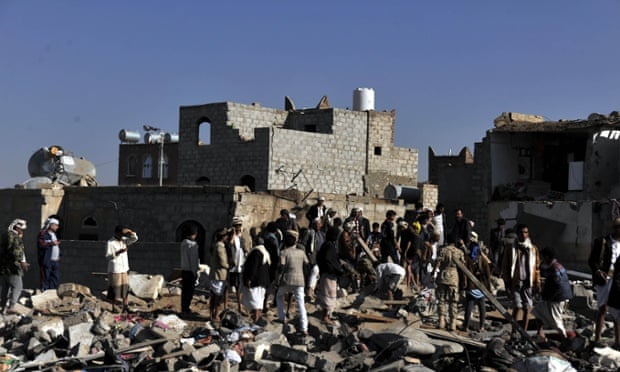
People search for casualties at a bomb site near an air base in Sana’a, Yemen.

The possibility of a ground offensive in Yemen has grown significantly as Egypt declared its readiness to send troops into the embattled country “if necessary” in the wake of air strikes launched by a Saudi-led coalition.

Arab officials still hope the air campaign – launched late on Wednesday and backed by the US, Gulf states, Egypt and Turkey – will weaken the Iranian-backed Houthi rebels, who are attempting to overthrow President Abd-Rabbu Mansour Hadi, and make a ground offensive unnecessary.

But the rebels’ leader, Abdulmalik al-Houthi, declared that Yemen would be the “graveyard of invaders” if the coalition launched a ground invasion and called for an end to what he declared an illegal, unprovoked aggression.

Hadi, who fled to Aden earlier this month, arrived in Riyadh on Thursday, Saudi state television reported.

The campaign, Operation Decisive Storm, threatens to spark a regional confrontation between Iran and its Arab rivals, who are increasingly anxious at the Islamic Republic’s growing influence in Yemen, Iraq, Syria and Lebanon.

“Egypt has declared its political and military support, as well as its participation with the coalition with an aerial and naval Egyptian force, as well as a ground force if necessary, in light of Egypt’s historic and unshakeable responsibility towards Arab and Gulf national security,” Egypt’s foreign minister, Sameh Shoukry, told a meeting of Arab foreign ministers in Sharm el-Sheikh on Thursday.

Three senior Egyptian security and military officials told the Associated Press that Saudi Arabia and Egypt would lead a ground operation in Yemen after a campaign of air strikes to weaken the rebels, saying the forces would enter by land from Saudi Arabia and by sea from the Red Sea and Arabian Sea. They said on Thursday that other nations would also be involved.

They would not specify troop numbers or say when the operation would start, only that it would be after air strikes weakened the rebels. They said the offensive aimed to push them into negotiations on power sharing.

Houthi, the rebel leader, delivered a defiant television address late on Thursday, calling on all Yemenis to mobilise in preparation for a ground invasion and decrying the “idiotic, stupid aggression.”
“These criminal, collaborative powers will discover that they committed a huge error with this aggression,” he said. “If any armies come to occupy, the Yemeni people will prove once again that Yemen is the graveyard of invaders.

“Do not enter into more stupidities. Stop immediately or all options are open,” he added. “If this aggression continues, there will be no surrender.”

Kuwait’s foreign minister urged the Yemeni factions involved in the conflict to come to Saudi-hosted talks to end the crisis, to prevent the country from “sliding into more chaos and destruction.”

The Gulf states have intervened on the ground before in recent years, with Saudi troops moving in to quell the uprising in Bahrain in 2011 in support of the Sunni Khalifa monarchy, which rules over a Shia majority. But a ground intervention in Yemen would pose major challenges, pitting the coalition against an insurgent movement backed by Iran with important redoubts in the country’s north.

The Russian president, Vladimir Putin, called for an “immediate cessation of military activities” in Yemen in phone conversations with his Iranian counterpart, Hassan Rouhani, the Kremlin said on Thursday.

Iran, which has aligned itself with the Houthis, strongly objected to the Saudi air strikes, urging their immediate halt.

“We demand an immediate stop to the Saudi military operations in Yemen and we believe they are an infringement to Yemen’s sovereignty,” said Iran’s foreign minister, Mohammad Javad Zarif, according to the semi-official Isna news agency. “These operations will only lead to bloodshed and we will spare no efforts to contain the crisis in Yemen.”

Ali al-Noaimi, a prominent UAE columnist for the state-run newspaper al-Ittihad, said the Gulf states were ready for a ground intervention but were hoping the air strikes would create “paralysis and shock” among the Houthis and energise the popular opposition to their rule, compelling them to retreat and avoid the need for a land offensive.

Saudi Arabia deployed 100 fighter jets and 150,000 troops for the operation, according to the Saudi-owned news channel al-Arabiya. The UAE also contributed 30 fighter jets, Kuwait and Bahrain 15 each, Qatar 10 and Jordan six.

Egypt is also providing naval support, deploying four warships to secure the Gulf of Aden, maritime sources at the Suez Canal told Reuters. The White House said it was providing “logistical and intelligence support.” The operation is led by the Saudi defence minister, Prince Muhammad bin Salman, the king’s son.

“We will do all we can to protect the legitimate government in Yemen and prevent it from collapsing and facing the dangers of militias,” the Saudi ambassador to Washington, Adel al-Jubeir, told a press conference late on Wednesday.

Saudi Arabia said Houthi-controlled air defences and four warplanes had been destroyed as well as al-Dulaimi airbase. A Houthi-backed TV station said 18 civilians were killed in the air strikes.

The International Committee of the Red Cross (ICRC) said it had been informed of a “considerable number” of civilian deaths and injuries following the air strikes.

Cedric Schweizer, the head of the ICRC delegation in Yemen, said it had been “a long and difficult night” for residents of Sana’a, Aden, Lahj and al-Baydha. “It is very difficult at this stage to establish the exact figures of those who lost their lives or were injured, but we have learned from our contacts with the ministry of public health and population on that there was a considerable number of civilians killed or wounded.”

The intervention came a day after Hadi’s government demanded an Arab military intervention to halt the Houthi advance, which came close to storming his southern redoubt of Aden. The Houthis, also known as Ansar Allah, are members of the Zaydi Shia sect, and took control of the capital, Sana’a, last year before placing Hadi under house arrest.

The escalation in Yemen comes amid growing Arab anxiety over Iran’s rise, with its influence spreading in Yemen and Iraq, as well as its involvement alongside the regime of President Bashar al-Assad in Syria and its prominence in Lebanon, where it backs the powerful military and political organisation Hezbollah.

Since the Houthi takeover of Sana’a, Iran has boosted its relations with the rebels, establishing direct flights to the Yemeni capital and hosting a group of influential rebels in Tehran for talks.

David Cameron’s spokeswoman said the prime minister had told Rouhani in a phone call on Thursday that other countries should not be supporting Houthi fighters in Yemen – something Tehran is already doing.

“In order to restore stability what we need is a political process and … as part of that other countries should not be supporting the Houthi rebels and instead be encouraging all the different parties in Yemen with different interests to come together in a political process,” the spokeswoman said.

In an interview with France 24, the Turkish president, Recep Tayyip Erdoğan, backed the Saudi-led coalition, saying he was considering providing logistical support. “Iran and the terrorist groups must withdraw,” he said.


*Additional reporting by Sam Jones

Saturday, February 28, 2015

Egyptian-led airstrikes in Libya kill 7 civilians, injure at least 20 others

HUMAN RIGHTS WATCH

Seven Dead, Dozens Injured; Libya and Egypt Need to Investigate

February 24, 2015

At least seven civilians, including three children, died in the joint Egyptian/Libyan airstrikes on the eastern city of Derna on February 16, 2015. Libya and Egypt should conduct speedy and transparent investigations into the deaths.

Indiscriminate attacks that cannot or do not distinguish between military targets and civilians or civilian infrastructure violate the laws of war. Serious violations of the laws of war, carried out with criminal intent, may be war crimes.

Egypt said on February 16 that it had carried out air strikes targeting extremist militants in Derna. This followed the mass killing of 21 Coptic Christians, including 20 Egyptians on February 15 by militants who pledged allegiance to the extremist group Islamic State (also known as ISIS).

Libya’s army chief of staff issued a statement confirming its coordination with Egypt in conducting the Derna air strikes. Forces loyal to the internationally recognized government, based out of eastern Libya, are engaged in an armed conflict with militant groups, including groups that pledged allegiance to ISIS, in the eastern region.

“Egypt and Libya say they are fighting extremists affiliated with ISIS, but that doesn’t give them a free hand to kill civilians,” said Sarah Leah Whitson, Middle East and North Africa director. “All parties to the conflicts in Libya need to do their utmost to spare civilians and should immediately investigate any civilian casualties.”

Human Rights Watch documented seven civilian deaths that appear to be a result of the airstrikes on Derna, and interviewed families of six of the victims by phone, all killed in their homes in the eastern city’s Al-Shiha neighborhood.

The dead included a mother, Rabiha al-Mansouri, and three of her four children, Afraa, Zakaria, and Huthaifa al-Karshoufi, who died when a missile hit their home. Others were Osama al-Shteiwi, a student who was watching from the roof of his home, who was hit by shrapnel; Attia Bousheiba al-Shaari, who died after the front of his house collapsed on him; and Hanan Faraj al-Drissi, who was on the roof of her home when a missile struck the street in front.

Residents told Human Rights Watch that the air strikes wounded at least 20 other civilians, some of whom were in intensive care at al-Hreish hospital.

Family members interviewed by Human Rights Watch said military plane over-flights and air strikes started at about 5 a.m., and many residents went onto their rooftops to observe them. All of the interviewees said that two missiles struck their neighborhood between 7 and 7:30 a.m. and that none of the homes that were hit were being used to store weapons or ammunition by local militiamen.

The head of Libya’s air force, which operates under the authority of Libya’s internationally recognized government based in eastern Libya, said in an interview that his forces had carried out “air strikes on houses in the city of Derna, which were the headquarters for ground launchers and weapons for the organization Daesh [ISIS],” and that the air strikes killed between 40 and 50 militants. He made no reference to civilian casualties.

Attacks targeting civilians or civilian property, and attacks that do not or cannot discriminate between civilians and fighters, are prohibited under the international laws governing the conduct of armed conflicts.

Attacks that are intended to punish civilians, including family members of a commander or fighter from an opposing faction, constitute collective punishment, which is also unlawful. Attacks that cause extensive and disproportionate destruction of property when carried out unlawfully and wantonly are also prohibited, Human Rights Watch said.

All parties to the conflicts in Libya, which now includes Egypt, are required to abide by the laws of war, which require them to take all feasible steps to protect civilians. Attacking parties are required by international law to take into account the risk to civilians that an attack would pose even if opposing forces are present and have situated military targets within or near populated areas.

Certain serious violations of the laws of war, when committed with criminal intent, are war crimes. Those who commit, order, assist, or have command responsibility for war crimes are subject to prosecution by domestic courts or the International Criminal Court (ICC), which has jurisdiction over war crimes, crimes against humanity, and genocide committed in Libya since February 15, 2011, under United Nations Security Council Resolution 1970.

ICC investigations in Libya remain limited to cases from 2011 involving officials of the former Gaddafi government. Despite ongoing serious crimes that may amount to war crimes and crimes against humanity in Libya, the prosecutor of the ICC has not brought any additional cases and has not announced any new investigations. The prosecutor should examine reports of serious ongoing crimes in Libya, with a view to determining whether further investigations are warranted.

The UN Human Rights Council should establish an investigative mechanism or appoint a special rapporteur on Libya to investigate all serious and widespread human rights violations in Libya, which may constitute possible war crimes and crimes against humanity, with the view to ensuring that those responsible for serious crimes are held accountable.

In 2014 the UN Security Council adopted resolution 2174, which threatens those responsible for serious crimes with sanctions, including travel bans and asset freezes, but the Security Council has yet to implement it effectively. The resolution also reiterated that individuals and groups were bound by an existing arms embargo, as stipulated in Security Council Resolution 1970 (2011.)

“Unless the Security Council acts quickly and decisively to hold those responsible for civilian deaths and injuries accountable and to reinforce the existing arms embargo, there is a risk that the situation will deteriorate further and result in many more civilian deaths,” Whitson said.

ARMED GROUPS

Several armed groups in eastern Libya publicly pledged allegiance to ISIS in November 2014, declared that they had established “Barqa Province,” and conducted public extrajudicial executions and floggings.

At least two other armed groups have claimed affiliation to ISIS in what they refer to as the Tripoli and Fezzan Provinces, respectively western Libya – including the capital, and southern Libya. These armed groups have claimed responsibility for several attacks, including the apparent mass killing of 21 Christian Copts near Sirte, and a January 27, 2015 attack on a luxury hotel in Tripoli that killed nine civilians.

On February 20, armed groups that claim to be affiliated to ISIS committed twin suicide attacks in the eastern town of al-Gubba, 40 kilometers from Derna, killing at least 44 people and injuring dozens more. A statement released by the “Barqa Province of IS” said the attacks were in retaliation for the Derna airstrikes.

The current armed conflicts, which began in May 2014 in eastern Libya and spread to the west two months later, has left the country with two rival governments: an internationally recognized government based in al-Bayda in the east, and a rival, self-proclaimed government in Tripoli that controls much of western Libya.

Both claim to be the legitimate government of all of Libya, but neither has been able to exert control nationally. Meanwhile, Libya’s institutions, particularly its judiciary, are at near-collapse, with courts and prosecutors in most cities no longer functioning because of direct targeting of judges and prosecutors by militants, and general insecurity.
 
EVIDENCE FROM WITNESSES AND FAMILY MEMBERS

Al-Karshoufi Family


Human Rights Watch spoke by phone with two members of the al-Kharshoufi family on February 18 and February 20, 2015. They said a rocket struck the family home on the morning of February 16, immediately killing Rabiha al-Mansouri and three of her four children – ages 2, 6, and 7. Al-Mansouri’s husband and their 8-year-old son survived. One relative told Human Rights Watch: “The house was nearly destroyed after one of the missiles landed straight on it at around 7 a.m. It’s a big four-story family home, and the ceiling, which is very heavy, landed where the mother and her four children were staying.”

Another relative told Human Rights Watch that the bombing almost totally destroyed 16 other houses in the same neighborhood and caused some damage to another 32 homes.

Al-Shteiwi Family

A brother of Osama al-Shteiwi, who spoke to Human Rights Watch by phone on February 20, said he saw Osama killed instantly when shrapnel hit his head as he was on the roof of their home trying to film the air strikes, which had begun at about 5a.m. He said Osama had returned to Libya from Turkey, where he was an engineering student, on February 2, when his scholarship funds ran out.

“My brother and I had been up since the early morning when we first heard over-flights of military airplanes and air strikes in the distance,” the brother said. “Just seconds before the missiles landed on our house, I shouted to my brother to come back indoors, but it was too late. Shrapnel hit him on the head and severed it from his body. He died instantly.”

Osama’s brother said he had not heard any anti-aircraft weapons fired from their neighborhood although “there was a lot of shooting that day, from all over the city,” including small arms fire from their neighborhood.

Human Rights Watch saw a copy of Osama’s burial certificate, which stated the cause of death and listed the injuries he had sustained.

Al-Shaari Family

The son of Attia Bousheiba al-Shaari, who was at the family home the day of the air strike, told Human Rights Watch in a call on February 20 that his father was in front of their house to warm up the car sometime between 7 and 7:30 a.m., waiting for one of his daughters, when a missile struck in front of the home.

“We had been hearing air strikes since the early morning in the city and we heard them coming closer, but our home is in a residential area, we never expected anything like this to happen,” the son said.

“I cannot begin to describe what it felt like when the missile struck. I ran out immediately after and saw that the front of our home had just fallen off. I then saw that my father was lying on the ground next to his car. He had injuries on his face and I specifically remember blood running out of his ear. I brought him to the hospital, but it was too late, he’d died immediately.”

The son said that he had not heard any shooting from their street before the air strike: “Our neighborhood is neutral. I do not know of anyone who stores weapons or ammunition. I find it very strange that our street was targeted specifically.”

Human Rights Watch was unable to contact family members of the other victim, Hanan al-Drissi, but spoke by phone to three of her neighbors, who said she died instantly when a rocket hit her home. One neighbor said that al-Drissi was on the roof at the time, and that one of her sisters, also at the house, was critically injured.

Sunday, August 31, 2014

Israel & Egypt bar rights groups from monitoring their crimes

International Business Times

Gaza Strip: Amnesty and Human Rights Watch 'Barred from Entering Gaza Strip'

August 18, 2014 


*Photo by Siegfried Modola courtesy of Reuters