Showing posts with label Education. Show all posts

Saturday, September 30, 2017

KSA Religion Textbooks Promote Intolerance


HUMAN RIGHTS WATCH

Saudi Arabia: Religion Textbooks Promote Intolerance
 

Textbooks Disparage Sufi, Shia; Label Jews, Christians ‘Unbelievers’


September 13, 2017 


Saudi Arabia’s school religious studies curriculum contains hateful and incendiary language toward religions and Islamic traditions that do not adhere to its interpretation of Sunni Islam, Human Rights Watch said today. The texts disparage Sufi and Shia religious practices and label Jews and Christians “unbelievers” with whom Muslims should not associate.

A comprehensive Human Rights Watch review of the Education Ministry-produced school religion books for the 2016-17 school year found that some of the content that first provoked widespread controversy for violent and intolerant teachings in the aftermath of the September 11, 2001 attacks remains in the texts today, despite Saudi officials’ promises to eliminate the intolerant language.

“As early as first grade, students in Saudi schools are being taught hatred toward all those perceived to be of a different faith or school of thought,” said Sarah Leah Whitson, Middle East director at Human Rights Watch. “The lessons in hate are reinforced with each following year.”

This research was part of a broader investigation into Saudi officials and religious clerics’ use of hate speech and incitement to violence for an upcoming Human Rights Watch report. The reviewed curriculum, entitled al-tawhid, or “Monotheism,” consisted of 45 textbooks and student workbooks for the primary, middle, and secondary education levels. Human Rights Watch did not review additional religion texts dealing with Islamic law, Islamic culture, Islamic commentary, or Qur’an recitation.

The United States Department of State first designated Saudi Arabia a “country of particular concern” under the International Religious Freedom Act for particularly severe violations in 2004. It has continued to do so every year since. The designation should trigger penalties, including economic sanctions, arms embargoes, and travel and visa restrictions. But the US government has had a waiver on penalties in place since 2006. The waiver allows the US to continue economic and security cooperation with Saudi Arabia unencumbered.

Saudi Arabia has faced pressure to reform its school religion curriculum since the September 11 attacks, particularly from the US, after it was revealed that 15 of the 19 hijackers were Saudi citizens. Saudi officials have said repeatedly they will carry out these reforms, although past reviews of the curriculum over the last dozen years have shown these promises to be hollow. In February 2017, Saudi’s education minister admitted that a “broader curriculum overhaul” was still necessary, but did not offer a target date for when this overhaul should be completed.

Saudi Arabia does not allow public worship by adherents of religions other than Islam. Its public school religious textbooks are but one aspect of an entire system of discrimination that promotes intolerance toward those perceived as “other.”

As Saudi Arabia moves towards implementing its Vision 2030 goals to transform the country culturally and economically, it should address the hostile rhetoric that nonconforming Sunni Muslims, Shia Muslims, and non-Muslim expatriate workers face in Saudi Arabia, said Human Rights Watch.

Saudi Arabia’s al-tawhid, “Monotheism,” curriculum harshly criticizes practices and traditions closely associated with both Shia Islam and Sufism. In many cases, the curriculum labels practices, such as visiting the graves of prominent religious figures, and the act of intercession, by which Shias and Sufis supplicate to God through intermediaries, as evidence of shirk, or polytheism, that will result in the removal from Islam and eternal damnation.

The curriculum repeatedly condemns building mosques or shrines on top of graves, a clear reference to Shia or Sufi pilgrimage sites.

The third book in the five-part secondary level curriculum, for example, contains a section, entitled, “People’s Violation of the Teachings of the Prophet with Graves,” stating that “many people have violated what the prophet forbade in terms of bida’ or ‘illicit innovations’ with graves and committed what he prohibited and because of that fell into illicit innovations or the greatest polytheism” by “building mosques and shrines on top of graves.”

The text also states that people use shrines as a place to commit other acts of illicit innovations or polytheism, including: “praying at them, reading at them, sacrificing to them and those [interred] in them, seeking help from them, or making vows by them…”
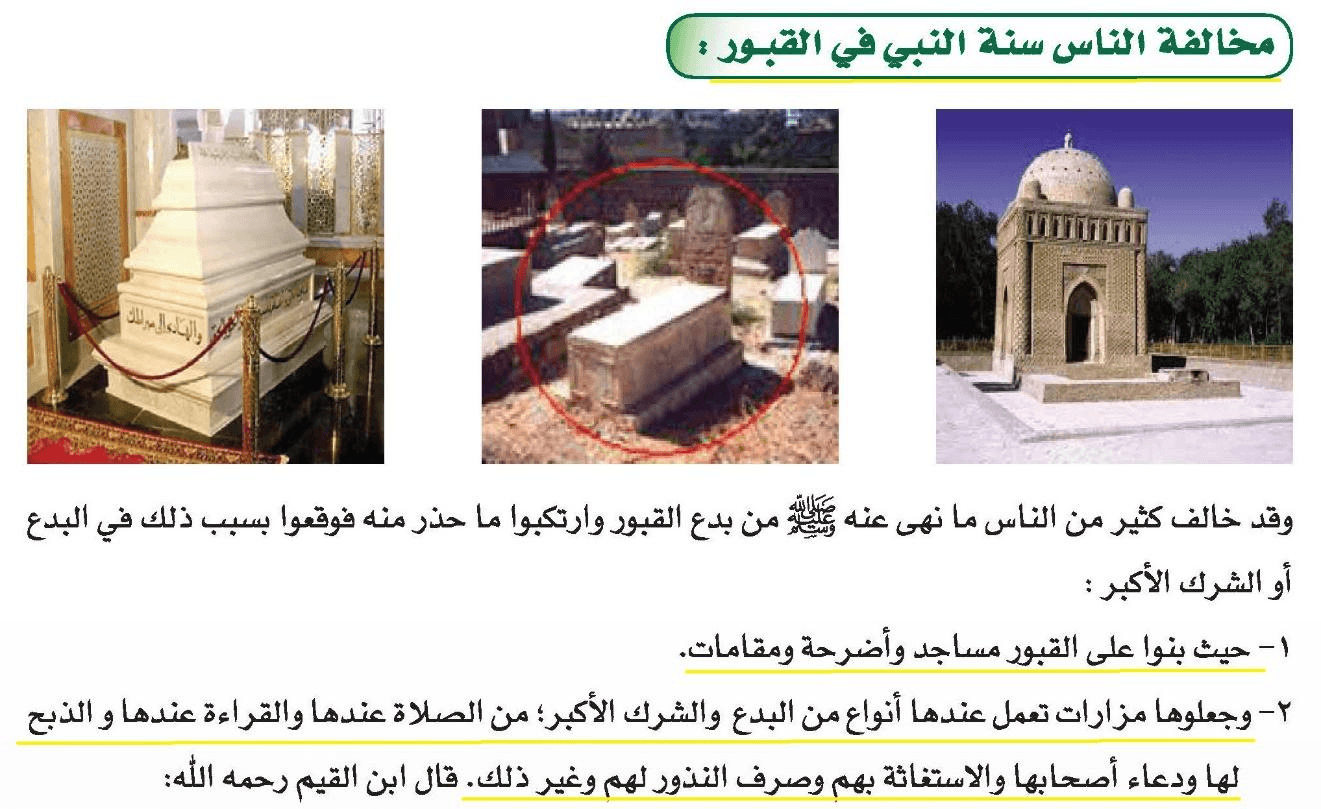
Ministry of Education, Al-Tawhid, Student Book, Secondary Semester Program, Level Three, 2016-17, p. 104
The second semester of the seventh-grade text expresses similar sentiment, saying that “those who make the graves of prophets and the righteous into mosques are evil-natured.”

Toward the end of one chapter, “The Role of Reformers in Declaring and Defending the Correct Doctrine,” in a secondary-level textbook, a short glossary lists practices of those who have deviated from correct religious practice. It describes Sufism as “a perverse path that began with the claim of asceticism, or severe self-discipline, then entered into illicit innovation, mis-guidedness, and exaggeration in reverence to the righteous.”
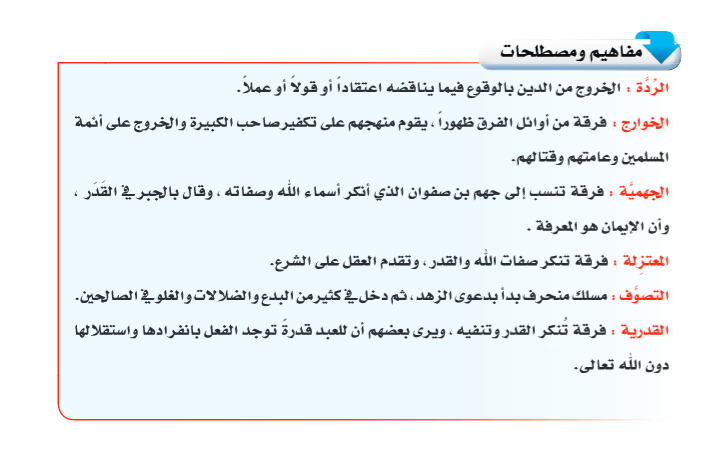
Saudi Ministry of Education, Al-Tawhid, Student Book, Secondary Semester Program, Level One, 2016-17, p. 40 
Saudi Ministry of Education, Al-Tawhid, Student Book, Secondary Semester Program, Level One, 2016-17, p. 40

The curriculum reserves its harshest criticisms for Jews, Christians, and people of other faiths, often describing them as kuffar, or “unbelievers.”


In one fifth-grade second semester textbook, the curriculum calls Jews, Christians, and Al Wathaniyeen, or “pagans,” the “original unbelievers” and declares that it is the duty of Muslims to excommunicate them: “For whoever does not [excommunicate them], or whoever doubts their religious infidelity is himself an unbeliever.”
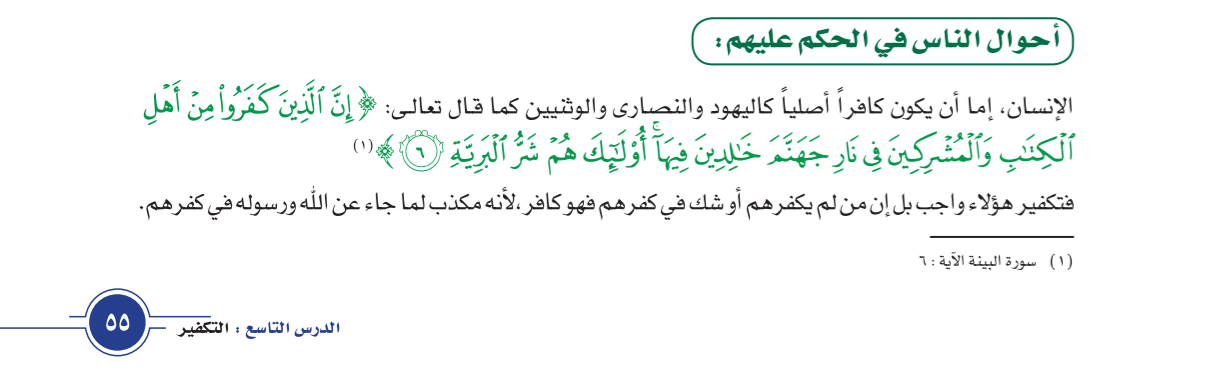
Saudi Ministry of Education, Al-Tawhid, Student Book, Fifth Grade, Second Semester, 2016-17, p. 55

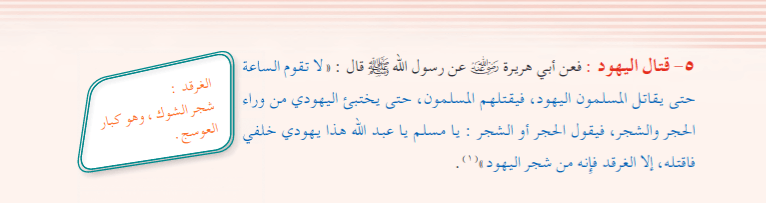
In a chapter listing markers by which one can recognize the approach of the Day of Resurrection, one passage states: “The Hour will not come until Muslims will fight the Jews, and Muslims will kill the Jews.”

Saudi Ministry of Education, Al-Tawhid, Student Book, Secondary Course, Level Two, 2016-17, p. 102.

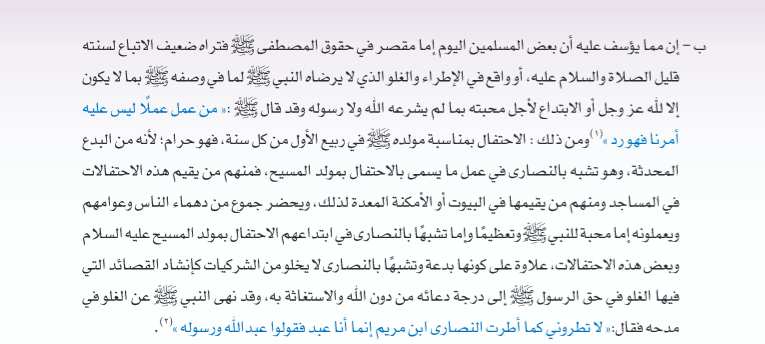
A recurring and alarming lesson in the curriculum warns against imitating, associating with, or joining the “unbelievers” in their traditions and practices. One passage rejects and denounces the Sufi practice of celebrating the birth of the prophet, accusing Sufis of imitating Christians, i.e. “unbelievers,” in their celebration of the birth of Jesus.


Al-Tawhid, Student Book, Fifth Grade, Second Semester, 2016-17, p. 279
[Translation: Celebrating the prophet’s birth in the spring of every year is prohibited; for it is a new innovation and is in imitation of the Christian celebration of what is known as the birth of Christ.]
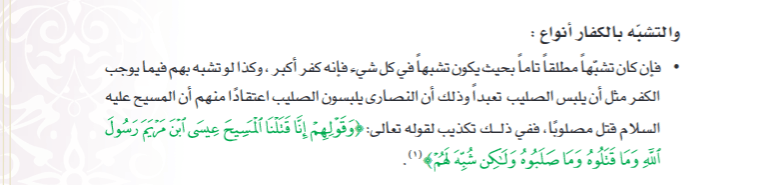
In another chapter, “Loyalty to Unbelievers,” the text explicitly calls on Muslims to reserve loyalty to God, the prophet, and other believers and to express hostility and antagonism toward “unbelievers.” It warns Muslims that by imitating “unbelievers” or even joining them in their celebrations, one is at risk of expressing loyalty to them, and worse even, becoming one of them.

Saudi Ministry of Education, Al-Tawhid, Student Book, Secondary Course, Level One, 2016-17, p. 165

The Saudi government’s official denigration of other religious groups, combined with its ban on public practice of other religions, could amount to incitement to hatred or discrimination.

International human rights law requires countries to prohibit “[a]ny advocacy of national, racial or religious hatred that constitutes incitement to discrimination, hostility or violence.”

Article 18 of the International Covenant for Civil and Political Rights (ICCPR) states: “Everyone shall have the right to freedom of thought, conscience and religion. This right shall include the freedom to have or adopt a religion or belief of his choice, and freedom, either individually or in community with others and in public or in private, to manifest his religion or relief in worship, observance, practice and teaching.”

“Saudi Arabia’s officials should stop denigrating other people’s personal beliefs,” Whitson said. “After years of reform promises there is apparently still little room for tolerance in the country’s schools.”

---

Read also:

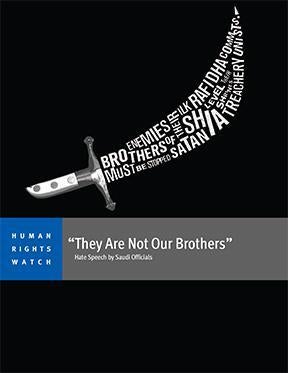
“They Are Not Our Brothers” 

Hate Speech by Saudi Officials


Thursday, March 31, 2016

Saud-led war against Yemen results in 6,200+ fatalities, 2.3 million displaced

The Guardian
Saudi Arabia campaign leaves 80% of Yemen population needing aid

Peace talks give Saudis way out as conflict fails to combat terrorism and puts an already impoverished country on the brink

Friday, 25 March 2016


Simon Tisdall


It is difficult to view Saudi Arabia’s relentless war of attrition in Yemen as anything other than a destructive failure. The military intervention that began one year ago has killed an estimated 6,400 people, half of them civilians, injured 30,000 more and displaced 2.5 million, according to the UN. Eighty per cent of the population, about 20 million people, are now in need of some form of aid.

The Saudis’ principal aim – to restore Yemen’s deposed president, Abd Rabbuh Mansur Hadi – has not been achieved. If they hoped to contain spreading Iranian regional influence, that has not worked, either. If the US-backed coalition’s campaign was intended to combat terrorism, that too has flopped. Al-Qaida in the Arabian Peninsula (AQAP), in particular, and Islamic State (Isis) have profited from the continuing unrest.

The conflict pits Aden-based Hadi government forces and their Sunni Arab allies against Houthi Shia militias, backed by Tehran, who control the capital, Sana’a, and much of central and northern Yemen. Already one of the world’s poorest countries before fighting escalated last year, Yemen now faces widespread famine. Food shortages are being exacerbated by a growing bank and credit crisis, Oxfam warned this week.

 
“The destruction of farms and markets, a de facto blockade on commercial imports, and a long-running fuel crisis have caused a drop in agricultural production, a scarcity of supplies and exorbitant food prices,” Oxfam said. Sajjad Mohamed Sajid, Oxfam’s country director, said: “A brutal conflict on top of an existing crisis ... has created one of the biggest humanitarian emergencies in the world today – yet most people are unaware of it. Close to 14.4 million people are hungry and the majority will not be able to withstand the rising prices.”

The UN’s 2016 appeal for donor cash has largely fallen on deaf ears. Belatedly responding to international criticism, including pressure for UK and EU arms embargoes, the Saudi government has agreed to scale back military operations pending renewed peace talks. The announcement followed a horrific airstrike on a market in Houthi-controlled Hajja province on 15 March that killed 119 people, including many children.

The UN’s human rights chief, Zeid Ra’ad Al Hussein, pointed the finger directly at Riyadh. “Looking at the figures, it would seem that the coalition is responsible for twice as many civilian casualties as all other forces put together, virtually all as a result of airstrikes,” he said. Markets, hospitals, clinics, schools, factories, wedding parties, and hundreds of private residences had been hit, Zeid said.


The Saudis’ agreement to re-enter UN-mediated peace talks in Kuwait following a proposed 10 April ceasefire looks like an admission that continued military attrition is no solution and is making matters worse. The Houthis are far from defeated, while Iran recently signalled willingness to step up direct involvement, as in Syria.

Brigadier General Masoud Jazayeri, the army’s deputy chief of staff, suggested Iran could deploy military advisers. “The Islamic Republic … feels its duty to help the people of Yemen in any way it can and to any level necessary,” he said.

Saudi Arabia has paid a high political and diplomatic price for its Yemeni misadventure, with scant return so far. Its actions have turned the spotlight on its lamentable human rights record, notably its recent execution of Sheikh Nimr al-Nimr, a leading Shia cleric. The Yemen bloodshed has alienated western public opinion and European politicians fearful of another Middle East refugee emergency and associated Islamist radicalisation.

Despite the Saudi-led intervention, al-Qaida, in particular, retains a strong and expanding foothold in southern Yemen and uses it as a recruiting and training base. Washington is quietly carrying out its own campaign there behind the Saudi smokescreen. At least 40 AQAP militants were killed in a US drone strike this week.

Saudi failure in Yemen follows strategic reverses in Syria, where Russia’s autumn intervention reinforced Bashar al-Assad, Syria’s president and Riyadh’s sworn foe. Bold plans by Prince Mohammed bin Salman, the impulsive Saudi defence minister, to send troops to support Syria’s Sunni rebels have come to nothing, while Saudi involvement in the US-led air campaign against Isis has been minimal.

Iranian leaders, meanwhile, appear ever more confident as they entrench their influence and interests in Syria, Lebanon, Iraq and the Arabian peninsula. Their buoyant mood can be attributed in part to last year’s landmark nuclear deal with Washington and the subsequent lifting of western sanctions. The Saudis were appalled. But the US overrode their objections.

Speaking recently, Barack Obama was woundingly candid about US-Saudi differences over Syria and Iran. He spoke of America’s Saudi alliance with barely disguised distaste. And he offered some unpalatable advice to his “friends” in Riyadh.

“The competition between the Saudis and the Iranians – which has helped to feed proxy wars and chaos in Syria and Iraq and Yemen – requires us to say to our friends as well as to the Iranians that they need to find an effective way to share the neighbourhood,” Obama said.

Sectarian rivalries were not in the US interest. And the Saudis, he suggested, could no longer count on preferential treatment.


*Photos courtesy of AFP and Getty Images 

** Related article:

Tens of thousands of Yemenis mark a year of war, denounce Saudi-led offensive - Reuters

***

Porn in Egypt: Legal & ethical issues pertaining to local production of sex videos

Mada Masr
Egypt’s shady world of sex videos

In the absence of a professional porn industry, sex videos pose legal, ethical problems

Friday, March 11, 2016

Jano Charbel 


Egypt ranks second worldwide in terms of the volume of pornography shared online, coming only after Iraq, according to the global statistical study “Who are the largest consumers of online porn?” published by SimilarWeb (an online tool that measures website traffic and analytics).

The world average for shares of online porn amounts to 4.41 percent, but in Egypt the number shoots up to 8 percent, with sexual repression usually cited as the reason.

But this massive viewership stands in stark contrast to Egyptian legislation banning pornography.

Article 178 of the Penal Code criminalizes the making and distribution of any materials — including images, illustrations and publications — that could be considered indecent or disruptive to public morality.

A few months ago, a criminal suit was filed against Egyptian actress Entisar after an episode of her televised talk show “Nafsana” (Rancor), in which she praised a young man who said he exercises patience and self-control by watching pornography, and confessed to watching erotica herself. The Nasr City Criminal Court has acquitted Entisar of “promoting immorality and depravity,” but prosecutors are looking into pursuing an appeal.

“The state is attempting to tighten its grip on society by claiming that society is constantly under moral threat,” argues Egyptian Initiative for Personal Rights researcher Dalia Abdel Hameed.

“A moral panic is created, with threats of social and moral degeneration. This had led to several arrests and lawsuits against homosexuals, against Entisar, against dancers or singers appearing in music video clips — on the grounds of protecting and safeguarding Egypt's morals."

The confluence of this sky-high demand for porn and a state-sponsored moral panic sets the tenor for the porn industry in Egypt, an industry that’s as secretive as it is ubiquitous, and fraught with questions of legality and consent.

A homemade industry raises questions of consent

Millions of Egyptians visit porn sites every day, with the international sites XNXX and XVideos among the top 50 viewed nationwide, according to the Alexa internet traffic and analytics server. But while Egypt ranks high in global porn viewership, it does not have a professional erotica industry of its own. But that doesn’t mean viewers only watch international high-end productions — locally made sex videos frequently end up being posted on porn sites.

Most of these domestically produced video clips are amateur, homemade productions, typically captured on low-quality cellphone or laptop cameras that are often hidden from view of the women being filmed.

Very rarely is there a third party filming the action, and there is never a camera crew involved. The videos are usually pixelated, grainy and shaky, typically shot from the male actor’s point of view as he engages in sexual acts while filming at the same time. The video titles frequently claim that the filmed women are prostitutes.

Sayed (not his real name) is an amateur producer of sex films and self-diagnosed porn addict who works in the financial sector. He explains that “numerous honeymoon sex tapes and private, homemade sex videos” end up being leaked by third parties, such as computer repair shops that accidentally find this content in their customers’ devices, “and whoever uploads them can give them any title of their choosing.”

Sayed says he has recorded over 30 of his own sex videos (which he says are higher resolution than average) with his female partner over the past five years, but has no intention of posting these private files.

These videos are based on consent with his partners, according to him, although none of them could be reached for verification. Sayed stores his films in a secure location on an external hard drive, as he fears the recordings could be leaked and shared locally via cellphones using Bluetooth technology, as well as CDs and flash drives or posted on the internet for an international audience. His biggest worry is when he sends his laptop to a computer repair shop.

“I don’t want to end up like ‘Anteel al-Gharbiya’,” says Sayed, referring to Mamdouh Hegazy, a middle-aged man from the Gharbiya Governorate who became a local porn star of sorts after his sex videos were stolen from his computer. Some media reports claim that his private porn collection was leaked by an employee of the shop where he had dropped off his computer to update his copy of Microsoft Windows.

When a dozen of his sex videos — filmed with several different women, via hidden cameras in his home — were uploaded onto the net in November 2014, the man quickly earned the honorary nickname “Anteel Hezb al-Nour” (the stud of the Nour Party). The ultra-conservative Salafi Nour Party quickly distanced itself from the amateur filmmaker and denied he was ever a party member.

“Some other sex videos are posted online as acts of revenge by a former lover,” Sayed continues, “claiming that the woman involved is a prostitute, when she actually isn’t, in order to publicly shame and stigmatize her.”

A few months earlier, in 2014 Abdel Fattah al-Saeedi, a karate instructor from Mahalla al-Kubra, earned the similar nickname, “Anteel al-Mahalla,” (the stud of Mahalla) when videos of him having sex with several different women, all filmed with a hidden camera in a gym, were posted to the internet. There are conflicting media reports as to how the videos wound up online, but the fact that the cameras were hidden, as this video shows, suggests that the partners were not informed of the filming process.

On February 24, 2015, the Mahalla Appeals Court sentenced Saeedi to two years in prison, then on May 31, also sentenced one of the women in the videos to two years, as she was married to another man at the time the video was filmed. Both defendants were convicted of adultery. The woman’s husband filed the criminal suit against his wife and Saeedi, allegedly after he found the video in question. He also commenced divorced proceedings.

A senior employee of a youth center near Damanhour City gained notoriety as “Anteel al-Beheira” (the stud of Beheira) when he was identified as the producer of a string of leaked sex videos. He was arrested in July 2014 and later sentenced to three years in prison.

A news video shows security forces interrogating the defendant, who confesses to filming sex videos with five different women. He claimed the women were paid LE100 per session and consented to being filmed — but several media reports alleged he used his stock of sex videos to blackmail the women into continuing to have sex with him for free.

“Anteel al-Beheira” pleads with his interrogators in the news video, arguing that he was “sick,” and claiming that his son accidentally contributed to leaking the videos.

Media reports alleged the son took his dad's cellphone to a service shop to purchase some new ringtones. A shop employee then reportedly copied and circulated the sex videos, which were widely shared across Beheira Governorate.

Farah (not her real name), a woman in her early 30s, says she dislikes the violations of privacy and the non-consensual aspects of local sex video production.

“It’s all homemade, and sometimes the videos are taken without informing the female or receiving her permission,” Farah argues. “We all know that there is no porn production in Egypt.”

One of Egypt’s most widely viewed sex videos was a 2007 production featuring the renowned belly dancer Dina with her then-husband, businessman Hossam Aboul Fotouh. Dina later appeared on a TV talk show in which she tearfully insisted she wasn’t aware her husband was filming her during sex.

Wiping the tears from her eyes, Dina asserted that she was filmed with a hidden camera. “No woman would expect to search under the bed or by the closet to make sure her husband hasn’t planted a camera here or there,” she said. “No woman would expect her husband could harm her in such a way.”

Before finding its way onto virtually every major porn server on the internet, Dina and Aboul Fotouh’s sex tape was widely circulated on video CDs and flash drives, shared even between young students in schools. With the presence of many of these videos online for free, the locally shared material is not subject to financial transactions.

The women appearing in such videos who are aware they are being filmed frequently request of their camera-wielding partner, “Don’t reveal my face,” while others cover their faces with their hands or clothes, Sayed explains.

Because it was difficult to get a response from a female actor performing in a sex video, it wasn’t possible to confirm whether women typically only believe they are agreeing to be filmed, or have also agreed to allow the videos to be distributed.

Abdel Hameed says that anyone who filmed without their consent has the right to take legal action, especially if the resulting video was made public, but legal action is rarely taken.

“It largely depends on the status of the woman,” she explains. “If she’s a public figure like Dina for example, she may be more inclined to file a lawsuit. But many, if not most, would seek to avoid such legal actions in order to avoid the associated social stigmatization, or harm to their reputation.”

Abdel Hameed points out that "there is an increasing occurrence of the violation of privacy and personal rights … and the state usually does nothing to halt these blatant violations of privacy.”

Local vs. global

Egypt’s poor-quality sex videos often pale before the more popular professional productions made abroad.

“I’d definitely go with local porn, if it was on par with foreign porn productions,” says self-employed artist Samir Amman, who describes himself as “a major porn fan.”

Sayed agrees. “If there was Egyptian porn of good quality with actresses who are physically in shape, then I’d prefer to watch them. But this isn’t the case. That’s why I like to watch professionally made foreign porn.”

Awatef (not her real name) also prefers foreign productions as opposed to the domestic variety, saying, “Egyptian men in sex videos are burly, unflattering to watch and rough with their women.”

Egyptian sex videos “lack creativity,” she continues, “while foreign productions invest more on role-playing, costumes, and creating a whole environment.”

On the other hand, as opposed to the professional porn industry, sex videos are “very real,” Farah says, and that’s why she still likes to watch them.

But erotica coming from the region also has its charms for many viewers.

ArabSexWeb is the most popular website for Egyptian pornography, Amman points out. The site compiles erotica from countries around the Arab world, including many videos that appear to be private recordings of solo masturbation performances, heterosexual couples having sex and, to a lesser extent, same-sex acts.

In a few rare exceptions, there are videos filmed by a third party or camera crew, indicating a more public nature to this sort of erotica, or perhaps even a very low-budget, homemade porn that’s a step above the purely amateur productions.

Amman explains there are also Western-based porn websites, such as ArabStreetHookers, that falsely cast non-Arab women sex workers from Egypt and other countries from the region. Many of these women are dressed up in hijabs, niqab, belly-dancing outfits, genie costumes and other Middle Eastern garb as they perform sexual acts.

“Viewers are very curious as to what lies beneath the concealing hijab or niqab,” says Amman. He suggests that in cases where porn is falsely promoted as Arab, the target audience may be Arab men, but is more likely Western porn browsers curious to view taboo images of sex from this presumably conservative region.

Why porn is here to stay?

Entisar’s contentious program intimated that Egyptian youth come to learn about sexuality primarily through pornography, as adequate sex education is lacking in the school system. “Both male and female youth learn little to nothing form their sex-ed. classes,” claims Amman. Indeed, pornographic movies in Egypt are also referred to as “aflam thaqafiya” (cultural films.)

Education aside, porn and sex videos act sometimes as an alternative to the murkier process of having sex outside marriage, which are difficult to circumvent due to legal and societal barriers.

Sayed says that watching porn and masturbating may be more convenient than having sex.

Bareeza fil yad walla hawga li 'had,” he jokingly concludes: “Masturbation in hand, there is no need for another.”


*Related reports:

Administrative Court rules to ban access to porn websites again

Little evidence that American actress shot porn at Giza pyramids, despite local media reports

***

Tuesday, March 31, 2015

Egyptian dwarfs succeed in establishing trade union & constitutional amendment safeguarding their rights

Mada Masr
Dwarfs of Egypt Unite

Dwarfism-rights activists succeed in establishing associations, a trade union, and constitutional amendment safeguarding their rights

Tuesday, March 17, 2015


Jano Charbel


During the Old Kingdom of Ancient Egypt people with dwarfism were believed to be celestially-gifted little people - some of whom became renowned royal court officials, while many others were employed in esteemed occupations. In modern day Egypt, however, the story is very different.

Currently estimated to number around 75,000 nationwide - Egyptians with dwarfism suffer discrimination, marginalization, unemployment, and poverty. They are subjected to ridicule in schools, workplaces, and in public on a daily basis. *Dwarfs also cite a lack of affordable healthcare and easily accessible transportation, amongst other grievances.

It is on the basis of confronting such discrimination, and a host of socio-economic obstacles, that groups of Egyptian dwarfs have begun to unite their ranks in recent years.

The 'Association for the Welfare of Dwarfs in Alexandria' (AWDA) was officially established in this Mediterranean city in December 2012, while the 'Independent Trade Union of Dwarfs' was established in March 2014 and officially registered with the Ministry of Manpower. This labor union for dwarfs is the only such organization in the Arab World, and perhaps worldwide.

AWDA currently boasts a general assembly membership of around 120 - with smaller branches in Cairo, along with the Suez Canal cities of Port Said and Ismailiya.

This while the newly established 'Independent Trade Union of Dwarfs' currently has a membership of some 50 members, with only one union committee - which is also headquartered in Alexandria.

The Association for the Welfare of Dwarfs describes itself as being a venue for social, cultural and sports events. While the Trade Union of Dwarfs is concerned with its members' employment, vocational training programs, professional skills, workplace discrimination, and other labor-related issues.

Both the association and the union are open to the membership of any Egyptian with dwarfism.

While there is no official national census data or other records indicating the exact number of the dwarfism community countrywide. By AWDA's rough estimates there are some 400,000 Egyptians (the vast majority of whom are of full-stature) whose families include at least one person with dwarfism. Families headed by dwarf parents are particularly prone to economic hardships in contemporary Egypt.


CONSTITUTIONAL RECOGNITION

The association won an unprecedented victory last year when Egyptians with dwarfism were recognized in a constitutional amendment including them in employment quotas. The amendment also granted special consideration to the community in terms of their socio-economic rights.

Thanks to AWDA’s advocacy, the 2014 Constitution now stipulates in Article 81:

“The state is committed to ensuring the rights of persons with disabilities and dwarfs in terms of healthcare, economic and social rights, in the fields of culture, entertainment, sports and education. Along with the provision of job opportunities for them, the allocation of employment quotas, the creation of public facilities and an environment whereby they may exercise all their political rights so as to facilitate their integration amongst other citizens — in keeping with the principles of equity, justice and equal opportunities.”

A 5 percent employment quota is specifically stipulated for both public and private sector enterprises, in accordance with the labor law.

Previous constitutions provided these rights to citizens with disabilities, but never contained provisions specifically for dwarfs. Employers would thus often exclude people with dwarfism from such quotas, on the basis that they were not mentally or physically disabled.

Essam Shehata and his wife Nisreen Hamed were the driving force behind the amendment. Tireless activists for the dwarfism community since the 1980s and co-founders of AWDA, the couple successfully lobbied lawyers and other Constituent Assembly members to include these provisions during the constitution drafting process.

Shehata, AWDA's Director and the President of the Union for Dwarfs, told Mada Masr that the new provision of constitutional article 81 is not being enforced, however.

"Neither the state nor private businessmen are standing with us in terms of the providing employment opportunities for dwarfs."
Shehata added that political parties have also neglected the rights of Egyptians with dwarfism.

Some AWDA members have successfully maintained steady jobs in the public sector, working as customs officials, employees at the Alexandria Port Authority and in the healthcare sector. Yet these cases are the exception, not the rule.

Ahmed Fouad - who has dwarfism - is employed at the Health Ministry explained that public sector employers would typically not classify dwarfs amongst the ranks of the physically or mentally disabled, especially prior to the issuing of the (January) 2014 Constitution with its Article 81.

Fouad explained that - in his experience - "We would often find that employers do recognize the five percent quota for disabled persons. But instead of providing such people with jobs at their workplaces, they are paid to stay at home." He went on to criticize such practices as being dismissive and non-constructive acts of charity.

Fouad emphatically added: "We're not asking for charity, we are asking for our rights and for equal opportunities in our country."

BARRED FROM THE WORKFORCE

Unemployment or precarious employment is often cited as the most pernicious problem facing the dwarfism community.

AWDA co-founder and secretary for women’s and children’s affairs, Nisreen Hamed points out that the association’s professional skills workshops — such as courses in cellphone repairs and maintenance — have “proven that dwarfs are mentally and physically capable of performing technical work exactly like fully grown people."

Sami Ramsis has been out of work for three years. “I've been repeatedly seeking employment at the Ministry of Manpower's bureaus,” he says. “But the employees there ridicule me, saying normal people can't even find employment, let alone dwarfs.”

Ramsis feels like he's stuck in a cycle of social exclusion. "Since I can’t find a job, I can't buy or rent an apartment for myself,” he continues. “Since I don't have any steady income or an apartment, I can't get married or have a family of my own.”

And even if a person with dwarfism does get a job, he or she is then confronted with the problem of how to get there — many report that most forms of public transportation are inaccessible.

"I have no problem riding the tramway, but some buses and microbuses are very difficult to climb aboard. They are not easily accessible to people our height," AWDA member Qadria Mahrous says.

Other association members say they hope government officials or private donors will help to subsidize the purchase of cars or motorcycles that are modified for their height, so as to increase their mobility - and, by extension, their prospects for employment.

BUILDING COMMUNITY

AWDA may still have a long way to go when it comes to tackling issues of national infrastructure and transportation — but it has been successful in creating a community center, and offering the services and activities that Egyptian dwarfs can’t find elsewhere.

AWDA offers some medical services to its members, who often struggle with access to healthcare. Hamed explained that there are a multitude of different forms of dwarfism. Her association provides human growth hormone injections for those children whose specific form of dwarfism is caused by hormonal imbalances or nutritional deficiencies.

Hamed added: “from childhood dwarfs are ridiculed at school, then in adulthood suffer discrimination in employment,” she asserts.

“We've been calling on the Ministry of Education to raise awareness, to increase tolerance and acceptance of dwarf children in schools,” Hamed explains. “We want to end the physical and verbal bullying of dwarf students by their classmates.”

She hopes that increased efforts on the part of education officials will help to foster a sense of social integration and belonging that would ultimately lead to greater success later in life.

And aside from these crucial services, the social experience the association provides makes a major impact on its members’ lives.

"I enjoy the sense of community, and the company of friends I've made here. We can relate to each other's daily grievances,” says Mahrous.

The association convenes for its general assembly meetings on the first Friday of every month. Mahrous expressed her appreciation for the trips, excursions, (limited) health care assistance, pilgrimages to Mecca/Medina, Ramadan food packages, along with vocational training and job skills that AWDA offers its members.

These activities have helped to build a close, tight-knit community — Hamed proudly notes that at least six couples with dwarfism met and got married through the association. Several of AWDA's married members have subsequently produced offspring who are of full-stature.

Shehata is currently working to establish a National Day for Egyptian Dwarfs on March 27 to raise awareness regarding the community, and its needs and aspirations. AWDA is preparing events including football matches between teams of dwarfs, together with songs, dances, competitions, and cultural shows - by performers with dwarfism.


At the association's headquarters, five costumed AWDA members are rehearsing an Upper Egyptian stick dance and a Nubian jig in traditional costumes. They smile joyfully for their photo shoot, and say they’re excited to perform in front of an audience. They even hope to perform professionally in the future.

But the rehearsals might be in vain if Shehata doesn’t secure the funds required for such a national event.

"If we don't have sponsors to promote or financially assist us with these events, then we won't be able to be able to go ahead with them,” he explains. “Our plans for this National Day of Egyptian Dwarfs may have to be put on hold."


While the Association for the Welfare of Dwarfs in Alexandria does not have an official webpage, pertinent information on the Egyptian little people community can be found on the Dwarves Dot Com Facebook page.


*In interviews with Mada Masr, members of the community referred to themselves as "qezm/aqzam," literally "dwarf/dwarfs." This term has been contested globally, with some preferring to use "people of short-stature" or "little people," as there is no agreement on whether or not dwarfism is a disability. 
**Photos by Jano Charbel 

Sunday, August 31, 2014

Students can now be expelled for criticizing Dictator Sisi

Mada Masr

Students could be expelled for criticizing President Sisi

Friday, August 29, 2014


The boards of two public universities have now decided to expel any student who insults or defames President Abdel Fattah al-Sisi.

Following a precedent set by the University of Beni Suef, the board of Ain Shams University agreed on Thursday to expel any student who insults Sisi.

Quoted on the privately owned Sada al-Balad news website, vice president of Ain Shams University, Mohamed al-Toukhi, stated: “The university shall refer to a disciplinary hearing any student who insults any symbol of the state, not merely President Sisi.”

"This is not a punitive measure to expel any student at will,” Toukhi claimed.

Students would instead be expelled as soon as the disciplinary board determined their responsibility for “wronging” state officials with insults, he added.

In another statement to privately owned newspaper Al-Masry Al-Youm, Toukhi claimed that such insults against state officials are a violation of university regulations.

On Friday, privately owned Al-Mougaz news website published a critical response to the new university rules, from the head of the student union at Zaqaziq University.

Student union president Mohamed Sherbini commented that expulsion for criticizing Sisi or other state officials “is an injustice against students.”

Sherbini added that he believed students should only be expelled if they actively interrupt the academic year, or are found responsible for destroying university property.

Organized primarily by Islamist-leaning students since the July 3 ouster of former President Mohamed Morsi, a host of protests in and around university campuses have resulted in arrests of hundreds of students, along with the deaths and injuries of tens of others during security crackdowns.

The presidents and boards of several public universities have called on the Ministry of Interior to deploy police forces both inside and around campuses to quell opposition student protests.

In statements to state-owned newspaper Al-Akhbar Al-Youm on Friday, the Minister of Endowments called on universities, especially the Islamic Al-Azhar University, to remove professors affiliated to or sympathetic with the outlawed Muslim Brotherhood.

Minister Mohamed Mokhtar Gomaa commented that “extremists” and “affiliates of the terrorist society” must be purged from universities ahead of the academic year.

Public universities are scheduled to begin their academic year on September 27.

Gomaa added that this should apply to both professors and deans sympathetic to the Brotherhood.

In Al-Masry Al-Youm, Gomaa was quoted as saying that action must be taken against the group known as “Academics Against the Coup” whose names and identities are purportedly known to Al-Azhar University’s board.


*Caricature by Adam Zyglis

Sunday, March 30, 2014

Female victim blamed for mob sex assault in Cairo University

Mada Masr 
Victim blamed after sexual assault at Cairo University

March 18, 2014


A case of mass sexual assault on a female student at Cairo University on Monday has led to a storm of accusations on TV channels and social networking sites.

This alarming incident has also raised questions and concerns regarding Egyptian society’s toleration of sexual harassment and its apparent acceptance of physical assaults on women nationwide.

On Tuesday, women’s rights activists and anti-harassment volunteer groups began preparations for a protest outside Cairo University on Thursday, while the (state-controlled) National Council for Women called on the government to enforce stricter legislation criminalizing sexual harassment and assault. 

A female law student was mobbed by a group of male students, groped and sexually assaulted, shortly after she entered the campus on Monday. The victim sought to escape from her attackers by hiding in the women’s bathroom, yet even then a gang of students surrounded her inside, awaiting her exit.

It was only after she was trapped inside the bathroom, apparently crying and in a state of great distress, that university security guards moved to disperse the assailants from around the bathroom and escorted the girl off campus.

Gaber Nassar, president of Cairo University, spoke with privately owned ONtv satellite channel on Monday, and claimed that such an incident of sexual “harassment” at the University is atypical and “exceptional.” He added that Cairo University is a respectable institution that upholds a respectable dress code.

Nassar contradicted himself, saying, “there is no justification for harassment,” yet he went on to imply that the student had brought this assault upon herself as a result of the tight clothing she was wearing.

He added that the student in question was wearing a black robe covering her body, but took it off after entering the campus. Amateur video footage shows the victim dressed in a long-sleeved pink sweater and black pants.

The incident was captured on camera and Nassar claimed the male students involved would be investigated. However, it isn't clear what legal measures have actually been taken, as he added that lawyers were scrutinizing video footage to ascertain if a crime had taken place. Originally, the University denied the incident had occurred.

On Tuesday, TV presenter Tamer Amin went even further in his justification of the assault. His program “Min al-Akher” on the Rotana Egypt satellite channel came under fire following comments he made.

The renowned TV presenter criticized Cairo University’s statement regarding “the personal freedom of attire.”

Amin said, “Clothing is not a personal freedom unless it is worn at home or in private; not in places like public universities or schools. An employee cannot go to work dressed in their shorts, for example.”

The TV presenter went on to blame the victim even further by claiming that the female student in question was “dressed like a belly dancer.” Amin asked, “How was it that university guards allowed her to enter campus in such garb, which exposed more than it covered?”

Amin further justified the mob’s sexual assault by claiming that the “student was dressed like a slut,” and thus it was her attire which aroused, encouraged and instigated the assault against her.

On social networking site, Twitter, user Mohamed al-Khateeb wrote that harassment is not only a crime that happens in dark alleyways at night, it also happens on university campuses during the daytime.

A host of female Twitter users denounced Amin as “an animal,” while many others called on the Rotana Channel to sack him from his job for his sexist comments condoning harassment and assaults against women.

Many other Twitter users commented that harassment is rampant in Egypt because of unemployment, lack of affordable apartments and the general inability to afford marriage expenses.

Other users pointed out that sexual harassment and assaults are perpetrated by prepubescent boys and married men even though they do not suffer from the aforementioned problems.

Sexual harassment and assaults continue to plague Egypt’s streets on a daily basis — and, as mentioned on social networking sites — do not appear to be based solely on womens’ attire. Women wearing the head veil (hijab) or full face-veil (niqab) are often subjected to the same mistreatment and assaults as those who don’t.

According to a 2013 report by UN Women, 99.3 percent of women have said they have experienced sexual harassment or assault at some point in their lives. 

Tuesday, December 31, 2013

Egypt: 15 year-old boy jailed for carrying a ruler with Brotherhood symbol

The Telegraph

Egypt: detention extended for 15-year-old boy found with pro-Muslim Brotherhood symbol on school ruler

Case of boy found with an anti-regime sticker at school highlights the extremes authorities are prepared to go

16 Dec 2013

Richard Spencer

Prosecutors in Egypt have doubled a 15-day detention period of a 15-year-old boy for having an anti-regime sticker on his school ruler and issued arrest warrants for two of his teachers and his father.
In one of a series of cases which have highlighted the measures the authorities will go to in their determination to end pro-Muslim Brotherhood opposition. The boy, Khaled Mohammed Bakara, was detained after his schoolteacher saw the sticker and reported him to the police.

The sticker showed a hand holding up four fingers - the sign used by supporters of the deposed Brotherhood president, Mohammed Morsi, since the crushing of protests against his removal at a cost of hundreds of deaths at the Raba’a al-Adawiya mosque in Cairo. “Rabaa” means “four” in Egyptian Arabic.

The “Raba’a” sign, normally in black on a yellow background, has been held up at many subsequent demonstrations.

Khaled was initially ordered to be detained for 15 days pending inquiries into a claim that he possessed a “ruler bearing a sign that implies violence and offends the armed forces.”

He has subsequently been ordered to remain a further 15 days in detention at the Central Security Forces barracks in his home governorate of Kafr al-Sheikh.

At the same time, prosecutors issued arrest warrants for two of his teachers, one of whom was a relative, and his father, Mohammed Abdulghani Bakara, a fisherman, for “inciting” Khaled to take the ruler to school, along with two notebooks found in his school bag which also carried the symbol.

“Khaled has confessed that the ruler is his own, so there is no need to keep him in jail without bringing him to court,” his lawyer, Amr Ali al-Deen said. “But the prosecutor is now afraid to bring the case to court as it will harm his reputation even more than his reputation has already suffered. The case doesn’t even rise to the level of a misdemeanour.”

The arrest was ordered despite commitments from the military-backed authorities to freedom of speech, enshrined in a new constitution signed by the interim president, Adly Mansour, last week.

The constitution will be subject to a nationwide referendum next month, though the Muslim Brotherhood-led “Anti-Coup Alliance” announced on Monday that it would urge a boycott of the vote.

Khaled’s father told The Daily Telegraph he was still waiting for the arrest warrant to be executed. “Khaled is just a child,” he said.

“There is no background to this. Khaled is a placid child and not a trouble-maker. The whole situation is weird. We are waiting to see how it will end. There is no case to answer, they didn’t find him with a gun or a knife. It was just a ruler and there is no crime in the Raba’a symbol.”


Friday, May 31, 2013

‘Don’t Pay Electric Bills’ Campaign Protests Blackouts

Al-Arabiya News
Shounaz Mekky
 
 
Egyptians across the country are becoming increasingly frustrated with repeated electricity cuts in recent weeks, prompting campaigns urging consumers not to pay their bills until service is fully restored.

A Facebook campaign called “No service, No payment” urges users not to pay electricity bills. 
 
The page posted pictures of residents putting notes on their doors that read: “Dear electricity bill collector, kindly respect yourself and do not knock on this door. Take the expense of electricity – which we are not using – from those who are cutting it. Forewarned is forearmed.”

Group administrator, Hassan Nassar, told Al Arabiya English on Saturday that this is “a peaceful tool” to protest against the electricity ministry.

“We are not receiving the service, why should we pay for it?” he said, adding that power outages occur for 3-5 hours on a daily basis in several Cairo districts.

Nassar said that people living in el-Marg, a district in the north-east of Cairo, positively responded to the initiative.

In Egypt’s large industrial and agricultural city, el-Mahalla el-Kubra, a number of worshipers during Friday prayers used speakers to urge citizens not to pay electricity bills, a local newspaper said.

Leaflets distributed out to worshipers called on the city’s residents not to pay in protest against the continuous blackouts, the Youm7 newspaper reported.

Throughout the past days, Egyptian youth flooded Facebook and Twitter with their frustrations over the power cuts.

“The worst job you can have now in Egypt is to be an electricity bill collector,” wrote Twitter user @HanyAEllatif2h.

This week, a comical poster created by social media users urged the ministry of electricity to avoid a blackout on Friday night to ensure they are able to watch a weekly show hosted by Egypt’s popular satirist Bassem Yousef, as well as pan-Arab talent show Arab Idol.

But for many students trying to prepare for their exams, the issue was more serious.

“Every time I decide to study electricity blacks out; I don’t know if it’s my luck or somebody else’s stupidity,” said Twitter user @ahmedwida2h.

Port Said resident Shahinda Gharib, who is continuing a master degree in Family and Child Studies, told Al Arabiya English the blackouts are a major obstacle for students.

“Students lose concentration. With this hot weather and lack of light, I’m no longer motivated to study,” she said.

Blackouts tied to politics

The latest wave of electricity blackouts in Egypt has sparked public anger against President Mohammed Mursi’s government, which seems to be struggling with what turned to be a seasonal drawback in electricity supply.

“Is it possible for our genius government to tell us how many tons of meat got spoiled as a result of power outage?!! How many tons of medicine, especially insulin?? #Egypt #Mursi” said Twitter user Mostafa Dawood.

The electricity ministry apologized in an official statement last week for the nationwide power cuts, saying “fuel shortages have made it difficult for allocated generators to keep up with mounting consumption,” according to al-Ahram Online.

Coptic teacher to be tried for 'insulting Islam'

REUTERS 
Christian teacher to be tried in Egypt for insulting Islam

Tue May 14, 2013 

CAIRO | (Reuters) - Egypt's prosecutors on Tuesday referred a Christian schoolteacher to trial on charges of insulting Islam, judicial sources said.

Dimiana Abdel-Nour, who was arrested on Wednesday, was accused by her Muslim students' parents of insulting Islam and comparing it to Christianity by saying that the late Coptic Pope Shenouda was better than the Prophet Mohammad.

Alongside the political and economic turmoil Egypt has endured since Hosni Mubarak was overthrown in February 2011, tensions have risen between Muslims and Christians, especially since the election of Islamist President Mohamed Mursi in June.

Christians make up about 10 percent of Egypt's 84 million people and have complained that the authorities have failed to protect them since Mubarak was ousted, giving radical Islamists a free hand.

Last year, an Egyptian court sentenced a 17-year-old Christian to three years in jail for publishing cartoons on his Facebook page that mocked Islam and the Prophet, triggering sectarian violence.

At least three people were killed and more than 80 injured in clashes last month between Christians and Muslims at the Coptic Orthodox Cathedral in Cairo after a funeral service for four Christians killed in sectarian violence with Muslims.

Abdel-Nour will appear in a court in Luxor next Tuesday, a judicial source said. She was free on bail of 20 thousand Egyptian pounds ($2,900) pending her trial.

($1 = 6.9645 Egyptian pounds)


*Writing by Asma Alsharif; Editing by Alison Williams

Teacher charged for insulting Morsi on 'sheep' question

Ahram Online
Egyptian teacher accused of insulting Morsi over 'sheep' question

Tuesday 14 May 2013


Ihab El-Islamboly, an English teacher in Alexandria, was questioned by police on Tuesday for setting a "politicised" exam question that "insulted" President Mohamed Morsi. 

The question that angered some members of the Alexandria Teachers' Syndicate which El-Islamboly says is dominated by the Muslim Brotherhood, included the quote, "In the animal kingdom, a sheep cannot be king."

"El-Islamboly told Al-Ahram Arabic news website that he had not intended to insult the president, who hails from the Brotherhood, and the quote is part of the curriculum.

"What part of this quote has anything to do with the president or politics?" asked El-Islamboly. Critics often accuse Muslim Brotherhood members of acting like sheep for slavishly following the orders of the group's supreme-guide.

On Saturday, the deputy education minister in Kafr El-Sheikh governorate ordered the punishment of an English teacher for including a question involving an imaginary dialogue between ousted president Hosni Mubarak and his successor Morsi.

Early last year, a teacher in the Nile Delta governorate of Sharqiya was penalised for setting an exam that included a question equating protesters with criminals and another requesting an essay congratulating the Muslim Brotherhood's Freedom and Justice Party for winning a majority in Egypt's first post-Mubarak parliamentary polls.

Tuesday, April 30, 2013

Egypt's Street Children - Victims of Poverty, Abuse & Neglect

Middle East Voices
VOICES: Egypt’s Street Children – Victims of Political Instability  

April 23, 2013

Amira Mikhail


Egypt's street children had a lot to gain from the country's revolution. However, change has come slowly if at all, and in many ways, their cause has been pushed off course. Increasing poverty, a growing shadow economy, and continued political instability, have proven challenges to the safety of these children.

The issue of street children is not a new phenomenon in Egypt, and even before the revolution, these children were often found at corners and under bridges – begging, cleaning cars, or selling tissue paper.

In 2005, the ESCWA estimated that there were anywhere between 200,000 to 2 million children on the streets. Other sources claimed that there were even up to 3 million on the streets. With a government resistant to social research and data, the real number of children on the streets remains unknown.

Like many Egyptians, these children have become intimately involved in the revolution. During sit-ins, many homeless families and children wander toward Tahrir Square to find work and even just a place to sleep at night. Street children adopt tents to take shelter among the activists.

Small schools and shelters have been set up in the square and downtown for children’s safety and education. Vending carts with seeds or sweet potatoes, some being manned by kids as young as nine, line the streets of every protest. Young boys have joined the front lines of the clashes.

Yet despite the rise and fall of revolutionary fervor and social change, street children remain victims of the state’s mismanagement and disregard for human rights, and are generally forgotten by society. There have been ongoing reports of sweeping arrest campaigns resulting in the arrest of thousands of children over the past year and a half.

Children are often apprehended during clashes or protests, but at other times they are picked up randomly. One child reported that he was in Tahrir Square buying a laser pointer when he was dragged off by a policeman. The detainees, sometimes as young as five, are often accused of ‘thuggery,’ ‘theft,’ ‘resisting authorities,’ and ‘damage of public property.’

At a recent conference held between civil society and relevant government officials, Ahmed Moselhy, a representative of the Egyptian Coalition for Child Rights, reported that over 1,000 minors under the age of 18 have been killed in the past seven months.
The well-known case of Omar Salah, one of the victims, demonstrates the government’s blatant role. On February 3, at the age of around 10, Omar was shot in the chest twice by military personnel in an ‘accidental’ show of force.


Almost two months later, the lawyers and Omar’s family are still struggling against a court that is dragging its feet despite clear evidence implicating the accused in Omar’s death.

In a report released April 4, the Popular Campaign for the Protection of Children confirmed that the courts have been working with an altered forensic report favoring the defendant.
 
In addition to reports of child deaths, thousands have been detained and incarcerated.The alarming treatment of children, post apprehension, is in clear violation of both local and international law.

Reports of physical and sexual abuse are common, reaching the degree of severe beatings, torture, and rape. Many of the children are not sent to age-appropriate institutions, but are kept in cells with adult criminals, thus subjected to further abuse.

But even juvenile detention centers are in dire condition. Horrific stories of abuse, even between the children themselves, make it difficult to recommend such centers as a viable alternative.

Despite some legal gains in 2008 when portions of the Child Law (Law No. 12 of 1996) were revised, the greatest challenge remains the law’s implementation. In fact, it is a sad irony that the very people who bear the responsibility of implementing these laws are often the first to break them.

Article 4 says, “The State shall provide the child deprived of family care with alternative care,” clearly mandating the state’s responsibility for the protection of displaced children.

And yet the Egyptian government remains in violation of their own local law, not to mention their commitment to international law. The Convention on the Rights of Children clearly indicates the responsibility of the state to protect a child’s right to protection, care, education, and health.

For years, Egyptian civil society and international non-governmental organizations have worked to improve the lives of these children. However, under the Muslim Brotherhood’s rule, the recently drafted NGO law threatens to create crippling obstacles for civil society.

Many NGOs rely on foreign funding for development and charity work. Now, with the new draft law, NGOs and other similar institutions are worried about their ability to keep up with the changing policies and regulations.


The political and societal consequences of Egypt’s growing population of street children are vast, and serious steps must be taken to address this issue. These children are becoming further alienated from society.

Policies are restrictive, and many of these children cannot go to school, join the workforce, or in some cases, even obtain a national identity documents, including their own birth certificates.
Certain proposals from the current government, if passed into law, would be catastrophic for children’s development. For example, the Ministry of Social Affairs and Insurance announced last year that 17 million EGP would be allocated to build self-sustaining cities for street children where they would be kept until they were ‘ready to be rehabilitated back into society.’ 

Fortunately, this proposal has not yet been passed. Such ideas are far from effective and keep civil society on edge about the future of street children’s lives under the current government.

With up to three million street children (a number that could be larger than the actual membership of the Muslim Brotherhood), Egypt is faced with a growing portion of society that is disillusioned and uneducated, a disaster scenario given the economy’s downward spiral. The government's policies are essentially fostering an accelerated growth of poverty in Egypt, which could lead the country to long-term instability.

The Egyptian government carries the responsibility of tackling this serious and deepening problem, starting with prevention of child runaways in each home, while addressing the immediate needs of each child already on the streets. Serious reform is needed, and the unimpeded work of civil society groups is essential for providing Egypt's children with their inherent and national rights.

*First photo courtesy of Reuters
*Second photo courtesy of Ahram
*Third photo courtesy of AFP

Thursday, January 31, 2013

Education minister: Bahais can't enroll in public schools

Egypt Independent

Bahais cannot enroll in public schools, education minister says

Sun. January 6, 2013

The education minister has repeated remarks that Bahais cannot enroll in public schools, saying it violates the Constitution.

“The Constitution only recognizes the three Abrahamic religions,” Ibrahim Ghoneim told Akbar Al-Youm newspaper Saturday. “And as religion is a subject taught in schools, they do not meet the requirements for enrollment.”

Ghoneim had told Al-Sabah newspaper the same statement in November, when he was asked, “What is the position of the ministry concerning the children of Bahais? Do they have the right to enroll in a [ministry-affiliated] school?”

The minister responded by saying, “The state only recognizes three religions, and the Bahai faith is not among them. Thus their children do not have the right to register in government schools.”
In recent years, Bahais fought a battle with the government, as it refused to issue ID cards or birth certificates for them.

All Egyptians must have national ID cards starting at the age of 16. These cards indicate religion, and are a must for any other formal transaction, such as applying for a driver’s license or a birth certificate, or opening a bank account.

In 2008, an Egyptian court granted Bahais the right to obtain ID cards without mentioning their religion, thereby ending four years of debate over that issue.

But tensions between Bahais and the state predate the ID card issue.

In 1960, the government confiscated their assets, including land on the banks of the Nile intended for building a house of worship, and sold them in a public auction. At that time, the government accused the Bahais of being loyal to Israel, which hosts the faith’s main place of worship.

The Bahai community says some Egyptian Bahais were detained for six months after the 1967 war.