Showing posts with label Saudi Arabia. Show all posts

Saturday, September 30, 2017

Former prez. candidate sentenced to jail, in bid to bar him from 2018 elections

AMNESTY INTERNATIONAL
Egypt: Former presidential candidate given jail term in bid to stop him running in 2018 election

25 September 2017


Today’s conviction of Khalid Ali, a former presidential candidate and prominent human rights lawyer who is widely viewed as President Abdel Fattah al-Sisi’s top contender for the 2018 presidential elections, is politically motivated, said Amnesty International.

Khaled Ali was sentenced to three months in prison which would prevent him from standing in the 2018 presidential elections if the verdict is confirmed on appeal. The court found him guilty of “violating public decency” in relation to a photograph showing him celebrating a court victory after successfully reversing a controversial Egyptian government decision to hand over control of two Red Sea islands to Saudi Arabia.

He was released on a bail of 1000 Egyptian pounds pending appeal.

“Khaled Ali’s politically motivated conviction today is a clear signal that the Egyptian authorities are intent on eliminating any rival who could stand in the way of President Abdel Fattah al-Sisi’s victory in next year’s elections. It also illustrates the government’s ruthless determination to crush dissent to consolidate its power,” said Najia Bounaim, Amnesty International’s Head of North Africa Campaigns.

“It beggars belief that Khaled Ali, a prominent human rights lawyer and political activist, has been given a jail term simply for celebrating his victory in a court case. His conviction on this absurd charge must be quashed.”

The trial in Khaled Ali’s case was also riddled with flaws; the court issued its decision without hearing the defence lawyers’ final pleadings or allowing them to cross-examine witnesses for the prosecution about disputed video evidence submitted against Khaled Ali, which his defence lawyers argued was fabricated.

Earlier this year Amnesty International warned that the Egyptian authorities have intensified their crackdown on opposition activists ahead of the 2018 presidential election by rounding up activists from opposition parties. 


*Photo by Mohamed El-Shahed, courtesy of AFP/Getty Images

KSA Religion Textbooks Promote Intolerance


HUMAN RIGHTS WATCH

Saudi Arabia: Religion Textbooks Promote Intolerance
 

Textbooks Disparage Sufi, Shia; Label Jews, Christians ‘Unbelievers’


September 13, 2017 


Saudi Arabia’s school religious studies curriculum contains hateful and incendiary language toward religions and Islamic traditions that do not adhere to its interpretation of Sunni Islam, Human Rights Watch said today. The texts disparage Sufi and Shia religious practices and label Jews and Christians “unbelievers” with whom Muslims should not associate.

A comprehensive Human Rights Watch review of the Education Ministry-produced school religion books for the 2016-17 school year found that some of the content that first provoked widespread controversy for violent and intolerant teachings in the aftermath of the September 11, 2001 attacks remains in the texts today, despite Saudi officials’ promises to eliminate the intolerant language.

“As early as first grade, students in Saudi schools are being taught hatred toward all those perceived to be of a different faith or school of thought,” said Sarah Leah Whitson, Middle East director at Human Rights Watch. “The lessons in hate are reinforced with each following year.”

This research was part of a broader investigation into Saudi officials and religious clerics’ use of hate speech and incitement to violence for an upcoming Human Rights Watch report. The reviewed curriculum, entitled al-tawhid, or “Monotheism,” consisted of 45 textbooks and student workbooks for the primary, middle, and secondary education levels. Human Rights Watch did not review additional religion texts dealing with Islamic law, Islamic culture, Islamic commentary, or Qur’an recitation.

The United States Department of State first designated Saudi Arabia a “country of particular concern” under the International Religious Freedom Act for particularly severe violations in 2004. It has continued to do so every year since. The designation should trigger penalties, including economic sanctions, arms embargoes, and travel and visa restrictions. But the US government has had a waiver on penalties in place since 2006. The waiver allows the US to continue economic and security cooperation with Saudi Arabia unencumbered.

Saudi Arabia has faced pressure to reform its school religion curriculum since the September 11 attacks, particularly from the US, after it was revealed that 15 of the 19 hijackers were Saudi citizens. Saudi officials have said repeatedly they will carry out these reforms, although past reviews of the curriculum over the last dozen years have shown these promises to be hollow. In February 2017, Saudi’s education minister admitted that a “broader curriculum overhaul” was still necessary, but did not offer a target date for when this overhaul should be completed.

Saudi Arabia does not allow public worship by adherents of religions other than Islam. Its public school religious textbooks are but one aspect of an entire system of discrimination that promotes intolerance toward those perceived as “other.”

As Saudi Arabia moves towards implementing its Vision 2030 goals to transform the country culturally and economically, it should address the hostile rhetoric that nonconforming Sunni Muslims, Shia Muslims, and non-Muslim expatriate workers face in Saudi Arabia, said Human Rights Watch.

Saudi Arabia’s al-tawhid, “Monotheism,” curriculum harshly criticizes practices and traditions closely associated with both Shia Islam and Sufism. In many cases, the curriculum labels practices, such as visiting the graves of prominent religious figures, and the act of intercession, by which Shias and Sufis supplicate to God through intermediaries, as evidence of shirk, or polytheism, that will result in the removal from Islam and eternal damnation.

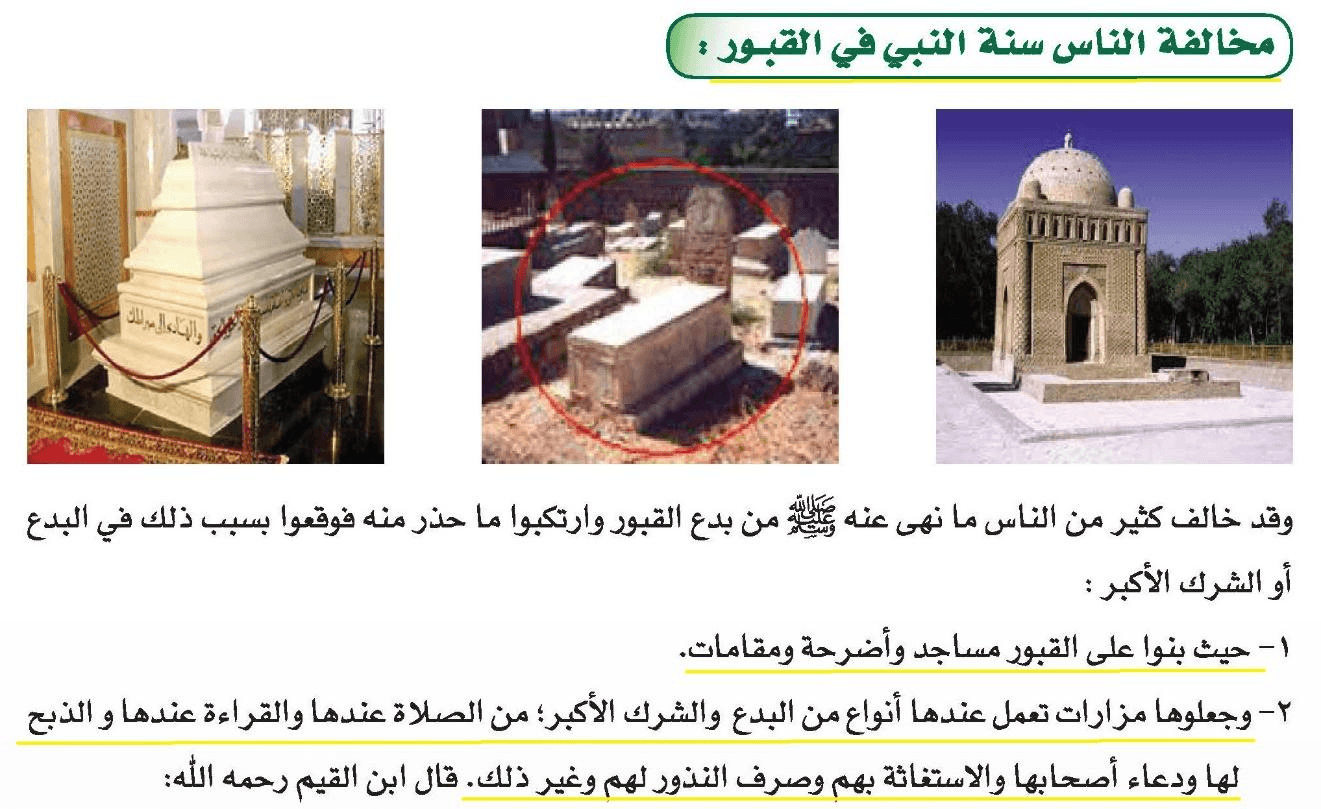
The curriculum repeatedly condemns building mosques or shrines on top of graves, a clear reference to Shia or Sufi pilgrimage sites.

The third book in the five-part secondary level curriculum, for example, contains a section, entitled, “People’s Violation of the Teachings of the Prophet with Graves,” stating that “many people have violated what the prophet forbade in terms of bida’ or ‘illicit innovations’ with graves and committed what he prohibited and because of that fell into illicit innovations or the greatest polytheism” by “building mosques and shrines on top of graves.”

The text also states that people use shrines as a place to commit other acts of illicit innovations or polytheism, including: “praying at them, reading at them, sacrificing to them and those [interred] in them, seeking help from them, or making vows by them…”

Ministry of Education, Al-Tawhid, Student Book, Secondary Semester Program, Level Three, 2016-17, p. 104
The second semester of the seventh-grade text expresses similar sentiment, saying that “those who make the graves of prophets and the righteous into mosques are evil-natured.”

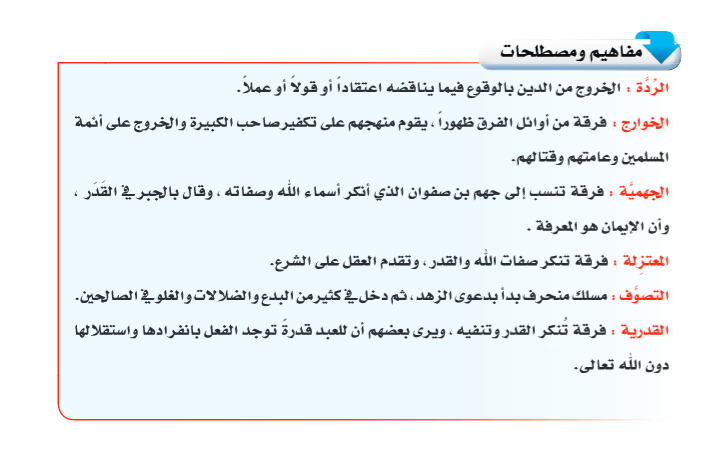
Toward the end of one chapter, “The Role of Reformers in Declaring and Defending the Correct Doctrine,” in a secondary-level textbook, a short glossary lists practices of those who have deviated from correct religious practice. It describes Sufism as “a perverse path that began with the claim of asceticism, or severe self-discipline, then entered into illicit innovation, mis-guidedness, and exaggeration in reverence to the righteous.”

Saudi Ministry of Education, Al-Tawhid, Student Book, Secondary Semester Program, Level One, 2016-17, p. 40 
Saudi Ministry of Education, Al-Tawhid, Student Book, Secondary Semester Program, Level One, 2016-17, p. 40

The curriculum reserves its harshest criticisms for Jews, Christians, and people of other faiths, often describing them as kuffar, or “unbelievers.”


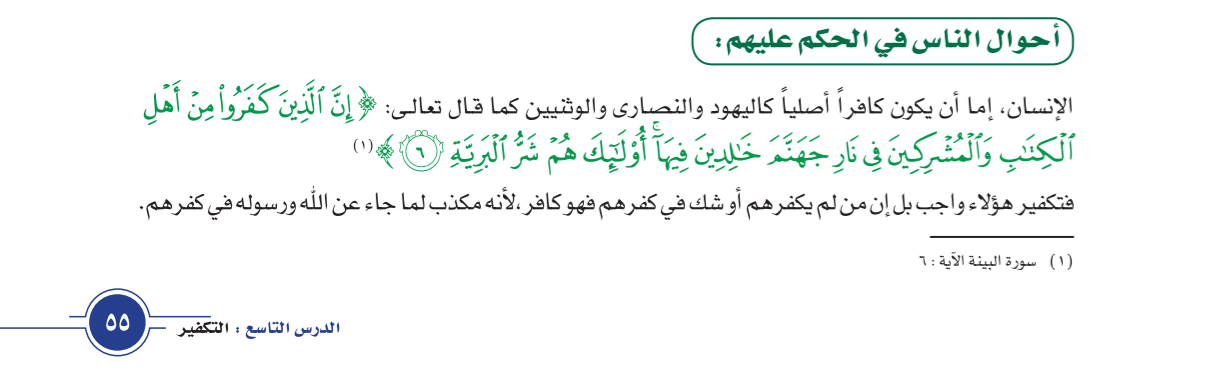
In one fifth-grade second semester textbook, the curriculum calls Jews, Christians, and Al Wathaniyeen, or “pagans,” the “original unbelievers” and declares that it is the duty of Muslims to excommunicate them: “For whoever does not [excommunicate them], or whoever doubts their religious infidelity is himself an unbeliever.”

Saudi Ministry of Education, Al-Tawhid, Student Book, Fifth Grade, Second Semester, 2016-17, p. 55

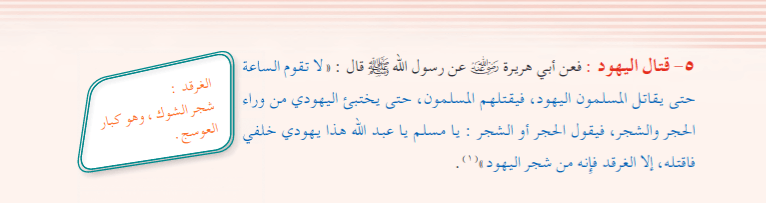
In a chapter listing markers by which one can recognize the approach of the Day of Resurrection, one passage states: “The Hour will not come until Muslims will fight the Jews, and Muslims will kill the Jews.”

Saudi Ministry of Education, Al-Tawhid, Student Book, Secondary Course, Level Two, 2016-17, p. 102.

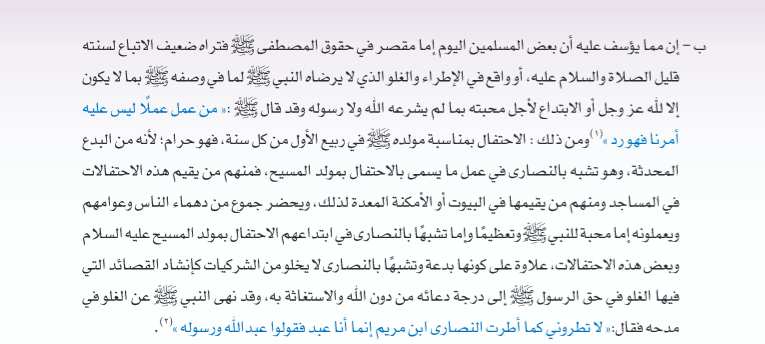
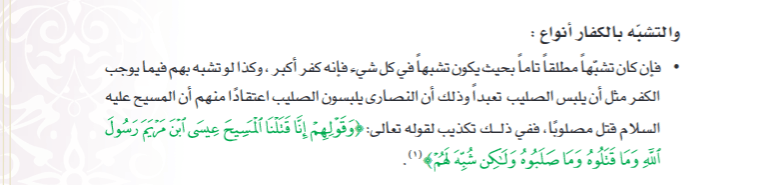
A recurring and alarming lesson in the curriculum warns against imitating, associating with, or joining the “unbelievers” in their traditions and practices. One passage rejects and denounces the Sufi practice of celebrating the birth of the prophet, accusing Sufis of imitating Christians, i.e. “unbelievers,” in their celebration of the birth of Jesus.


Al-Tawhid, Student Book, Fifth Grade, Second Semester, 2016-17, p. 279
[Translation: Celebrating the prophet’s birth in the spring of every year is prohibited; for it is a new innovation and is in imitation of the Christian celebration of what is known as the birth of Christ.]

In another chapter, “Loyalty to Unbelievers,” the text explicitly calls on Muslims to reserve loyalty to God, the prophet, and other believers and to express hostility and antagonism toward “unbelievers.” It warns Muslims that by imitating “unbelievers” or even joining them in their celebrations, one is at risk of expressing loyalty to them, and worse even, becoming one of them.

Saudi Ministry of Education, Al-Tawhid, Student Book, Secondary Course, Level One, 2016-17, p. 165

The Saudi government’s official denigration of other religious groups, combined with its ban on public practice of other religions, could amount to incitement to hatred or discrimination.

International human rights law requires countries to prohibit “[a]ny advocacy of national, racial or religious hatred that constitutes incitement to discrimination, hostility or violence.”

Article 18 of the International Covenant for Civil and Political Rights (ICCPR) states: “Everyone shall have the right to freedom of thought, conscience and religion. This right shall include the freedom to have or adopt a religion or belief of his choice, and freedom, either individually or in community with others and in public or in private, to manifest his religion or relief in worship, observance, practice and teaching.”

“Saudi Arabia’s officials should stop denigrating other people’s personal beliefs,” Whitson said. “After years of reform promises there is apparently still little room for tolerance in the country’s schools.”

---

Read also:

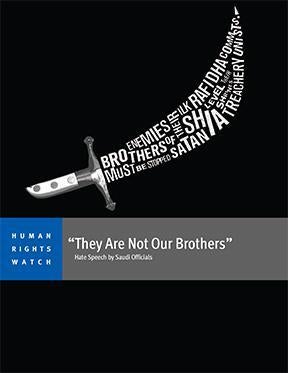
“They Are Not Our Brothers” 

Hate Speech by Saudi Officials


Thursday, August 31, 2017

Saudi-led war on Yemen contributes to cholera outbreak, killing ~2,000 & affecting 500,000+

AFP
Yemen cholera cases soar past half-million: WHO


Cholera is believed to have affected more than 500,000 people and killed nearly 2,000 since late April, the World Health Organization said Monday.

A full 503,484 suspected cases and 1,975 deaths are attributable to the outbreak that erupted last than four months ago in the war-ravaged country, a WHO overview showed.

The UN health agency said the speed at which the deadly waterborne disease was spreading had slowed significantly since early July, but warned that it was still affecting an estimated 5,000 people each day.

The collapse of Yemen's infrastructure after more than two years of war between the Saudi-backed government and Shiite rebels who control the capital Sanaa has allowed the country's cholera epidemic to swell to the largest in the world.

WHO warned that the disease had spread rapidly due to deteriorating hygiene and sanitation conditions, with millions of people cut off from clean water across the country.

"Yemen's health workers are operating in impossible conditions," WHO chief Tedros Adhanom Ghebreyesus said in a statement.

"Thousands of people are sick, but there are not enough hospitals, not enough medicines, not enough clean water," he said, also lamenting that many of the doctors and nurses needed to rein in the outbreak had not been paid for nearly a year.

"They must be paid their wages so that they can continue to save lives," he said.

WHO said that it and its partners were "working around the clock" to support the national efforts to halt the outbreak, adding that more than 99 percent of people who contract cholera in Yemen can survive if they can access health services.

More than 15 million people in the country have no access to basic healthcare.

Tedros called on all sides in Yemen's conflict, which has killed more than 8,300 people since March 2015, to urgently seek a political solution.

"The people of Yemen cannot bear it much longer - they need peace to rebuild their lives and their country," he said.


*Photo courtesy of AFP 

Friday, June 30, 2017

Egyptian authorities now blocking over 100 websites

Quartz Africa
Egypt has blocked over 100 local and international websites including HuffPost and Medium

Thursday, 29 June 2017

Abdi Latif Dahir


The list of blocked websites in Egypt keeps growing, as the government widens what some say is an unprecedented crackdown on both local and international digital outlets. So far, 114 websites have been blocked in the north African nation since May 24, according to the latest figures from the non-governmental organization Association for Freedom of Thought and Expression.

A majority of these are news websites, but also included are platforms that can be used to access blocked sites or that allow for anonymous browsing and communication.

The affected websites include sites like Mada Masr, the financial newspaper Al Borsa, and Huffington Post Arabic. Twelve websites linked to Al Jazeera were also been blocked. Medium, the online publishing platform, was also banned.

The outage also affected Tor, the free software that provides users with online anonymity, and Tor bridges, which helps users circumvent the blocking of Tor itself. The website of the Open Observatory of Network Interference (OONI), an international network that monitors internship censorship and surveillance, was also blocked.  

The growing censorship comes as the government says it’s cracking down on websites that are “publishing false information” and “supporting terrorism.” (Link in Arabic) Egypt is currently in the midst of a three-month state emergency, following twin attacks on churches that killed almost 50 people in April.

The country is also part of a Saudi-led coalition that has put a blockade on Qatar, demanding, among other things, the closure of the Doha-based Al Jazeera media network which it considers to a be a propaganda tool for Islamists. The government of president Abdel Fattah el-Sisi is also embroiled in a maritime demarcation agreement over its decision to vote on the transfer of two islands in the Red Sea to Saudi Arabia—a move that has angered many Egyptians.

However, journalists and activists say the campaign is suppressing free expression and voices critical of the government. Some are accusing the regime of failing to disclose any judicial or administrative decision to block the sites—or whether emergency law provisions were applied.

“Even in the darkest days of the repressive Mubarak era, the authorities didn’t cut off access to all independent news sites,” Najia Bounaim, Amnesty International’s north Africa campaigns director, said.

In a June 19 report, OONI stated that deep packet inspection technology was being used to monitor and block these websites. Mada Masr, one of the blocked sites, also reported that the decision to block the sites was carried through a “centralized decision” by the government rather than by the country’s telecoms or internet service providers.

Since going offline, sites like Mada have been publishing articles on Facebook. Lina Attallah, the editor of the site, said the strategy of blocking the sites works to the government’s advantage for now.

“If they did something more grave like arresting team members or me it would make big noise, whereas blocking the website is the best way to paralyze us without paying a high price for it,” Attallah told Reuters.


*Photo by Mohamed Abd El Ghany, courtesy of Reuters

Traitor Sisi ratifies agreement handing over two Egyptian islands to KSA

Mada Masr
Sisi ratifies Tiran and Sanafir agreement, cedes islands to Saudi Arabia

Saturday, 24 June 2017


Image may contain: one or more people

President Abdel Fattah al-Sisi ratified the maritime border demarcation agreement that cedes sovereignty over Tiran and Sanafir islands to Saudi Arabia on Saturday, according to a Cabinet statement.

The Tiran and Sanafir agreement was passed with a majority in Parliament on June 14, with only 119 MPs voting against it.

Sisi was able to seal the deal with Saudi Arabia after the Supreme Constitutional Court temporarily froze two contradictory rulings, one issued by the State Council in January and the other by the Court of Urgent Matters in April, on Wednesday.

In June 2016 the State Council’s Court of Administrative Justice (CAJ) annulled the agreement signed by Prime Minister Sherif Ismail in April of the same year. This was followed by two Court of Urgent Matters rulings on September 29 and December 31 to overturn the CAJ’s decision.

However, on January 16, the State Council’s Supreme Administrative Court upheld the initial June ruling, stating that the deal was a concession of territory, an act that is prohibited per Article 151 of the Constitution. On April 2, the Court of Urgent Matters overturned the CAJ’s decision.

Several political parties and prominent politicians held a press conference on June 12, ahead of Parliament’s discussion of the deal, to announce a series of sit-ins protesting the agreement which many members of Egypt’s opposition hailed as unconstitutional.

The presser was attended by dozens of activists and members of several political parties, as well as former presidential candidates Hamdeen Sabbahi and Khaled Ali. Also in attendance were ousted chief of the Central Auditing Authority Hesham Geneina, expelled member of Parliament Mohamed Anwar Sadat, critical journalist Khaled al-Balshy, National Council for Human Rights member George Ishaq and former Ambassador Masoum Marzouk.

Following Parliament’s approval, hundreds of members of professional syndicates signed statements in opposition to the Tiran and Sanafir agreement, including 850 journalists, 620 members of the Engineers Syndicate’s general assembly and more than 600 members of the Cinema Syndicate, among others.

Since the June press conference security forces have carried out an extensive arrest campaign across several governorates, apprehending more than 120 activists and protesters seen to oppose the deal.

Syndicates mobilize against handover of Tiran & Sanafir islands

Mada Masr
Syndicates mobilize against Tiran and Sanafir agreement

Monday, 19 June 2017

Image may contain: 7 people, people smiling, text

Hundreds of members of professional syndicates have signed statements in opposition to Parliament’s recent approval of the Tiran and Sanafir agreement, brokered by Egypt and Saudi Arabia in April 2016.

Eight hundred and fifty journalists issued a statement on Sunday announcing that they reject the agreement, which concedes sovereignty over the two Red Sea islands to Saudi Arabia, describing it as invalid and “demanding that state institutions respect the Constitution and the law, and the blood of martyrs who defended Egyptian land.”

The Journalists Syndicate announced that it would launch an investigation into the sit-in held in its headquarters on Wednesday, protesting the agreement.

Hatem Zakareya, a member of the syndicate’s board, told Mada Masr that no request was submitted before the protest, in violation of the syndicate’s bylaws. He added that investigations will also be launched into footage aired on Al Jazeera and other pro-Muslim Brotherhood channels from inside the building and its entrance showing non-syndicate members attending the protest.

Gamal Abdel Rehim, one of four syndicate board members who signed a statement rejecting the agreement, told Mada Masr that allegations that Muslim Brotherhood-affiliated channels entered the syndicate are untrue, arguing that it is not necessary to submit a request before initiating sit-ins at the syndicate.

“Never in the history of the syndicate has any group submitted a request to start a sit-in,” he said, adding that it is common for non-syndicate members to join political action taking place within the syndicate.

A statement was also signed by 620 members of the Engineers Syndicate’s general assembly denouncing the deal, labeling it unconstitutional. The statement criticized “attempts to pressure opposition and the blocking of websites that attempt to reveal the truth of the matter.”

The statement mirrors that issued by the Journalists Syndicate, calling on citizens to exercise their constitutional right to express their opinions peacefully “in defense of the blood of the martyrs who died to defend the unity of Egyptian land.”

Head of the Engineers Syndicate Tarek al-Nabarawy said last Friday that in his personal opinion the islands are Egyptian, adding that the syndicate should not be involved in politics.

Akram Ismail, member of the Engineers Syndicate and the Bread and Freedom Party told Mada Masr: “Major national causes cannot be separated from syndicate work,” adding that syndicates, parties and social media are the only remaining platforms for political action following the crackdown on the street movement and blocking of websites.

Ismail said that the fact that three leading figures in the syndicate expressed their opposition to the agreement on their personal Facebook pages indicates the syndicate’s position, even if no official statement was made.

Members of the Cinema Syndicate also released a statement inviting people to protest the transfer of the islands “using all peaceful and legal means.”

They called for a protest at their headquarters on Saturday to oppose the agreement, however the protest was canceled due to the heavy security presence in the area.

Six members of the Doctors Syndicate board also announced their opposition to the agreement in a statement. However Mona Mina, the syndicate’s secretary general, wrote on her Facebook page: “As a vocational institution, the syndicate has nothing to do with this important political and national cause.”

Members of the Lawyers Syndicate also held a protest inside syndicate headquarters on Tuesday to express their objection.

Since discussions of the maritime border agreement reached Parliament, security forces have carried out an extensive arrest campaign across several governorates, targeting activists and protesters opposing the deal.

At least 60 opponents arrested in connection to Tiran & Sanafir handover

Mada Masr
Rights Monitor: Police have arrested 60 opponents of the Tiran and Sanafir agreement 

Friday, 16 June 2017

Image may contain: one or more people, people standing and text

Police have arrested a total of 60 people connected to political action against the agreement to concede sovereignty over Tiran and Sanafir islands to Saudi Arabia, according to the Freedom for the Brave campaign.

The nationwide arrests commenced after Parliament approved the agreement on Wednesday night, with police moving to detain political activists and party members in Cairo, Alexandria, Damietta, Sharqiya, Beni Suef, Fayoum, Luxor, Port Said and Suez.

Lawyer Mohamed Abdel Aziz told Mada Masr that those arrested come from several political parties, including the Socialist Popular Alliance Party, the Constitution Party, the Bread and Freedom Party, the Popular Current Party and the Karama Party, as well as from Egypt’s independent activist community, all of whom voiced their opposition to the agreement.

According to Abdel Aziz, security forces arrested many of the activists and party members from their homes, including Hassan Ahwany who is being questioned by the Dokki prosecution in Cairo and is being represented by Abdel Aziz.

Many of those arrested will be questioned by prosecutors on Friday, including six people who were arrested in Port Said and Tanta, according to the Front to Defend Egyptian Protesters.

The FDEP has added that activists Mahmoud Nagib and Israa Fahid face charges of incitement to protest and obstructing public transportation, and that three people arrested in Luxor on Thursday are in the National Security Agency’s custody. In Ismailia, Constitution Party member Ahmed Santos was questioned by the prosecutor, who has issued Santos a 15-day detention order pending an NSA report.

According to lawyer Abdel Aziz Yousef, the prosecutor issued Egyptian Social Democratic Party member Islam Marei a 15-day detention order pending investigation into charges of incitement against the regime; insulting state institutions, including the Armed Forces, police and the judiciary; distributing anti-government flyers; and using social networks for incitement against state institutions.

Abdel Aziz described the arrests as “ferocious,” saying security forces are attempting to prevent any mobilization against the Tiran and Sanafir agreement. The scope of the arrests, he asserted, is disproportionate to the protests that have taken place in reaction to the agreement.

Police arrested eight people in the proximity of the Journalists Syndicate’s headquarters in downtown Cairo on Wednesday night, which was the site of a protest against the Tiran and Sanafir agreement. All eight were released yesterday on LE10,000 bail.

Police also dispersed a demonstration on Wednesday in front of the Egyptian Social Democratic Party’s headquarters in downtown Cairo, barricading the protesters inside the building, according party member Ziad al-Eleimi.

"Sisi is a Traitor" - Top trending hashtag in Egypt, following handover of Tiran & Sanafir islands to KSA

EFE News
“Al-Sisi is a Traitor” Tops Twitter’s Trending Hashtags in Egypt


Wednesday, 14 June 2017

CAIRO – The hashtag “Al-Sisi is a traitor,” referring to the Egyptian president, topped on Wednesday the trending hashtags on Twitter in Egypt.

This comes amid controversy over the transfer of ownership of two Red Sea islands to Saudi Arabia, discussed by parliament since Sunday and approved on Wednesday.

According to official rhetoric, dismissed by many Egyptians, the islands of Tiran and Sanafir, located at the entrance of the Gulf of Aqaba, have always belonged to Saudi Arabia, and Egypt only administered them at the request of the kingdom.

Based on this, both countries signed an agreement in April 2016 for the “return” of both islands to Saudi Arabia, sparking huge protests in the country.

The controversy, which ended in court with a ruling against the treaty issued by the Supreme Administrative Court, has resurfaced after parliament began on Sunday discussions prior to the ratification of the agreement.

The parliamentary committee gave validity on Tuesday to the pact and sent it to the Legislative Assembly which, in turn, sent it to the national defense and security commission, which should review it before it is voted on in general session by all legislators, who have approved the agreement with a two-thirds majority.

Several representatives from political parties gathered on Tuesday at the Journalists Syndicate to object the decision taken by the commission as part of a campaign of protest called by activists and minority parties on social networks.

Journalist and activist Khaled Balshi denounced on Wednesday to EFE the arrest on Tuesday night of eight people from the Syndicate building, although he confirmed they were released hours later.

The hashtag “Al-Sisi is a traitor” climbed to the top after two days when the hashtag “Tiran and Sanafir are Egyptian” occupied the same place, and is now in second place.

Traitor Sisi handing over Tiran & Sanafir islands to his Saudi master


*Artwork by Carlos Latuff

Activists & journalists arrested in protest over handover of Egypt islands to KSA

AFP
Egypt approves transfer of islands to Saudi Arabia

Wednesday, 14 June 2017


CAIRO - Egypt's parliament approved on Wednesday a controversial maritime agreement with Saudi Arabia that transferred two Red Sea islands to the kingdom.

The deal, which was being challenged in court, had sparked rare protests in the country, with the opposition accusing the government of selling Egyptian territory to its Saudi benefactors.

The vote came after days of heated debate in Parliament, with opponents even interrupting one committee session with chanting.

Courts had initially struck down the agreement, signed in April 2016, but a year later another court upheld it.

Lawyers were now challenging the deal before the constitutional court.

The accord sparked rare protests in Egypt last year, with President Abdel Fattah al-Sisi accused of having traded the islands of Tiran and Sanafir for Saudi largesse.

The government said the islands were Saudi to begin with, but were leased to Egypt in the 1950s.
Opponents of the agreement insisted that Tiran and Sanafir were Egyptian.

On Tuesday evening, dozens of journalists protested against the agreement in central Cairo, before being dispersed by police, journalists' union official Gamal Abdel Rehim said.

Several were briefly arrested before being released, but "three reporters are still detained, and contacts are being made with the interior ministry to get them released," he said.


*Photo by Mohamed El-Raai, courtesy of AFP

Wednesday, May 31, 2017

Trump compliments dictator Sisi for his shoes

CNN


Riyadh, Saudi Arabia (CNN) - Moments after Egyptian President Abdel Fattah al-Sisi complimented President Donald Trump on his "unique personality that is capable of doing the impossible," Trump exchanged pleasantries back, praising el Sisi's shoes.

"Love your shoes. Boy, those shoes. Man ... ," Trump said, as reporters were being escorted out of the room.

It's unclear the exact shoe the Egyptian President was wearing, but appeared to be black boots, similar to those Trump was wearing, but shinier.


The exchange wasn't observed by video cameras in the room, but was captured in an audio recording.

Trump held meetings with several Arab world leaders Sunday morning, ahead of a planned speech on confronting Islamist extremism and later a forum on Twitter.


*Photos by Evan Vucci, courtesy of Associated Press

- - - -  -

Other bizarre photos


Tuesday, January 31, 2017

Egypt extends military operations in Yemen to support ongoing Saudi-led war

Deutsche Welle
Egypt extends Yemen military participation, amid reports of first Trump drone strike

Egypt's National Defense Council has extended military participation in Saudi-led operation in Yemen. The first US drone strike believed to be carried out under Trump presidency has also killed two Al-Qaeda members.

Sunday 22, January 2017


Cairo announced in a statement on Sunday, that Egypt's military participation in a Saudi-led operation in Yemen has been extended by the presidency.

"The National Defense Council agreed during the meeting to extend the participation of the required elements from the Egyptian armed forces in a combat operation outside the nation's border to defend Egyptian and Arab national security in the Gulf, Red Sea, and Bab al-Mandab areas," the statement said.

The presidency failed to disclose, however, exactly how long the extension would be for.

ALMOST 70 DEATHS IN 24 HOURS

The announcement on Sunday came as medics and security sources confirmed that 66 people had been killed in Yemen in 24 hours. The fatalities occurred as forces loyal to President Abedrabbo Mansour Hadi pushed forward in their efforts to oust rebels from a key west coastline.

Air strikes carried out by a Saudi-led coalition, as well as fighting near the strategic Bab al-Mandab strait killed at least 52 fighters belonging to the Shiite Huthi rebels and allied troops loyal to ex-president Ali Abdullah Saleh.

On the pro-government side, 14 soldiers were killed and 22 wounded, according to medics in the southern port city of Aden where Hadi's government is based.

Pro-Hadi forces launched the huge offensive to retake the region overlooking the Bab al-Mandab strait on January 7. The channel is a key maritime route connecting the Red Sea and the Indian Ocean.

By Sunday, loyalist forces reported that they were within 10 kilometers (6 miles) of the city of Mokha, but the offensive was slowed by mines laid by rebel forces.

REPORTS OF FIRST TRUMP DRONE

Two suspected members of al Qaeda's Yemen branch were also killed on Sunday by what local officials believe was a US drone strike.

If confirmed, it would be the first such attack since Donald Trump assumed office as US president on Friday.

According to officials, who spoke on condition of anonymity, the men were killed when a missile hit their vehicle in the southern al-Bayda province.

In a bid to combat al Qaeda in the Arabian Peninsula - regarded as one of the global militant group's most dangerous branches - the US controversially conducted dozens of drone strikes throughout Barack Obama's presidency. The attacks were repeatedly criticized by human rights groups, however, following the deaths of hundreds of civilians.

The newly-inaugurated Trump administration is yet to lay out a clear policy on drone strikes. However the Republican president has said he would support an escalation of the fight against Islamist militants.


 *Photo courtesy of Reuters

Two Red Sea islands are Egyptian, not Saudi territories: Court issues final ruling

Mada Masr
Final court ruling declares Egyptian sovereignty over Tiran and Sanafir islands

Monday January 16, 2017


Egypt’s Supreme Administrative Court (SAC) issued a final ruling on Monday confirming Egypt’s sovereignty over the Red Sea islands of Tiran and Sanafir, stating that the Egyptian government has not provided adequate evidence supporting Saudi Arabia’s claim to the land. According to the ruling, therefore, the executive branch of Egypt’s government does not have the administrative authority to cede the territory to Saudi Arabia.

Judge Ahmed al-Shazly, the vice president of the State Council, announced in court that “the Egyptian military was not an occupying force and the sovereignty of Egypt over Tiran and Sanafir is irrevocable,” in response to the Egyptian government’s claims that the uninhabited islands are Saudi Arabian territory but have been administered by Egypt since the 1950s upon the request of the Gulf monarchy.

In April, a lawsuit was filed in the Court of Administrative Justice (CAJ) to challenge the controversial agreement signed by Egyptian Prime Minister Sherif Ismail and Saudi Arabian Deputy Crown Prince and Defense Minister Mohamed bin Salman during King Salman bin Abdel Aziz’s April 2016 visit to Cairo.

The CAJ ruled in June that Prime Minister Sherif Ismail violated the Constitution by signing the agreement and nullified his signature — the court could not rule on the legitimacy of the agreement itself, however, as international agreements fall outside of its jurisdiction.

The government challenged this ruling on several fronts: appealing the decision, filing a request for injunction to stay its implementation, preemptively submitting the deal to Parliament and attempting to circumvent and challenge judicial jurisdiction.

In November, the CAJ approved the request to force the state to implement the annulment of Ismail’s signature and denied the state’s counter-motion.

The report by the State Commissioners Authority on the case, an influence on today’s ruling, recommended that the SAC reject the government’s appeal, stating that “the treaty in question, which will result in giving up sovereignty of Egyptian land, is null and void as the party that signed it violated the Constitution.”

In a press conference following the ruling, prominent rights lawyer Khaled Ali — a member of the legal team who filed the case against the government — stated that Parliament cannot discuss a document nullified by the SAC, warning that if Parliament insists on pursuing this course of action, then it can be held legally accountable.

Ali read out the final paragraph of the ruling to the applause from the audience, saying the ruling would not have been possible without the support of the Egyptian people.

While Monday’s ruling was the final verdict in the appellate process within the State Council regarding the agreement, the state filed a separate appeal in August before the Supreme Constitutional Court (SCC) claiming the State Council has no jurisdiction over international agreements. This appeal remains pending, having been adjourned to February 12.

Opposition to the border deal between Egypt and Saudi Arabia has led to the biggest protest movement since President Abdel Fattah al-Sisi came to power in June 2014, in which a large number of demonstrators have been arrested on charges of illegal protest.

Others have been prosecuted on charges of disseminating false information after publicly stating that the two islands are Egyptian, including prominent rights lawyer Malek Adly and journalists Amr Badr and Mahmoud al-Sakka.


*Photo by Heba Afify

Saturday, December 31, 2016

Egypt topped developing countries in arms imports in 2015 - Sisi continues to squander national budget

Mada Masr
US report: Egypt topped developing countries in arms imports in 2015

December 27, 2016

 
Egypt imported US$5.3 billion worth of arms in 2015, more than any other developing country, according to a report released this month by Congressional Research Service, a public policy research arm of the United States Congress.

Egypt also came second among developing countries in 2015 arms transfer agreements — agreements that were signed but not necessarily delivered — signing agreements worth $11.9 billion. Qatar ranked first, with agreements worth $17.5 billion.

According to the report, which traces arms sales to developing nations between 2008 and 2015, Egypt signed arms transfers agreements totaling $30 billion, coming third after Saudi Arabia and India.

Egypt ranked sixth among developing countries in total arms transfers agreements between 2008 and 2011, worth $8.6 billion. The US was the biggest arms exporter to Egypt in this period, with 79 percent of total arms transfer agreements, followed by China then Russia.

In the same period, Egypt’s actual arms imports reached $5 billion, the fifth largest among developing countries. Between 2012 and 2015, Egypt ranked fourth in arms imports at a total of $9.8 billion, preceded by Saudi, India and Iraq. The report indicates that Egypt’s arms transfer agreements for this period reached $21.5 billion.

Western European countries and Russia were major arms exporters to Egypt in this period, with 43 percent of agreements respectively, then came the US with 6 percent.

The report revealed that US and Russia were major arms exporters to developing countries in the period between 2012 and 2015, with 81 percent of the total arms transfer agreements.

In 2015 only, Qatar topped the developing nations signing arms transfer agreements with $17.5 billion, followed by Egypt with $11.9 billion, Saudi with $8.6 billion, then South Korea with $5.4 billion.

Arms transfer agreements signed by Egypt in 2015 represented 15 percent of total agreements signed worldwide, which reached $80 billion, according to the report.

But the database of the Stockholm International Peace Research Institute (SIPRI) has shown that Egypt’s arms imports between 2011 and 2015 reached just $3.4 billion, ranking 12th worldwide.

A report published by London-based global analysis firm IHS Markit. indicated that Egypt’s military imports reached $2.268 billion in 2015, making it the world’s fourth-largest defense importer.

Egypt receives $1.3 billion in annual military aid from the US, and under President Abdel Fattah al-Sisi it has also made major purchases from other exporting countries, including Russia and France.

High-profile deals include a 2015 agreement with France to purchase 5.2 billion euro worth of military equipment, including 24 Rafale fighter jets and a naval frigate, and a contract with Russian firm Rosoboronexport to buy 46 attack helicopters.

Monday, October 31, 2016

US continues to arm KSA for war on Yemen, despite massive civilian casualties

New York Times
Saudi Arabia Kills Civilians, the US Looks the Other Way


In the span of four days earlier this month, the Saudi Arabia-led coalition in Yemen bombed a Doctors Without Borders-supported hospital, killing 19 people; a school, where 10 children, some as young as 8, died; and a vital bridge over which United Nations food supplies traveled, punishing millions.

In a war that has seen reports of human rights violations committed by every side, these three attacks stand out. But the Obama administration says these strikes, like previous ones that killed thousands of civilians since last March, will have no effect on the American support that is crucial for Saudi Arabia’s air war.

On the night of Aug. 11, coalition warplanes bombed the main bridge on the road from Hodeidah, along the Red Sea coast, to Sana, the capital. When it didn’t fully collapse, they returned the next day to destroy the bridge.

More than 14 million Yemenis suffer dangerous levels of food insecurity — a figure that dwarfs that of any other country in conflict, worsened by a Saudi-led and American-supported blockade. One in three children under the age of 5 reportedly suffers from acute malnutrition. An estimated 90 percent of food that the United Nation’s World Food Program transports to Sana traveled across the destroyed bridge.

An Obama administration official told me on the condition of anonymity that the United States included the bridge on a no-strike list of vital infrastructure, explicitly informing the Saudis that it was “critical to responding to the humanitarian crisis in Yemen.” And yet the Saudi-led coalition obliterated the structure, either intentionally disregarding humanitarian considerations and the wishes of the United States, or out of sheer incompetence.

On Aug. 14, coalition airstrikes hit the school in the Saada governorate, a stronghold of the Houthi rebels. Saudi officials said the Houthis were running a training facility there for child soldiers. The United Nations’ child welfare agency said it was a religious school.

A day later, warplanes attacked the hospital supported by Doctors Without Borders, or M.S.F., for its French name, Médecins Sans Frontières. It was the fourth coalition attack on a facility of the doctors’ group since October. At least 19 people were killed, including an M.S.F. staffer.

M.S.F. said its hospitals’ coordinates had been shared with all parties to the conflict, including the Saudis. The hospital should have already been on no-strike lists that the United States and Saudi Arabia insist the coalition maintains.

The American assistance for Saudi Arabia that Mr. Obama authorized last March includes aerial refueling for coalition jets, intelligence and targeting assistance. American tankers offload fuel to any coalition jet, no matter its target. This support comes on top of more than $100 billion in arms deals with Saudi Arabia between 2010 and 2015, and recent deals made explicitly to “replenish” stockpiles spent in Yemen.

At the United Nations, Saudi Arabia and its allies have blocked investigations into the Yemen conflict and complained when the Security Council considered a resolution aimed at protecting Yemeni civilians. Saudi Arabia has also warned aid workers to leave much of Yemen, ominously presaging M.S.F.’s Aug. 18 decision to pull out of two governorates in the country’s north because of the coalition’s “indiscriminate bombings.” Without the group’s presence, it will be more difficult to know the toll of future strikes in these areas.

In June, Saudi Arabia threatened to cut its funding to the United Nations after Secretary General Ban Ki-moon included the coalition on a list of violators of children’s rights. While criticizing the Saudis for their bullying, Mr. Ban’s office has also been accommodating out of a belief that it can’t afford to lose Saudi money.

The Saudis are not the only negative force in Yemen. The Houthis and their allies loyal to former President Ali Abdullah Saleh have waged a cynical war, and are responsible for human rights violations. But it is difficult to see what possible progress can be made when Saudi Arabia routinely bombs civilian sites.

Many in Washington see support for the Saudi-led coalition as necessary for maintaining American-Saudi relations after the nuclear deal with Iran last year. Saudi Arabia has used this leeway to carry out its Yemen campaign with abandon. Each fatal strike and subsequent implausible Saudi denial should test the limits of the Obama administration’s support.

Instead, a spokesman for United States Central Command, which oversees American operations in the Middle East including support for the coalition, told me last week that the United States is not conducting a single investigation into civilian casualties in Yemen.

The recent uptick in airstrikes and fighting across Yemen follows the collapse of United Nations-brokered peace talks that were being held in Kuwait. The possibility of a resumption of full-scale war and all the suffering that accompanies it could have been an opportunity for the Obama administration to reflect on its axiomatic support for the Saudi coalition. But even after last week’s string of outrageous bombings, the White House has still not done that.
\
The Obama administration has in recent days insisted that it wants all sides in Yemen’s war to stop fighting. But as American tankers wait to refuel American-made fighter jets, loaded with American-made bombs destined for Yemen, the White House evidently doesn’t realize that it is waging a war.

Friday, September 30, 2016

Over 1/3 of Saudi air raids on Yemen hit civilian sites

The Guardian
One in three Saudi air raids on Yemen hit civilian sites, data shows 
Pressure on UK and US roles in war set to increase as survey shows school buildings and hospitals among targets


More than one-third of all Saudi-led air raids on Yemen have hit civilian sites, such as school buildings, hospitals, markets, mosques and economic infrastructure, according to the most comprehensive survey of the conflict.

The findings, revealed by the Guardian on Friday, contrast with claims by the Saudi government, backed by its US and British allies, that Riyadh is seeking to minimise civilian casualties.

The survey, conducted by the Yemen Data Project, a group of academics, human rights organisers and activists, will add to mounting pressure in the UK and the US on the Saudi-led coalition, which is facing accusations of breaching international humanitarian law.

It will refocus attention on UK arms sales to Saudi Arabia, worth more than £3.3bn since the air campaign began, and the role of British military personnel attached to the Saudi command and control centre, from which air operations are being mounted. Two British parliamentary committees have called for the suspension of such sales until a credible and independent inquiry has been conducted.
 
Saudi Arabia disputed the Yemen Data Project figures, describing them as “vastly exaggerated”, and challenged the accuracy of the methodology, saying somewhere such as a school building might have been a school a year ago, but was now being used by rebel fighters.

The independent and non-partisan survey, based on open-source data, including research on the ground, records more than 8,600 air attacks between March 2015, when the Saudi-led campaign began, and the end of August this year. Of these, 3,577 were listed as having hit military sites and 3,158 struck non-military sites.

Where it could not be established whether a location attacked was civilian or military, the strikes were classified as unknown, of which there are 1,882 incidents.

Saudi Arabia intervened in March 2015 to support the Yemeni government against Iran-backed Houthi rebels in control of the capital, Sana’a. The UN has put the death toll of the 18-month war at more than 10,000, with 3,799 of them being civilians. 

Human rights organisations in Yemen have documented repeated violations by the Houthis, including the use of landmines and indiscriminate shelling. Human Rights Watch noted this year that Yemeni civilians had “suffered serious laws of war violations by all sides.”

The Yemen Data Project has chosen to focus exclusively on the impact of the air campaign, rather than fighting on the ground, citing the difficulty of gaining access to frontline fighting and impartial information.

One of the most problematic findings of the survey for Saudi Arabia is the number of reported repeat attacks. While some attacks on civilian sites can be explained away as mistakes or being the location of military camps in densely populated areas such as Sana’a, repeated strikes on school buildings and hospitals will add to demands for an independent investigation.

One school building in Dhubab, Taiz governorate, has been hit nine times, according to the data. A market in Sirwah, Marib governorate, has been struck 24 times.
The UK’s shadow defence secretary, Clive Lewis, said of the survey: “It’s sickening to think of British-built weapons being used against civilians and the government has an absolute responsibility to do everything in its power to stop that from happening. But as ministers turn a blind eye to the conflict in Yemen, evidence that humanitarian law has been violated is becoming harder to ignore by the day.”

The Liberal Democrat foreign affairs spokesperson, Tom Brake, said the data added more weight to calls for the suspension of arms sales. “Despite consistent evidence showing targeting of civilians, first Cameron and now May’s governments have continued their hypocritical defence of Saudi Arabia’s brutal campaign in Yemen,” he said.

Sixty-four members of the US Congress, from the Democratic and Republican parties, sent a letter to Barack Obama last month urging the president to postpone sales of new arms to Saudi Arabia. The US also provides the Saudis with intelligence, surveillance, reconnaissance and logistical support.

The Democratic congressman Ted Lieu, who organised the letter and is a colonel in the US air force reserve, said: “The actions of the Saudi-led coalition in Yemen are as reprehensible as they are illegal. The multiple, repeated airstrikes on civilians look like war crimes.”

Campaigners are calling for an independent inquiry to establish whether attacks on civilian targets are because of poor intelligence, lack of precision on the part of the Saudi-led coalition planes, or a high degree of disregard for civilian lives.

Staff at the Yemen Data Project said they adopted rigorous standards, using news reports aligned with both sides in the conflict and crosschecked against other sources, such as social media, non-governmental organisations and evidence on the ground.

According to the project, the Saudi-led coalition hit more non-military sites than military in five of the past 18 months. In October 2015, the figures were 291, compared with 208; in November, 126 against 34; December, 137 compared with 62; February 2016, 292 to 139, and March, 122 compared with 80.

Despite a ceasefire announced in April, air raids have continued.

Over the course of the war, the survey lists 942 attacks on residential areas, 114 on markets, 34 on mosques, 147 on school buildings, 26 on universities and 378 on transport.


Asked by the Guardian about the figures during a visit to London, the Saudi foreign minister, Adel bin Ahmed al-Jubeir, portrayed the Saudi air force as professional and armed with precision weapons.

He said the Houthis had “turned schools and hospitals and mosques into command and control centres. They have turned them into weapons depots in a way that they are no longer civilian targets. They are military targets. They might have been a school a year ago. But they were not a school when they were bombed”.

The attachment of British military staff at the Saudi command centre has become increasingly controversial.

A UK Ministry of Defence spokesperson said: “The United Kingdom is not a member of the Saudi-led coalition and UK personnel are not involved in directing or conducting operations in Yemen, or in the target selection process.

“The MoD does provide training and shares best practice to the Royal Saudi air force, including training on targeting. We also provided guidance and advice to support continued compliance with international humanitarian law.”

The Yemen Data Project was set up this year in response to a lack of reliable official military figures. It says the project brings together figures from backgrounds in security, academia, human rights and humanitarian issues, and describes it as “independently funded to avoid any partisan affiliation.”

“Where independent reporting is not available, the data has been cross-referenced with sources from opposing sides to the conflict to ensure the reporting is as accurate and impartial as possible,” the project said.

Given the general lack of transparency from parties to the conflict and a paucity of independent reporting on the ground, the data had been verified and cross-referenced to the greatest extent possible, it added.

The number of civilian casualties is not included, because much of this area is highly politicised and it has not been possible to independently verify claims.


*Photos courtesy of APF/Getty Images