Showing posts with label GCC. Show all posts

Thursday, August 31, 2017

Saudi-led war on Yemen contributes to cholera outbreak, killing ~2,000 & affecting 500,000+

AFP
Yemen cholera cases soar past half-million: WHO


Cholera is believed to have affected more than 500,000 people and killed nearly 2,000 since late April, the World Health Organization said Monday.

A full 503,484 suspected cases and 1,975 deaths are attributable to the outbreak that erupted last than four months ago in the war-ravaged country, a WHO overview showed.

The UN health agency said the speed at which the deadly waterborne disease was spreading had slowed significantly since early July, but warned that it was still affecting an estimated 5,000 people each day.

The collapse of Yemen's infrastructure after more than two years of war between the Saudi-backed government and Shiite rebels who control the capital Sanaa has allowed the country's cholera epidemic to swell to the largest in the world.

WHO warned that the disease had spread rapidly due to deteriorating hygiene and sanitation conditions, with millions of people cut off from clean water across the country.

"Yemen's health workers are operating in impossible conditions," WHO chief Tedros Adhanom Ghebreyesus said in a statement.

"Thousands of people are sick, but there are not enough hospitals, not enough medicines, not enough clean water," he said, also lamenting that many of the doctors and nurses needed to rein in the outbreak had not been paid for nearly a year.

"They must be paid their wages so that they can continue to save lives," he said.

WHO said that it and its partners were "working around the clock" to support the national efforts to halt the outbreak, adding that more than 99 percent of people who contract cholera in Yemen can survive if they can access health services.

More than 15 million people in the country have no access to basic healthcare.

Tedros called on all sides in Yemen's conflict, which has killed more than 8,300 people since March 2015, to urgently seek a political solution.

"The people of Yemen cannot bear it much longer - they need peace to rebuild their lives and their country," he said.


*Photo courtesy of AFP 

Tuesday, January 31, 2017

IFFCO Oils Co. workers launch boycott of company products to protest sackings, arrests & police raids

Mada Masr
IFFCO workers launch boycott campaign to protest sackings, arrests and sit-in dispersal

January 31, 2017


Workers at the International Foodstuffs Co (IFFCO) in Suez have launched a campaign calling for a boycott of the company’s products after 27 workers were sacked, and a sit-in at the company was forcefully dispersed by police forces on January 2.

The campaign to boycott the company’s products, over 100 of which are produced in Egypt, was announced during a labor conference held at the office of the Center for Trade Union and Workers’ Services (CTUWS) on Friday. It is a response to the implementation of measures which violate workers’ rights by the local administration.


According to Ahmed Bakr, the secretary general of IFFCO’s local union committee, 27 workers have been barred from entering the company since police forcefully dispersed a sit-in in early January. Among those sacked are all nine members of the local union, including Bakr.

Workers launched the sit-in to demand the augmentation of their wages in line with increasing inflation rates, and the payment of overdue bonuses.

Bakr told Mada Masr that prosecutors referred criminal charges of instigating strike action to trial, “even though the right to strike is protected by law, and is safeguarded in the Egyptian Constitution.”

Twenty one of the 27 workers stood trial at the Suez Criminal Court for their involvement in the industrial action, and were acquitted on Sunday. They described the verdict, which has cleared them of any wrongdoing, as a victory which upholds their rights as workers.

The privately owned United Arab Emirates-based company, which produces oils, foodstuffs and other consumer goods, has 37 production plants worldwide. It is owned by the Allana family, listed among the top five wealthiest Indian families in the Gulf Cooperation Council in 2016.

Regarding the potential for the boycott to negatively affect wages of IFFCO workers, Bakr said that his fellow workers are overwhelmingly in favor of the campaign, until the rights of all employees and unionists are restored.

He told Mada Masr: “The company is implementing punitive measures against our coworkers, many of whom are afraid to speak up for their rights, especially since the administration sacked the entire union committee.”

According to Bakr, 200 striking workers, many of whom were briefly arrested during the sit-in dispersal, were prevented from entering company grounds until they signed an agreement with administrators pledging to refrain from pursuing industrial action again. “They were forced to sign these papers, and if they refused they were threatened with the loss of their jobs.”

Additionally, administrators at IFFCO’s branch in Suez claimed that the workers’ sit-in had cost the company LE4 million in losses, and accordingly deducted LE500 from each of its 600 workers for going on strike.

The workers have been demanding the reinstatement of the local union committee, and the 27 employees who are currently prevented from returning to their jobs at the company, he said.

The company’s administration could not be reached for comment.

In addition to the alleged infringements on labor and union rights, Mohamed Saeed, president of the local union committee, claimed that he was blindfolded, threatened and summoned for questioning by National Security Agency (NSA) officers in Suez regarding the strike.

He said that during the strike, he was “told to return to the company, to call off the strike, or return to the NSA to face subsequent measures against me.” Saeed added that his apartment was repeatedly raided by police forces.

The CTUWS’ legal consultant Rahma Refaat commented that “boycott campaigns in Egypt may be more symbolic and promotional, whereas they tend to be more successful abroad.”

She suggested that IFFCO’s workers “focus on a boycott centering on your most popular product. Fern Butter, for example.”


Bakr asserted that the boycott is not an open-ended action against the Allana family. “If our boycott does succeed in upholding workers’ rights at the company, then we will call it off.”

The union has requested international solidarity from labor unions and federations, and consumer rights groups. He argued that an effective boycott campaign in the UK or USA could have a great impact on IFFCO’s distribution centers there, saying Allana and IFFCO “would be afraid to lose customers and investments, or even afraid to have their name was tarnished.”

Recent years have seen a crackdown on industrial action in Egypt’s public and private sector, and the state has increasingly turned to the deployment of security forces to arrest workers and impose exceptional legal measures to punish those detained.

Egypt extends military operations in Yemen to support ongoing Saudi-led war

Deutsche Welle
Egypt extends Yemen military participation, amid reports of first Trump drone strike

Egypt's National Defense Council has extended military participation in Saudi-led operation in Yemen. The first US drone strike believed to be carried out under Trump presidency has also killed two Al-Qaeda members.

Sunday 22, January 2017


Cairo announced in a statement on Sunday, that Egypt's military participation in a Saudi-led operation in Yemen has been extended by the presidency.

"The National Defense Council agreed during the meeting to extend the participation of the required elements from the Egyptian armed forces in a combat operation outside the nation's border to defend Egyptian and Arab national security in the Gulf, Red Sea, and Bab al-Mandab areas," the statement said.

The presidency failed to disclose, however, exactly how long the extension would be for.

ALMOST 70 DEATHS IN 24 HOURS

The announcement on Sunday came as medics and security sources confirmed that 66 people had been killed in Yemen in 24 hours. The fatalities occurred as forces loyal to President Abedrabbo Mansour Hadi pushed forward in their efforts to oust rebels from a key west coastline.

Air strikes carried out by a Saudi-led coalition, as well as fighting near the strategic Bab al-Mandab strait killed at least 52 fighters belonging to the Shiite Huthi rebels and allied troops loyal to ex-president Ali Abdullah Saleh.

On the pro-government side, 14 soldiers were killed and 22 wounded, according to medics in the southern port city of Aden where Hadi's government is based.

Pro-Hadi forces launched the huge offensive to retake the region overlooking the Bab al-Mandab strait on January 7. The channel is a key maritime route connecting the Red Sea and the Indian Ocean.

By Sunday, loyalist forces reported that they were within 10 kilometers (6 miles) of the city of Mokha, but the offensive was slowed by mines laid by rebel forces.

REPORTS OF FIRST TRUMP DRONE

Two suspected members of al Qaeda's Yemen branch were also killed on Sunday by what local officials believe was a US drone strike.

If confirmed, it would be the first such attack since Donald Trump assumed office as US president on Friday.

According to officials, who spoke on condition of anonymity, the men were killed when a missile hit their vehicle in the southern al-Bayda province.

In a bid to combat al Qaeda in the Arabian Peninsula - regarded as one of the global militant group's most dangerous branches - the US controversially conducted dozens of drone strikes throughout Barack Obama's presidency. The attacks were repeatedly criticized by human rights groups, however, following the deaths of hundreds of civilians.

The newly-inaugurated Trump administration is yet to lay out a clear policy on drone strikes. However the Republican president has said he would support an escalation of the fight against Islamist militants.


 *Photo courtesy of Reuters

Friday, September 30, 2016

Over 1/3 of Saudi air raids on Yemen hit civilian sites

The Guardian
One in three Saudi air raids on Yemen hit civilian sites, data shows 
Pressure on UK and US roles in war set to increase as survey shows school buildings and hospitals among targets


More than one-third of all Saudi-led air raids on Yemen have hit civilian sites, such as school buildings, hospitals, markets, mosques and economic infrastructure, according to the most comprehensive survey of the conflict.

The findings, revealed by the Guardian on Friday, contrast with claims by the Saudi government, backed by its US and British allies, that Riyadh is seeking to minimise civilian casualties.

The survey, conducted by the Yemen Data Project, a group of academics, human rights organisers and activists, will add to mounting pressure in the UK and the US on the Saudi-led coalition, which is facing accusations of breaching international humanitarian law.

It will refocus attention on UK arms sales to Saudi Arabia, worth more than £3.3bn since the air campaign began, and the role of British military personnel attached to the Saudi command and control centre, from which air operations are being mounted. Two British parliamentary committees have called for the suspension of such sales until a credible and independent inquiry has been conducted.
 
Saudi Arabia disputed the Yemen Data Project figures, describing them as “vastly exaggerated”, and challenged the accuracy of the methodology, saying somewhere such as a school building might have been a school a year ago, but was now being used by rebel fighters.

The independent and non-partisan survey, based on open-source data, including research on the ground, records more than 8,600 air attacks between March 2015, when the Saudi-led campaign began, and the end of August this year. Of these, 3,577 were listed as having hit military sites and 3,158 struck non-military sites.

Where it could not be established whether a location attacked was civilian or military, the strikes were classified as unknown, of which there are 1,882 incidents.

Saudi Arabia intervened in March 2015 to support the Yemeni government against Iran-backed Houthi rebels in control of the capital, Sana’a. The UN has put the death toll of the 18-month war at more than 10,000, with 3,799 of them being civilians. 

Human rights organisations in Yemen have documented repeated violations by the Houthis, including the use of landmines and indiscriminate shelling. Human Rights Watch noted this year that Yemeni civilians had “suffered serious laws of war violations by all sides.”

The Yemen Data Project has chosen to focus exclusively on the impact of the air campaign, rather than fighting on the ground, citing the difficulty of gaining access to frontline fighting and impartial information.

One of the most problematic findings of the survey for Saudi Arabia is the number of reported repeat attacks. While some attacks on civilian sites can be explained away as mistakes or being the location of military camps in densely populated areas such as Sana’a, repeated strikes on school buildings and hospitals will add to demands for an independent investigation.

One school building in Dhubab, Taiz governorate, has been hit nine times, according to the data. A market in Sirwah, Marib governorate, has been struck 24 times.
The UK’s shadow defence secretary, Clive Lewis, said of the survey: “It’s sickening to think of British-built weapons being used against civilians and the government has an absolute responsibility to do everything in its power to stop that from happening. But as ministers turn a blind eye to the conflict in Yemen, evidence that humanitarian law has been violated is becoming harder to ignore by the day.”

The Liberal Democrat foreign affairs spokesperson, Tom Brake, said the data added more weight to calls for the suspension of arms sales. “Despite consistent evidence showing targeting of civilians, first Cameron and now May’s governments have continued their hypocritical defence of Saudi Arabia’s brutal campaign in Yemen,” he said.

Sixty-four members of the US Congress, from the Democratic and Republican parties, sent a letter to Barack Obama last month urging the president to postpone sales of new arms to Saudi Arabia. The US also provides the Saudis with intelligence, surveillance, reconnaissance and logistical support.

The Democratic congressman Ted Lieu, who organised the letter and is a colonel in the US air force reserve, said: “The actions of the Saudi-led coalition in Yemen are as reprehensible as they are illegal. The multiple, repeated airstrikes on civilians look like war crimes.”

Campaigners are calling for an independent inquiry to establish whether attacks on civilian targets are because of poor intelligence, lack of precision on the part of the Saudi-led coalition planes, or a high degree of disregard for civilian lives.

Staff at the Yemen Data Project said they adopted rigorous standards, using news reports aligned with both sides in the conflict and crosschecked against other sources, such as social media, non-governmental organisations and evidence on the ground.

According to the project, the Saudi-led coalition hit more non-military sites than military in five of the past 18 months. In October 2015, the figures were 291, compared with 208; in November, 126 against 34; December, 137 compared with 62; February 2016, 292 to 139, and March, 122 compared with 80.

Despite a ceasefire announced in April, air raids have continued.

Over the course of the war, the survey lists 942 attacks on residential areas, 114 on markets, 34 on mosques, 147 on school buildings, 26 on universities and 378 on transport.


Asked by the Guardian about the figures during a visit to London, the Saudi foreign minister, Adel bin Ahmed al-Jubeir, portrayed the Saudi air force as professional and armed with precision weapons.

He said the Houthis had “turned schools and hospitals and mosques into command and control centres. They have turned them into weapons depots in a way that they are no longer civilian targets. They are military targets. They might have been a school a year ago. But they were not a school when they were bombed”.

The attachment of British military staff at the Saudi command centre has become increasingly controversial.

A UK Ministry of Defence spokesperson said: “The United Kingdom is not a member of the Saudi-led coalition and UK personnel are not involved in directing or conducting operations in Yemen, or in the target selection process.

“The MoD does provide training and shares best practice to the Royal Saudi air force, including training on targeting. We also provided guidance and advice to support continued compliance with international humanitarian law.”

The Yemen Data Project was set up this year in response to a lack of reliable official military figures. It says the project brings together figures from backgrounds in security, academia, human rights and humanitarian issues, and describes it as “independently funded to avoid any partisan affiliation.”

“Where independent reporting is not available, the data has been cross-referenced with sources from opposing sides to the conflict to ensure the reporting is as accurate and impartial as possible,” the project said.

Given the general lack of transparency from parties to the conflict and a paucity of independent reporting on the ground, the data had been verified and cross-referenced to the greatest extent possible, it added.

The number of civilian casualties is not included, because much of this area is highly politicised and it has not been possible to independently verify claims.


*Photos courtesy of APF/Getty Images

Thursday, March 31, 2016

Saud-led war against Yemen results in 6,200+ fatalities, 2.3 million displaced

The Guardian
Saudi Arabia campaign leaves 80% of Yemen population needing aid

Peace talks give Saudis way out as conflict fails to combat terrorism and puts an already impoverished country on the brink

Friday, 25 March 2016


Simon Tisdall


It is difficult to view Saudi Arabia’s relentless war of attrition in Yemen as anything other than a destructive failure. The military intervention that began one year ago has killed an estimated 6,400 people, half of them civilians, injured 30,000 more and displaced 2.5 million, according to the UN. Eighty per cent of the population, about 20 million people, are now in need of some form of aid.

The Saudis’ principal aim – to restore Yemen’s deposed president, Abd Rabbuh Mansur Hadi – has not been achieved. If they hoped to contain spreading Iranian regional influence, that has not worked, either. If the US-backed coalition’s campaign was intended to combat terrorism, that too has flopped. Al-Qaida in the Arabian Peninsula (AQAP), in particular, and Islamic State (Isis) have profited from the continuing unrest.

The conflict pits Aden-based Hadi government forces and their Sunni Arab allies against Houthi Shia militias, backed by Tehran, who control the capital, Sana’a, and much of central and northern Yemen. Already one of the world’s poorest countries before fighting escalated last year, Yemen now faces widespread famine. Food shortages are being exacerbated by a growing bank and credit crisis, Oxfam warned this week.

 
“The destruction of farms and markets, a de facto blockade on commercial imports, and a long-running fuel crisis have caused a drop in agricultural production, a scarcity of supplies and exorbitant food prices,” Oxfam said. Sajjad Mohamed Sajid, Oxfam’s country director, said: “A brutal conflict on top of an existing crisis ... has created one of the biggest humanitarian emergencies in the world today – yet most people are unaware of it. Close to 14.4 million people are hungry and the majority will not be able to withstand the rising prices.”

The UN’s 2016 appeal for donor cash has largely fallen on deaf ears. Belatedly responding to international criticism, including pressure for UK and EU arms embargoes, the Saudi government has agreed to scale back military operations pending renewed peace talks. The announcement followed a horrific airstrike on a market in Houthi-controlled Hajja province on 15 March that killed 119 people, including many children.

The UN’s human rights chief, Zeid Ra’ad Al Hussein, pointed the finger directly at Riyadh. “Looking at the figures, it would seem that the coalition is responsible for twice as many civilian casualties as all other forces put together, virtually all as a result of airstrikes,” he said. Markets, hospitals, clinics, schools, factories, wedding parties, and hundreds of private residences had been hit, Zeid said.


The Saudis’ agreement to re-enter UN-mediated peace talks in Kuwait following a proposed 10 April ceasefire looks like an admission that continued military attrition is no solution and is making matters worse. The Houthis are far from defeated, while Iran recently signalled willingness to step up direct involvement, as in Syria.

Brigadier General Masoud Jazayeri, the army’s deputy chief of staff, suggested Iran could deploy military advisers. “The Islamic Republic … feels its duty to help the people of Yemen in any way it can and to any level necessary,” he said.

Saudi Arabia has paid a high political and diplomatic price for its Yemeni misadventure, with scant return so far. Its actions have turned the spotlight on its lamentable human rights record, notably its recent execution of Sheikh Nimr al-Nimr, a leading Shia cleric. The Yemen bloodshed has alienated western public opinion and European politicians fearful of another Middle East refugee emergency and associated Islamist radicalisation.

Despite the Saudi-led intervention, al-Qaida, in particular, retains a strong and expanding foothold in southern Yemen and uses it as a recruiting and training base. Washington is quietly carrying out its own campaign there behind the Saudi smokescreen. At least 40 AQAP militants were killed in a US drone strike this week.

Saudi failure in Yemen follows strategic reverses in Syria, where Russia’s autumn intervention reinforced Bashar al-Assad, Syria’s president and Riyadh’s sworn foe. Bold plans by Prince Mohammed bin Salman, the impulsive Saudi defence minister, to send troops to support Syria’s Sunni rebels have come to nothing, while Saudi involvement in the US-led air campaign against Isis has been minimal.

Iranian leaders, meanwhile, appear ever more confident as they entrench their influence and interests in Syria, Lebanon, Iraq and the Arabian peninsula. Their buoyant mood can be attributed in part to last year’s landmark nuclear deal with Washington and the subsequent lifting of western sanctions. The Saudis were appalled. But the US overrode their objections.

Speaking recently, Barack Obama was woundingly candid about US-Saudi differences over Syria and Iran. He spoke of America’s Saudi alliance with barely disguised distaste. And he offered some unpalatable advice to his “friends” in Riyadh.

“The competition between the Saudis and the Iranians – which has helped to feed proxy wars and chaos in Syria and Iraq and Yemen – requires us to say to our friends as well as to the Iranians that they need to find an effective way to share the neighbourhood,” Obama said.

Sectarian rivalries were not in the US interest. And the Saudis, he suggested, could no longer count on preferential treatment.


*Photos courtesy of AFP and Getty Images 

** Related article:

Tens of thousands of Yemenis mark a year of war, denounce Saudi-led offensive - Reuters

***

Tuesday, March 31, 2015

Yemen: Heavy toll of Saudi-led assault on civilian non-combatants

HUMAN RIGHTS WATCH

Saudis Should Not Repeat Use of Cluster Bombs
March 28, 2015

(Beirut) – The Saudi Arabia-led coalition of Arab countries that conducted airstrikes in Yemen on March 26 and 27, 2015, killed at least 11 and possibly as many as 34 civilians during the first day of bombings in Sanaa, the capital, Human Rights Watch said today. The 11 dead included 2 children and 2 women. Saudi and other warplanes also carried out strikes on apparent targets in the cities of Saada, Hodaida, Taiz, and Aden.

The airstrikes targeted Ansar Allah, the armed wing of the Zaidi Shia group known as the Houthis, that has controlled much of northern Yemen since September 2014.

In January, the group effectively ousted the government of President Abdu Rabu Mansour Hadi. Human Rights Watch found that on March 26 warplanes struck populated urban neighborhoods in Sanaa and observed Ansar Allah forces who appeared to be firing anti-aircraft weapons from residential neighborhoods.

“Both the Saudi-led forces and the Houthis need to do everything they can to protect civilians from attack,” said Joe Stork, deputy Middle East and North Africa director. “Reports of air strikes and anti-aircraft weapons in heavily populated areas raise serious concerns that not enough is being done to ensure their safety.”

The governments of the United Arab Emirates, Kuwait, Bahrain, Qatar, Jordan, Morocco, and Sudan said that their warplanes also participated in airstrikes on March 26 and 27. Pakistan and Egypt provided naval support and the United States provided intelligence and logistical support, media reports said.

Interior Ministry officials linked to Ansar Allah shared with Human Rights Watch details of their final casualty count from the bombings in Sanaa on March 26.

They said that warplanes bombed various parts of the city, including Bani Hawat, a predominantly Houthi neighborhood near Sanaa’s international and military airports, and al-Nasr, near the presidential palace.

The officials said they had documented that 23 civilians had been killed and 24 wounded. Among the dead were 5 children, ages 2 to 13, 6 women, and an elderly man, they said. The wounded included 12 children, ages 3 to 8, and 2 women.

These numbers are consistent with information provided by two hospitals that Human Rights Watch visited. At the hospitals, Human Rights Watch documented the deaths of 11 civilians, including 2 women and 2 children, whose names were not included among those provided by Interior Ministry officials as well as 14 more wounded, including 3 children and 1 woman.

Amnesty International reported that bombing destroyed at least 14 homes in Bani Hawat.

Human Rights Watch has not been able to determine whether specific attacks complied with the laws of war, which apply to the armed conflict in Yemen. The laws of war prohibit attacks that target civilians or civilian property, or that do not or cannot discriminate between civilians and fighters.

Attacks that cause casualties or damage disproportionate to any anticipated military advantage are also prohibited. All parties to the conflict have an obligation to take all feasible precautions to spare civilians from harm, and not to deploy forces in densely populated areas.

Saudi Arabia’s past use of cluster bombs, which are indiscriminate weapons, raises concerns that they will be used in the current fighting, Human Rights Watch said. There is credible evidence that in November 2009 Saudi Arabia dropped cluster bombs in Yemen’s northern Saada governorate during fighting between the Houthis and the Yemeni and Saudi militaries.

Cluster munition remnants from the 2009 airstrikes, including unexploded submunitions, have been reported by a number of sources. In July 2013, Yemeni clearance personnel photographed unexploded US-made BLU-97 and BLU-61 submunitions. In May 2014, VICE News published photos and a video shot near Saada showing numerous remnants of US-made CBU-52 cluster bombs deployed in 2009.

Cluster munitions contain dozens or hundreds of submunitions. The submunitions are designed to explode when they hit the ground but spread over a wide area, often the size of a football field, putting anyone in the area at the time of attack at risk of death or injury. In addition, many submunitions do not explode on impact but remain armed, becoming de facto landmines.

The US provided Saudi Arabia with significant exports of cluster bombs between 1970 and 1999. Saudi Arabia possesses attack aircraft of US and Western/NATO origin capable of dropping US-made cluster bombs. Human Rights Watch has urged Saudi Arabia and Yemen to join the 2008 Convention on Cluster Munitions, which prohibits the use of cluster munitions in any circumstance.

“Saudi forces should publicly reject any use of cluster munitions and recognize that their use could have a devastating impact on civilians,” Stork said.

To satisfy Saudi paymasters, Sisi ready to send ground troops into Yemen

The Guardian

Yemen conflict poised to escalate as Egypt says it is ready to send troops

Houthi rebels say country will be ‘graveyard of invaders’ if ground offensive follows Saudi-led air strikes

Thursday 26 March 2015

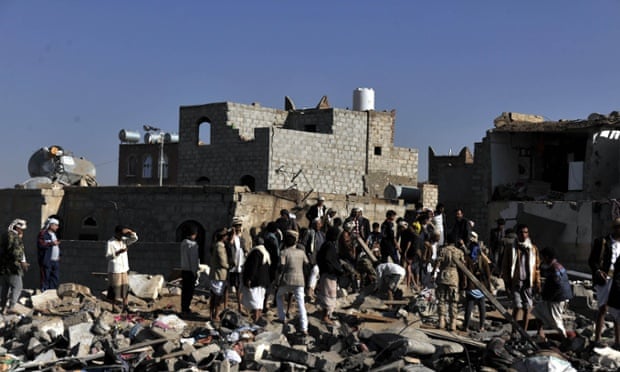
People search for casualties at a bomb site near an air base in Sana’a, Yemen.

The possibility of a ground offensive in Yemen has grown significantly as Egypt declared its readiness to send troops into the embattled country “if necessary” in the wake of air strikes launched by a Saudi-led coalition.

Arab officials still hope the air campaign – launched late on Wednesday and backed by the US, Gulf states, Egypt and Turkey – will weaken the Iranian-backed Houthi rebels, who are attempting to overthrow President Abd-Rabbu Mansour Hadi, and make a ground offensive unnecessary.

But the rebels’ leader, Abdulmalik al-Houthi, declared that Yemen would be the “graveyard of invaders” if the coalition launched a ground invasion and called for an end to what he declared an illegal, unprovoked aggression.

Hadi, who fled to Aden earlier this month, arrived in Riyadh on Thursday, Saudi state television reported.

The campaign, Operation Decisive Storm, threatens to spark a regional confrontation between Iran and its Arab rivals, who are increasingly anxious at the Islamic Republic’s growing influence in Yemen, Iraq, Syria and Lebanon.

“Egypt has declared its political and military support, as well as its participation with the coalition with an aerial and naval Egyptian force, as well as a ground force if necessary, in light of Egypt’s historic and unshakeable responsibility towards Arab and Gulf national security,” Egypt’s foreign minister, Sameh Shoukry, told a meeting of Arab foreign ministers in Sharm el-Sheikh on Thursday.

Three senior Egyptian security and military officials told the Associated Press that Saudi Arabia and Egypt would lead a ground operation in Yemen after a campaign of air strikes to weaken the rebels, saying the forces would enter by land from Saudi Arabia and by sea from the Red Sea and Arabian Sea. They said on Thursday that other nations would also be involved.

They would not specify troop numbers or say when the operation would start, only that it would be after air strikes weakened the rebels. They said the offensive aimed to push them into negotiations on power sharing.

Houthi, the rebel leader, delivered a defiant television address late on Thursday, calling on all Yemenis to mobilise in preparation for a ground invasion and decrying the “idiotic, stupid aggression.”
“These criminal, collaborative powers will discover that they committed a huge error with this aggression,” he said. “If any armies come to occupy, the Yemeni people will prove once again that Yemen is the graveyard of invaders.

“Do not enter into more stupidities. Stop immediately or all options are open,” he added. “If this aggression continues, there will be no surrender.”

Kuwait’s foreign minister urged the Yemeni factions involved in the conflict to come to Saudi-hosted talks to end the crisis, to prevent the country from “sliding into more chaos and destruction.”

The Gulf states have intervened on the ground before in recent years, with Saudi troops moving in to quell the uprising in Bahrain in 2011 in support of the Sunni Khalifa monarchy, which rules over a Shia majority. But a ground intervention in Yemen would pose major challenges, pitting the coalition against an insurgent movement backed by Iran with important redoubts in the country’s north.

The Russian president, Vladimir Putin, called for an “immediate cessation of military activities” in Yemen in phone conversations with his Iranian counterpart, Hassan Rouhani, the Kremlin said on Thursday.

Iran, which has aligned itself with the Houthis, strongly objected to the Saudi air strikes, urging their immediate halt.

“We demand an immediate stop to the Saudi military operations in Yemen and we believe they are an infringement to Yemen’s sovereignty,” said Iran’s foreign minister, Mohammad Javad Zarif, according to the semi-official Isna news agency. “These operations will only lead to bloodshed and we will spare no efforts to contain the crisis in Yemen.”

Ali al-Noaimi, a prominent UAE columnist for the state-run newspaper al-Ittihad, said the Gulf states were ready for a ground intervention but were hoping the air strikes would create “paralysis and shock” among the Houthis and energise the popular opposition to their rule, compelling them to retreat and avoid the need for a land offensive.

Saudi Arabia deployed 100 fighter jets and 150,000 troops for the operation, according to the Saudi-owned news channel al-Arabiya. The UAE also contributed 30 fighter jets, Kuwait and Bahrain 15 each, Qatar 10 and Jordan six.

Egypt is also providing naval support, deploying four warships to secure the Gulf of Aden, maritime sources at the Suez Canal told Reuters. The White House said it was providing “logistical and intelligence support.” The operation is led by the Saudi defence minister, Prince Muhammad bin Salman, the king’s son.

“We will do all we can to protect the legitimate government in Yemen and prevent it from collapsing and facing the dangers of militias,” the Saudi ambassador to Washington, Adel al-Jubeir, told a press conference late on Wednesday.

Saudi Arabia said Houthi-controlled air defences and four warplanes had been destroyed as well as al-Dulaimi airbase. A Houthi-backed TV station said 18 civilians were killed in the air strikes.

The International Committee of the Red Cross (ICRC) said it had been informed of a “considerable number” of civilian deaths and injuries following the air strikes.

Cedric Schweizer, the head of the ICRC delegation in Yemen, said it had been “a long and difficult night” for residents of Sana’a, Aden, Lahj and al-Baydha. “It is very difficult at this stage to establish the exact figures of those who lost their lives or were injured, but we have learned from our contacts with the ministry of public health and population on that there was a considerable number of civilians killed or wounded.”

The intervention came a day after Hadi’s government demanded an Arab military intervention to halt the Houthi advance, which came close to storming his southern redoubt of Aden. The Houthis, also known as Ansar Allah, are members of the Zaydi Shia sect, and took control of the capital, Sana’a, last year before placing Hadi under house arrest.

The escalation in Yemen comes amid growing Arab anxiety over Iran’s rise, with its influence spreading in Yemen and Iraq, as well as its involvement alongside the regime of President Bashar al-Assad in Syria and its prominence in Lebanon, where it backs the powerful military and political organisation Hezbollah.

Since the Houthi takeover of Sana’a, Iran has boosted its relations with the rebels, establishing direct flights to the Yemeni capital and hosting a group of influential rebels in Tehran for talks.

David Cameron’s spokeswoman said the prime minister had told Rouhani in a phone call on Thursday that other countries should not be supporting Houthi fighters in Yemen – something Tehran is already doing.

“In order to restore stability what we need is a political process and … as part of that other countries should not be supporting the Houthi rebels and instead be encouraging all the different parties in Yemen with different interests to come together in a political process,” the spokeswoman said.

In an interview with France 24, the Turkish president, Recep Tayyip Erdoğan, backed the Saudi-led coalition, saying he was considering providing logistical support. “Iran and the terrorist groups must withdraw,” he said.


*Additional reporting by Sam Jones

Is Egypt's top judge protecting privatization contracts from workers' appeals?

Mada Masr

Egyptian companies trapped in limbo by investment-friendly law

Sunday, March 15, 2015


Egyptian workers have been fighting an uphill battle against draconian privatization measures for decades, but a 2014 presidential decree and the government’s current concerted push for economic investment has completely sidelined workers in the name of investor confidence.  

Issued by Egypt’s Interim President Adly Mansour, Presidential Decree 32/2014 (Arabic/English translation) pulled the rug from under public sector workers, stripping them (and any civilian) of the right to make legal plaints against the sale of their companies – or any public property, leaving several companies in a legal quagmire and the future of their workforces precarious.

The law was issued following a string of court verdicts, which nullified the sale and privatization contracts of seven companies, owing to faulty contracts with the state.

From September 2011 to March 2014, administrative courts issued verdicts in favor of workers who had appealed against the privatization of these seven companies, ruling they had been sold-off for far less than their real market value.

Accordingly the courts ruled that these companies were to be returned to the state's ownership. Most of these companies, however, remain in a state of legal limbo.

One of these seven companies, the Nubariya Seeds Production Company was returned to the ownership of Saudi investor Abdel Ellah al-Kaaki in late 2014, after the state largely settled its contractual difficulties and despite the fact that the Administrative Court verdicts had nullified its sale.

A key stipulation of the law means that it works retroactively, halting all ongoing appeals against contracts prior to the law’s issuance. However, the law also stipulates that court verdicts should not be affected.

Kaaki also purchased another one of the seven companies, Tanta Flax and Oils Company, in 2005, but this company also remains in a legal and financial state of limbo.

“We've already received our court verdicts which are supposed to return our company to the state," argues Hisham al-Oql, a Tanta Flax worker, hoping that the retroactive clause cannot affect his company.

For Oql, it boils down to the Egyptian state being “eager to resolve contractual problems with investors – especially Saudi investors these days – because these contracts are worth billions of pounds, but it’s not nearly as eager to resolve our unemployment problems."

For the more than 20 other companies (including Cemex Assiut, and Al-Arabiya Exports Company,) which were in the process of having their privatization contracts reviewed by the State Council Court (SCC), the future is far more tenuous.

Despite these difficulties, Egypt’s mainstream media has been praising Decree 32. In a statement published in the state-owned Middle East News Agency on May 11, 2014, Minister of Trade and Investment Mounir Fakhry Abdel Nour spoke very favorably of the law. 

"This law takes into account the delicate balance between many of the most important considerations required to maintain the stability of contracts," Abdel Nour stated.

He added that the law "promotes confidence in the ability of the state and its legal system to safeguard contracts in which it is a party, and promotes the appropriate climate to encourage investment and create economic activity."

While its media spokesperson could not be reached for further questions regarding Decree 32, in February the Ministry of Trade and Investment announced that it is working with other Egyptian authorities towards resolving commercial disputes with Saudi and other Gulf investors before the international economic investment summit in Sharm al-Sheikh. 

On January 20, Ahmed Darwish, secretary general of the Saudi-Egyptian Businessmen Association, told state-media that authorities recently resolved nearly 85 percent of the disputes and obstacles facing Saudi-owned companies operating in Egypt.

The return of the Nubariya Seeds Company to the Saudi investor, whose initial contract was ruled to be null and void, has spurred the Egyptian Center for Economic and Social Rights (ECESR) into action. 

On July 8 2014, the rights group filed a lawsuit before the SCC, contesting the constitutionality of the decree and have since drawn negative media attention from the mainstream media, who suggest that such actions deter both foreign and domestic capital from investing in Egypt.

The executive editor of the privately-owned Al-Wafd newspaper, Wagdy Zein Eddin, praised the 2014 decree in an op-ed published on May 7, 2014, for “attracting investment and cracking down on corruption mafias that challenge the state's contracts, and result in capital flight from the country.”

Zein Eddin added that these “corruption mafias” along with “people looking for their own interests ahead of the state's interests” are responsible for creating a climate of uncertainty among investors.

Finally, Zein Eddin claims that Law 32 will ensure that investors will not have to resort to international arbitration – or seek financial settlements amounting to several billion dollars – in order to resolve their disputes with the Egyptian state.

“This law limits legal disputes to only two parties: the governmental authorities involved, and the investor.”

But this key law, an apparent linchpin for Egypt’s economic ambitions, does little more, according to an ECESR statement than “further squander state assets and natural resources” by providing “immunity for previous state contracts” while facilitating the signing of similarly flawed and corrupt contracts in the future.

The rights group argues that Egyptians should have the right to oversee and safeguard their country’s wealth and public funds, but the government has “decided to seize this right from the hands of citizens and judicial authorities, particularly the administrative courts.”

ECESR further argue that Mansour's overlapping roles as lawmaker and judge, violate norms of impartiality and impinge on the separation of state powers.

"The judiciary and executive branches have both been intertwined in the person of Judge Mansour," argues Mohamed Adel, a lawyer at the ECESR, adding that, in light of Article 94, this judge should “either put into early retirement, or be reassigned to another court."

Yet until the legality of the decree is resolved, the court cases dealing with the more than 20 other companies, according to Adel, will remain frozen and courts cannot accept further appeals against the sales of these companies.

In the case of the Tanta Flax Company, it has been reinstated under the umbrella of the state's Holding Company for Chemical Industries, but according to Oql only one of Tanta Flax's production lines is partially back operating "with minimal production, and a skeleton crew of workers operating it."

"This boils down to whether or not the state is genuinely willing to invest in them or re-operate them," Adel says.

On the process of appealing against Law 32, Adel commented, "We're waiting for the issuance of the advisory judicial report from the SCC before we are allowed to make our case in front of the court. This process may take two months, or two years."

The ECESR is putting together a case that cites the law's violation of nine (32, 33, 34, 53, 94, 97, 100, 190, and 225) constitutional articles.

But these efforts could drag on for years, and until then, Decree 32, a bedrock of sorts for the economic vision being pushed at investors during the March economic conference, will only have the effect of threatening the sovereignty of Egypt’s law, argues Adel.

"The sovereignty of the law should serve to root-out corruption, not protect it,” he states, adding that the state, by standing in violation of its own laws, is the real cause of poor investor confidence.

"Government officials who arrange and draft corrupt contracts are the real causes of both financial and legal instability in Egypt. Their actions hurt the economy, investors' confidence, and they squander the country's public assets.”


*Photo of Tanta Flax Workers outside State Council Court, by Jano Charbel