Egypt has approved
the construction of 19 new prisons since January 2011 amid an ongoing
crackdown on freedoms, according to report released on Monday by the
Arabic Network for Human Rights Information (ANHRI.)
The number of prisons has risen in Egypt from
43 to 62 since 2011, when then-president Hosni Mubarak was ousted after a
popular uprising against his rule.
Out of the 19 new prisons, 16 were built during
the reign of Adli Mansour and Abdel Fattah al-Sisi, two under the rule
of Mohamed Mursi and one during the transitional period led by the
Supreme Council of the Armed Forces.
According to the report, prisons
across Egypt are bursting at the seams due to “random arrests and unjust
trials, in addition to the unfair laws passed after July 3, 2013,”
when then-Defence Minister Sisi ousted Mursi following mass protests
against the latter's rule.
Hundreds have been arrested for breaking the
controversial assembly law issued during the transitional months under
then-Interim President Mansour. The law imposes restrictions on protests
and stipulates that protesters must obtain a permit from the interior
ministry beforehand.
The report also ascribed the government’s need
for new prisons to the extension of pre-trial detention periods, which
should not exceed two years, according to the law.
Photojournalist Mahmoud Abu Zeid, widely known
as Shawkan, is among those who exceeded the legal maximum period in
pre-trial detention, having spent over two years in prison before he was
referred to court in December 2015.
There are no official statistics on the
interior ministry’s website regarding the number of inmates in Egyptian
prisons, but head of the Prison Authority Mostafa Baz said in a
televised interview in May 2016 that the number of prisoners stands at
80,000.
However, a source at the Prison Authority, who
preferred to remain anonymous, told ANHRI that Egyptian
prisoners totaled over 106,000 prisoners, 60,000 of whom are political
prisoners, despite security officials repeatedly asserting that Egyptian
prisons were free of political prisoners and detainees.
According to the report, the post-July 3
period, as well as the period of sectarian violence during the early
1990s, are the only periods during which the number of political
detainees exceeded that of criminal detainees in Egypt.
The report said that the Egyptian regime needs
to recognise the problems that arise from absence of law and
accountability policy, saying that “stability may come through
repression, or through justice and the rule of law, and the latter is
more lasting.”
“The government builds new prisons, detains
larger number of activists, at a time when the country suffers an
economic crisis and is reluctant to build hospitals, schools and public
libraries,” the report read.
A new wave of labor strikes is sweeping Egypt, from Alexandria to Aswan, primarily in public sector companies.
In
the Mediterranean governorate of Alexandria, hundreds of bus drivers
and other Transport Authority employees have been on strike for the past
two days, prompting military authorities to deploy strike-breaking
tactics.
In the Nile Delta, a textile workers strike is ongoing at
the state-owned Samanoud Felt Company and the Damanhour Carpet Company.
Employees in the Endowments Ministry are also striking, as well as an
extended strike by Aswan street cleaners and private transport company
drivers.
Transport workers strike
Since
Sunday, workers in Alexandria have refused to operate any buses from
the Transport Authority’s garages in the districts of Somouha, Sidi
Beshr, Moharam Beik, Agamy, Amariya, and Kormouz.
According to several local news portals,
this strike has left throngs of commuters stranded and overburdened
other forms of public transport, causing traffic jams across the city of
Alexandria. The strike is only affecting bus services, not the
authority’s tramlines, the President of Alexandria’s Public Transport
Authority, Khaled al-Eiwa, told media outlets.
Officials
from the Northern Military Region, headquartered in Alexandria,
dispatched 25 buses, with a 52-passenger capacity each, in response to
the strike, the privately owned Tahrir news portal reported.
Employees from Alexandria’s Public Transport Authority posted a list of demands
on their official webpage, calling for the payment of overdue bonuses,
unpaid profit shares, and an end to pay-deductions associated with buses
that have broken down or are in need of maintenance work, amongst other
demands. Workers say they have presented these demands before to Eiwa,
to no avail.
Despite sharp increases in public bus fares since
2008, the meager wages of Transport Authority workers have largely
stagnated, they argue, threatening to escalate from work stoppages to
hunger strikes if their demands continue to be ignored.
Also in
Aswan, the drivers of private passenger pick-up trucks commenced a
strike on Saturday in protest over the termination of their licenses by
the governor. This ongoing strike caused major traffic congestion across
the governorate, according to the state-owned Al-Ahram newspaper.
Endowments workers strike
Several hundreds of striking employees from the Endowments Ministry protested outside its branch office
in the Dokki district of Giza on Monday, demanding improved wages, and
working conditions.
They had been on strike since Sunday, according to
the privately owned Masr al-Arabia news portal, who added that many of these state-employed workers do not receive the minimum wage of LE1,200 per month, which was enforced in January 2014. Some Endowments Ministry workers earn as little as LE600 per month — half the minimum wage — according to the state-owned Al-Akhbar news portal.
The
ministry reportedly employs around 6,000 workers, many of who cite
precarious working conditions and invalid employment contracts, and are
demanding the resignation of Endowments Minister Mohamed Mokhtar Gomaa,
for repeatedly failing to heed their demands and resolve issues.
Scores
of workers at the Damanhour Carpet Company, in the Nile Delta
Governorate of Beheira — which is affiliated with the Endowments
Ministry, have been on strike for a week.
Several workers at the company
say their monthly wages are just LE400, according to the privately
owned Al-Watan newspaper.
Other grievances reportedly include the non-payment of bonuses, along
with stalled production lines and a lack of ministerial investment in
this public sector company.
Textile workers strike
In
a separate industrial action in the Town of Samanoud, located in the
Nile Delta Governorate of Gharbiya, hundreds of textile workers launched
a strike on Monday over the sacking of their local union
representatives.
The independent Center for Trade Union and Workers’ Services reported
that eight workers from the public sector Samanoud Felt Company –
including the president of the local union committee and several other
union members – were sacked by the company’s administration on Sunday.
These
unionists were fired in contravention of domestic labor and trade union
legislation, as they weren’t permitted a hearing before the General
Union of Textile Workers, to which this union is affiliated.
Although
Monday’s strike was held to demand the reinstatement of these eight
workers, unionists and laborers have been demanding the payment of
overdue bonuses and the re-operation of several stalled production lines
for months.
Street cleaners strike
Hundreds
of public sector street cleaners continued to strike for the eleventh
day in Aswan on Monday, resulting in floods of uncollected garbage in
the streets, Al-Watan reported.
Street
cleaners have been demanding fulltime contracts for fulltime work, as
they are currently employed by the governorate of Aswan on precarious,
part-time contracts, some of them for more than five years. Such
contracts deprive them of bonuses, the right to join trade unions,
adequate insurance or pension plans, and other rights.
In reponse to the strike, the Governor of Magdy Hegazy has promoted a “Clean-up Your Country”
campaign this week, aimed at local residents, and seeking to circumvent
the strike by having locals collect and dispose of their own garbage.
*Photo of Damanhour Carpet Company strike courtesy of Arabsolaa.com
Several international and local
rights groups issued statements demanding the release of investigative
journalist and sociopolitical researcher Ismail Alexandrani,
detained for 15 days pending investigation into charges of belonging to
the outlawed Muslim Brotherhood group and disseminating false
information.
The Committee to Protect Journalists said
his arrest “is the latest attempt by the Egyptian government to silence
critical reporting through force and intimidation,” according to its
Middle East and North Africa research associate Jason Stern.
CPJ warned that Alexandrani’s detention could be renewed indefinitely.
"We call on authorities to release Alexandrani immediately and drop all charges against him," Stern said.
Alexandrani
was taken into custody by National Security forces in Hurghada, where
he was arrested at the airport early on Sunday, according to his wife
Khadiga Gaafar’s Twitter account. He was then moved to Cairo, where he was interrogated for over eight hours by National Security Prosecution.
The
prosecution inspected Alexandrani’s laptop, his cellphone and business
cards he kept in his wallet of friends, colleagues, fellow journalists
and academics, according to his lawyers.
In another joint statement,
several local rights groups condemned Alexandrani’s detention, deeming
it a violation, and called for his immediate and unconditional release.
The
statement was signed by the Egyptian Initiative for Personal Rights,
the Egyptian Center for Economic and Social Rights, the Arab Network for
Human Rights Information, Nazra for Feminist Studies and the
Association for Freedom of Thought and Expression, among others.
The
groups asserted Alexandrani’s detention is in line with the continued
crackdown on journalists and opposition writers, which is “a violation
of freedom of thought and expression and a disregard of rights and
international standards to protect freedom of the press.” It also
violates the Egyptian constitution, the statement added.
They
also called for the release of all prisoners of conscience and the
opening up of political space for expression, urging “abandoning the
gagging policy which only pushed us further into a dark tunnel.”
Alexandrani
was held for over 10 hours at Hurghada airport on Sunday and was not
allowed to see a lawyer until Tuesday. Human Rights Watch deemed
this a violation of Egyptian law, which requires security officials to
inform detainees of the reasons behind their detention and allow them to
contact a lawyer.
“The arrest of Ismail Alexandrani is deeply
disturbing and fits a pattern of Egyptian security agencies arresting
people whose writings don’t conform to official views,” Joe Stork, HRW
deputy Middle East director, stated.
“If Alexandrani had any
arrest warrant or official charges, he should have been informed
immediately,” Stork added. “What happened to him is clear intimidation
and has little to do with the rule of law.”
Alexandrani’s
journalistic work is often critical of government policies. Recent
articles he published in Beirut-based newspapers As-Safir Arabic and
Al-Modon claimed the new Suez Canal passageway is a delusion, criticized
the state’s war on Sinai-based militants and used local sources to
report details on the military’s battle with militants in the Western
Desert.
All the statements by human rights organizations also referred to the three-day detention of Mada Masr contributor Hossam Bahgat
last month, who was held on charges of publishing false news that harms
national interests and disseminating information that disturbs the
public peace.
Bahgat was released from military intelligence after
he signed a document pledging to abide by legal and security procedures
when publishing material pertaining to the Armed Forces.
A translation of Bahgat's statement by Mada Masr reads as follows:
Firstly,
I would like to express my gratitude to everyone who has expressed any
form of solidarity during the three days in which I was “hosted” by the
Egyptian military.
It is not the appropriate moment for me to
narrate all the details of the past three days, so I will only document
the events that took place briefly.
On the morning of Sunday
November 8, I headed to military intelligence headquarters in response
to a written summons that was delivered to my house three days earlier.
I
spent approximately three hours at military intelligence before I was
escorted through a back door to a car and driven to the military
judiciary, accompanied by armed guards. My request to contact my family,
lawyer or colleagues, who were waiting for me outside the building, was
denied.
At the military judiciary, I was held in the car with
armed guards for over five hours, before being made to appear in front
of a member of the North Cairo Military Prosecution and interrogated as
someone facing charges.
I resisted several attempts to intimidate
and entice me into waiving my right to have a lawyer present. Upon my
insistence, I was allowed one phone call to inform a friend of my
whereabouts and request a lawyer.
As my interrogation began, a
large number of colleagues, friends and lawyers, who are the companions
of years of struggle, waited for me outside with the knowledge of the
colonel who heads the prosecution.
The interrogation, which
commenced in the presence of 25 volunteer defense lawyers, was wholly
focused on a journalistic investigation that I published in Mada Masr on
October 13 with the headline “A coup busted?”
My
interrogation was based on a report by military intelligence against
me. At the end, the head of the prosecution informed me that I faced
charges of deliberately broadcasting false news that harms national
interests and involuntarily disseminating information that harms public
interests, as per Articles 102 and 188 of the Penal Code.
After
the interrogation was completed and the lawyers were dismissed, I was
transferred to military intelligence again. I waited in the same car
until 11 pm, when another car arrived with three armed men in civilian
clothing. They searched me thoroughly, then took me to their car,
blindfolded me and asked me to lower my head on the seat in front of me.
I
was taken to an unknown location and questioned by a doctor upon
arrival, who asked if I had any illnesses or was taking any medication. I
was then asked to take off my clothes, and the doctor performed
a non-invasive physical inspection.
Afterward, I was allowed to
get dressed and was escorted into a building. My blindfold was taken off
and all my possessions were confiscated, including my glasses, and I
was moved to a small, dark cell with nothing but two blankets on the
floor.
After about 15 minutes, the guard blindfolded me again and I
spoke to officials who did not reveal their identities. They told me
that the matter would end in the morning and ordered that I be
transferred to the “villa.”
I was then escorted to a room with a bed and
a small bathroom and I was allowed to bring in some of the food that
lawyers had provided while I was at military prosecution.
I was
kept in this room, which was secured by both a wooden and metal door,
from Sunday November 8 at midnight until Tuesday November 9 at noon.
During this time, I was not interrogated.
All of the demands I
made to the guards were ignored. I requested many times that they inform
officials of my wishes to know the military prosecution’s decision
regarding my detention and to understand my legal position — to know
whether I was being detained under investigation, referred to trial or
abducted. I was not even allowed to meet any of the officers.
Today,
on Tuesday, at noon, I was blindfolded and escorted by an armed guard
in a car to military intelligence again. I met with two officers, a
general and a lieutenant colonel, for an hour, and was informed for the
first time that the prosecution had ordered my detention for four days
pending investigations, but that military intelligence had decided to
release me today.
At the end of the meeting, I wrote a statement
that was dictated to me stating: “I will abide by legal and security
procedures when publishing material pertaining to the Armed Forces” and
asserting that I did not experience any physical or emotional abuse
during my detention at military intelligence. My possessions were
returned to me and I was allowed to leave.
I still do not know the
fate of the investigations into the two charges mentioned above.
Defense lawyers will try to clarify the matter in the coming days.
Throughout
the course of my interrogation by military prosecution, they reiterated
that I do not enjoy the legal and syndicate protection that journalists
have, because I am not a member of the Journalists Syndicate.
While I
thank the syndicate for sending a lawyer to attend my interrogation, I
urge, again, the board of the Journalists Syndicate and its general
assembly to take immediate measures to secure syndicate protection to
all those who practice journalism with no discrimination.
In the
end, I was lucky to receive an outpouring of solidarity and sympathy,
which guaranteed a degree of relatively better treatment during my
detention and the short duration of my stay, despite the aforementioned
procedural violations of my rights as a detainee. I can only thank all
the lawyers, colleagues, friends, comrades and Egyptian and
international organizations that expressed their support and offered me
their assistance.
I wish for freedom for the thousands of people
unfairly detained in Egyptian prisons. I reassert my rejection of the
criminalization of journalistic work, the use of the Penal Code to
imprison journalists, and the trial of civilians in military courts.
President Gets Western Support While Erasing Human Rights Gains
President Abdel Fattah al-Sisi of Egypt
has presided over the flagrant abuse of human rights since taking
office a year ago pledging to restore stability. Violence by armed
groups and the government has escalated.
The United States and
European governments should stop overlooking Egyptian government abuses,
including a lack of accountability for many killings of protesters by
security forces, mass detentions, military trials of civilians, hundreds
of death sentences, and the forced eviction of thousands of families in
the Sinai Peninsula.
Over the past year, al-Sisi and his cabinet, governing by decree in
the absence of an elected parliament, have provided near total impunity
for security force abuses and issued a raft of laws that severely
curtailed civil and political rights, effectively erasing the human
rights gains of the 2011 uprising that ousted the longtime ruler Hosni
Mubarak.
“The al-Sisi government is acting as though to restore stability
Egypt needs a dose of repression the likes of which it hasn’t seen for
decades, but its treatment is killing the patient,” said Joe Stork,
deputy Middle East and North Africa director. “What makes it worse is
that Western governments that subordinated human rights in their
relations with Egypt during the Mubarak era seem ready to repeat their
mistake.”
No member of the security forces has been held accountable for the
mass killings of protesters that followed the military’s July 2013
removal of Mohamed Morsy, Egypt’s first freely elected president, which
al-Sisi orchestrated as defense minister. These included the killing of at least 900 people in a single day, August 14, during security operations to clear protest sites in Cairo.
These killings amounted to probable crimes against humanity. But a
government-commissioned fact-finding committee that investigated the
events related to Morsy’s removal released only an executive summary of
its findings in November 2014. The executive summary did not recommend
any investigations into the mass killings, and Egypt’s prosecutor
general has never announced an independent investigation.
Attacks by insurgent groups increased in the North Sinai governorate
immediately following Morsy’s removal, but both insurgent attacks and
government arrests and violence have escalated sharply since an October
2014 attack on a military base there, Human Rights Watch research has
found. Attacks on police and government infrastructure have also become
common in mainland Egypt. The government has responded by clearing a
kilometer-wide buffer zone on the border with the Gaza Strip, trying
thousands of civilians in military courts, and arresting those who
dissent.
In its annual report,
released in May 2015, the quasi-governmental National Council for Human
Rights (NCHR) stated that the “right to life witnessed horrible
deterioration” in 2013 and 2014. The report said that violence had
resulted in about 2,600 deaths in that period, including 700 security
personnel, 1,250 supporters of the Muslim Brotherhood – the organization
to which Morsy belonged – and 550 other civilians.
Since al-Sisi came to power, the authorities have continued to
aggressively enforce a de facto protest ban and routinely dispersed
anti-government demonstrations with force. In January 2015, at least 20 people died
during events surrounding the fourth anniversary of the 2011 uprising.
Prosecutors charged a member of the Central Security Forces (CSF) for
the January 24 killing of a leftist activist but also charged 17 people
who witnessed her killing with violating the anti-protest law. In
February, at least 19 soccer fans died in a stampede outside a Cairo
stadium after police fired tear gas into a crowd of hundreds lined up to
pass through an enclosed metal corridor. Prosecutors charged members of
one of the team’s fan clubs and alleged Brotherhood members for the
stampede, but no police officers.
A congressionally mandated US State Department report
on Egypt’s political situation submitted in May 2015 found that “a
series of executive initiatives, new laws, and judicial actions severely
restrict freedom of expression and the press, freedom of association,
freedom of peaceful assembly, and due process, and they undermine
prospects for democratic governance.”
Yet in March, President Barack
Obama resumed supplying military equipment to Egypt and announced that
most military aid would continue, albeit with policy changes, to be
implemented later, that would eliminate Egypt’s ability to buy on credit
and more strictly define the uses of such aid.
The European Union
(EU) and its 28 member states have failed to find a collective, firm,
and principled response to Egypt’s crackdown on dissent and the
imprisonment of critical journalists, activists, and political
opposition following blatantly unfair trials.
While EU High
Representative Federica Mogherini has expressed dismay about hundreds of
death penalties and noted that a May 16 verdict preliminarily
sentencing Morsy to death was “not in line with Egypt’s obligations
under international law,” she failed to insist on the release of those
who are wrongfully imprisoned.
The EU has repeatedly pledged to place human rights at the core of
its relations with third countries and stand up for those who defend
human rights and rule of law. However, when Mogherini attended a March
economic conference in the Egyptian city of Sharm al-Sheikh, she said
her visit was a signal of the EU’s “continuous support” to Egypt and she
remained silent on gross government abuses, the closing space for civil
society, and continued impunity for grave government abuses.
The US and EU should press al-Sisi and his advisers to roll back the
numerous repressive laws passed in the past two years and release the
many people unjustly detained for exercising their human rights, Human
Rights Watch said.
“Continued silence from the United States and Europe legitimizes
al-Sisi’s flawed logic that the state’s clampdown on its own citizens
will yield stability,” Stork said. “It’s not too late to push the
Egyptian government to correct its course.”
MASS ARRESTS & ABUSES IN DETENTION
The authorities detained, charged, or sentenced at least 41,000 people
between July 2013 and May 2014, straining Egypt’s prisons and
aggravating hugely overcrowded conditions in the police stations and
security directorates where the Interior Ministry now holds detainees,
many of them without trial.
In its report, the NCHR stated that prisons
were at 160 percent capacity, and police stations at 300 percent. The
authorities have also used unofficial facilities, including military
bases and security agency sites to house detainees. Torture and
ill-treatment at these facilities are routine.
Judges have routinely approved lengthy periods of pretrial detention
for accused Brotherhood members and activists who oppose the
government, while allowing members of the security forces and others who
support al-Sisi to be freed on bail. In one case, 494 people arrested
at Cairo’s Al Fath Mosque in August 2013 during the fallout from Morsy’s
removal and who are being tried together have been held in detention since their arrest.
In July 2014, the Interior Ministry said that
7,389 people arrested in connection with the unrest surrounding Morsy’s
overthrow remained in pretrial detention. It has not released updated
statistics. On June 6, 2015, the Interior Ministry announced that 200 detained high school students would take their final exams in prison.
Egyptian human rights organizations documented at least 124 deaths in
custody since August 2013 as a result of medical negligence, torture,
or ill-treatment. The Justice Ministry’s Forensic Medical Authority said
in December 2014 that at least 90 people
died that year in police stations in the Cairo and Giza governorates
alone.
At least three former Brotherhood parliament members have died in
custody. In May 2015, the Nadim Center for the Rehabilitation of
Victims of Violence and Torture documented 23 deaths for which it said
security forces were most likely responsible, including four from
medical negligence, three from torture, and two after the victims went
missing.
Prosecutors opened an investigation into one case, the death of
lawyer Karim Hamdy. Two Egypt Homeland Security officers were arrested
on February 25 in connection with the investigation, and a court
released them on bail of 15,000 Egyptian pounds (US$1,310) on March 28.
Rather than reassessing policies on pretrial detention in the face of
allegations of ill-treatment in police custody or dropping charges
against those unjustly detained, the Interior Minister has issued
decrees officially designating some police stations as prisons.
MASS TRIALS, MILITARY TRIALS OF CIVILIANS & DEATH SENTENCES
The harsh crackdown and arrest campaign that began after the July 2013
coup has sent numerous secular activists to prison, including human
rights defenders Yara Sallam and Mahienour al-Masry, April 6 Youth
Movement co-founder Ahmed Maher, and blogger Alaa Abdel Fattah. Other
secular activists have been sentenced to long prison terms in mass
trials. In February 2015, a judge sentenced activist Ahmed Douma,
women’s rights defender Hend al-Nafea, and 228 others to life in prison
for participating in a December 2011 protest.
Many members of the Muslim Brotherhood including its leaders have
also been prosecuted under al-Sisi. Judges have handed down at least 547
death sentences and many more sentences of life imprisonment for
political violence or activities, many after mass trials involving
alleged Brotherhood supporters and other Islamists.
In separate
decisions on May 16, a criminal court recommended the death penalty for
122 people, including Morsy, the noted academic Emad Shahin, and half a
dozen top Brotherhood officials. The court will rule on whether to
finalize those death sentences on June 16. To date, only one of these
death sentences has been approved by the Court of Cassation, a
requirement before they can be carried out.
After a period of two and a half years after the 2011 uprising in which Egypt carried out no executions,
the authorities have executed 27 people since al-Sisi took up office.
Among them, seven had been convicted of murder in connection with
political violence, six of them following unfair trials in a military
court. The six men were executed despite credible evidence that at least three of them had been in detention at the time of the crimes for which they were accused.
In October 2014, al-Sisi issued a decree expanding military court jurisdiction
to all “public and vital facilities” for two years. Since then,
prosecutors have referred at least 2,280 civilians for military trial,
according to a Human Rights Watch count based on media reports. In May,
one of these military courts, in Alexandria, sentenced six children to 15 years in prison, according to the National Community for Human Rights and Law.
SINAI EVICTIONS
In October 2014, following an attack on an Egyptian army checkpoint in
the Sinai Peninsula by the insurgent group Ansar Beit al-Maqdis, also
known as Sinai Province, the Egyptian armed forces began evicting
thousands of families from their homes along the border with the Gaza
Strip. Al-Sisi claimed that armed groups in the Sinai had received
weapons and fighters through tunnels from Gaza.
The removal of thousands of families from the border zone violated
protections against forced evictions under international human rights
law. The US State Department May 2015 report on Egypt to the US Congress
stated that “government forces have committed arbitrary or otherwise
unlawful killings during dispersal of demonstrators, of persons in
custody, and during military operations in the northern Sinai
Peninsula.”
The Cairo Court for Urgent Affairs issued a
verdict on Saturday banning the activities of all hardcore football fan
groups known as Ultras across the country and declaring them terrorist
organizations.
The verdict, which criminalizes the existence of
Ultras groups, stems from a report by Zamalek Club President Mortada
Mansour, who also accused them of attempting to kill him and banned them from entering the club.
It
is the latest development in a long history of animosity between the
state and the Ultras, which has resulted in frequent confrontations
between Ultras fans and police forces at football stadiums and escalated
following the involvement of Ultras in the 2011 revolution.
Two massacres have occurred during football matches since 2012, which Ultras groups hold security forces responsible for.
In February 2012, clashes between Ahly and Port Said fans following a match in Port Said stadium turned tragic when security forces blocked the exits of the stadium and 72 Ahly fans were killed.
Again in February 2015, around 20 Zamalek fans were killed when the police deployed teargas in the small metal box they were passing through to enter the stadium.
Dalia
Abdel Hamid, a social researcher who has studied Ultras groups
extensively in recent years, says that the state’s animosity towards the
Ultras is based on several factors, including their participation in
the revolution and the state’s fear of organized groups.
“They are
being punished along with all other factions who took part in the
revolution, whether activists, journalists, or civil society, but they
have endured the most severe consequences, along with the Muslim
Brotherhood as the two groups who have faced real massacres,” she
explained.
Since the establishment of the two main groups — Ultras
White Knights and Ultras Ahlawy — in 2007, the fan groups have clashed
frequently with the authorities.
In 2008, there were
confrontations when police forces attempted to ban fans from entering
indoor matches. This resulted in clashes outside the stadiums that
occurred again when security forces tried to prevent fans from using
fireworks and banners during games.
In 2009, a media campaign was
started against the fan groups, led by former footballer and talk show
host Ahmed Shobeir, who accused them of being drug addicts. This was
followed by the mass arrests of ultras members from their houses,
according to a report by privately owned Al-Masry Al-Youm newspaper.
The
Ultras groups used their experience in confrontations with the police
during football matches on the front-lines of clashes during the 2011
revolution.
Abdel Hamid says the fact that Ultras groups are well
organized and self-funded makes them a threat to the state, despite them
not being primarily political groups.
Ultras groups, whose
members are in the thousands and are spread across the country, have not
yet officially responded to Saturday's ruling.
*Additional reporting by Mostafa Mohie **Photo courtesy of Ultras White Knights Facebook age
Too early to tell whether partnership between both channels will continue, yet we support OnTV, DW AR spokesperson says
Menan Khater
German TV channel Deutsche Welle (DW) Arabic condemned the alleged
interference of Egyptian authorities in banning a joint programme
between the German channel and Egyptian private channel OnTV on Friday.
The weekly programme “Gama’a Moanath Salem” [Feminine sound plural],
presented by Egyptian anchor Reem Maged, has only aired two episodes on
both channels since 2 May, to feature success stories of Egyptian women
in society.
The first episode featured folklore artist Shaheera Mehrez, while the
second episode, aired on Saturday, featured Al-Masry Al-Youm
photojournalist Eman Helal and her encounters with shooting and field
reporting current events in Egypt from 25 January Revolution in 2011 to
the dispersal of Rabaa Al-Adaweya sit-ins on 14 August 2013.
There is much ambiguity surrounding the ban’s real reasons, as well
as uncertainty regarding the entity which ordered the ban. DW Arabic
spokesperson Christoph Jumplet told Daily News Egypt: “I cannot really
tell why the show was banned, ask the Egyptian authorities.”
He added: “It is too early to tell whether the partnership will
continue between both channels, yet we support OnTV and we want to
continue this programme.”
In an official DW Arabic statement Friday, the channel said: “This
act is a blatant violation against press freedom in Egypt.” The
statement added that the programme will continue airing on its channel
and on the website every Saturday.
The banning has also stirred negative responses on social media
platforms. Thousands of Twitter users, media personnel, and activists
used a hashtag of the programme’s name to criticise the ban. “Reem
presents a source of fear to the state dictatorship,” a Tweet read.
The show was considered a comeback for Maged on TV after an absence
that lasted for nearly two years following the halt of her programme
“Baladna b el masry” [Our country in the Egyptian way] on OnTV in 2013.
Maged is also a political advocate who took part in the “No to
military trials” protest in front of the Shura Council in 2013. Earlier,
she was accused of insulting judiciary on her show in 2012. She was
also summoned by military prosecution, for previewing alleged military
violence towards activists in 2011.
Former president spoke on satellite channel Sada Al-Balad on the commemoration of 33rd anniversary of Sinai Liberation day
Ousted president Hosni Mubarak called on Egyptians “to stand behind and support” current President Abdel Fattah Al-Sisi.
Mubarak made these comments during a phone interview Sunday evening
on satellite channel Sada Al-Balad with TV host Ahmed Mousa.
The former
president narrated events relating to the withdrawal of Israel from the
Sinai Peninsula in 25 April 1982, in commemoration of the 33rd anniversary of Sinai Liberation Day.
“Egypt is facing great challenges, without doubt, the variables
surrounding us are very complicated, the region is complicated and our
national security is linked everything happening in the region,” he
said.
He further said that Egypt has a “strong army” that is capable of
defending its land as “sons of the military establishments, currently
headed by President Abdel Fattah Al-Sisi know the meaning of national
sovereignty”.
Since being toppled as president after the 25 January Revolution,
Mubarak was charged in several cases including corruption cases, abuse
of power and killing protestors during the revolution.
In November 2014, Cairo Criminal Court dismissed the murder charges
against Mubarak as the court was “inadmissible” to rule on the case. He
was also acquitted on the corruption cases.
Mubarak was interviewed on Sada Al-Balad following his acquittal,
where he stressed that he “didn’t commit” any crimes against protestors.
Mubarak’s era was followed by the Muslim Brotherhood coming into
power when Mohamed Morsi held the position for a year between 2012 and
2013. Mass protests against his tenure took to the streets led to his
ouster.
Morsi is charged on other cases that include: espionage with Qatar, espionage with Hamas Palestinian movement and Prison break.
Unlike Mubarak, the Islamist president was handed a 20-years
imprisonment sentence on 21 April, on charges of ‘demonstrating power
and violence’ and ‘inciting violence’ against protestors in December
2012 outside the Presidential Palace.
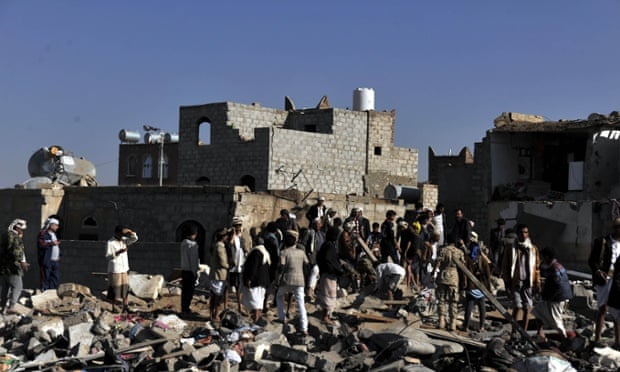
(Beirut) – The Saudi Arabia-led coalition of Arab countries that conducted airstrikes in Yemen
on March 26 and 27, 2015, killed at least 11 and possibly as many as 34
civilians during the first day of bombings in Sanaa, the capital, Human
Rights Watch said today. The 11 dead included 2 children and 2 women.
Saudi and other warplanes also carried out strikes on apparent targets
in the cities of Saada, Hodaida, Taiz, and Aden.
The airstrikes targeted Ansar Allah, the armed wing of the Zaidi Shia
group known as the Houthis, that has controlled much of northern Yemen
since September 2014.
In January, the group effectively ousted the
government of President Abdu Rabu Mansour Hadi. Human Rights Watch found
that on March 26 warplanes struck populated urban neighborhoods in
Sanaa and observed Ansar Allah forces who appeared to be firing
anti-aircraft weapons from residential neighborhoods.
“Both the Saudi-led forces and the Houthis need to do everything they can to protect civilians from attack,” said Joe Stork,
deputy Middle East and North Africa director. “Reports of air strikes
and anti-aircraft weapons in heavily populated areas raise serious
concerns that not enough is being done to ensure their safety.”
Interior Ministry officials linked to Ansar Allah shared with Human
Rights Watch details of their final casualty count from the bombings in
Sanaa on March 26.
They said that warplanes bombed various parts of the
city, including Bani Hawat, a predominantly Houthi neighborhood near
Sanaa’s international and military airports, and al-Nasr,
near the presidential palace.
The officials said they had documented
that 23 civilians had been killed and 24 wounded. Among the dead were 5
children, ages 2 to 13, 6 women, and an elderly man, they said. The
wounded included 12 children, ages 3 to 8, and 2 women.
These numbers are consistent with information provided by two hospitals
that Human Rights Watch visited. At the hospitals, Human Rights Watch
documented the deaths of 11 civilians, including 2 women and 2 children,
whose names were not included among those provided by Interior Ministry
officials as well as 14 more wounded, including 3 children and 1 woman.
Amnesty International reported that bombing destroyed at least 14 homes in Bani Hawat.
Human Rights Watch has not been able to determine whether specific
attacks complied with the laws of war, which apply to the armed conflict
in Yemen. The laws of war prohibit attacks that target civilians or
civilian property, or that do not or cannot discriminate between
civilians and fighters.
Attacks that cause casualties or damage
disproportionate to any anticipated military advantage are also
prohibited. All parties to the conflict have an obligation to take all
feasible precautions to spare civilians from harm, and not to deploy
forces in densely populated areas.
Saudi Arabia’s past use of cluster bombs, which are indiscriminate
weapons, raises concerns that they will be used in the current fighting,
Human Rights Watch said. There is credible evidence
that in November 2009 Saudi Arabia dropped cluster bombs in Yemen’s
northern Saada governorate during fighting between the Houthis and the
Yemeni and Saudi militaries.
Cluster munition remnants from the 2009 airstrikes, including unexploded
submunitions, have been reported by a number of sources. In July 2013,
Yemeni clearance personnel photographed unexploded US-made BLU-97 and BLU-61 submunitions. In May 2014, VICE News published photos and a video shot near Saada showing numerous remnants of US-made CBU-52 cluster bombs deployed in 2009.
Cluster munitions contain dozens or hundreds of submunitions. The
submunitions are designed to explode when they hit the ground but spread
over a wide area, often the size of a football field, putting anyone in
the area at the time of attack at risk of death or injury. In addition,
many submunitions do not explode on impact but remain armed, becoming
de facto landmines.
The US provided Saudi Arabia with significant exports of cluster bombs
between 1970 and 1999. Saudi Arabia possesses attack aircraft of US and
Western/NATO origin capable of dropping US-made cluster bombs. Human
Rights Watch has urged Saudi Arabia and Yemen to join the 2008
Convention on Cluster Munitions, which prohibits the use of cluster
munitions in any circumstance.
“Saudi forces should publicly reject any use of cluster munitions and
recognize that their use could have a devastating impact on civilians,”
Stork said.
Houthi rebels say country will be ‘graveyard of invaders’ if ground offensive follows Saudi-led air strikes
Thursday 26 March 2015
The possibility of a ground offensive in Yemen has grown significantly as Egypt
declared its readiness to send troops into the embattled country “if
necessary” in the wake of air strikes launched by a Saudi-led coalition.
Arab officials still hope the air campaign – launched late on
Wednesday and backed by the US, Gulf states, Egypt and Turkey – will
weaken the Iranian-backed Houthi rebels, who are attempting to overthrow
President Abd-Rabbu Mansour Hadi, and make a ground offensive
unnecessary.
But the rebels’ leader, Abdulmalik al-Houthi, declared that Yemen
would be the “graveyard of invaders” if the coalition launched a ground
invasion and called for an end to what he declared an illegal,
unprovoked aggression.
Hadi, who fled to Aden earlier this month, arrived in Riyadh on Thursday, Saudi state television reported.
The campaign, Operation Decisive Storm, threatens to spark a regional confrontation between Iran
and its Arab rivals, who are increasingly anxious at the Islamic
Republic’s growing influence in Yemen, Iraq, Syria and Lebanon.
“Egypt has declared its political and military support, as well as
its participation with the coalition with an aerial and naval Egyptian
force, as well as a ground force if necessary, in light of Egypt’s
historic and unshakeable responsibility towards Arab and Gulf national
security,” Egypt’s foreign minister, Sameh Shoukry, told a meeting of
Arab foreign ministers in Sharm el-Sheikh on Thursday.
Three senior Egyptian security and military officials told the
Associated Press that Saudi Arabia and Egypt would lead a ground
operation in Yemen after a campaign of air strikes to weaken the rebels,
saying the forces would enter by land from Saudi Arabia and by sea from the Red Sea and Arabian Sea. They said on Thursday that other nations would also be involved.
They would not specify troop numbers or say when the operation would
start, only that it would be after air strikes weakened the rebels. They
said the offensive aimed to push them into negotiations on power
sharing.
Houthi, the rebel leader, delivered a defiant television address late
on Thursday, calling on all Yemenis to mobilise in preparation for a
ground invasion and decrying the “idiotic, stupid aggression.”
“These criminal, collaborative powers will discover that they
committed a huge error with this aggression,” he said. “If any armies
come to occupy, the Yemeni people will prove once again that Yemen is
the graveyard of invaders.
“Do not enter into more stupidities. Stop immediately or all options
are open,” he added. “If this aggression continues, there will be no
surrender.”
Kuwait’s foreign minister urged the Yemeni factions involved in the
conflict to come to Saudi-hosted talks to end the crisis, to prevent the
country from “sliding into more chaos and destruction.”
The Gulf states have intervened on the ground before in recent years, with Saudi troops moving in to quell the uprising in Bahrain
in 2011 in support of the Sunni Khalifa monarchy, which rules over a
Shia majority. But a ground intervention in Yemen would pose major
challenges, pitting the coalition against an insurgent movement backed
by Iran with important redoubts in the country’s north.
The Russian president, Vladimir Putin, called for an “immediate
cessation of military activities” in Yemen in phone conversations with
his Iranian counterpart, Hassan Rouhani, the Kremlin said on Thursday.
Iran, which has aligned itself with the Houthis, strongly objected to the Saudi air strikes, urging their immediate halt.
“We demand an immediate stop to the Saudi military operations in
Yemen and we believe they are an infringement to Yemen’s sovereignty,”
said Iran’s foreign minister, Mohammad Javad Zarif, according to the
semi-official Isna news agency. “These operations will only lead to
bloodshed and we will spare no efforts to contain the crisis in Yemen.”
Ali al-Noaimi, a prominent UAE columnist for the state-run newspaper
al-Ittihad, said the Gulf states were ready for a ground intervention
but were hoping the air strikes would create “paralysis and shock” among
the Houthis and energise the popular opposition to their rule,
compelling them to retreat and avoid the need for a land offensive.
Saudi Arabia deployed 100 fighter jets and 150,000 troops for the
operation, according to the Saudi-owned news channel al-Arabiya. The UAE
also contributed 30 fighter jets, Kuwait and Bahrain 15 each, Qatar 10
and Jordan six.
Egypt is also providing naval support, deploying four warships to
secure the Gulf of Aden, maritime sources at the Suez Canal told
Reuters. The White House said it was providing “logistical and
intelligence support.” The operation is led by the Saudi defence
minister, Prince Muhammad bin Salman, the king’s son.
“We will do all we can to protect the legitimate government in Yemen
and prevent it from collapsing and facing the dangers of militias,” the
Saudi ambassador to Washington, Adel al-Jubeir, told a press conference
late on Wednesday.
Saudi Arabia said Houthi-controlled air defences
and four warplanes had been destroyed as well as al-Dulaimi airbase. A
Houthi-backed TV station said 18 civilians were killed in the air
strikes.
The International Committee of the Red Cross (ICRC) said it had been
informed of a “considerable number” of civilian deaths and injuries
following the air strikes.
Cedric Schweizer, the head of the ICRC delegation in Yemen, said it
had been “a long and difficult night” for residents of Sana’a, Aden,
Lahj and al-Baydha. “It is very difficult at this stage to establish the
exact figures of those who lost their lives or were injured, but we
have learned from our contacts with the ministry of public health and
population on that there was a considerable number of civilians killed
or wounded.”
The intervention came a day after Hadi’s government demanded an Arab
military intervention to halt the Houthi advance, which came close to
storming his southern redoubt of Aden. The Houthis, also known as Ansar
Allah, are members of the Zaydi Shia sect, and took control of the
capital, Sana’a, last year before placing Hadi under house arrest.
The escalation in Yemen comes amid growing Arab anxiety over Iran’s
rise, with its influence spreading in Yemen and Iraq, as well as its
involvement alongside the regime of President Bashar al-Assad in Syria
and its prominence in Lebanon, where it backs the powerful military and
political organisation Hezbollah.
Since the Houthi takeover of Sana’a, Iran has boosted its relations
with the rebels, establishing direct flights to the Yemeni capital and
hosting a group of influential rebels in Tehran for talks.
David Cameron’s spokeswoman said the prime minister had told Rouhani
in a phone call on Thursday that other countries should not be
supporting Houthi fighters in Yemen – something Tehran is already doing.
“In order to restore stability what we need is a political process
and … as part of that other countries should not be supporting the
Houthi rebels and instead be encouraging all the different parties in
Yemen with different interests to come together in a political process,”
the spokeswoman said.
In an interview with France 24, the Turkish president, Recep Tayyip
Erdoğan, backed the Saudi-led coalition, saying he was considering
providing logistical support. “Iran and the terrorist groups must
withdraw,” he said.
The No to Military Trials for
Civilians campaign said on Monday that 3000 civilians were tried in
military courts in the last five months, since President Abdel Fattah
al-Sisi passed new legislation treating certain state facilities as
military institutions.
The findings formed part of the campaign’s
fourth annual conference, which included testimonies from those who have
been through military trials and their families.
Campaign member
Sara al-Sherif says this constitutes a “dramatic” increase in an already
endemic practice, presenting a greater challenge for the campaign, as
public outrage has been more recently directed at harsh rulings by
civilian courts.
She says people claim, “civilian judiciaries
issue death penalties and life sentences without restriction, in
contrast to verdicts by military judiciaries that are swift and will
never be worse than what is already practiced in civilian courts,” but
maintains this is not accurate, given the nature of military courts and
the verdicts they have issued.
Lawyer Ahmed Heshmat raises
concerns over the independence of military courts in the first place.
“The law that enabled military courts to try civilians stipulated that
this judiciary is independent, but it is not independent at all.
Military judges are employees of the Defense Ministry, and as such they
have to adhere to the demands of their superiors.”
“Verdicts
issued by military courts should be approved by the military leader or
his deputy, and he has the right to request the amending of a sentence,
or a retrial if the defendants were acquitted,” he adds.
Heshmat
also questioned the legal procedures for military trials. Verdicts by
military courts are all issued as if the defendants are present, even if
they are actually absent.
Since Sisi’s decree, the number of
civilians referred to military courts has increased, especially among
students arrested on campuses for protesting, many of who have been
handed lengthy prison sentences. Universities are now considered
military institutions under the new law.
An activist in the
“Horreya” (freedom) campaign, concerned with the detention of students,
Seif al-Islam Farag, said that the campaign has recorded the cases of
160 students referred to military tribunals, including 48 students from
Mansoura University, 31 from Al-Azhar University and 14 from Monufiya
University.
He added that the sentences against many of these
students are not based on reality, as in the example of student Ahmed
Shokier, who was sentenced to life in prison, when he had actually
passed away one month before the incident for which he was
convicted took place. Another student in Port Said was referred to 11
military tribunals.
Mother of 16-year-old Youssef Shaaban, who was
arrested in September, says her son was tortured to make him confess to
crimes he didn’t commit, including killing a police officer. The
grieving mother says she is not able to visit her son in prison as no
one knows his whereabouts.
Father of 19-year-old Ain Shams student
Mohamed al-Araby, said that he was surprised when five police officers
stormed his house and arrested his son. They said his son had published a
video concerning the military and would face charges of “spreading
false news about the Armed Forces.” The father was told his son would
return home in a few hours, but he never came back.
“Days later, I
found a lawyer asking for a lot of money to defend my son who was
facing a military trial. When I went to military prosecution, they
said there is no need to hire a lawyer, as the case would be heard by a
misdemeanor court and not a criminal one. I have just realized that the
case was referred to criminal court,” Araby’s father added.
Araby
himself spent many weeks in military prison before he was referred to
Tora, with signs of torture on his face, according to his father.
The
No to Military Trials campaign organizers pleaded with local media to
raise the issue of military trials for civilians, which they say
threatens everyone under the new legislation.
General Mohamed Ibrahim’s controversial tenure as minister of interior
came to an end on Thursday, when the president replaced eight ministers
in his Cabinet and declared the formation of two new ministries.
Ibrahim, who served as interior minister since January 2013, has been
widely lambasted for the brutal, and often deadly, security crackdown on
political dissidents after former President Mohamed Morsi's ouster in
July 2013.
His time in office also saw a dramatic rise in fatal attacks
on police personnel, including an attempt on his life in September
2013.
The president's office announced Ibrahim will now serve as security
affairs adviser to the prime minister. Major General Magdy Abdel Ghaffar
has been appointed to take over his post.
Ghaffar, who headed up the National Security Agency (NSA) in 2011, was sworn in on Thursday by President Abdel Fattah al-Sisi.
The NSA was inaugurated by the Supreme Council of the Armed Forces
(SCAF) during their brief tenure at the helm of the nation, after former
President Hosni Mubarak fell from power in February 2011.
SCAF formed
the NSA to replace the notorious State Security Investigation Services
(SSIS), which was widely perceived as the iron fist of Mubarak’s regime
and infamous for its ruthless human rights violations.
Ghaffar served as NSA deputy chief from March to July 2011, when he
assumed the top post after General Hamed Abdallah stepped down.
According to the state-owned Middle East News Agency (MENA), he also
oversaw the agency's religious extremism unit, which combats militant
Islamists. But just over a year later, in October 2012 the Morsi
administration sent Ghaffar into retirement, replacing him with General
Khaled Tharwat.
Born in Monufiya in 1952, Ghaffar graduated from the Police Academy in
1974. He then began work in the Central Security Forces before moving to
the SSIS, where he spent most of his career. Two years prior to the
revolution, Ghaffar was appointed head of the Ports Authority, until he
was called back to the NSA.
In his first televised appearance in 2011, Ghaffar admitted that under
Mubarak, the SSIS had infringed on the personal freedoms of Egypt’s
citizens, implemented illegal practices and failed to adhere to the
basic principles of human rights. But he did assert that nonetheless,
state security played an “important role” in combating terrorism.
“We confess that there were some incorrect practices under the old
regime. We confess there were violations,” he said. “But we have to
understand that security forces were working under certain circumstances
created under a certain atmosphere.”
But in contrast to the SSIS, the newly formed NSA was informed by a new
philosophy that would “suit the new democratic order,” Ghaffar
insisted, hailing the apparatus as one of the “revolution’s victories.”
Given the sensitive political climate in which he headed up the state’s
most important security body, Ghaffar has made few media appearances.
In one rare interview published in the Wafd Party’s official newspaper,
Al-Wafd, in February 2012, he stated that the NSA was combating the
“third column.”
The term refers to an unknown entity that the government alleged was
inciting violence and animosity between security forces and protesters
during the clashes that lasted from 2011 into mid-2012.
“The third column consists of different entities aiming at making chaos
last longer,” he said, but “the NSA does not intervene now in many
issues, including interrogations, detentions or the religious activities
of citizens.”
Security analyst and retired brigadier general Khaled Okasha told
Reuters that Ghaffar's appointment comes as no surprise, given
his background in fighting religious extremism. Okasha speculated that
"the ministry will definitely witness a new strategy to combat
terrorism."
The Sisi administration also replaced the ministers of tourism,
agriculture and telecommunications, just over a week before the major
investment conference in Sharm el-Sheikh that the government hopes will
bring billions of dollars into the Egyptian economy.
On Wednesday, the North Cairo Military Court sentenced 21 students to
15 years imprisonment each.
Ten of these students were present in court
during the sentencing, while another 11 were sentenced in absentia.
These 21 students of Sadat City University had stood trial on charges
of protesting without a permit and vandalizing public property on
campus.
The office of the Prosecutor General referred these students to a
military tribunal in light of the presidential decree which stipulates
that "attacks against public institutions, facilities and public
properties fall under the jurisdiction of the military judiciary."
The events in question date back to October, prior to Presidential
Decree 136/2014 which was issued on October 27, when security forces
arrested ten students on the aforementioned charges, and filed these
same charges against another 11 students.
Prosecutors in the Nile Delta city of Tanta, who had initially filed
criminal charges against these 21 students, moved to refer them to a
military tribunal following the issuing of Presidential Decree 136/2014.
One of the lawyers for these students, Mohamed Eissa, told Mada Masr
that the referral of his clients to a military trial "was fraught with
problems from the very beginning, as the arrests took place prior to the
issuing of this decree which grants military courts jurisdiction over
their case."
Subsequently, the lawyer pointed out that the referral of these
students to a military trial violates the principle of non-retroactivity
of legislation, especially when such legislation violates a defendant's
rights.
According to Eissa, several of the lawyers for these 21 students sought
to file a legal appeal citing the military court's lack of jurisdiction
in this case, due to the fact that the law was issued after the
students were arrested and charged.
However, other defense lawyers and even family members agreed to have
these students stand trial before the military court, as they were under
the impression that military courts mete out justice more thoroughly
than civilian courts.
The differences amongst the defense team led Eissa and other lawyers to
take another legal path.
Eissa's camp filed a legal appeal before the
State Council Court against Presidential Decree 136/2014, and
specifically against the referral of the 21 students to a military
court.
The State Council Court has accepted the lawyers' motion, and has set
February 24 as the date for the preliminary session through which to
examine this legal appeal as well as assessing the constitutionality of
this presidential decree.
Eissa concluded: "The law has been amended so as to allow appeals
against verdicts issued by first degree military courts. However, upon
looking into the appeals of the military judiciary we find that all
previous verdicts issued by military courts have subsequently been
upheld."
REUTERS Twenty-two people killed outside Cairo soccer stadium
Ahmed Maher and Mahmoud Mourad
Sun Feb 8, 2015
CAIRO (Reuters) -
Twenty-two people were killed outside an Egyptian soccer stadium on
Sunday when security forces barred fans from entering, the public
prosecutor's office said.
Most of the dead were
suffocated when the crowd stampeded after police used tear gas to clear
the fans trying to force their way into a league match between two Cairo
clubs, Zamalek and Enppi, doctors and witnesses said.
A
health ministry spokesman told Reuters by phone the final toll was 19
dead and 20 injured. The reason for the discrepancy in numbers between
the health ministry and the public prosecutor's office was not
immediately clear.
Soccer matches
are often a flashpoint for violence in Egypt where 72 fans were killed
at a match in Port Said in February 2012. Since then Egypt has curbed
the number of people allowed to attend, and supporters have often tried
to storm stadiums they are banned from entering.
Outside
the Cairo hospital treating the injured, scores of youths wearing
Zamalek T-shirts appeared shocked as families arrived to see if their
relatives were safe.
One mother cried and shouted when she found the name of her son on a list of the dead posted by hospital staff.
"I'd told him: leave soccer matches," she said.
Relations
between security forces and fan groups known as Ultras have been tense
since the 2011 popular uprising that ended the rule of autocrat Hosni
Mubarak, in which the Ultras played a key role.
"Huge
numbers of Zamalek club fans came to Air Defense Stadium to attend the
match ... and tried to storm the stadium gates by force, which prompted
the troops to prevent them from continuing the assault," the interior
ministry said.
The public
prosecution ordered the arrest of the leaders of the Zamalek supporters
group, Ultras White Knights, after Sunday's incident, official media
reported.
On their Facebook page,
the Ultras White Knights described the 22 dead as "martyrs" and accused
security forces of a "massacre."
Despite the violence, the match went ahead and ended with a 1-1 draw.
The
Egyptian Football Federation said it had reversed an earlier decision
to allow fans to return to the stadium by the start of the second half.
Shortly
after the incident, the Cabinet said in a statement that the national
league championship would be postponed indefinitely.
*Photo of burning police pickup truck courtesy of Youm 7 Newspaper & photo of angry football fans courtesy of Reuters, respectively.
**Additional reporting by Mostafa Hashem, Ali Abdelati and Mohamed Abdellah; Editing by Robin Pomeroy and Eric Walsh