The first quarter of 2015 was marked by a
total of 393 labor-related protest actions, including strikes, hunger-strikes, marches,
sit-in protests, and workplace occupations, El-Mahrousa Center for Economic Development reported this week.
In
its report, Mahrousa — an independent association that documents
protest actions across the country — said the figure does represent a
high occurrence of labor unrest, but pales in comparison to the same
period last year, in which a total of 1,420 labor-related actions were
reported.
This plunge in the numbers can be attributed to several
factors, according to Mahrousa, including concerted efforts from the
Manpower Ministry and other state authorities to curtail worker strikes
over the past year.
As part of those efforts, there have been ongoing
police crackdowns on protesting workers, and employers have been taking
punitive measures against workers or unionists involved in protest
actions, the report said.
But labor unions have also been leading initiatives to minimize strikes for the sake of the economy, Mahrousa added.
Over
the past three months, the chief grievance behind labor protests has
been overdue payments, such as past due wages, bonuses, profit shares
and other forms of compensation. At least 75 worker protests were
responding to this problem, the report said.
Demands for better
working conditions and higher wages were the second leading motivator
behind protest actions. Mahrousa said 64 industrial protest actions have
been organized around those demands since January.
Safety
hazards, worker deaths and industrial accidents, improved healthcare,
and demands for safety gear and heightened safety measures came in third
place, with 56 protests rallying around these issues, according to
Mahrousa. The report then listed demands for full-time contracts as the
fourth most popular demand, with 49 protest actions targeting that
issue.
Trailing behind those rallying points were protests against
employers’ punitive actions against workers, such as mass lay-offs,
forced relocations, pay cuts and demotions. Workers have so far
organized 25 protests challenging these problems, Mahrousa said.
Sharqiya
had one of the highest incidents of labor unrest, with a reported 31
protests occurring in the Nile Delta governorate since the beginning of
2015. Giza followed with 28, while Suez and Monufiya weighed in with 25
industrial actions during the first quarter.
Dozens of worker protests were also documented across several Upper Egyptian governorates over the past three months.
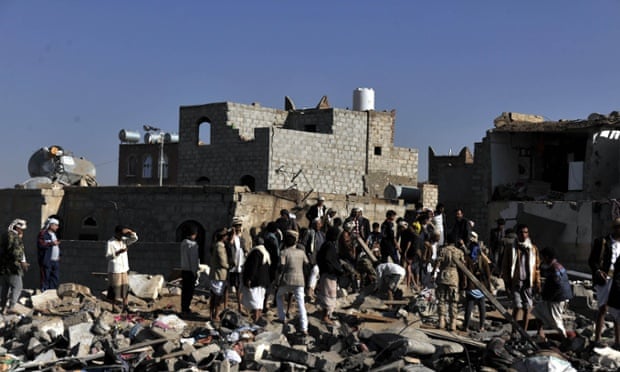
The Saudi-led war in Yemen continued Wednesday, with the bombing
of a dairy and juicing factory near the western port city of Hodeida
killing at least 37 workers and injuring 80 others. The factory was hit
by two bombs dropped by warplanes from the Saudi-led coalition,
according to a Yemeni army newspaper.
According to statistics reported by UNICEF and the Field Medical
Organization, the Saudi-led air raids as well as fighting between the
Houthis, members of a minority Zaydi Shiite group, and military units
loyal to President Abd-Rabbu Mansour Hadi have already killed at least
102 Yemeni civilians, including at least 62 children.
Since Thursday, air force units from Kuwait, Sudan, Jordan, Morocco,
United Arab Emirates, Bahrain, Qatar and Egypt have taken part in the
assault, in addition to Saudi Arabia.
US officials have confirmed that American forces are playing a direct
support role in the operations by providing “logistical and
intelligence” aid to the Saudi coalition of Persian Gulf Sunni
monarchies.
While care has been taken to ensure that there is “no overt sign of US partnership,” as the Washington Post
has noted, the Saudis and their allies are armed to the teeth with new
weaponry and are deploying battle tanks, attack helicopters, and state
of the art warplanes for a massive onslaught against targets throughout
the country.
Coalition planes have launched repeated strikes in support of Hadi
loyalists as they engaged in urban gun battles with Houthi riflemen in
areas north of Aden. Arab League planes also launched strikes at targets
in the central highlands, along the coast, and in the northern and
eastern provinces. Strikes are also reportedly planned against the
“security belt” of Houthi entrenchments around the outskirts of Sanaa,
the capital city.
The Saudi air campaign has failed to halt the southward drive of the
insurgents, and Houthi infantry and armor moved into central Aden
Wednesday. Houthi forces, which are loosely tied to Iran, seized
government fortifications that look down upon the strategic Bab el
Mandeb strait Tuesday night.
The occupation by the Houthi forces of a strategically critical
portion of the Arabian peninsula, sitting alongside the main US ally in
the region and overlooking the narrow waters of the strait where huge
volumes of oil, grain, and other commodities pass daily, makes clear the
regional and global ramifications of the ongoing crisis.
There have been numerous reports that Saudi Arabia and Egypt would
spearhead a ground invasion once military planners have determined that
airstrikes on military bases, weapons stockpiles and air defenses have
made the Houthis sufficiently vulnerable. Yemeni Foreign Minister Riyadh
Yassin, loyal to Hadi, repeated calls for an invasion on the grounds
that “at some stage air strikes will be ineffective.”
Plans for the impending invasion reportedly outlined by Saudi
military planners would aim to reconquer southern areas of the country
from the Shiite militants, and use these areas as staging grounds for
the creation of a new proxy army inside Yemen.
US officials announced Tuesday that they would approve arms and
equipment shipments to the Egyptian military government of President
Abdel Fattah Al Sisi, whose regime has overseen mass killings, detention
and torture of tens of thousands since coming to power in 2013. With
the shipment of arms and weaponry, the US is giving its assent to
preparations for a ground invasion of Yemen, which would draw in troops
from throughout the region.
The threat of a massive new ground war in the Arabian peninsula, with
the potential to kill tens or hundreds of thousands of Yemenis, comes
amid broader preparations for escalating US military intervention in
Syria and growing clamor within sections of the US ruling elite for war
against Iran.
The Pentagon is deploying the Army’s 5th Special Forces Group to
Jordan to establish a “multinational special operations task force,”
which will train fighters for the civil war the US has fomented against
Syrian President Bashar Al Assad since 2011.
US military leaders are
increasingly demanding that the White House authorize the deployment of
“large formations” of Special Operations troops to CIA and Pentagon-run
training camps in Jordan and Iraq which serve as staging areas for the
war against Assad, according to a high ranking Special Forces officer
who spoke to Foreign Affairs .
The crisis in Yemen is an acute manifestation of the intensifying
breakdown of the US-dominated political order in the Middle East. In
spite of intense efforts by the US to prop up the dictatorship of Ali
Abdullah Saleh, destabilized by Arab Spring demonstrators in 2011, the
longtime leader was pushed from power and eventually replaced by then
Vice President Hadi.
While Hadi garners backing from Saudi Arabia and the United States,
he lacks any broad support amongst the population within Yemen. Hadi has
been forced out of the country less than three years after winning a
one-man election, staged as the culmination of a supposedly democratic
transition process orchestrated by American imperialism and the Saudi
monarchy.
Hadi fled Sanaa for his stronghold of Aden earlier in February
and finally last week he fled Yemen for Saudi Arabia after his compound
came under attack by planes commanded by forces loyal to Saleh, who has
backed the Houthis.
Despite extensive financial and military support for the Yemeni
security apparatus and more than a decade of secret US drone strikes
inside the country against Al Qaeda in the Arabian Peninsula and other
anti-government militias, the Iranian-supported Houthi militants have
been able to rapidly overrun much of the country’s western provinces.
In response to the collapse of their puppet government they patched
together in 2012, the US and the savage monarchies and dictatorships
which serve as its regional gendarmes are now preparing an escalation of
the slaughter in Yemen. The response of US imperialism and its proxies
to growing disorder is to launch yet another major sub-regional war that
has the potential to set off a military conflagration engulfing
societies across North Africa and Central Asia.
(Beirut) – The Saudi Arabia-led coalition of Arab countries that conducted airstrikes in Yemen
on March 26 and 27, 2015, killed at least 11 and possibly as many as 34
civilians during the first day of bombings in Sanaa, the capital, Human
Rights Watch said today. The 11 dead included 2 children and 2 women.
Saudi and other warplanes also carried out strikes on apparent targets
in the cities of Saada, Hodaida, Taiz, and Aden.
The airstrikes targeted Ansar Allah, the armed wing of the Zaidi Shia
group known as the Houthis, that has controlled much of northern Yemen
since September 2014.
In January, the group effectively ousted the
government of President Abdu Rabu Mansour Hadi. Human Rights Watch found
that on March 26 warplanes struck populated urban neighborhoods in
Sanaa and observed Ansar Allah forces who appeared to be firing
anti-aircraft weapons from residential neighborhoods.
“Both the Saudi-led forces and the Houthis need to do everything they can to protect civilians from attack,” said Joe Stork,
deputy Middle East and North Africa director. “Reports of air strikes
and anti-aircraft weapons in heavily populated areas raise serious
concerns that not enough is being done to ensure their safety.”
Interior Ministry officials linked to Ansar Allah shared with Human
Rights Watch details of their final casualty count from the bombings in
Sanaa on March 26.
They said that warplanes bombed various parts of the
city, including Bani Hawat, a predominantly Houthi neighborhood near
Sanaa’s international and military airports, and al-Nasr,
near the presidential palace.
The officials said they had documented
that 23 civilians had been killed and 24 wounded. Among the dead were 5
children, ages 2 to 13, 6 women, and an elderly man, they said. The
wounded included 12 children, ages 3 to 8, and 2 women.
These numbers are consistent with information provided by two hospitals
that Human Rights Watch visited. At the hospitals, Human Rights Watch
documented the deaths of 11 civilians, including 2 women and 2 children,
whose names were not included among those provided by Interior Ministry
officials as well as 14 more wounded, including 3 children and 1 woman.
Amnesty International reported that bombing destroyed at least 14 homes in Bani Hawat.
Human Rights Watch has not been able to determine whether specific
attacks complied with the laws of war, which apply to the armed conflict
in Yemen. The laws of war prohibit attacks that target civilians or
civilian property, or that do not or cannot discriminate between
civilians and fighters.
Attacks that cause casualties or damage
disproportionate to any anticipated military advantage are also
prohibited. All parties to the conflict have an obligation to take all
feasible precautions to spare civilians from harm, and not to deploy
forces in densely populated areas.
Saudi Arabia’s past use of cluster bombs, which are indiscriminate
weapons, raises concerns that they will be used in the current fighting,
Human Rights Watch said. There is credible evidence
that in November 2009 Saudi Arabia dropped cluster bombs in Yemen’s
northern Saada governorate during fighting between the Houthis and the
Yemeni and Saudi militaries.
Cluster munition remnants from the 2009 airstrikes, including unexploded
submunitions, have been reported by a number of sources. In July 2013,
Yemeni clearance personnel photographed unexploded US-made BLU-97 and BLU-61 submunitions. In May 2014, VICE News published photos and a video shot near Saada showing numerous remnants of US-made CBU-52 cluster bombs deployed in 2009.
Cluster munitions contain dozens or hundreds of submunitions. The
submunitions are designed to explode when they hit the ground but spread
over a wide area, often the size of a football field, putting anyone in
the area at the time of attack at risk of death or injury. In addition,
many submunitions do not explode on impact but remain armed, becoming
de facto landmines.
The US provided Saudi Arabia with significant exports of cluster bombs
between 1970 and 1999. Saudi Arabia possesses attack aircraft of US and
Western/NATO origin capable of dropping US-made cluster bombs. Human
Rights Watch has urged Saudi Arabia and Yemen to join the 2008
Convention on Cluster Munitions, which prohibits the use of cluster
munitions in any circumstance.
“Saudi forces should publicly reject any use of cluster munitions and
recognize that their use could have a devastating impact on civilians,”
Stork said.
Houthi rebels say country will be ‘graveyard of invaders’ if ground offensive follows Saudi-led air strikes
Thursday 26 March 2015
The possibility of a ground offensive in Yemen has grown significantly as Egypt
declared its readiness to send troops into the embattled country “if
necessary” in the wake of air strikes launched by a Saudi-led coalition.
Arab officials still hope the air campaign – launched late on
Wednesday and backed by the US, Gulf states, Egypt and Turkey – will
weaken the Iranian-backed Houthi rebels, who are attempting to overthrow
President Abd-Rabbu Mansour Hadi, and make a ground offensive
unnecessary.
But the rebels’ leader, Abdulmalik al-Houthi, declared that Yemen
would be the “graveyard of invaders” if the coalition launched a ground
invasion and called for an end to what he declared an illegal,
unprovoked aggression.
Hadi, who fled to Aden earlier this month, arrived in Riyadh on Thursday, Saudi state television reported.
The campaign, Operation Decisive Storm, threatens to spark a regional confrontation between Iran
and its Arab rivals, who are increasingly anxious at the Islamic
Republic’s growing influence in Yemen, Iraq, Syria and Lebanon.
“Egypt has declared its political and military support, as well as
its participation with the coalition with an aerial and naval Egyptian
force, as well as a ground force if necessary, in light of Egypt’s
historic and unshakeable responsibility towards Arab and Gulf national
security,” Egypt’s foreign minister, Sameh Shoukry, told a meeting of
Arab foreign ministers in Sharm el-Sheikh on Thursday.
Three senior Egyptian security and military officials told the
Associated Press that Saudi Arabia and Egypt would lead a ground
operation in Yemen after a campaign of air strikes to weaken the rebels,
saying the forces would enter by land from Saudi Arabia and by sea from the Red Sea and Arabian Sea. They said on Thursday that other nations would also be involved.
They would not specify troop numbers or say when the operation would
start, only that it would be after air strikes weakened the rebels. They
said the offensive aimed to push them into negotiations on power
sharing.
Houthi, the rebel leader, delivered a defiant television address late
on Thursday, calling on all Yemenis to mobilise in preparation for a
ground invasion and decrying the “idiotic, stupid aggression.”
“These criminal, collaborative powers will discover that they
committed a huge error with this aggression,” he said. “If any armies
come to occupy, the Yemeni people will prove once again that Yemen is
the graveyard of invaders.
“Do not enter into more stupidities. Stop immediately or all options
are open,” he added. “If this aggression continues, there will be no
surrender.”
Kuwait’s foreign minister urged the Yemeni factions involved in the
conflict to come to Saudi-hosted talks to end the crisis, to prevent the
country from “sliding into more chaos and destruction.”
The Gulf states have intervened on the ground before in recent years, with Saudi troops moving in to quell the uprising in Bahrain
in 2011 in support of the Sunni Khalifa monarchy, which rules over a
Shia majority. But a ground intervention in Yemen would pose major
challenges, pitting the coalition against an insurgent movement backed
by Iran with important redoubts in the country’s north.
The Russian president, Vladimir Putin, called for an “immediate
cessation of military activities” in Yemen in phone conversations with
his Iranian counterpart, Hassan Rouhani, the Kremlin said on Thursday.
Iran, which has aligned itself with the Houthis, strongly objected to the Saudi air strikes, urging their immediate halt.
“We demand an immediate stop to the Saudi military operations in
Yemen and we believe they are an infringement to Yemen’s sovereignty,”
said Iran’s foreign minister, Mohammad Javad Zarif, according to the
semi-official Isna news agency. “These operations will only lead to
bloodshed and we will spare no efforts to contain the crisis in Yemen.”
Ali al-Noaimi, a prominent UAE columnist for the state-run newspaper
al-Ittihad, said the Gulf states were ready for a ground intervention
but were hoping the air strikes would create “paralysis and shock” among
the Houthis and energise the popular opposition to their rule,
compelling them to retreat and avoid the need for a land offensive.
Saudi Arabia deployed 100 fighter jets and 150,000 troops for the
operation, according to the Saudi-owned news channel al-Arabiya. The UAE
also contributed 30 fighter jets, Kuwait and Bahrain 15 each, Qatar 10
and Jordan six.
Egypt is also providing naval support, deploying four warships to
secure the Gulf of Aden, maritime sources at the Suez Canal told
Reuters. The White House said it was providing “logistical and
intelligence support.” The operation is led by the Saudi defence
minister, Prince Muhammad bin Salman, the king’s son.
“We will do all we can to protect the legitimate government in Yemen
and prevent it from collapsing and facing the dangers of militias,” the
Saudi ambassador to Washington, Adel al-Jubeir, told a press conference
late on Wednesday.
Saudi Arabia said Houthi-controlled air defences
and four warplanes had been destroyed as well as al-Dulaimi airbase. A
Houthi-backed TV station said 18 civilians were killed in the air
strikes.
The International Committee of the Red Cross (ICRC) said it had been
informed of a “considerable number” of civilian deaths and injuries
following the air strikes.
Cedric Schweizer, the head of the ICRC delegation in Yemen, said it
had been “a long and difficult night” for residents of Sana’a, Aden,
Lahj and al-Baydha. “It is very difficult at this stage to establish the
exact figures of those who lost their lives or were injured, but we
have learned from our contacts with the ministry of public health and
population on that there was a considerable number of civilians killed
or wounded.”
The intervention came a day after Hadi’s government demanded an Arab
military intervention to halt the Houthi advance, which came close to
storming his southern redoubt of Aden. The Houthis, also known as Ansar
Allah, are members of the Zaydi Shia sect, and took control of the
capital, Sana’a, last year before placing Hadi under house arrest.
The escalation in Yemen comes amid growing Arab anxiety over Iran’s
rise, with its influence spreading in Yemen and Iraq, as well as its
involvement alongside the regime of President Bashar al-Assad in Syria
and its prominence in Lebanon, where it backs the powerful military and
political organisation Hezbollah.
Since the Houthi takeover of Sana’a, Iran has boosted its relations
with the rebels, establishing direct flights to the Yemeni capital and
hosting a group of influential rebels in Tehran for talks.
David Cameron’s spokeswoman said the prime minister had told Rouhani
in a phone call on Thursday that other countries should not be
supporting Houthi fighters in Yemen – something Tehran is already doing.
“In order to restore stability what we need is a political process
and … as part of that other countries should not be supporting the
Houthi rebels and instead be encouraging all the different parties in
Yemen with different interests to come together in a political process,”
the spokeswoman said.
In an interview with France 24, the Turkish president, Recep Tayyip
Erdoğan, backed the Saudi-led coalition, saying he was considering
providing logistical support. “Iran and the terrorist groups must
withdraw,” he said.
Former police chief Habib al-Adly, who served
as Hosni Mubarak’s interior minister, has been released from prison
today after receiving clearance from the Prosecutor General's office. He
is the latest figure – and perhaps the most controversial – from Mubarak’s inner circle to be released from detention over the past few months.
The
state-owned Middle East News Agency (MENA) confirmed that authorities
at Tora Prison released the 77 year-old Adly upon orders from Egyptian
prosecutors.
Adly had been jailed for
the past four years pending his four trials, in which he had
been charged with the mass killing of over 800 anti-Mubarak protesters
(according to official figures from the Health Ministry) in late January
2011, along with charges of corruption, money laundering, illicit gains
and misappropriation of public funds amounting to hundreds of millions
of pounds, and the use of conscript labor to construct his personal
villa.
In the four court cases where he has stood trial, Egyptian
judges have cleared Adly of all charges leveled against him, with the
exception of the case pertaining to the use of forced labor for the
construction of his estate. In February 2014, Adly was sentenced to
three years imprisonment for his role in exploiting conscripts for his
personal ends.
However, after having spent four years in Tora
Prison, Adly may imminently be cleared of every last criminal charge
filed against him, according to statements issued by his defense lawyer
to local media outlets. One final court acquittal could render the
former interior minister a free man.
Mubarak appointed Adly as
minister of interior in 1997, as a successor to Hassan al-Alfi following
the Deir al-Bahari massacre in Luxor Governorate, which resulted in the
deaths of 62 individuals – mostly foreign tourists – that had been
claimed by the armed group Jama’a al-Islamiya.
Adly was Mubarak's longest-serving interior minister.
During
his nearly 13-year tenure as interior minister, human rights groups had
accused Adly and his police apparatus of the systematic use torture,
forced disappearances, involvement in extraordinary renditions, physical
and psychological abuse of detainees in places of detention, espionage
against opposition figures, among other violations, although neither
Adly nor his deputies stood trial on these charges.
In November 2014, the Cairo Criminal Court dismissed charges brought against Mubarak and Adly,
along with his six police deputies, pertaining to the deaths of
hundreds of anti-regime protesters during Egypt’s 2011 popular uprising.
In
his court defense, Adly denied that his police forces had killed
protesters, and instead pinned the blame on the Muslim Brotherhood and
the Palestinian Islamic resistance group Hamas, despite the fact that
the minister of interior had personally issued a host of threats against
protesters on state-owned media warning of a heavy-handed police
response ahead of the 2011 mass protests.
On his personal account on Twitter,
human rights lawyer Gamal Eid commented that Mubarak’s clique of
officials who "sought to crush the January 25 revolution" have all been
released, while the many of the youth who struggled for the revolution
are either buried or jailed.
Another Egyptian Twitter
user wrote, "Today Habib al-Adly is released and has returned to his
home, while thousands of peaceful protesters are kept away from their
homes and families as they languish behind prison bars."
The first
day of the 2011 uprising was organized on January 25 – Egypt’s National
Police Day – largely as a display of popular protest against police
brutality.
However, since 2011 only a handful of policemen or
officers have stood trial for the killings of protester or other
transgressions. Egypt’s judiciary has subsequently cleared the majority
of these security forces of any wrongdoing.
The No to Military Trials for
Civilians campaign said on Monday that 3000 civilians were tried in
military courts in the last five months, since President Abdel Fattah
al-Sisi passed new legislation treating certain state facilities as
military institutions.
The findings formed part of the campaign’s
fourth annual conference, which included testimonies from those who have
been through military trials and their families.
Campaign member
Sara al-Sherif says this constitutes a “dramatic” increase in an already
endemic practice, presenting a greater challenge for the campaign, as
public outrage has been more recently directed at harsh rulings by
civilian courts.
She says people claim, “civilian judiciaries
issue death penalties and life sentences without restriction, in
contrast to verdicts by military judiciaries that are swift and will
never be worse than what is already practiced in civilian courts,” but
maintains this is not accurate, given the nature of military courts and
the verdicts they have issued.
Lawyer Ahmed Heshmat raises
concerns over the independence of military courts in the first place.
“The law that enabled military courts to try civilians stipulated that
this judiciary is independent, but it is not independent at all.
Military judges are employees of the Defense Ministry, and as such they
have to adhere to the demands of their superiors.”
“Verdicts
issued by military courts should be approved by the military leader or
his deputy, and he has the right to request the amending of a sentence,
or a retrial if the defendants were acquitted,” he adds.
Heshmat
also questioned the legal procedures for military trials. Verdicts by
military courts are all issued as if the defendants are present, even if
they are actually absent.
Since Sisi’s decree, the number of
civilians referred to military courts has increased, especially among
students arrested on campuses for protesting, many of who have been
handed lengthy prison sentences. Universities are now considered
military institutions under the new law.
An activist in the
“Horreya” (freedom) campaign, concerned with the detention of students,
Seif al-Islam Farag, said that the campaign has recorded the cases of
160 students referred to military tribunals, including 48 students from
Mansoura University, 31 from Al-Azhar University and 14 from Monufiya
University.
He added that the sentences against many of these
students are not based on reality, as in the example of student Ahmed
Shokier, who was sentenced to life in prison, when he had actually
passed away one month before the incident for which he was
convicted took place. Another student in Port Said was referred to 11
military tribunals.
Mother of 16-year-old Youssef Shaaban, who was
arrested in September, says her son was tortured to make him confess to
crimes he didn’t commit, including killing a police officer. The
grieving mother says she is not able to visit her son in prison as no
one knows his whereabouts.
Father of 19-year-old Ain Shams student
Mohamed al-Araby, said that he was surprised when five police officers
stormed his house and arrested his son. They said his son had published a
video concerning the military and would face charges of “spreading
false news about the Armed Forces.” The father was told his son would
return home in a few hours, but he never came back.
“Days later, I
found a lawyer asking for a lot of money to defend my son who was
facing a military trial. When I went to military prosecution, they
said there is no need to hire a lawyer, as the case would be heard by a
misdemeanor court and not a criminal one. I have just realized that the
case was referred to criminal court,” Araby’s father added.
Araby
himself spent many weeks in military prison before he was referred to
Tora, with signs of torture on his face, according to his father.
The
No to Military Trials campaign organizers pleaded with local media to
raise the issue of military trials for civilians, which they say
threatens everyone under the new legislation.
The State Council officially exempted the judiciary and the prosecution from the Maximum Wage Law in a Wednesday ruling.
Ratified
last summer, the law caps wages at LE42,000 for public-sector
employees. That includes bonuses and all other payments on top of
regular monthly wages, with the exception of travel expenses.
At
the time, members from several branches of the judiciary protested
against the law and demanded their exclusion from its provisions. The
State Council looked into the matter at the request of the head of the
Mansoura Court of Appeals.
Responding to another request from
Telecom Egypt, the State Council had also ruled that joint stock
companies financed by the state were exempt from the wage limit, as
well. That ruling then led to the further exclusion of public sector
banks established through these stock companies.
Ahmed Hossam, a
lawyer at the Egyptian Center for Economic and Social Rights (ECESR),
told Mada Masr that exempting joint companies from the law has a sound
legal basis, but excluding the judiciary is harder to rationalize.
In
the absence of a legal explanation behind the decision, Hossam
speculated that it may have been motivated by an ongoing effort to
exclude the judiciary from state bodies, and treat is as an independent,
stand-alone institution.
However, from a legal and economic
perspective, the judiciary is still a state facility whose wages are
paid by the state and tax payers, Hossam explained. From that
perspective, he asserted that the maximum wage cap should be applied.
The
law’s vague stipulations have already allowed for several exceptions,
and may ultimately render the law useless and only applicable to a
handful of state employees, Hossam argued.
He also pointed out
that because the law was passed by presidential decree without the State
Council’s review, as mandated by the 2014 Constitution, then it could
be attacked as unconstitutional.
Therefore, according to Hossam,
if anyone affected by the wage cap decided to challenge the law, it
could legally be struck down.