Showing posts with label Tear Gas. Show all posts

Sunday, August 31, 2014

Israeli-trained police deployed to quell Ferguson protests

Electronic Intifada


Since the killing of eighteen-year-old Michael Brown by Ferguson police in Missouri last weekend, the people of Ferguson have been subjected to a military-style crackdown by a squadron of local police departments dressed like combat soldiers. This has prompted residents to liken the conditions on the ground in Ferguson to the Israeli military occupation of Palestine.

And who can blame them?

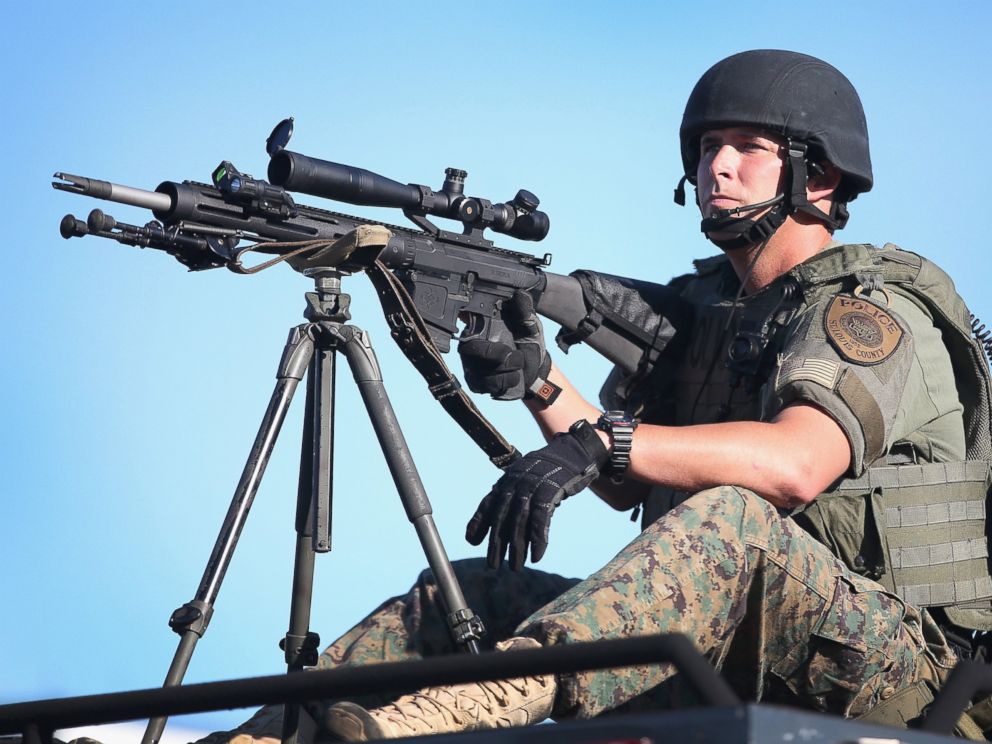
The dystopian scenes of paramilitary units in camouflage rampaging through the streets of Ferguson, pointing assault rifles at unarmed residents and launching tear gas into people’s front yards from behind armored personnel carriers (APCs), could easily be mistaken for a Tuesday afternoon in the occupied West Bank.

And it’s no coincidence.

At least two of the four law enforcement agencies that were deployed in Ferguson up until Thursday evening — the St. Louis County Police Department and the St. Louis Police Department — received training from Israeli security forces in recent years.

Brute force

It all started when a yet to be named Ferguson police officer killed Michael Brown, an unarmed black teenager. According to witnesses, Brown was attempting to surrender with his hands up when a Ferguson police officer emptied his clip into Brown’s body, shooting the teen up to ten times.

For hours police left Brown’s lifeless body sprawled in the street uncovered as a growing number of residents gathered nearby, demanding answers from authorities. Police responded by deploying K-9 units and riot squads to crush the crowd, predictably inciting a riot, which police used to justify more brute force.

But the people of Ferguson refuse to submit and have mobilized every single day to demand justice for Brown and an end to the racist, undemocratic regime they live under.

Hands up, don’t shoot” has become their rallying cry, a symbol of Brown in his last moments and what it means to be black in America, where every 28 hours an African-American is killed by a self-styled vigilante, security guard or police officer.

Still, police did not relent, prompting one Ferguson protester to shout at a row of military-style tactical vehicles, “You gonna shoot us? Is this the Gaza Strip?”

“Will we as a people rise up like the people of Gaza? Will our community be bombed like last night with tear gas? That was a terrorist attack,” remarked another Ferguson protester to The Daily Beast.

Meanwhile, journalists were manhandled and detained. Police were caught on video deliberately firing tear gas at an Al Jazeera America film crew as they were setting up their equipment.

Even elected officials weren’t spared. Missouri state Senator Maria Chappelle-Nadal was tear gassed and St. Louis Alderman Antonio French, who had been documenting the unfolding police repression in Ferguson on social media since just after Brown’s murder, was arrested.

As the situation spiraled further out of control, Palestinians began tweeting advice on dealing with tear gas to the people of Ferguson.

Cops become soldiers

Domestic policing in the US has a long and sordid history rooted in the violent control and subjugation of communities of color, so the police violence directed at the predominantly black residents of Ferguson is nothing new.

But the widespread militarization on display in Ferguson is part of a more recent trend that began three decades ago with the introduction of the disastrous “war on drugs” and dramatically escalated with the “war on terror” — leading directly to the counterinsurgency-like tactics deployed against the people of Ferguson by civilian police officers who more closely resemble combat soldiers in Afghanistan than domestic cops.

This cop-to-soldier transformation has been facilitated by the US government through mechanisms like the Pentagon’s 1033 or military surplus program, which funnels excess military gear to law enforcement agencies across the country. The program’s motto: ”From warfighter to crimefighter.”

In 2013 alone, the program showered US police departments with nearly $450 million worth of military equipment.

St. Louis County law enforcement agencies, including the Ferguson Police Department, participate in this program and have received military-grade rifles, pistols and night vision equipment in recent years, though it’s unclear if the equipment is being used in Ferguson now.

As The New York Times reported in June, the scaling down of US wars in Iraq and Afghanistan means “former tools of combat — M-16 rifles, grenade launchers, silencers and more — are ending up in local police departments, often with little public notice.”

“During the Obama administration, according to Pentagon data, police departments have received tens of thousands of machine guns; nearly 200,000 ammunition magazines; thousands of pieces of camouflage and night-vision equipment; and hundreds of silencers, armored cars and aircraft,” the newspaper added.

Ferguson police also receive money from the Department of Homeland Security as part of a grant program that has doled out billions to US law enforcement agencies to purchase military-style equipment, like the APCs charging through the streets of Ferguson.

In the last five years alone, Missouri has received nearly $70 million in DHS money for law enforcement related programs.

Emulating apartheid

While there is a wealth of scholarship on police militarization in the US, there has been little to no examination of the ways Israel’s security apparatus facilitates it.

Decades of testing and perfecting methods of domination and control on a captive and disenfranchised Palestinian population has given rise to a booming “homeland security industry” in Israel that refashions occupation-style repression for use on marginalized populations in other parts of the world, including St. Louis.

Under the cover of counterterrorism training, nearly every major police agency in the United States has traveled to Israel for lessons in occupation enforcement, a phenomenon that journalist Max Blumenthal dubbed “the Israelification of America’s security apparatus.”

Israeli forces and US police departments are so entrenched that the New York City Police Department (NYPD) has opened a branch in Tel Aviv.

In 2011, then St. Louis County Police Department chief Timothy Fitch attended the Anti-Defamation League’s (ADL) National Counter-Terrorism Seminar, an annual week-long Israeli training camp where US law enforcement executives “study first hand Israel’s tactics and strategies” directly from “senior commanders in the Israel National Police, experts from Israel’s intelligence and security services, and the Israel Defense Forces,” according to the ADL’s website.

Until Thursday night, the St. Louis County Police Department appeared to be the largest most militarized and brutish force operating in Ferguson. “St. Louis County Police” was scrawled across the side of most of the tactical unit vehicles and appeared on the combat-style uniforms of officers aiming assault rifles at peaceful protesters.

The ADL boasts of sending more than 175 senior US law enforcement officials from 100 different agencies to the seminar since 2004, which are “taking the lessons they learned in Israel back to the United States.”

The ADL is just one of several pro-Israel groups forging close ties between US cops and Israel’s security and intelligence apparatus.

Another is the Jewish Institute for National Security Affairs (JINSA), a neoconservative think tank that claims to have hosted some 9,500 law enforcement officials in its Law Enforcement Exchange Program (LEEP) since 2004.

LEEP “takes delegations of senior law enforcement executives to Israel to study methods and observe techniques used in preventing and reacting to acts of terrorism” and “sponsors conferences within the United States, bringing Israeli experts before much larger groups of law enforcement leaders,” according to JINSA’s brochure.

Former St. Louis Police Department police chief Joseph Mokwa is listed as having traveled to Israel as part of a LEEP conference in February 2008.

Following nationwide outrage and embarrassment, Missouri Governor Jay Nixon pulled St. Louis County Police forces out of Ferguson and placed the Missouri Highway Patrol in charge of policing demonstrators. The St. Louis Police Department voluntarily removed its officers from Ferguson.

As a result, Ferguson no longer looks like occupied territory, though the underlying issue, Michael Brown’s murder, has yet to be addressed.

Meanwhile, the scope of Israel’s influence on US law enforcement remains virtually ignored by the media despite the troubling implications of emulating an apartheid regime actively engaged in ethnic cleansing and war crimes.

The culture of racism and impunity that has long plagued American policing is deadly enough as it is. Adding Israeli-style repression to an already dangerous mix guarantees disaster.


*Photo by Jeff Robertson courtesy of the Associated Press

Tuesday, April 30, 2013

USA sends Egypt 140,000 new teargas canisters

Egypt Independent
US teargas shipment arrives in Suez

Mon, 08/04/2013


A shipment of teargas canisters from the United States arrived at the Abadeya Port in Suez on Sunday, according to official documents obtained by Al-Masry Al-Youm.

Five containers carrying 140,000 teargas canisters were shipped to the Interior Ministry by Aramex International, a courier service based in Alexandria.

The shipping documents stipulate that only the Egyptian government may use the canisters, and that they are forbidden to re-export the shipment or sell it to third parties.

The shipment sailed from the port of Wilmington, Delaware on 14 March on board the SS Jamestown. A letter of credit was forwarded without specifying the name of the bank, and the Egyptian government paid the freight fees.

In February, Al-Masry Al-Youm reported that the Interior Ministry agreed to import the canisters for US$2.463 million (LE17.241 million), to be shipped by an Egyptian military cargo plane.

Interior Ministry spokesperson Hani Abdel Latif said that the ministry imported the grenades in order to protect state facilities.


*Edited translation from Al-Masry Al-Youm
**Photo courtesy of AFP

Egypt's Islamist dictator & the Christian problem


“Any attack on Egypt’s Christians is an attack on me personally,” said President Mohamed Morsi during his 100th day as president speech last September, a statement which he again reiterated when he spoke to Pope Tawadros II, the pope of the Coptic Orthodox Church, last night after 8 hours of attacks on St Mark’s Cathedral, during which he stayed silent, as he usually does.

Given how wildly unpopular our president is, people on Facebook were joking whether or not this statement should be considered inciting violence against Egypt’s Christians.  We are Egyptians. We make jokes when we are horrified, but what happened yesterday is no laughing matter.

Yesterday the Coptic cathedral was attacked after a funeral for four Christians who were killed two days earlier in sectarian clashes in the town of Al-Khosous that also left one Muslim killed. The funeral was attended by hundreds of Christians and sympathetic Muslims, who started chanting for the removal of Morsi and his Muslim Brotherhood buddies from power, which apparently was unacceptable to “some people.”

Those “people” started attacking the emerging mourners the moment they stepped out of the cathedral, and shortly after, they were joined by riot police with armed vehicles, who stood next to the attackers and shot teargas canisters into the cathedral.

So, not only was the cathedral not getting protected by the Egyptian police as it was being attacked by thugs, the police were actively providing cover to the attackers, and tear-gassing the trapped inside mourners. The country was watching, half in horror and the other half probably in glee, as the police of the Islamist state of Egypt actively joined a mob in their attack on the cathedral.

To put things into perspective, St Mark’s Cathedral is the heart and brain of the Egyptian Coptic Church. It is where the pope lives and works, and the home of one of the oldest churches in recorded history, and the only church worldwide that has equal standing with the Roman Catholic Church in terms of history and influence over Christianity.

The cathedral runs the affairs of Egypt’s Coptic minority, as well as churches in over 150 countries, and it was being attacked by the police of our Muslim Brotherhood president. It should be noted that worldwide, in countries where there is active civil war and genocide churches are places of refuge for victims, because of their holy standing as places of worship. We don’t care about that in Egypt. Over here, we attack cathedrals after funerals with mourners inside, and the state helps.

The Muslim Brotherhood-dominated Ministry of Interior naturally released a statement, blaming the Christian mourners for the clashes, and claiming to be doing its best to stop the clashes. Known Islamist activist Abdelrahman Ezz, who incited the attack on the Itihadiya protesters back in December and was never investigated, was openly calling and encouraging the attack on the cathedral, citing it as proof that the church has “militias” and “weapons.”

Joining the crazy wagon was the Salafi TV channel Al-Hafez, which aimed to capitalise on the situation by having a text message-poll on “whether or not a civil war between Muslims and Christians will erupt in Egypt”, with each text message costing the sender 3 EGP.

The following day, the foreign relations secretary of the ruling Freedom and Justice Party, Mohamed Soudan, sent an email blaming all that took place around the cathedral on the Coptic mourners, who claimed that the Christians finally showed the weapons they were hiding inside the churches, and that, and I quote here, “ they seem to be up to something.” And yet when I posted yesterday on Twitter my belief that the Morsi administration doesn’t care about the Egyptian Christian population at all, Brotherhood apologists abroad accused me of having a Kanye West “Bush moment”. Fine, let’s go over the evidence, shall we?

Since Morsi took office, the following attacks took place on the Coptic churches: 5 November, Muslims tried to seize the lands belonging to the Central Shobra Al-Khaima church; 15 February, the Seresna Church in Fayoum was attacked; 26 February, the administrative building of the Abu Maqar church in Shobra AlKhaima was attacked; 1 March, the Kom Ombo church in Aswan was attacked while on the same day the administrative building of the Beni Suef Central church was ransacked. Those are only the attacks on the churches and their properties, the same Church that Morsi never visited, never met with its leader and whose pope’s coronation he didn’t attend.

This is the same President Morsi that openly espoused anti-Semitic and hateful views on video and then claims to be taken out of context. This is the same president whose people during the constitutional crisis openly stated that he enjoys the support of 90% of all Egyptians and that the protesters were pushed by the church.

This is the same president who during his reign , Beshoy Kamel was sentenced to six years for insulting “Islam and the president’s family” on Facebook, Alber Saber was arrested for “blasphemy” on Facebook , and 10-year-old Nabil Nagy Rizk and 9-year-old Mina Nady Farag from Beni Suef were arrested in October 2012 on charges of tearing up the Quran. The children were illegally arrested, and Morsi didn’t move a finger to release them. They were, after all, Christians.

Needless to say that in none of those incidents of church attacks, no one was seriously charged. Needless to say that the Brotherhood apologists in the west will claim that he doesn’t fully control the Interior Ministry or its actions, despite the ministry’s defense of the Muslim Brotherhood Guidance Council office (which is neither a state institution nor a holy place) and vicious attacks against anti-Brotherhood protesters.

The ministry can apparently be ordered to protect the two-year-old Guidance Council office but cannot protect the almost 2,000-year-old church represented by the cathedral.

The Brotherhood apologists will blame all of this on the remnants of the old regime in the Ministry of the Interior, and cite that Morsi is not yet in complete control of it. If this is him without complete control of the Interior Ministry, I openly dread the day he does control it.

In other news, during those clashes, European Union officials were in Egypt discussing with the president and opposition figures the parliamentary elections and how they intend to monitor them, with the Egyptian newspaper citing Catherine Ashton promising to help Egypt get that IMF loan, so that the EU, alongside the US can continue to prop the Muslim Brotherhood regime as it continues its reign of terror.

I have a suggestion, EU: How about we resort to your magical ballot box to solve Morsi’s Christian problem once and for all? We can start a referendum asking whether or not to burn all of Egypt’s churches and kick all the Christians out. I am positive it will pass with a stunning rate, and then the state can persecute the Egyptian Christians and attack their churches legitimately. After all, the ballot box has spoken. Dear EU, you can monitor that if you like.

Attack on Copts comes after Morsi's pledge to protect Christians

New York Times

DAVID D. KIRKPATRICK and KAREEM FAHIM

CAIRO — Police officers firing tear gas joined with a rock-throwing crowd fighting a group of Christian mourners Sunday in a battle that escalated into an attack on Egypt’s main Coptic Christian Cathedral that lasted for hours. 

It was the third day of an outburst of sectarian violence that is testing the pledges of Egypt’s Islamist president to protect the country’s Christian minority. By nightfall, at least one person had died from the day’s clashes, bringing the weekend’s death toll to six.

Later Sunday, President Mohamed Morsi called the Coptic pope, Tawadros II, to reassure him. “I consider any aggression against the cathedral an aggression against me personally,” Mr. Morsi said, according to state media.

The president ordered an investigation of the violence and instructed security forces “to protect the citizens inside the Cathedral,” state media reported, and he pledged to protect both Muslims and Christians.

The violence began Friday when a sectarian dispute in the town of Khusus outside Cairo escalated into a gunfight that killed four Christians and a Muslim — the first major episode of deadly sectarian violence since Mr. Morsi’s election last year. Hundreds of Christians and sympathetic Muslims gathered at the cathedral Sunday for the four Christians’ funeral, chanting for the removal from power of Mr. Morsi and his Islamist allies.

“With our blood and our soul we will sacrifice ourselves for the cross,” the crowd intoned.

Clashes erupted immediately after the service between the emerging mourners and a crowd outside the cathedral. It was unclear who started the violence. But later dozens of riot police with armored vehicles and tear-gas canons appeared to enter the fray on the side of crowds of young Muslim men who were throwing rocks and fire bombs at the mourners.

In what seemed like a siege of the cathedral, tear-gas canisters fell inside the walls of its compound, sending gas into the sanctuary and two nuns running for shelter in a nearby loading dock.

Later, some of the young civilians who had been attacking the cathedral switched to taunts, making lewd gestures involving the sign of the cross. The riot policemen made no attempt to stop them, either from throwing rocks toward the cathedral or insulting the Christians.

“The police are not trying to protect us or do anything to stop the violence,” said Wael Eskandar, a Coptic Christian activist. “On the contrary, they are actively aiding the people in civilian clothes” attacking the Christians, he said.

Dozens rushed to defend the cathedral, and many pulled back their sleeves at the iron entrance gate to display the cross that many Copts tattoo on their wrists.

Groups of young men stood on the cathedral walls and rooftops nearby, throwing fire bombs and the shards of bricks at the riot police. At least two of the young men on the church grounds carried what appeared to be crude pistols. Others prepared crates full of fire bombs.

The Interior Ministry, in a statement on its Web site, said the mourners had started the violence and that the riot police intervened to stop it. “Some mourners vandalized a number of cars, which led to clashes and fights with the people of the area,” the statement said, adding, “Interference to separate the clashing parties is ongoing.”

Coptic Christians, who make up about 10 percent of Egypt’s roughly 85 million citizens, were already anxious about the dominance of elections by the Islamist Muslim Brotherhood since the ouster of President Hosni Mubarak, the former secular autocrat.

Not that sectarian animosities were absent under Mr. Mubarak. Copts suffered from discrimination as well as recurring episodes of sectarian violence, and the Mubarak government worsened the problem by denying the existence of domestic sectarianism and pinning blame on either local conflicts or foreign conspiracies.

Mr. Morsi and the Muslim Brotherhood have sometimes appeared to understand that as Islamists they have more to prove to Egypt’s Copts. During elections, Brotherhood candidates have emphasized their commitment to equal citizenship and security for Copts, even sending young Brotherhood members to stand guard outside churches at a Christmas service one year.

When a dispute over a shirt burned at the laundry exploded into a sectarian battle that killed a Christian and damaged several properties last year, Mr. Morsi departed from the Mubarak script, sending a legal adviser to meet with the Christians, instructing the local governor to compensate the victims and asking the prosecutor to investigate without prejudice.

But on Sunday, many Copts blamed Mr. Morsi for the violence. “Who is responsible for the surroundings of the cathedral being unsecured for more than five hours today?” demanded Bishop Bakhomious, a senior Coptic cleric who had been acting pope until the designation of Tawadros II. “If the security services want to know who is behind these events, they will.”

It is unclear how much practical control Mr. Morsi exercises over the police. He has done little to reform the force left over from Mr. Mubarak despite continuing complaints about its abuses. A rash of police strikes has showcased widespread insubordination, and the riot police lack training in effective crowd control. On Sunday, they sometimes appeared to fire tear gas at random into the surrounding neighborhood.

But even before the police joined the fray, human rights advocates said Mr. Morsi and his party had failed to confront the sectarianism driving the violence. Until late Sunday, both Mr. Morsi and his party appeared to fall into the Mubarak pattern, denouncing the violence but without acknowledging the problem of sectarianism. Instead, the Islamists suggested a conspiracy by some unknown party to sow dissent among Egyptians.

Only on Sunday night, after the clashes had subsided, did Mr. Morsi publicly acknowledge the role of sectarian aggression or personally pledge to protect the Copts. “He seems to have begun to realize the scale of this,” said Hossam Bahgat, founder of the Egyptian Initiative for Personal Rights.


*Mayy El Sheikh contributed reporting.

Anti-Morsi protests in 3 cities, police fire tear gas at opposition activists

Agence France-Presse
Egypt police tear gas at Cairo protesters

April 7, 2013


CAIRO: Police fired tear gas at protesters outside a Cairo court on Saturday, as several thousand people rallied in Egyptian cities to mark the founding of a key activist group opposed to President Mohamed Morsi.

Witnesses said police fired tear gas at protesters outside the Superior Court building, which also houses the offices of the state prosecutor, who has opened several investigations into opposition figures.

Live television showed clouds of tear gas rising from the court in central Cairo.

Supporters of the April 6 group also held rallies in the Nile Delta industrial town of Mahalla, where a labour strike turned into deadly clashes with police five years ago.

The Mahalla clashes on April 6, 2008 marked an escalation in the burgeoning protest movement against long-time strongman Hosni Mubarak, eventually overthrown in an early 2011 popular uprising.

Activists with the group also rallied in the coastal city of Alexandria.

Hailed as heroes in the aftermath of Mubarak's overthrow, the youth-led group, which splintered into two factions, clashed with the military that ruled Egypt between Mubarak's ouster and Morsi's election in June.

The group is now part of a coalition of secular-leaning movements that have organised sometimes violent protests against the Islamist Morsi, whom they accuse of mimicking Mubarak's practices.


*Photo courtesy of AFP/Gianluigi Guercia 

US-made tear gas & state violence in Egypt

TRUTH-OUT.ORG 

US-Made Tear Gas Supports State Violence in Egypt

Friday, April 5, 2013

Sarah Lazare

Lazare bears witness to the use of "Made in the USA" (but no longer so-labeled) tear gas, its export approved by the US state department, in the violent state repression of dissent in Cairo. 


On the final night of John Kerry's much vaunted early March visit to Egypt to meet with the Muslim Brotherhood and some opposition leaders, a familiar scene played out in the streets of Cairo. Around the corner from the iconic Tahrir Square, about 200 protesters clashed with police in response to a police incursion into the square the previous night.

Shop owners slammed their doors shut, and shoppers quickly emptied out of the streets as the protesters, many appearing to be children no older than 12, approached police lines. Suddenly a series of bangs rang out, and choking tear gas filled the air. In the resulting confusion, protesters sprinted down the street in a swarm, with a police vehicle tearing after them.

When the gas and chaos settled, I learned that two people had been run over and possibly killed, and another two had suffered less serious wounds. A screeching ambulance carried the injured away and the crowd disbursed.

During John Kerry's visit, which centered on the offer of $250 million in aid to muscle Egypt into loan negotiations with the International Monetary Fund, this new secretary of state made a show of his supposed impartiality, meeting with the Muslim Brotherhood and some opposition politician, and chiding political leaders on the economic good sense of "vibrant democracy."

This aid is in addition to the $1.3 billion the United States gives to Egypt's military, a continuation from the Mubarak years.

What was missing was any mention of US state department consent for mass exports of tear gas from US companies to the Egyptian government that regularly uses this weapon against continued uprisings throughout Egypt, in crackdowns like the one I witnessed.

Exports of tear gas from the United States to the Egyptian government are no secret. US shipments to the Mubarak regime were used against the protesters who overthrew his regime. Images of protesters holding tear gas canisters that read "made in the USA" stoked the ire of anti-Mubarak protesters and came to be one symbol of the US role propping up Mubarak's overgrown security state.

Yet, these shipments did not stop with the fall of Mubarak. Amnesty International documents repeated shipments of tear gas from US-based Combined Systems, Inc., dating back to November 2011, exports that were approved by the US state department on the grounds that the Egyptian government is not misusing this weapon.

According to Egypt Independent, Egypt's interior ministry ordered 140,000 tear gas canisters from the United States on February 22, this time without a visible Made-In-The-USA label. Leaked documents indicate that the removal of the country of origin label was a condition of US state department approval.

US-based companies Nonlethal Technologies and Defense Technology ship tear gas around the world, as well as domestically. Wyoming-based Defense Technology is responsible for the tear gas canister that may have severely injured and almost killed Scott Olsen, Occupy Oakland protester and Iraq Veterans Against the War Member, in November 2011.

Whether this tear gas is sold or given from the US government to another or sold from commercial companies to governments, at the very least, it is subject to weapons export rules, meaning shipments require US government approval. Therefore tear gas shipments from the United States to anywhere in the world carry US government consent.

I went to Cairo fully aware of massive corporate sales of tear gas, approved by the state department, to the Muslim Brotherhood. What I was not prepared for was the way in which this supposedly nonlethal weapon is incorporated into broad tactics of violence against protesters that often have lethal results, in chaotic scenes like the one I witnessed, where speeding police cars, tear gas, and sometimes live fire create deadly combinations.

And then there is the ability of tear gas itself to kill, by direct impact of a tear gas canister or through the effects of gas inhalation. Physicians for Human Rights documents 34 cases of death by tear gas in the first year of Bahrain's uprising, tear gas that likely came from Combined Systems, Inc., the same producer that mass ships to Egypt. As recently as March 9, Egyptian security officials said a protester died of tear gas inhalation.

Every protester I talked to - anarchists, feminist organizers, independents and activists with No More Military Trials for Civilians - made a clear call for an immediate end of US shipments of tear gas. Each person had a story to tell of getting gassed and experiences of sustaining and witnessing other forms of violence, including police torture and shootings.

In an outdoor seaside café as the sun set behind the Alexandria coast, independent activist and writer Aly El Raggal, who was injured in the early days of the revolution, said, "Please do something about the tear gas. It is a big problem. This is an example of US support of Muslim Brotherhood, SCAF (Supreme Council of Armed Forces) and Mubarak repression of protests."

In a downtown Cairo outdoor café, in the midst of bustling shops, independent activist Shimaa Helmy explained that everyone knows tear gas comes from the United States. "Why would the US continue to allow this while talking about supporting the Egyptian people?"

I had assumed that activists would have bigger things to worry about, like police live fire on street mobilizations. But each person I talked to insisted that the tear gas is part of a strategy of state violence against protesters, backed by the United States.

Groups and coalitions around the world are taking direct action against US tear gas shipments. Al Ahram reports that in early December 2011, a group of workers in Egypt's Suez seaport refused to receive a shipment of 21 tons of tear gas from the United States. That was one month after an Occupy Wall Street protest outside of the New York City headquarters of Combined Systems Inc.

In early February 2012, Anonymous hackers marked the one-year anniversary of civil uprisings in Bahrain by hacking the web site of tear gas producer Combined Systems, Inc.

The War Resisters League has launched a petition against the most recent shipment of 140,000 canisters of US-made tear gas, as well as a campaign Facing Tear Gas that collects stories of people around the world whose lives have been affected by US shipments of teargas to their governments.

One chilling testimony reads:

"Tahrir square, Jan 25th, 2013. Me and my parents were protesting against the new 'religious' regime ruled by Morsi. All of a sudden, we heard screams from several areas around us and people running away from an unknown attack. We couldn't tell what it was till we felt sharp burns through our respiratory system, we coughed so hard, and we didn't know that we had to run so fast.

It was strange, the gas was colorless, and no warning sound was heard before the bomb was released. Young men and women found it easier to run to fresh air and catch breath. But me while tied to 2 old parents, we were unable to run fast; in a few seconds we almost lost our sight and consciousnesses, burning in our eyes, faces and throat.

I fell on the ground spitting liquids and trying stick to my parents. But looking behind me, I couldn't find them anymore. A lifesaver made me breath some vinegar vapor, somehow it worked and came back to life after i almost thought it's my end. And thankfully later, I discovered my parents were saved in the same manner. This gas has a killing effect for us. Please help us STOP getting gas into our cities. – Mohammed"

US political discourse may ignore this issue, but people in cities around the world who face death and fear protesting in their own cities and towns do not have that option. John Kerry would be advised, next time he is in Egypt, to step outside into Egypt's streets and see, firsthand, the United State's real contribution to Egypt's "vibrant democracy."


*Photo by Gigi Ibrahim

Thursday, February 28, 2013

Egypt spent $2.5 Million on teargas amid economic crisis


The Guardian
Egypt 'spent £1.7m on teargas' amid economic crisis

Friday 22 February 2013

Activists condemn government's purchase of 140,000 canisters at a time when foreign reserves are at critical low and IMF loan is delayed


Patrick Kingsley


Egypt spent the equivalent of £1.7m on 140,000 US-sourced teargas canisters last month, despite the Egyptian government nearing bankruptcy – and amid a wave of police brutality that 21 human rights groups this week labelled a return to Mubarak-era state repression.

Egypt's interior ministry made the emergency order at the end of January, according to records retrieved by Egyptian broadsheet al-Masry al-Youm. It came at the start of a week of civil unrest sparked by protests against President Mohamed Morsi, his Muslim Brotherhood, and police malpractice.

Opposition activists have questioned the government's willingness to buy the teargas at a time when Egypt's foreign reserves have more than halved since 2011, the government has run out of money to pay for fuel subsidies, and officials have yet to agree the details of a much-needed and much-delayed IMF loan worth $4.8bn.

They also see it as yet another example of the government's unwillingness to rein in the police force, whose brutality was a major cause of the 2011 revolution that toppled Hosni Mubarak, and whose behaviour has come under renewed scrutiny this year.

"It's the same tactics the Mubarak regime used – spending taxpayers' money to kill the sons of taxpayers," said Hussein Abdel Ghany, a spokesman for the National Salvation Front, a disparate collection of non-Islamist opposition parties. "And at the same time they're cutting gas subsidies and raising taxes on cigarettes, which the only way some people get any joy."

Teargas has been repeatedly used during protests this year, at times rendering it unsafe to navigate thoroughfares in downtown Cairo that lie several streets from the clashes. At one point in January, Tahrir Doctors – a group of volunteer medics who treat protesters hurt in clashes – warned that teargas in Tahrir Square had reached dangerous levels.

But the teargas is just one part of a wave of violence that led 21 Egyptian rights groups to claim on Thursday that police brutality is as serious – or in some cases worse – than it was under Hosni Mubarak.

Since the start of the unrest, sparked by the two-year anniversary of Mubarak's toppling on 25 January, activists say at least 70 protesters have been been tortured, with hundreds more detained without trial. In some cases, protesters have been murdered and raped.

The number of male activists raped in custody is higher than it has been for at least a decade, according to Hossam Bahgat, director of the Egyptian Initiative for Personal Rights.

In one high-profile murder case, left-wing activist Mohamed el-Guindy was abducted for four days before being found at a hospital in a coma.

Authorities claimed he had died in a car crash, but rights activists said they found torture marks on his tongue, as well as signs of strangulation and electrocution. Lawyers said he was abducted by police after a protest in late January before being held in a police camp outside Cairo. "You couldn't recognise his face from a photograph, it was so swollen," said Islam Khalifa, a human rights lawyer investigating Guindy's death, who visited him in hospital before he died.

Hundreds of children are also being targeted, activists said. At least 200 have been arrested, and many beaten, according to Amr Imam, a lawyer at the Hisham Mubarak Law Centre, a rights group.

"The government thinks these children hold the torch of the revolution," Imam told film-makers from Mosireen, a protest-orientated media collective. "So they must get rid of them – destroy them, to put it plainly." A 13-year-old cancer patient from Alexandria – Mahmoud Adel – was confined to an adult prison for more than a week without access to his treatment.

Allies of Morsi have said it is unreasonable to blame the president for police malpractice, arguing that it will take 15 years to reform institutions as intransigent as the interior ministry and its police force.
"If it took them 60 years to build a system that corrupt, imagine how long it will take to reform it," said the Muslim Brotherhood's Gehad al-Haddad last month.

But Heba Morayef, head of the Egypt branch of Human Rights Watch, said Morsi has shown little inclination for police reform so far. "It's not just that he hasn't delivered on any changes, it's that he hasn't publicly acknowledged that there is a serious problem of police abuse," Morayef has said.


*Photograph courtesy of Mohamed Abd El Ghany/Reuters

Monday, December 31, 2012

Over 100,000 protest outside presidential palace

Associated Press

Egypt protesters swell to over 100,000

December 4, 2012

CAIRO A protest by at least 100,000 Egyptians outside the presidential palace in Cairo turned violent on Tuesday as tensions grew over Islamist President Mohammed Morsi's seizure of nearly unrestricted powers and a draft constitution hurriedly adopted by his allies.

Crowds around the capital and in the coastal city of Alexandria were still swelling several hours after nightfall. The large turnout signaled sustained momentum for the opposition, which brought out at least 200,000 protesters to Cairo's Tahrir Square a week ago and a comparable number on Friday. They are demanding the Morsi rescind decrees that placed him above judicial oversight.

In a brief outburst, police fired tear gas to stop protesters approaching the palace in the capital's Heliopolis district. Morsi was in the palace conducting business as usual while the protesters gathered outside. But he left for home through a back door when the crowds "grew bigger," according to a presidential official who spoke on condition of anonymity because he was not authorized to speak to reporters.

The official said Morsi left on the advice of security officials at the palace and to head off "possible dangers" and to calm protesters. Morsi's spokesman, however, said the president left the palace at the end of his work schedule through the door he routinely uses.

The violence erupted when protesters pushed aside a barricade topped with barbed wire several hundred yards from the palace walls. Police fired tear gas, and then retreated. With that barricade removed, protesters moved closer to the palace's walls, with police apparently choosing not to try and push the crowds back.

Soon afterwards, police abandoned the rest of the barricades, allowing the crowds to surge ahead to the walls of the palace complex. But there were no attempts to storm the palace, guarded inside by the army's Republican Guard.

The brief outburst of violence left 18 people injured, none seriously, according to the official MENA news agency.

Protesters also commandeered two police vans, climbing atop the armored vehicles to jubilantly wave Egypt's red, white and black flag and chant against Morsi. Nearly two hours into the demonstration, protesters were mingling freely with the black-clad riot police, with many waving the flag and chanting against Morsi.

There were as many as 100,000 protesters in the immediate vicinity of the palace and the wide thoroughfare that runs by it. Thousands more filled side streets leading off the area.
Many in the crowd were chanting "erhal, erhal," Arabic for "leave, leave" and "the people want to topple the regime" — two well-known chants from the 2010-2011 Arab Spring revolts that toppled Mubarak and other Middle Eastern and North African rulers.

In Alexandria, some 10,000 opponents of Morsi gathered in the center of the country's second largest metropolis. They chanted slogans against the leader and his Islamic fundamentalist group, the Muslim Brotherhood.

The protests were dubbed "The Last Warning" by organizers amid rising anger over the draft charter and decrees issued by Morsi giving himself sweeping powers that placed him above judicial oversight. Morsi called for a nationwide referendum on the draft constitution on Dec. 15.

It is Egypt's worst political crisis since the ouster nearly two years ago of authoritarian president Hosni Mubarak. The country has been divided into two camps: Morsi and the Brotherhood, as well as ultraconservative Salafi Islamists, versus youth groups, liberal parties and large sectors of the public.

Tens of thousands also gathered in Cairo's downtown Tahrir Square, miles away from the palace, to join several hundred who have been camping out there for nearly two weeks. There were other large protests around the city separate from the one outside the palace.

Smaller protests by Morsi opponents were staged in the southern city of Assiut, an Islamists stronghold, and the industrial city of Mahallah north of Cairo as well as Suez.

"Freedom or we die," chanted a crowd of several hundred outside a mosque in the Abbasiyah district. "Mohammed Morsi illegitimate! Brotherhood! Illegitimate!" they also yelled.

"This is the last warning before we lay siege to the presidential palace," said Mahmoud Hashim, a 21-year-old student from the city of Suez on the Red Sea. "We want the presidential decrees cancelled."

Several hundred protesters also gathered outside Morsi's residence in an upscale suburb.
"Down with the sons of dogs. We are the power and we are the people," they chanted.

Morsi, who narrowly won the presidency in a June election, appeared to be in no mood for compromise.

A statement by his office said he met Tuesday with his deputy, prime minister and several top Cabinet members to discuss preparations for the referendum. The statement suggested business as usual at the palace, despite the mass rally outside its doors.

The Islamists responded to the mass opposition protests last week by sending hundreds of thousands of supporters into Cairo's twin city of Giza on Saturday and across much of the country. Thousands also besieged Egypt's highest court, the Supreme Constitutional Court.

The court had been widely expected Sunday to declare the constitutional assembly that passed the draft charter on Friday illegitimate and to disband parliament's upper house, the Shura Council. Instead, the judges went on strike after they found their building under siege by protesters.

The opposition has yet to say whether it intends to focus its energy on rallying support for a boycott of the Dec. 15 vote or defeating the draft with a "no" vote.

"We haven't made any decisions yet, but I'm leaning against a boycott and toward voting `no,"' said Hossam al-Hamalawy of the Socialist Revolutionaries, a key group behind last year's uprising. "We want a (new) constituent assembly that represents the people and we keep up the pressure on Morsi."

The judges' strikes were part of a planned campaign of civil disobedience that could spread to other industries.

On Tuesday, at least eight influential dailies, a mix of opposition party mouthpieces and independent publications, suspended publication for a day to protest against what many journalists see as the restrictions on freedom of expression in the draft constitution.

The country's privately owned TV networks planned their own protest Wednesday, when they will blacken their screens all day.

Morsi's Nov. 22 decrees placed him above oversight of any kind, including the courts. The constitutional panel then rushed through a draft constitution without the participation of representatives of liberals and Christians. Only four women, all Islamists, attended the marathon, all-night session.

The charter has been criticized for not protecting the rights of women and minority groups, and many journalists see it as restricting freedom of expression. Critics also say it empowers Islamic religious clerics by giving them a say over legislation, while some articles were seen as tailored to get rid of Islamists' enemies.

Thursday, November 29, 2012

Protesters mourn another death as clashes continue

Egypt Independent

Protesters mourn another death as clashes continue

Wed, 28/11/2012

Hundreds of protesters participated in the funeral of protester Fatehy Gharib Wednesday at Omar Makram Mosque in Tahrir Square.

Gharib, a member at the Socialist Popular Alliance Party, died on Tuesday after inhaling tear gas fired by security forces during clashes with demonstrators, said the party.

A report by the Health Ministry on the incident claimed that the death was the result of a heart attack, and a sharp drop in blood circulation.

The body arrived at the mosque on Wednesday afternoon, where hundreds were waiting to perform the funeral prayers.

They chanted, “O, martyr rest in peace, they are in hell and you're in heaven,” and “Down with the rule of the [Muslim Brotherhood Supreme] Guide.”

Security forces withdrew from the vicinity of the mosque to Simon Bolivar Square, southwest Tahrir Square, where they continued clashing with dozens of stone-throwing protesters.

Security forces used teargas canisters to scatter demonstrators, but clashes continued and reached the vicinity of the Semiramis Hotel by the Nile.

The Interior Ministry has denied reports that security forces attempted to clear Tahrir Square early Wednesday morning, saying it is committed to encouraging freedom of expression and peaceful protests.

In a statement on Wednesday, the ministry said it fired teargas because “rioters” prevented security forces from extinguishing fires around Simon Bolivar Square.

“Rioters started fires early on Wednesday at the area surrounding Simon Bolivar Square. One of them was in a store on Qasr al-Doubara Street, another one on the top of a building facing Semiramis Hotel, while the third one broke out at the social center for talents at Qasr al-Doubara School,” the statement alleged.

“While firefighters were trying to reach the fires, some rioters intercepted and attacked them in an attempt to damage the water hoses,” the statement added.

“Security services were forced to intervene and get them away using teargas, so firefighters could get to the fires and prevent them reach neighboring buildings. They were then able to extinguish the fires.”

“The ministry calls on representatives of political and revolutionary forces in Tahrir Square to attempt communication with protesters to prevent assault on public and private properties in the area,” the statement concluded.


*Edited translation from Al-Masry Al-Youm

Egypt: The legacy of Mohammed Mahmoud Street

BBC News

Egypt: The legacy of Mohammed Mahmoud Street

A year on from clashes between protesters and security services in central Cairo, the BBC's SHAIMAA KHALIL reports on the impact they had on the country's ongoing transition to democracy.


The walls lining Mohammed Mahmoud Street look like a mural chronicling the battles it has seen.
The names and faces of those who died in street battles with security forces feature heavily.

"Glory to the martyrs," one piece of graffiti says. "Take to the streets," urges another.

Some of the paintings are of those who lost their eyes.

The eye patch has become a prominent symbol of resistance since the Mohammed Mahmoud clashes erupted last November.

The critical location of Mohammed Mahmoud street - just off Tahrir Square and leading to the interior ministry - made it a constant scene of ongoing battles between protesters and security forces.
But on 19 November 2011, those clashes took on a new level of violence.

For about six days Egypt's riot police, the Central Security Forces (CSF), suppressed protests in Tahrir Square and Mohammed Mahmoud Street.

The protests started after the security forces dispersed a sit-in organised by families of those killed or injured in the uprising in Tahrir Square in January and February 2011.
 
News of what had happened to the families spread quickly and people started heading to the square.
More than 40 people were killed in what was to become one of the most violent clashes since the fall of President Hosni Mubarak in February.


'EYE SNIPER'

Three main things made the November clashes stand out.

First, the ferocity of riot police in response to protesters.

The security forces have said that they used force to protect their headquarters, the interior ministry. But many saw this as them avenging their lost pride after they were forced to withdraw from the streets in January 2011 during the 18-day revolution which toppled Mubarak.

Secondly, the use of tear gas.


This in itself was not new, but the intensity with which it was used was. Protesters reported severe symptoms after inhaling tear gas.

One medical volunteer at a field hospital on the edge of the square said at the time that he saw people suffering problems with their nervous system and having epileptic fits.

Others said people were coughing up blood and collapsing.

Some suggested that the Egyptian security forces had been using stronger kinds of gas.
In the end, there was no solid evidence that anything other than CS gas (the chemical compound used in most tear gas canisters) had been used.

But scenes of young men and women being carried away on motorcycles - which became improvised ambulances at that time - became a very prominent image of the Mohammed Mahmoud clashes.

Thirdly, the "eye sniper": the phenomenon of the many protesters who were shot in the eye.

One of those was Ahmed Harara, who has become one of the most famous faces of the revolution.

Ahmed had lost an eye on 28 January and was known around Tahrir Square for wearing an eye patch which carried that date.

On 19 November, Ahmed was shot in his other eye.

A famous YouTube video showing an officer aiming his rifle at a protester as his colleagues cheered him on for "getting the boy's eye" led to calls for his arrest and investigations into what is now known as the eye sniper.


POLITICAL MILESTONE 


The irony was that all of this was happening as Egypt was preparing for the first democratic parliamentary elections in its history.

But Egypt's political milestone faded in the background of yet another wave of violence.

Instead of taking to the polls, many protesters in Tahrir Square called for the cancellation of the elections and deemed them pointless so long as the Supreme Council of the Armed Forces (SCAF) was in power and protesters were being killed.

Others insisted on voting, saying that this was the moment they have been waiting for - that for the first time, their vote counted for something.

In some streets in Cairo, especially the ones closer to Tahrir Square, banners calling for the end of military rule and saying that the "revolution was ongoing" hung side-by-side with election campaign posters.

The parliament that has come out of these elections was annulled, then reinstated, then annulled again.

It is one of the many confusing political manoeuvres Egyptians have been trying to get to grips with.
The ruling military did hand power to Egypt's first democratically elected President, Mohammed Mursi.

A few months after that, the leadership of the military council was forced into retirement.


Despite all these changes, Egypt remains at a very delicate point in its history.

The dwindling economy, security vacuum and general sense of frustration and mistrust in the country's leadership are all reminders of how challenging life is in Egypt.

And a year on from the Mohammed Mahmoud clashes, Egyptians are also reminded that potential violence lurks in country's volatile streets.

*Photos courtesy of BBC, REUTERS, AP 

Thursday, March 29, 2012

'Ships of Shame' carrying weapons from US to Egypt

AMNESTY INTERNATIONAL
Halt ships of shame from the USA carrying weapons to Egypt

March 15, 2012

A ship carrying a cargo of weapons with explosives en route from the USA to Egypt must not be allowed to offload because of a substantial risk the weapons will be used by Egyptian security forces to commit human rights violations, Amnesty International said on Thursday.

The organization has tracked the Dutch-flagged ship, MV Schippersgracht, for the past two months. It is currently in the Mediterranean Sea and due to arrive in Egypt early next week.

The vessel had previously arrived at the US Military Ocean Terminal Sunny Point (MOTSU), Southport in North Carolina, USA on 24 February 2012.

MOTSU is the largest ammunition port in the US and is the Department of Defense’s key Atlantic Coast ammunition shipping point.

On 3 March 2012 the ship left Sunny Point, a military-only port, carrying a class of dangerous goods that covers cartridges for weapons, fuses, and other ammunition. The ship has a cargo capacity of 21,000 tons and 1,100 twenty foot containers. The captain reported the ship’s next destination as Port Said in Egypt.

“This ship of shame should not be allowed to unload its dangerous cargo in Egypt, and there is a substantial risk that this is what it plans to do,” said Brian Wood Amnesty International’s head of arms control. “There is a clear pattern that weapons from previous ships have recently been used to commit serious human rights violations by the Egyptian security forces, and yet the US is recklessly sending a constant flow of arms to Egypt.”

As recently as last month, Egypt’s Central Security Forces (riot police) used excessive force, including shotguns and live ammunition, to disperse protests, killing at least 16 people and injuring hundreds of others.

Over the past year, the Egyptian security forces including the military have used excessive force, including lethal force, against protestors. More than one hundred people were killed and thousands more injured over the last five months by security forces.

The Dutch company Spliethoff's Bevrachtingskantoor BV, a contractor for the US Military Sealift Command, that manages the Schippersgracht provided no comment on the latest shipment when contacted by Amnesty International.

The latest shipment follows a series of significant quantities of arms the US supplied to Egypt.

Between 11 December 2011 and 5 February 2012, the Egyptian Procurement Office (EPO) of the Armament Authority, Ministry of Defense shipped a total of 349 tons of military and dual use equipment with a value of at least USD$35 million supplied on seven US-flagged cargo ships, which are managed by American President Lines Maritime Ltd.

Equipment on these seven cargo ships included military spare parts and components for electronic equipment, tactical and support vehicles, tanker vehicles, armoured vehicles and tanks, spare parts for AH-64 Apache, H-3 and SH-2G(E) helicopters.

The Egyptian security forces’ use of ammunition is a clear example of the urgent need for the establishment and implementation of an effective global Arms Trade Treaty (ATT) which enters the final stage of crucial negotiations in July.

Amnesty International is calling for ammunitions to be included among the conventional arms to be regulated by the treaty, a move the US currently opposes.

“The violent repression of protestors at the hands of Egyptian security forces is sadly one of many examples as to why the world needs a bullet-proof Arms Trade Treaty. As the world’s largest arms exporter, the US in particular needs to match its rhetoric on human rights with genuine action, something it has so far failed to do,” said Brian Wood.

Amnesty International working with Transarms and the International Peace and Information Service (IPIS) has documented a series of ‘Ships of Shame’ transferring of arms from the world’s major irresponsible arms suppliers, including China, Russia, and USA, to countries where there is a substantial risk the weapons will be used to commit serious human rights violations.


*Amnesty International conducted the research into recent ships from the US to Egypt in conjunction with Transarms and IPSIS.

BACKGROUND INFORMATION ON MV SCHIPPERSGRACHT'S JOURNEY

The Dutch-flagged general cargo ship MV Schippersgracht arrived at Baltimore, in Maryland, in the USA, on 25 January 2012 from Eemshaven, in Groningen, in the Netherlands.

The ship left Baltimore on 26 January 2012 and reached Jacksonville, in Florida, on 28 January 2012. The Schippersgracht left Jacksonville nearly one month later, on 23 February 2012, and sailed North to the port of the Military Ocean Terminal Sunny Point (MOTSU), Southport in North Carolina, in the USA, where the ship arrived on 24 February 2012.

The MOTSU is described by North Carolina Department of Commerce as the “largest ammunition port in the nation… and is the Department of Defense’s key Atlantic Coast ammunition shipping point. It provides worldwide trans-shipment of Department of Defense ammunition, explosives and other dangerous cargo”, as well as being a logistics hub for intermodal military cargo movements by rail, trucks, and ships.

On 3 March 2012, the ship left Sunny Point with cargo that included IMO Class C of dangerous goods that is equivalent to the UN Hazard Material Division 1.4, which covers cartridges for weapons, fuzes and detonators, other ammunition.

The Schippersgracht was not listed in the commercial movements of the US East Coast ports and its last port of call in the USA was Sunny Point, indicating that its cargo is of military nature only.

The International Maritime Organisation and UN Hazarad Materials category 1.4 covers cartridges for weapons, fuses, and other ammunition.