The move comes after a fisherman was killed by Israeli gunfire
Moamen Ghorab
GAZA CITY, Palestine
Palestinian
fishermen in the Gaza Strip on Tuesday staged a one-day strike to
protest the killing of a fellow fisherman by Israeli gunfire.
“The step aims to protest Israeli practices,” Nizar Ayyash, the head of the Gaza-based fishermen’s union, told Anadolu Agency.
On Monday, a Palestinian fisherman died of wounds sustained by Israeli gunfire off the Gaza coast.
Ayyash called on the UN to intervene to stop Israeli assaults against Gaza fishermen.
There was no comment from the Israeli military on the fisherman’s death.
According to the Gaza-based fishermen’s union, roughly 50,000 Gazans earn their living from fishing.
After
Israel’s devastating military onslaught against Hamas-run Gaza in
mid-2014, in which some 2,150 Palestinians were killed, Israel began
allowing Palestinian fishermen to ply their trade up to six nautical
miles off the coast of the strip, as opposed to three nautical miles
previously.
A few days ago, Israeli authorities increased the fishing area for Gaza fishermen to nine nautical miles.
Since
2007, Gaza’s roughly 2 million inhabitants have groaned under a
crippling Israeli blockade that has deprived them of many basic
commodities, including food, fuel, medicine and building materials.
*Photo by Mustafa Hassona, courtesy of Anadolu Agency
Ahmed El-Zend has been facing widespread criticism on social media for making comments that were considered to be blasphemous
Sunday 13 Mar 2016
Egypt’s Justice Minister Ahmed El-Zend was fired on Sunday little less
than a year in office in the wake of widespread criticism of comments he
made regarding the Muslim Prophet Muhammed that were considered to be
blasphemous.
The decision was taken by Egypt's Prime Minister Sherif Ismail,
state-run news agency MENA said. However, Ismail's cabinet is yet to
reveal the reasons for sacking El-Zend.
Last week, in response to a TV host's question on whether he would jail
journalists, El-Zend said, "Even if he was a prophet, peace and
blessings be upon him."
The 70-year-old then briefly uttered Islamic words of repentance before
adding that "the culprit, whatever his description is... I am not
talking about jailing a journalist or jailing a teacher, I am saying
jailing a defendant."
El-Zend, who is infamous for making controversial media statements, has
been facing a wave of criticism on social media after his comments went
viral and were largely interpreted as an insult to the Prophet
Muhammad, the most sacred figure among Muslims and whose sayings
comprise a prime source of Islamic jurisprudence. 'Slip of the tongue'
"The thing that a Muslim or a non-Muslim is held culpable for is what
is done willfully," El-Zend said when he called in to a TV show on
Saturday, stressing that it was a slip of the tongue.
"I ask God Almighty for forgiveness over and over and over again... I know my apology will be accepted [by Prophet Muhammad]."
Al-Azhar, the highest seat of Sunni Islamic learning, issued a
statement on Sunday warning against blasphemous comments regarding the
Prophet, even those made unintentionally.
An Arabic Twitter hashtag calling for his trial went viral in Egypt and
Saudi Arabia, with numerous Muslim users expressing anger over his
comment and heaping scorn on him even after his apology.
Prior to becoming justice minister, El-Zend was the head of the
powerful Judges Club, of which the majority of Egyptian judges are
members.
Before El-Zend’s sacking was announced, the Judges Club issued a
statement saying that they stand by the justice minister in the face of
the "systematic smear campaign against him."
Last May, El-Zend's predecessor Mahfouz Saber resigned as justice
minister after saying that sons of garbage collectors should not be
judges, which was widely seen as a classist statement and earned him
heavy criticism in the days leading up to his resignation.
*Photo of (asshole) Judge Zend, courtesy of Al-Ahram
In Insurgent Fight, Border Families Left to Fend for Themselves
Summary
“I myself
used to make food and tea for the soldiers and they came and sat in the
shade of our olive tree when the sun beat down on them … My mother told
me: ‘The tree is your responsibility. I fed you from it and raised you
on it. Even in times of war, we lived from its oil when nobody could
find food.’ Now there’s nothing I can do but hold the tree and kiss it
and say, ‘Forgive me, mom, what can I do.’” – Hajja Zaynab
Between July 2013 and August 2015, Egyptian authorities demolished at least 3,255
residential, commercial, administrative, and community buildings in the
Sinai Peninsula along the border with the Gaza Strip, forcibly evicting
thousands of people. Extended families who had lived side by side for
decades found themselves dispersed, forced to abandon the multi-story
houses they had built next to their relatives and passed down through
generations.
Some families became homeless and lived in tents or sheds
on open land or in informal settlements. The Egyptian authorities razed
around 685 hectares of cultivated farmland, depriving families of food
and livelihood and stripping most of the border of its traditional
olive, date and citrus groves. The evictions scattered families among
the Sinai’s towns and villages and in some cases as far as Cairo and the
Nile Delta.
The Egyptian government has indicated that these evictions
could continue.
The Egyptian army began demolishing buildings along the border
in July 2013 as part of a reinvigorated but long-considered plan to
establish a “buffer zone” with the Gaza Strip. These demolitions rapidly
accelerated after October 24, 2014, when the Sinai-based armed group
Ansar Beit al-Maqdis, or Supporters of Jerusalem, carried out an
unprecedented attack on an army checkpoint in North Sinai governorate,
reportedly killing 28 soldiers.
The following month, Ansar Beit
al-Maqdis pledged allegiance to the extremist group Islamic State, also
known as ISIS, and changed its name to Sinai Province.
President Abdel Fattah al-Sisi, who had taken office in June
2014 after orchestrating the ouster of former president Mohamed Morsy
the year before, said in a speech on national television the day after
the attack that Egypt was fighting a war “for its existence.” He
declared a three-month state of emergency in most of North Sinai and
convened the National Defense Council and Supreme Council of the Armed
Forces, which agreed on a plan to establish a “secure zone” along the
Gaza border.
Five days after the attack, Prime Minister Ibrahim Mehleb
issued a decree ordering the “isolation” and “evacuation” of 79 square
kilometers stretching along the entire Gaza border and extending between
five and seven kilometers into the Sinai. The buffer zone encompassed
all of Rafah, a town of some 78,000 people that lies directly on the
border, as well as significant agricultural land around the town.
Egyptian authorities justified the buffer zone as a way to
defeat the insurgency by shutting down the smuggling tunnels that they
said allowed fighters and weapons to pass from Gaza to the Sinai. Since
2007, Gaza, which is governed by the Islamist Palestinian movement
Hamas, has been under a strict Israeli blockade. For most of this
period, Egypt has cooperated in the blockade by severely restricting the
flow of people and goods between Gaza and the Sinai. Tunnels have
served as a key supply line between the two sides.
Egyptian officials described the buffer zone as a way to clear
the border area for military operations and eliminate this supply line. A
statement on the Defense Ministry’s website described the zone as a way
to “finally eliminate the problem” of tunnels, “one of the main
sources” for armed groups to enter Sinai and supply insurgents with
“arms and ammunition.”
Maj. Gen. Abd al-Fattah Harhour, the governor of
North Sinai, said the decree was intended “to defend Egypt from
terrorism.” One advisor to the military’s Commanders and Staff College
told a newspaper that the buffer zone would have two benefits: putting
the zone under military court jurisdiction and clearing it of civilians,
so that it would “be regarded as an open theater.”
[Satellite images show
final building demolition in central Rafah between October 5, 2014 and
August 12, 2015. Center Coordinates : Geo-34°14'13.106"E
31°17'15.48"N ; MGRS-36RXV1773762140. Pléiades-1
Though the renewed threat of violence from insurgent groups in
2014 provided a useful pretext, the Egyptian government had for years
taken steps to prepare a buffer zone. In response to pressure from
Israel and the United States to more effectively seal the border, former
President Hosni Mubarak had ordered a 150-meter-wide strip of land
cleared in 2007, but protests forced the government to abandon the plan
before it began.
Two years later, Mubarak’s government tried and failed
to build an 18-meter-deep steel wall under the ground along the border.
According to Sinai activists, the government rekindled the idea
of a buffer zone in 2012, under President Morsy, when al-Sisi—then
defense minister—banned private property ownership on land within five
kilometers of Gaza. Al-Sisi declared the land a “strategic area of
military importance,” a designation that, under Egyptian law, made it
easier for the military to seize property.
The October 2014 buffer
zone decree issued by Prime Minister Mehleb, which contained a map,
delineated an eviction area that matched al-Sisi’s decree from two years
prior.
In the wake of the decree, Egyptian officials gave
contradictory statements about the scope of the coming evictions. Though
newspapers had published the decree and 79-square-kilometer map in its
entirety, Governor Harhour claimed the day before the decree that the
military would only clear an area 500 meters from the border.
On
November 17, 2014, the military declared that the buffer zone would be
expanded to one kilometer. In January 2015, Harhour told a reporter that
the buffer zone would likely mean evicting the entire town of Rafah. In
August, Harhour confirmed that a further expansion of the buffer zone,
to 1.5 kilometers, would encompass about 1,200 more homes.
Furthermore, a Human Rights Watch analysis of satellite imagery
showed that the Egyptian authorities actually began large-scale home
demolitions on the border more than a year before the October 2014
buffer zone decree was issued and that these demolitions occurred far
outside the initial 500-meter strip described in public by officials.
These satellite images showed that home demolitions began after the
military, led by al-Sisi, ousted Morsy on July 3, 2013.
The authorities destroyed at least 540 buildings along the
border in the 16 months between Morsy’s ouster and the October 2014
decree, including 50 that lay more than a kilometer from the border,
Human Rights Watch found. Yet on the day of the decree, Governor Harhour
claimed that only 122 homes had been destroyed. After the decree, the
Egyptian military demolished at least 2,715 more buildings.
About 3,200
families have lost their homes, according to the government.
Human Rights Watch spoke with journalists and activists in the Sinai and 11 families evicted from the buffer zone and analyzed a detailed time series of over 50 commercial
satellite images recorded over Rafah between March 11, 2013 and August
15, 2015. Human Rights Watch determined that the large-scale destruction
of at least 3,255 buildings in Rafah to counter the threat of smuggling
tunnels was likely disproportionate and did not meet Egypt’s
obligations under international human rights law or the laws of war.
Since August 14, 2013, the day Egyptian security forces
violently dispersed a mass sit-in protesting Morsy’s removal, killing
more than 817 people in one day, Egypt has faced an increasingly
dangerous insurgency mounted by an array of groups throughout the
country but particularly intense in North Sinai.
Little is known about the Sinai insurgents. In November 2014, Western officials told the New York Times
that they estimated that the main insurgent group, Sinai Province—then
still known as Ansar Beit al-Maqdis—might boast as little as a few
hundred fighters or as many as “a few thousand.” The Sinai Province
group rarely provides any details about itself. The group has never
named a leader nor described its organization, and it has publicly
identified fewer than two dozen fighters by name.
Though the group launched sporadic raids and rocket attacks
against Israel in the years preceding Morsy’s removal and the mass
killing of his supporters, by September 2013, it had turned its
attention toward al-Sisi’s government and the military, promising
“revenge for Muslims against whoever helped in killing or assaulting
them.” The following December, it declared the Egyptian armed forces
“unbelievers” who “fight against all who call for the application of
Islamic law.”
Since 2013, the insurgents have proven capable of sustaining an
increasingly sophisticated campaign against Egyptian military and
security forces in North Sinai while also carrying out attacks on
security forces and buildings in Cairo, the Western Desert region and
elsewhere.
In addition to the October 2014 attack, the group launched
large, coordinated assaults on government positions in North Sinai in
January 2015 and July 2015, likely killing more than 100 Egyptian
soldiers in total, according to local media outlets. The July 1, 2015,
attack on army and police positions in the town of Sheikh Zuweid in
North Sinai may have been the largest insurgent attack in Egypt’s modern
history and marked the first time that insurgents in Sinai succeeded in
temporarily seizing populated territory.
Only attacks by Egyptian air
force F-16 fighter jets managed to drive the fighters out of Sheikh
Zuweid after 12 hours of combat. The Sinai Province group has also used
sophisticated guided missiles to destroy tanks, shoot down at least one
Egyptian military helicopter and severely damage at least one Egyptian
navy vessel.
More than 3,600 people, including civilians, security forces
and alleged insurgents, have reportedly died in North Sinai between July
2013 and July 2015, according to media reports and government
statements aggregated by the Washington, DC-based Tahrir Institute for
Middle East Policy. Roughly 2,650 people, about 73 percent of those who
died, have reportedly been killed since the first major attack in
October 2014.
This ongoing fighting, primarily between the Egyptian military and the
Sinai Province group, may amount to a non-international armed conflict,
meaning that the conduct of both sides would be subject to international
humanitarian law, also called the laws of war.
Under the laws of war, the Egyptian armed forces may close
tunnels that are being used to send arms or materiel to the armed groups
it is fighting, respond to attacks on its forces, and take preventive
measures to avoid further attacks. But such measures are strictly
regulated by the provisions of international humanitarian law, which
require all parties to distinguish between civilians and combatants.
Egypt’s military can attack or destroy civilian buildings only when they
become military objectives and are making an “effective contribution”
to military action. The laws of war also prohibit the forced
displacement of civilians “unless the security of the civilians involved
or imperative military reasons so demand.”
Human Rights Watch found that the large-scale destruction of
homes and other buildings in Rafah did not meet the requirement under
the laws of war that Egypt’s army target only specific military
objectives. The demolitions made no distinction between tunnels and
civilian homes, and less-destructive methods could have effectively
restricted, and in fact had reportedly restricted, tunnel smuggling.
For
example, in July 2013, when the military first began home demolitions
on the Gaza border, the United Nations Office for the Coordination of
Humanitarian Affairs in Occupied Palestinian Territory estimated that
existing Egyptian efforts to close the tunnels through demolition or
flooding had been successful, eliminating perhaps all but 10.
Furthermore, Egypt likely possessed the capability to detect
and eliminate specific tunnels without resorting to the arbitrary
destruction of a large buffer zone. In 2008 and 2009, according to media
reports and the US Defense Department, the US Army Corps of Engineers
trained Egyptian troops to use advanced technological equipment that
measures ground fluctuations to indicate tunnel digging. In August 2013,
the US Defense Department awarded the defense company Raytheon a $9.9
million contract to continue research and development in Egypt on its
version of this technology, which is known as a laser radar vibration
sensor.
Though the Sinai-Gaza tunnels may qualify as lawful military
objectives in some cases, Human Rights Watch also found it unclear to
what extent they make an effective contribution to the Sinai Province
group’s military capability or to the overall insurgency.
According to
both media reports and government statements, most of the heavy weapons
in use in the Sinai, including heavy machine guns, shoulder-fired
anti-aircraft missiles, and anti-tank missiles, have likely been
smuggled from Libya and bought, stockpiled and sold within the Sinai.
Israeli and US officials have expressed concern about weapons smuggling
from the Sinai to Gaza, but rarely the reverse. Indeed, the buffer zone
appears to be as important to Israel’s security as Egypt’s.
“When we take security measures in the Sinai, those measures
confirm our sovereignty over the Sinai, which is part and parcel of
Egyptian territory. We will never allow anyone to launch attacks from
our territory against neighbors or against Israel,” al-Sisi said in a
televised November 2014 interview. “The buffer zone should have been
established for years already … We took this decision in consultation
with the local population. Meetings have been organized to compensate
them of course, and to rebuild the city of Rafah to make it more
pleasant to live in.”
Whether or not the fighting in North Sinai has reached the level of a
non-international armed conflict, international human rights law
continues to apply and bind the Egyptian authorities. The demolition
campaign since July 2013 has violated these laws, specifically the right
to housing laid out in United Nations and African conventions to which
Egypt is a party.
This right provides specific protections during
evictions, such as: genuine consultation with those being evicted;
adequate and reasonable notice; information on the eviction and future
use of the land; legal remedies; and legal aid. International law
prohibits "forced evictions," defined as the permanent or temporary
removal of individuals, families or communities against their will from
their homes or land, without access to appropriate forms of legal or
other protection.
[Video shows the active
deployment of dozens of Egyptian government soldiers and at least three
armored personnel carriers (APCs) next to a military base along the
border with Gaza. Excavator is visible in adjacent courtyard demolishing
a wall and small building. Recorded between February 28 – April 12,
2014. Video Location- Geo-34°14'20.186"E 31°17'41.961"N;
MGRS-36RXV1791762959.]
[Two wheeled and tracked
APCs parked with soldiers observing residents remove their belongings on
to pickup truck before demolition. Recorded between October 20 – 31,
2014. Video location: Geo-34°14'28.365"E 31°17'18.796"N; MGRS:
36RXV1814262246.]
Video shows soldiers setting and wiring the demolition charges in building that is later demolished.
[Video of the building
seconds after the detonation of high explosives by government soldiers.
Recorded November 1-4, 2014. Video location: Geo-34°14'46.823"E,
31°16'31.159"N; MGRS-36RXV1864460785.]
Egypt is also obliged to protect the right to property, as set
out in the African Charter on Human and Peoples’ Rights, to which it is a
party. This includes recognizing individuals’ and groups’ property
rights over homes and land they have traditionally occupied, whether or
not they have written documentation. Evictions should be a last resort
and accompanied with fair compensation.
Residents told Human Rights Watch that the Egyptian army
provided no written warning of the impending evictions and that many
residents heard about the coming demolitions from army patrols,
neighbors or media outlets. These residents, often told to pack up their
lives and leave within 48 hours, were sometimes made to wait for weeks
for the demolition to take place and were forced to live in houses they
had hurriedly emptied, amid mostly abandoned neighborhoods where shops
had closed and government-supplied water and electricity had been shut
off.
The government offered families a small and inadequate one-time
payment of 900 Egyptian pounds (US $118) to cover three months of rent
as they searched for a new home for themselves and their relatives.
The Egyptian government offered compensation to residents for
their homes, but most of the families said that the compensation was not
enough to buy property that would equal their previous standard of
living and that the process was opaque and lacked any mechanism for
objection. Residents were coerced to sign a form that falsely stated
they had voluntarily given their property to the state and pledged to
not build again within the buffer zone.
Rafah city council employees
would not give families their compensation checks if they did not sign
the form. The government did not offer any compensation for agricultural
land, even land which families farmed or rented to others, considering
it “empty.”
The government did not provide compensation to anyone who
owned property where a tunnel or tunnel entrance was allegedly found.
The Egyptian government did not appear to have a plan to ensure
that the evictions did not interrupt children’s education. The army
destroyed at least six schools in the buffer zone, and families told
Human Rights Watch that they struggled to place their children in new
schools outside the buffer zone. One family said that they had not been
able to find a new school; the others said that they had placed their
children in schools with the help of family friends in the government.
The Rafah evictions have taken place amid an ongoing
counterinsurgency campaign by the Egyptian government involving
widespread arrests and attacks on alleged insurgent positions in the
area. Since the October 2014 insurgent attack on the army checkpoint,
much of North Sinai has been under a curfew and state of emergency.
One
resident told Human Rights Watch that the military used dogs to
intimidate homeowners during the eviction process, and in one early 2014
case their use was captured on video footage posted to YouTube. Another
video provided to Human Rights Watch, filmed in the first week of
November 2014, showed a US-made Egyptian army M60 main battle tank
firing at a building on the border, apparently in order to demolish it.
In an October 10, 2014, incident widely circulated after also being
posted to YouTube, and which Human Rights Watch verified, army soldiers
near the Gura checkpoint southwest of Rafah severely beat two Sinai men,
one of them apparently already injured and wearing blood-stained
clothes, before pushing them into an unmarked room where at least three
other people were being held. Civilians have also been intimidated and
attacked by insurgents. The Sinai Province group has destroyed the
property of alleged government collaborators and killed and on occasion
beheaded others.
Few voices in Egypt criticized the evictions, and many Egyptian
media outlets called for the armed forces to take harsh measures in
North Sinai. After the October 2014 attack, current and former Egyptian
security officials appeared on private television news shows saying that
“there is no need for [an] understanding” with North Sinai residents
and that “these so-called innocent residents are the ones harboring and
protecting terrorists.”
The National Council for Human Rights, in its
annual report, said that the evictions were legal and the compensation
fair. The government in almost all cases denied journalists and human
rights groups access to North Sinai. The head of news at Egypt’s state
broadcasting authority said the authority’s journalists could not
broadcast events in the Sinai without instructions and permission from
the armed forces.
The evictions have received virtually no international scrutiny
or condemnation. The United States reacted to them with approval. On
October 30, 2014, a State Department spokesperson said, referring to the
Egyptian government, “we understand the threat that they are facing
from the Sinai” and that “Egypt has the right to take steps to maintain
their own security.”
Neither Egypt’s Gulf allies nor sympathetic nations
in the European Union, including Germany, France and the United
Kingdom, have condemned the evictions.
Human Rights Watch calls on the Egyptian government to halt its
forced evictions along the Gaza border and study the possibility of
destroying tunnels using less destructive means. Human Rights Watch
calls on the United States, which supplies much of the military
equipment used by Egypt, to ensure that it can undertake robust
human rights vetting for the use of all US military assistance and to
not supply Egypt with military aid that risks being used in the
commission of serious human rights abuses.
Human Rights Watch
calls on the United Nations special rapporteur on housing to request an
urgent visit to Egypt and on the United Nations Human Rights Council to
pass a joint resolution expressing concern about the human rights
situation in Egypt.
Palestinians reportedly entered North Sinai through cross-border tunnels with plans to travel to Alexandria and then Europe
Sunday 17 Aug 2014
Egyptian authorities said on Sunday that 17 Palestinians have been
arrested while trying to illegally enter the country in attempts to flee
ongoing violence in the Gaza Strip, state-run news agency MENA
reported.
The Palestinians were arrested after they illegally reached the North
Sinai border town of Al-Arish via underground tunnels with Gaza. They
were headed to the Mediterranean city of Alexandria from where they
intended to illegally cross to Europe, MENA said.
The densely-populated Palestinian territory has been devastated by a
more than month-long assault by Israeli forces that has killed almost
2,000 Palestinians.
The United Nations said 425,000 of the strip's 1.8 million people have been displaced by the war.
Approximately 5 million Palestinian refugees live in UN-run camps in
Jordan, Lebanon, Syria, Gaza and the West Bank after they or their
families fled or were displaced during the 1948 war that saw Israel's
founding.
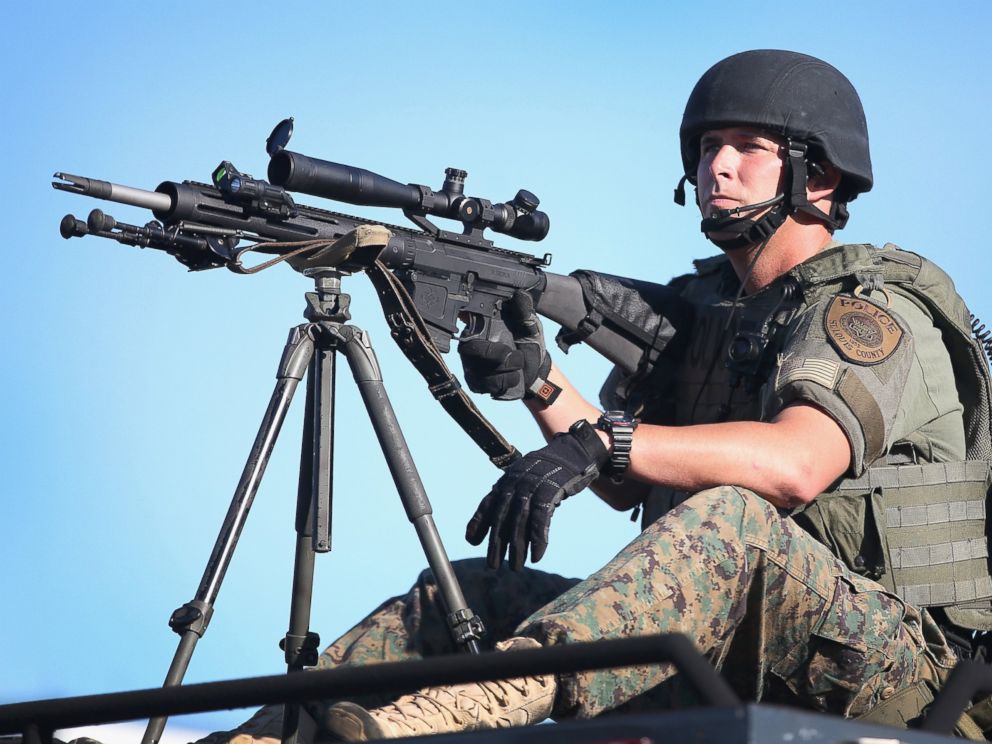
Since the killing of eighteen-year-old Michael Brown by Ferguson
police in Missouri last weekend, the people of Ferguson have been
subjected to a military-style crackdown by a squadron of local police
departments dressed like combat soldiers. This has prompted residents to
liken the conditions on the ground in Ferguson to the Israeli military
occupation of Palestine.
And who can blame them?
The dystopian scenes of paramilitary units in camouflage rampaging
through the streets of Ferguson, pointing assault rifles at unarmed
residents and launching tear gas into people’s front yards from behind
armored personnel carriers (APCs), could easily be mistaken for a
Tuesday afternoon in the occupied West Bank.
And it’s no coincidence.
At least two of the four law enforcement agencies
that were deployed in Ferguson up until Thursday evening — the St.
Louis County Police Department and the St. Louis Police Department —
received training from Israeli security forces in recent years.
Brute force
It all started when a yet to be named Ferguson police officer killed
Michael Brown, an unarmed black teenager. According to witnesses, Brown
was attempting to surrender with his hands up when a Ferguson police
officer emptied his clip into Brown’s body, shooting the teen up to ten times.
For hours police left Brown’s lifeless body sprawled in the street
uncovered as a growing number of residents gathered nearby, demanding
answers from authorities. Police responded by deploying K-9 units and
riot squads to crush the crowd, predictably inciting a riot, which
police used to justify more brute force.
But the people of Ferguson refuse to submit and have mobilized every single day to demand justice for Brown and an end to the racist, undemocratic regime they live under.
“Hands up, don’t shoot” has become their rallying cry, a symbol of Brown in his last moments and what it means to be black in America, where every 28 hours an African-American is killed by a self-styled vigilante, security guard or police officer.
Still, police did not relent, prompting one Ferguson protester to
shout at a row of military-style tactical vehicles, “You gonna shoot us?
Is this the Gaza Strip?”
“Will we as a people rise up like the people of Gaza? Will our
community be bombed like last night with tear gas? That was a terrorist
attack,” remarked another Ferguson protester to The Daily Beast.
Even elected officials weren’t spared. Missouri state Senator Maria Chappelle-Nadal was tear gassed
and St. Louis Alderman Antonio French, who had been documenting the
unfolding police repression in Ferguson on social media since just after
Brown’s murder, was arrested.
As the situation spiraled further out of control, Palestinians began tweetingadvice on dealing with tear gas to the people of Ferguson.
Cops become soldiers
Domestic policing in the US has a long and sordid history rooted in
the violent control and subjugation of communities of color, so the
police violence directed at the predominantly black residents of
Ferguson is nothing new.
But the widespread militarization on display in Ferguson is part of a more recent trend
that began three decades ago with the introduction of the disastrous
“war on drugs” and dramatically escalated with the “war on terror” —
leading directly to the counterinsurgency-like tactics deployed against
the people of Ferguson by civilian police officers who more closely
resemble combat soldiers in Afghanistan than domestic cops.
This cop-to-soldier transformation
has been facilitated by the US government through mechanisms like the
Pentagon’s 1033 or military surplus program, which funnels excess
military gear to law enforcement agencies across the country. The
program’s motto: ”From warfighter to crimefighter.”
In 2013 alone, the program showered US police departments with nearly $450 million worth of military equipment.
St. Louis County law enforcement agencies, including the Ferguson Police Department, participate in
this program and have received military-grade rifles, pistols and night
vision equipment in recent years, though it’s unclear if the equipment
is being used in Ferguson now.
As The New York Timesreported
in June, the scaling down of US wars in Iraq and Afghanistan means
“former tools of combat — M-16 rifles, grenade launchers, silencers and
more — are ending up in local police departments, often with little
public notice.”
“During the Obama administration, according to Pentagon data, police
departments have received tens of thousands of machine guns; nearly
200,000 ammunition magazines; thousands of pieces of camouflage and
night-vision equipment; and hundreds of silencers, armored cars and
aircraft,” the newspaper added.
Ferguson police also receive money from the Department of Homeland
Security as part of a grant program that has doled out billions to US
law enforcement agencies to purchase military-style equipment, like the
APCs charging through the streets of Ferguson.
In the last five years alone, Missouri has received nearly $70 million in DHS money for law enforcement related programs.
Emulating apartheid
While there is a wealth of scholarship on police militarization in
the US, there has been little to no examination of the ways Israel’s
security apparatus facilitates it.
Decades of testing and perfecting methods of domination and control
on a captive and disenfranchised Palestinian population has given rise
to a booming “homeland security industry” in Israel that refashions
occupation-style repression for use on marginalized populations in other
parts of the world, including St. Louis.
Under the cover of counterterrorism training, nearly every major
police agency in the United States has traveled to Israel for lessons in
occupation enforcement, a phenomenon that journalist Max Blumenthal
dubbed “the Israelification
of America’s security apparatus.”
Israeli forces and US police
departments are so entrenched that the New York City Police Department
(NYPD) has opened a branch in Tel Aviv.
In 2011, then St. Louis County Police Department chief Timothy Fitch attended the Anti-Defamation League’s (ADL) National Counter-Terrorism Seminar,
an annual week-long Israeli training camp where US law enforcement
executives “study first hand Israel’s tactics and strategies” directly
from “senior commanders in the Israel National Police, experts from
Israel’s intelligence and security services, and the Israel Defense
Forces,” according to the ADL’s website.
Until Thursday night, the St. Louis County Police Department appeared
to be the largest most militarized and brutish force operating in
Ferguson. “St. Louis County Police” was scrawled across the side of most
of the tactical unit vehicles and appeared on the combat-style uniforms of officers aiming assault rifles at peaceful protesters.
The ADL boasts of sending more than 175 senior US law enforcement
officials from 100 different agencies to the seminar since 2004, which
are “taking the lessons they learned in Israel back to the United
States.”
The ADL is just one of several pro-Israel groups forging close ties
between US cops and Israel’s security and intelligence apparatus.
Another is the Jewish Institute for National Security
Affairs (JINSA), a neoconservative think tank that claims to have hosted
some 9,500 law enforcement officials in its Law Enforcement Exchange Program (LEEP) since 2004.
LEEP “takes delegations of senior law enforcement executives to
Israel to study methods and observe techniques used in preventing and
reacting to acts of terrorism” and “sponsors conferences within the
United States, bringing Israeli experts before much larger groups of law
enforcement leaders,” according to JINSA’s brochure.
Former St. Louis Police Department police chief Joseph Mokwa is listed as having traveled to Israel as part of a LEEP conference in February 2008.
Following nationwide outrage and embarrassment, Missouri Governor Jay
Nixon pulled St. Louis County Police forces out of Ferguson and placed
the Missouri Highway Patrol in charge of policing demonstrators. The St.
Louis Police Department voluntarily removed its officers from
Ferguson.
As a result, Ferguson no longer looks like occupied territory, though the underlying issue, Michael Brown’s murder, has yet to be addressed.
Meanwhile, the scope of Israel’s influence on US law enforcement
remains virtually ignored by the media despite the troubling
implications of emulating an apartheid regime actively engaged in ethnic
cleansing and war crimes.
The culture of racism and impunity that has long plagued American
policing is deadly enough as it is. Adding Israeli-style repression to
an already dangerous mix guarantees disaster.
*Photo by Jeff Robertson courtesy of the Associated Press
The
new Egyptian regime is suspicious of political Islam and only 140
injured Gazans have gone to Egyptian hospitals since 8 July
Friday 1 August 2014
Louisa Loveluck
As the death toll in Gaza
passes 1,400, Egyptian hospitals have treated more than a hundred
casualties of an Israeli military campaign drawing an otherwise muted
response from Egypt, as its political establishment weighs humanitarian responsibilities against domestic politics.
Egypt's
Rafah border crossing – Gaza's only exit route not controlled by Israel
– has opened sporadically since Israel began Operation Protective Edge
on 8 July. According to Egypt's health ministry, 140 people have entered
the country for treatment since then.
The Egyptian authorities
cite security concerns as the reason for repeated closures: Rafah is in
Egypt's restive north Sinai region, where the army is attempting to root
out al-Qaida-affiliated Islamist militants.
Throughout the Gaza
crisis fluorescent ambulances have queued on the Egyptian side of Rafah,
waiting to receive the slow stream of patients chosen for evacuation by
Gaza's health ministry. At least eight hospitals within the Palestinian
enclave have been damaged in the violence, cutting the number of beds
by more than 500.
Inside Egypt's hospitals, doctors say they have
been shocked at the number of child casualties. "It's more than 20% …
the situation is bad," says Dr Sami Anwar, director of the Arish
hospital, 50km from Rafah. "One four year-old girl had a panic attack
when she awoke – she couldn't see anything or find anyone. She'd been
blinded," he says.
Egypt's muted response to the crisis over its
border is a contrast to its efforts in the previous round of violence,
in 2012, when the former president Mohamed Morsi, a staunch Hamas ally, was central to ceasefire negotiations.
This
time, Egypt is part of a coalition of Arab states, including regional
heavyweight Saudi Arabia, that has aligned itself with Israel,
signalling their deep suspicion towards Hamas and political Islam in general.
Egypt
remains a central player in ceasefire negotiations between Israel and
Hamas – it was due to host fresh talks today, but delayed the meetings
after the collapse of a freshly announced 72-hour ceasefire – but
hostility toward Hamas has resulted in a less flexible political
approach to diplomacy, and tight control of aid deliveries through
Rafah.
The crossing authority says 130 tonnes of humanitarian aid
was transferred to Gaza on 25 and 26 of July, using donations from
Morocco, Saudi Arabia, the Arab doctors' union in Egypt, and a Jordanian
donor. An Egyptian military convoy also delivered food and medicine in a
crossing the previous week.
But other convoys have been turned
away – notably those organised by Cairo-based activists. According to
Issandr el-Amrani, International Crisis Group's north Africa
project director, the Egyptian government is unlikely to allow aid
convoys that may be seen to carry a political message of support for
Hamas, or to provide support for the group's call for the border at
Rafah to be thrown open. The latter is a central demand of Hamas.
"[Egypt's]
official line is pretty clear: we support the Palestinian people,
condemn Israel's attacks on civilians and want to facilitate aid, but we
blame Hamas for the current situation," says Mr Amrani. "In practice,
this policy means that the humanitarian aid is stalled, hostage to
Cairo's desire to keep up the pressure on Hamas."
Three days after the Israeli Prime Minister Benjamin Netanyahu
launched the current war in Gaza, he held a press conference in Tel Aviv
during which he said, in Hebrew, according to the Times of Israel,
“I think the Israeli people understand now what I always say: that
there cannot be a situation, under any agreement, in which we relinquish
security control of the territory west of the River Jordan.”
It’s
worth listening carefully when Netanyahu speaks to the Israeli people.
What is going on in Palestine today is not really about Hamas. It is not
about rockets. It is not about “human shields” or terrorism or tunnels.
It is about Israel’s permanent control over Palestinian land and
Palestinian lives.
That is what Netanyahu is really saying, and that is
what he now admits he has “always” talked about. It is about an
unswerving, decades-long Israeli policy of denying Palestine
self-determination, freedom, and sovereignty.
What
Israel is doing in Gaza now is collective punishment. It is punishment
for Gaza’s refusal to be a docile ghetto. It is punishment for the gall
of Palestinians in unifying, and of Hamas and other factions in
responding to Israel’s siege and its provocations with resistance, armed
or otherwise, after Israel repeatedly reacted to unarmed protest with
crushing force. Despite years of ceasefires and truces, the siege of
Gaza has never been lifted.
As Netanyahu’s own words show,
however, Israel will accept nothing short of the acquiescence of
Palestinians to their own subordination. It will accept only a
Palestinian “state” that is stripped of all the attributes of a real
state: control over security, borders, airspace, maritime limits,
contiguity, and, therefore, sovereignty.
The twenty-three-year charade
of the “peace process” has shown that this is all Israel is offering,
with the full approval of Washington. Whenever the Palestinians have
resisted that pathetic fate (as any nation would), Israel has punished
them for their insolence. This is not new.
Punishing Palestinians
for existing has a long history. It was Israel’s policy before Hamas
and its rudimentary rockets were Israel’s boogeyman of the moment, and
before Israel turned Gaza into an open-air prison, punching bag, and
weapons laboratory.
In 1948, Israel killed thousands of innocents, and
terrorized and displaced hundreds of thousands more, in the name of
creating a Jewish-majority state in a land that was then sixty-five per
cent Arab.
In 1967, it displaced hundreds of thousands of Palestinians
again, occupying territory that it still largely controls, forty-seven
years later.
In 1982, in a quest to expel the Palestine
Liberation Organization and extinguish Palestinian nationalism, Israel
invaded Lebanon, killing seventeen thousand people, mostly civilians.
Since the late nineteen-eighties, when Palestinians under occupation
rose up, mostly by throwing stones and staging general strikes, Israel
has arrested tens of thousands of Palestinians: over seven hundred and
fifty thousand people have spent time in Israeli prisons since 1967, a
number that amounts to forty per cent of the adult male population
today.
They have emerged with accounts of torture, which are
substantiated by human-rights groups like B’tselem. During the second
intifada, which began in 2000, Israel reinvaded the West Bank (it had
never fully left.) The occupation and colonization of Palestinian land
continued unabated throughout the “peace process” of the
nineteen-nineties, and continues to this day.
And yet, in America, the
discussion ignores this crucial, constantly oppressive context, and is
instead too often limited to Israeli “self-defense” and the
Palestinians’ supposed responsibility for their own suffering.
In
the past seven or more years, Israel has besieged, tormented, and
regularly attacked the Gaza Strip. The pretexts change: they elected
Hamas; they refused to be docile; they refused to recognize Israel; they
fired rockets; they built tunnels to circumvent the siege; and on and
on.
But each pretext is a red herring, because the truth of ghettos—what
happens when you imprison 1.8 million people in a hundred and forty
square miles, about a third of the area of New York City, with no
control of borders, almost no access to the sea for fishermen (three out
of the twenty kilometres allowed by the Oslo accords), no real way in
or out, and with drones buzzing overhead night and day—is that,
eventually, the ghetto will fight back.
It was true in Soweto and
Belfast, and it is true in Gaza. We might not like Hamas or some of its
methods, but that is not the same as accepting the proposition that
Palestinians should supinely accept the denial of their right to exist
as a free people in their ancestral homeland.
This is precisely
why the United States’ support of current Israeli policy is folly. Peace
was achieved in Northern Ireland and in South Africa because the United
States and the world realized that they had to put pressure on the
stronger party, holding it accountable and ending its impunity.
Northern
Ireland and South Africa are far from perfect examples, but it is worth
remembering that, to achieve a just outcome, it was necessary for the
United States to deal with groups like the Irish Republican Army and the
African National Congress, which engaged in guerrilla war and even
terrorism. That was the only way to embark on a road toward true peace
and reconciliation. The case of Palestine is not fundamentally
different.
Instead, the United States puts its thumb on the
scales in favor of the stronger party. In this surreal, upside-down
vision of the world, it almost seems as if it is the Israelis who are
occupied by the Palestinians, and not the other way around. In this
skewed universe, the inmates of an open-air prison are besieging a
nuclear-armed power with one of the most sophisticated militaries in the
world.
If we are to move away from this unreality, the U.S. must
either reverse its policies or abandon its claim of being an “honest
broker.”
If the U.S. government wants to fund and arm Israel and parrot
its talking points that fly in the face of reason and international law,
so be it. But it should not claim the moral high ground and intone
solemnly about peace. And it should certainly not insult Palestinians by
saying that it cares about them or their children, who are dying in
Gaza today.
Egypt’s army said Sunday it has destroyed 13 more tunnels connecting the
Sinai Peninsula to the Gaza Strip, taking to 1,639 the overall number
it has laid waste to.
Cairo has poured troops into the peninsula to counter a rising
insurgency since the ouster of Islamist president Mohamed Mursi last
year, and its security operation involves the destruction of these
tunnels.
The Palestinian militant group Hamas, which is the main power in
Gaza, reportedly uses the tunnels to smuggle arms, food and money into
the blockaded coastal enclave.
Israel has been waging a military offensive on Gaza since July 8 to
halt rocket fire, and it launched a ground assault on July 17 aimed at
destroying the network of tunnels.
Egyptian soldiers in north Sinai prevented an aid convoy of
activists from reaching the Rafah border crossing with the embattled
Palestinian Gaza Strip on Saturday, an AFP correspondent said.
An army officer at the Balloza checkpoint, one of many along the desert
highway to Rafah, told an AFP correspondent that the security situation
in the restive peninsula was too unstable to allow the convoy of 11
buses and 500 activists to pass.
There was a brief scuffle between some activists and soldiers but no arrests were made.
Egypt usually keeps the crossing closed, citing a counter-insurgency
operation against militants in north Sinai, but has allowed entry to
Palestinians wounded in the 12-day conflict between Hamas and Israel.
At least 333 Palestinians and three Israelis have died in the unrest,
the third conflict to erupt in and around Gaza in seven years.
The Egyptian military had earlier said it was sending 500 tonnes of food and medical aide to the besieged enclave.
Hamas, militant Islamist rulers of Gaza, have refused to accept a
ceasefire with Israel until it receives guarantees that border crossings
to Gaza -- all but one under Israeli control -- will be opened.
Israel's defence minister has confirmed that military plans to 'uproot Hamas' are about dominating Gaza's gas reserves
Wednesday July 9, 2014
Nafeez Ahmed
Yesterday, Israeli defence minister and former Israeli Defence Force (IDF) chief of staff Moshe Ya'alon
announced that Operation Protective Edge marks the beginning of a
protracted assault on Hamas. The operation "won't end in just a few
days," he said, adding that "we are preparing to expand the operation by
all means standing at our disposal so as to continue striking Hamas."
This morning, he said:
"We
continue with strikes that draw a very heavy price from Hamas. We are
destroying weapons, terror infrastructures, command and control systems,
Hamas institutions, regime buildings, the houses of terrorists, and
killing terrorists of various ranks of command… The campaign against
Hamas will expand in the coming days, and the price the organization
will pay will be very heavy."
But in 2007, a year before Operation Cast Lead, Ya'alon's concerns focused on the 1.4 trillion cubic feet of natural gas discovered in 2000 off the Gaza
coast, valued at $4 billion. Ya'alon dismissed the notion that "Gaza
gas can be a key driver of an economically more viable Palestinian
state" as "misguided." The problem, he said, is that:
"Proceeds of a Palestinian gas sale to Israel
would likely not trickle down to help an impoverished Palestinian
public. Rather, based on Israel's past experience, the proceeds will
likely serve to fund further terror attacks against Israel…
A gas
transaction with the Palestinian Authority [PA] will, by definition,
involve Hamas. Hamas will either benefit from the royalties or it will
sabotage the project and launch attacks against Fatah, the gas
installations, Israel – or all three… It is clear that without an
overall military operation to uproot Hamas control of Gaza, no drilling
work can take place without the consent of the radical Islamic
movement."
Mark Turner, founder of the Research Journalism Initiative, reported
that the siege of Gaza and ensuing military pressure was designed to
"eliminate" Hamas as "a viable political entity in Gaza" to generate a
"political climate" conducive to a gas deal. This involved
rehabilitating the defeated Fatah as the dominant political player in
the West Bank, and "leveraging political tensions between the two
parties, arming forces loyal to Abbas and the selective resumption of
financial aid."
Ya'alon's comments in 2007 illustrate that the
Israeli cabinet is not just concerned about Hamas – but concerned that
if Palestinians develop their own gas resources, the resulting economic
transformation could in turn fundamentally increase Palestinian clout.
Meanwhile, Israel has made successive major discoveries
in recent years - such as the Leviathan field estimated to hold 18
trillion cubic feet of natural gas – which could transform the country
from energy importer into aspiring energy exporter with ambitions to
supply Europe, Jordan and Egypt.
A potential obstacle is that much of
the 122 trillion cubic feet of gas and 1.6 billion barrels of oil in the
Levant Basin Province lies in territorial waters where borders are
hotly disputed between Israel, Syria, Lebanon, Gaza and Cyprus.
Amidst
this regional jockeying for gas, though, Israel faces its own
little-understood energy challenges. It could, for instance, take until
2020 for much of these domestic resources to be properly mobilised.
But
this is the tip of the iceberg. A 2012 letter by two Israeli government
chief scientists – which the Israeli government chose not to disclose –
warned the government that Israel still had insufficient gas resources
to sustain exports despite all the stupendous discoveries. The letter,
according to Ha'aretz,
stated that Israel's domestic resources were 50% less than needed to
support meaningful exports, and could be depleted in decades:
"We
believe Israel should increase its [domestic] use of natural gas by
2020 and should not export gas. The Natural Gas Authority's estimates
are lacking. There's a gap of 100 to 150 billion cubic meters between
the demand projections that were presented to the committee and the most
recent projections. The gas reserves are likely to last even less than
40 years!"
As Dr Gary Luft - an advisor to the US Energy Security Council - wrote in the Journal of Energy Security,
"with the depletion of Israel's domestic gas supplies accelerating, and
without an imminent rise in Egyptian gas imports, Israel could face a
power crisis in the next few years… If Israel is to continue to pursue
its natural gas plans it must diversify its supply sources."
Israel's new domestic discoveries do not, as yet, offer an immediate solution as electricity prices
reach record levels, heightening the imperative to diversify supply.
This appears to be behind Prime Minister Netanyahu's announcement in
February 2011 that it was now time to seal the Gaza gas deal.
But even
after a new round of negotiations was kick-started between the Fatah-led
Palestinian Authority and Israel in September 2012, Hamas was excluded
from these talks, and thus rejected the legitimacy of any deal.
Earlier this year, Hamas condemned
a PA deal to purchase $1.2 billion worth of gas from Israel Leviathan
field over a 20 year period once the field starts producing.
Simultaneously, the PA has held several meetings with the British Gas Group
to develop the Gaza gas field, albeit with a view to exclude Hamas –
and thus Gazans – from access to the proceeds. That plan had been the
brainchild of Quartet Middle East envoy Tony Blair.
But the PA was also courting Russia's Gazprom
to develop the Gaza marine gas field, and talks have been going on
between Russia, Israel and Cyprus, though so far it is unclear what the
outcome of these have been. Also missing was any clarification on how
the PA would exert control over Gaza, which is governed by Hamas.
According to Anais Antreasyan in the University of California's Journal of Palestine Studies,
the most respected English language journal devoted to the Arab-Israeli
conflict, Israel's stranglehold over Gaza has been designed to make
"Palestinian access to the Marine-1 and Marine-2 gas wells impossible."
Israel's long-term goal "besides preventing the Palestinians from
exploiting their own resources, is to integrate the gas fields off Gaza
into the adjacent Israeli offshore installations." This is part of a
wider strategy of:
"…. separating the Palestinians
from their land and natural resources in order to exploit them, and, as a
consequence, blocking Palestinian economic development. Despite all
formal agreements to the contrary, Israel continues to manage all the
natural resources nominally under the jurisdiction of the PA, from land
and water to maritime and hydrocarbon resources."
For
the Israeli government, Hamas continues to be the main obstacle to the
finalisation of the gas deal. In the incumbent defence minister's words:
"Israel's experience during the Oslo years indicates Palestinian gas
profits would likely end up funding terrorism against Israel. The threat
is not limited to Hamas… It is impossible to prevent at least some of
the gas proceeds from reaching Palestinian terror groups."
The only option, therefore, is yet another "military operation to uproot Hamas."
Unfortunately, for the IDF uprooting Hamas means destroying the group's perceived civilian support base – which is why Palestinian civilian casualties massively outweigh that of Israelis. Both are obviously reprehensible, but Israel's capacity to inflict destruction is simply far greater.
In the wake of Operation Cast Lead, the Jerusalem-based Public Committee Against Torture in Israel
(Pcati) found that the IDF had adopted a more aggressive combat
doctrine based on two principles – "zero casualties" for IDF soldiers at
the cost of deploying increasingly indiscriminate firepower in densely
populated areas, and the "dahiya doctrine" promoting targeting of
civilian infrastructure to create widespread suffering amongst the
population with a view to foment opposition to Israel's opponents.
This
was confirmed in practice by the UN fact-finding mission in Gaza which
concluded that the IDF had pursued a "deliberate policy of
disproportionate force," aimed at the "supporting infrastructure" of the
enemy - "this appears to have meant the civilian population," said the UN report.
The
Israel-Palestine conflict is clearly not all about resources. But in an
age of expensive energy, competition to dominate regional fossil fuels are increasingly influencing the critical decisions that can inflame war.
Egyptian authorities kept the Rafah border crossing with the Gaza Strip
closed for the sixth consecutive day, whilst the Foreign Ministry’s
Spokesperson Badr Abdel Aty said on Tuesday, “Egypt denounces the chain
of raids launched on Gaza.”
Tuesday marked the bloodiest day of Israel’s most recent attacks on the
besieged Gaza Strip. The death toll in Gaza reached at least 17 after
the latest air strike killed six.
Meanwhile, sirens could be heard across Jerusalem after the Israeli
Iron Dome missile-defense system intercepted a rocket fired from the
Gaza Strip over Tel Aviv, the Anadolu Agency reported.
A statement released by the Jerusalem Municipality urged residents to
“remain in protected areas for 10 minutes [after the sirens go off]. Sit
on the floor under the window line against the most interior wall
available, opposite any windows.”
Hamas had announced that rockets were launched targeting Israeli cities
in response to the air strikes on Gaza. However, Israeli authorities
reported that no casualties occurred as a result of the attacks on
Jerusalem, Tel Aviv and the northern city of Haifa.
The only passageway in or out of Gaza remains closed, at Cairo’s
behest, despite the ongoing aerial assaults — which are reported to
have targeted more than 50 sites across this coastal enclave.
Nonetheless, the spokesman for the Egyptian Foreign Ministry decried
Israel’s “collective punishment policy” and called on the Zionist state
to exercise “self-restraint.”
The Rafah border crossing has predominantly been closed since July 3,
2013 — when Morsi was deposed by the Egyptian military — with rare
exceptions made for Palestinian pilgrims, students, and
medical/humanitarian cases.
Despite the ongoing violence, security forces have not allowed
Palestinians to seek shelter or medical assistance in Egypt. Alternative
routes are also limited, since Egypt’s authorities demolished nearly
all the smuggling tunnels between Egypt’s Sinai Peninsula and the Gaza
Strip in recent months.
On Tuesday, a host of Palestinian news websites and media outlets,
along with some Egyptian solidarity groups, called on the authorities in
Cairo to allow for the re-opening of the Rafah border crossing in light
of the present crisis.
According to Abdel Aty’s statement,
posted on the State Information Service website, “Egypt totally rejects
and condemns all violence that results in the killing of civilians from
both sides.”
For nearly three weeks, Palestinian armed groups — particularly the
Islamic resistance group Hamas — have been engaged in rocket and mortar
attacks targeting southern Israel. These primitive rocket attacks have
not resulted in any Israeli fatalities, although property damage has
been reported.
In response, Israeli armed forces launched “Operation Protective Edge”
against Palestinian targets in Gaza. A host of civilian casualties are
being reported.
A new wave of violence erupted between the Zionist state and the
Palestinian territories of the West Bank and Gaza Strip since three
Jewish teenage settlers disappeared on June 12.
Their dead bodies were
discovered in the West Bank on June 30. Israeli authorities have blamed
Hamas for the kidnapping and deaths of the three teens.
In their rescue attempts, Israeli forces searched and raided hundreds
of Palestinian properties across the West Bank. Over 300 Palestinians
are reported to have been arrested in the course of these operations.
In a revenge attack a Palestinian teenager was kidnapped from the West
Bank and reportedly burnt alive. His remains were found on July 2.