Showing posts with label Curfew. Show all posts

Saturday, November 29, 2014

Fear, violence & hardship part of everyday live in North Sinai towns

Daily News Egypt

Fear, violence and hardship part of everyday life in volatile North Sinai town

Residents of Al-Arish are caught in the fight between militants and the military 


“At 5pm the day ends with the sound of gunshots – a new ritual to remind people that it’s curfew time – and by 7am another round of gunshots informs residents that the curfew has ended,” said the teacher – a mother of two living in Al-Arish, northern Sinai.

Several residents of the town have shared their experiences with the Daily News Egypt of living under curfew. A state of emergency was declared in the area following attacks by militants on 24 October, which left at least 30 army personnel dead. A militant insurgency in Sinai has flared since the military’s ousting of Islamist president Mohamed Morsi in July 2013.

The residents, who all of whom asked to remain anonymous for security reasons, revealed that – even under curfew – explosions are a common occurrence, and the people are living in fear.
 
The teacher’s six year-old daughter wakes up every night crying and screaming, terrorised by the sounds of explosions and gunfire. A few months before the curfew, the family’s house was shot at when the children were at home alone with their mother. “Since then, the nightmares have never left them,” she said.

Residents often feel the need to report a car or a suspicious bag left in the street but, as the mobile phone networks are frequently cut, it has become difficult. “Even when something gets reported, the response from the army or police is very slow,” said the teacher.

According to a pharmacist in his late twenties, the poor mobile coverage is a protective measure used by the authorities to prevent militants from contacting each other. “However, the government is unable to take control of the situation even with this precaution,” he added.

An engineer in his mid-twenties however had a different theory, attributing the network cuts to the authorities’ aim of preventing those living outside of the area from knowing what is really going on in Al-Arish.

The mother teaches at a school in Sheikh Zuweid – a Bedouin town near the border with the Gaza Strip – and claimed that she has seen planes bombarding a village in the area known as Al-Toma.
She noted that travelling between towns in the region has become difficult.

On 17 November, teachers returning to Al-Arish from Sheikh Zuweid and Rafah had to wait for hours at a checkpoint outside Al-Arish due to suspected explosives on the road. The delays meant they were not able to get home before the 5pm curfew and as a result a 28 year-old teacher was shot in the thigh while passing a security checkpoint later that night in Dahiyat al-Salam neighbourhood of Al-Arish.

The man is currently at Al-Arish hospital and his condition is stable, she said. Other teachers were taken from the checkpoint in the Alreesa district in ambulances and military vehicles, not reaching their homes until 7-8pm.

Some mothers were not able to collect their children from day care centres and there was no network coverage to enable them to contact the centres and inform them about the delay. “The mothers were extremely worried and the children were kept at neighbours’ and baby sitters’ houses until the mobile network came back at night and the mothers were then able to know where their children were,” according to the teacher.

The day after she and a group of teachers met with the governor of North Sinai Abdel Fatah Harhour to find a solution to problems cause by security delays when travelling from Al-Arish to other towns. Two days later, on 20 November, Harhour ordered the indefinite closure of schools in Sheikh Zuweid and Rafah for security reasons.

Even travelling around Al-Arish in the day time has become arduous as security forces frequently set up new checkpoints made of sand, stone, and metal barriers, forcing residents to take longer routes to reach their destinations.

Residents report that travelling from Arish to Cairo and vice versa has become very difficult. A year and a half ago they used to pass over the Suez Canal on Al-Salam Bridge. However, following the increased security threats, people are now often forced to pass the canal via ferryboat. “The lines of cars waiting to pass are endless and more time is consumed because almost every car in the queue gets inspected,” said an Al-Arish housewife.

The financial situation has become challenging for many people in Al-Arish. All types of entertainment have been removed from their lives and they can hardly afford to buy basic necessities. Traders of fruits, vegetables and clothes have raised their prices to cover losses from the early closure of their shops under curfew.

“After 5pm Al-Arish becomes like a ghost town. Places that used to be full of people and shops that were open all night are now dead and no one dares to not abide by the rules,” said a pharmacist living in Al-Arish.People are losing their tempers because of what’s happening. “I am now considering leaving this country for good and the coming days will help me determine whether I’ll stay or leave,” the pharmacist said.

Some residents express a lack of confidence in the ability of the security forces to secure the area.
On 11 November residents stated that they had reported a suspicious car parked in their neighbourhood to the police around 4pm. At 8.30pm the car exploded, before the security forces could investigate, said one of the residents who preferred to remain anonymous.

No one was killed but some sustained minor injuries. Houses and shops sustained significant damage from the explosion. Two shops were completely shattered, buildings around the car were left with cracks and holes and windows were broken.

“I thought that the whole building was being blown up, all the windows in the house were smashed inside falling on beds, sofas and on the floors,” said a housewife and a mother of four living near the place of the incident.

Another housewife shared her view regarding the situation. She implied that things are moving from bad to worse and people are feeling unstable and insecure. “I don’t have a good feeling about what’s currently happening. After the displacement of residents from Rafah I personally think that Al-Arish will be next. I have a feeling that the government is planning to isolate Sinai from Egypt and everyday my doubts get justified even more,” she said.

The housewife is living with her husband and two children near a police station in Al-Arish; security is tight to protect the station from any attacks. She claimed that, if a car passes by the area, the security forces fire their weapons and start screaming at the driver to leave immediately. The woman always parks her car on the other side of the house trying to avoid any kind of panic. “For the same reasons we can’t even get out in our balconies,” she said.

Residents say that the behaviour of the security forces is alienating citizens.

“During the setback of the 1967 war with Israel, when the Israeli army invaded Sinai and occupied Arish, many Egyptian soldiers weren’t able to leave immediately, so they hid in local houses, where residents provided them with food, clothes and even created fake ID’s for them to protect them from the Israeli army. Now things have changed. If a similar situation happened with the new enemy in Sinai, residents wouldn’t respond the same,” said an engineer living in Al-Arish.

“The police and the military are now treating people in a very bad way, the possibility of people being taken to jail for no good reason is very high and it has been actually happening a lot lately,” said the engineer. He claims that innocent people are often arrested in their homes or in the streets.

Another resident shared a story about a neighbour who was taken from his home about a month and a half ago. The resident claims that 10-15 soldiers came to the house next door at 2am and asked for an 18 year-old man who was living in the house.

“The sound of knocking and yelling was so loud that people started getting out on their balconies to see what has been going on, but soldiers kept yelling at them, telling them to go back inside. My mother and my sister were crying out of fright and out of pity for the young man and his family.”

“Until now the parents have no clue where their son is; they looked for him at all the police stations in Al-Arish and even in Cairo but couldn’t reach him. I can’t imagine what his family must be going through right now,” the resident said.

“No one is reflecting the whole picture of what is happening in Al-Arish to the external world. Some residents in the town don’t even know what has been going on. The lack of media coverage in Sinai can definitely open the door for more human rights violations,” said the engineer.

According to the teacher, some houses are now being inspected by the army. They approached her brother’s house and asked for his family’s identity cards as well as the contract for his apartment. “He was lucky to be home at the time because if the army finds an empty apartment they smash it down without notice, which happened with his neighbour’s house,” she said.

Yet, while some criticise the military and their actions in Al-Arish, others see this as the right way to handle the current situation. A working father said that, when it comes to national security, the military and Egyptian general intelligence are the only ones who should determine what is to be done.

He said that the tunnels found in Rafah between Sinai and Gaza show that the army isn’t just performing carelessly. “They do know what they are doing,” he said.

“My work has been highly affected by the recent events as I’m losing a lot of money but I believe that what the military is doing is all in favour of the people of Sinai and to prevent the city from being separated from Egypt,” the father added.

Hundreds of stories can be told by the people of this small town as every day seems to bring them a new unpleasant adventure. People are actually eager to talk and share their experience, fear, and uncertainty with the outside world.

“Every day I feel like a disaster is about to happen and I only ask God to keep my parents and my children away from any harm, and I hope that I can get back to them safely,” the teacher said. “”Oh, Sinai, where are you headed to?”


Sunday, August 31, 2014

Egypt hypocritically calls on USA to respect right of protest

Mada Masr
Egypt calls on US to respect right of protest

Tuesday, August 19, 2014

 
Egypt’s Ministry of Foreign Affairs called on American authorities on Tuesday to uphold international human rights standards and to respect protesters’ rights to freedom of assembly in the city of Ferguson, Missouri.

The comments were made in light of heavy-handed security tactics by Missouri’s authorities following the police killing of Michael Brown, an unarmed 18-year-old African American on August 9.

A statement issued by the Egyptian Foreign Ministry Spokesperson, Badr Abdel Atty called on American authorities “to exercise restraint, and respect the rights of peaceful assembly and freedom of expression.”

It was met with skepticism, sarcasm and ridicule on social media networks.

“Laughing not permitted… Egypt calls on America to respect the right of peaceful assembly in light of protests in Ferguson,” Abdel Rahman Salah wrote on Twitter.

Another Egyptian Twitter user commented that if the events in Ferguson were happening in Egypt, there would be at least 100 fatalities due to the crackdown.

Following the murder of Brown, Missouri’s governor authorized the deployment of heavily militarized police forces, imposed a state of emergency and curfews, and gave the green light for the use of smoke and tear gas canisters against protesters, as well as rubber bullets.

Dozens of arrests have been reported and the National Guard has been deployed to the city in hopes of quelling unrest and racial tensions.

Abdel Atty’s comments affirmed recommendations by the United Nations General Secretary Ban Ki-moon, issued on Monday. In his statement, published on the UN News Center Website, Moon expressed hope that local and federal investigations will “shed full light on the killing and that justice will be done.”  

Last year, Egypt banned all forms of public assembly that are critical of the ruling government.

Presidential Decree 107 (2013), the “Law Regulating Right of Assembly, Processions and Peaceful Protest” strictly limits the freedom to protest and peaceful assembly, while granting police sweeping powers to forcefully disperse protests, even those that are officially authorized.

According to this law, the Egyptian police are empowered to use batons, water cannons, tear gas, rubber bullets and even live shotgun shells against protesters. The law also imposes penalties of imprisonment ranging from two to seven years and/or fines of up to LE300,000 ($US 42,000) for violations.

This year, the anniversary of the armed crackdown on Islamist protest camps at Rabea al-Adaweya and Nahda squares on August 14, 2013 — which left hundreds dead (estimates range from 400 to over 1,200) — saw fatal violence. Egyptian police shot dead at least five civilians protesting against the regime of President Abdel Fattah al-Sisi to mark the violent dispersals.

On August 11, security authorities at Cairo airport barred representatives of Human Rights Watch from entering the country. Their report regarding the August 14 crackdown was denounced and dismissed by Egypt’s ruling authorities.

A host of mainstream Egyptian TV channels have recently pointed the finger at human rights violations in Ferguson.

Mention has not been made of the scale of fatalities during the August 14 dispersals, the state of emergency and curfew imposed across most of Egypt for three months, or the over 800 Egyptian civilians killed during the January 25 uprising of 2011.


*Photo by Virginie Nguyen

_____________

Mada Masr

Washington fires back at Egypt’s comments on Ferguson

Wednesday, August 20, 2014

During the US State Department’s daily briefing on Tuesday, Deputy Spokesperson Mary Harf responded to the recent Egyptian Foreign Affairs statement regarding the Ferguson protests, saying that the US practices freedom of expression that isn't upheld with the same respect in Egypt.

Foreign Affairs Spokesperson Badr Abdel Aty had said in a press conference on Tuesday that Egypt “closely monitors” the protests in Ferguson and reiterated the United Nation’s calls on the US to exercise “self-restraint” and “respect the right of assembly and peaceful expression of opinion.”

Large protests had broken out in Ferguson, Missouri and were met with a violent police response following the killing of a teenager by a police officer.

“We here in the United States will put our record for confronting our problems transparently and openly and honestly up against anyone else’s in the world. And we, when we have issues here, confront them in that way, as you’ve seen over the past few days, and we would call on other countries to do the same. And unfortunately, we haven’t always seen that, so we’ll keep calling on them to do so,” Harf said in a response to a question about Egypt’s comment.

Asked whether she believed the Egyptian comment is meant as an answer to the US criticism of the Egyptian government, Harf continues, “People are free to say what they’d like. They are free to weigh in on issues. That’s the beauty of freedom of expression that we hold very dearly here in the United States. That freedom of expression hasn’t, quite frankly, been upheld with the same sort of respect in Egypt.”

Social media has responded to the Foreign Ministry’s statement with sarcasm as Egypt has imposed strict limitations on freedom of assembly and expression in the past year, issuing a Protest Law that requires a permit from the Ministry of Interior before assembly and arresting thousands of demonstrators in the past period, sentencing many to lengthy jail sentences.

Harf refused the comparison between the situation in Egypt and that in Ferguson, reiterating the US government’s concern about the human rights situation in Egypt.

Similarly Ministry of Interior Spokesperson Hany Abdel Latif gave advice to the US police during a phone interview on Sada al-Balad station on Tuesday regarding the treatment of protesters.

Abdel Latif urges the US police to negotiate with protesters and refrain from the use of excessive force. The Egyptian police is notorious for violence against protesters, as well as for practicing other forms of human rights violations, such as torture of detainees

Israeli-trained police deployed to quell Ferguson protests

Electronic Intifada


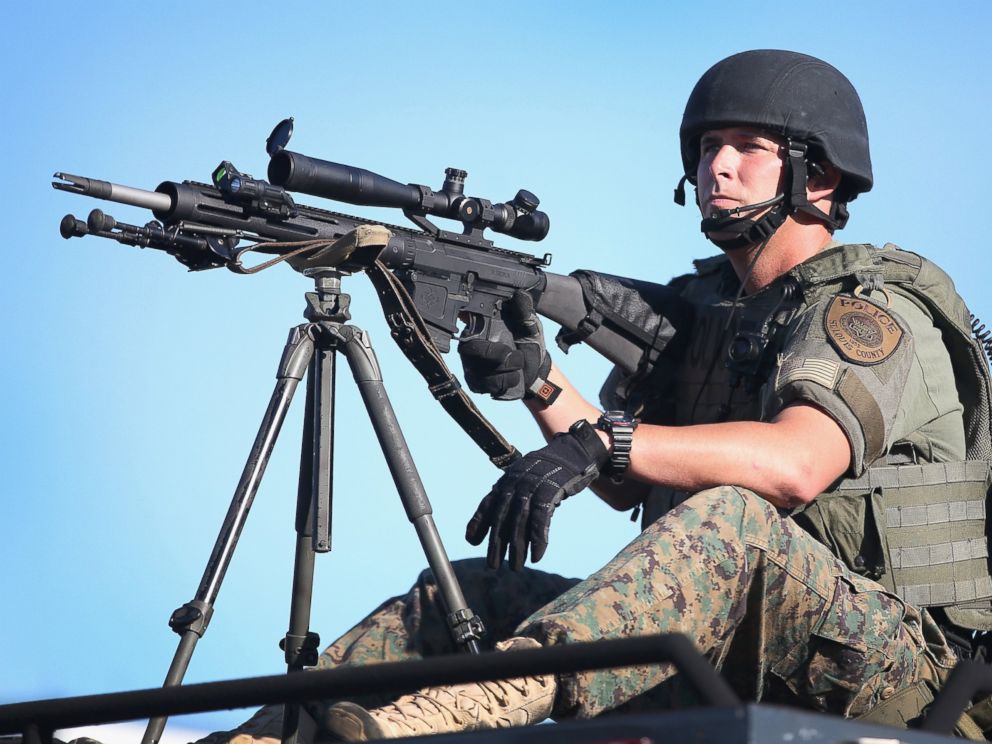
Since the killing of eighteen-year-old Michael Brown by Ferguson police in Missouri last weekend, the people of Ferguson have been subjected to a military-style crackdown by a squadron of local police departments dressed like combat soldiers. This has prompted residents to liken the conditions on the ground in Ferguson to the Israeli military occupation of Palestine.

And who can blame them?

The dystopian scenes of paramilitary units in camouflage rampaging through the streets of Ferguson, pointing assault rifles at unarmed residents and launching tear gas into people’s front yards from behind armored personnel carriers (APCs), could easily be mistaken for a Tuesday afternoon in the occupied West Bank.

And it’s no coincidence.

At least two of the four law enforcement agencies that were deployed in Ferguson up until Thursday evening — the St. Louis County Police Department and the St. Louis Police Department — received training from Israeli security forces in recent years.

Brute force

It all started when a yet to be named Ferguson police officer killed Michael Brown, an unarmed black teenager. According to witnesses, Brown was attempting to surrender with his hands up when a Ferguson police officer emptied his clip into Brown’s body, shooting the teen up to ten times.

For hours police left Brown’s lifeless body sprawled in the street uncovered as a growing number of residents gathered nearby, demanding answers from authorities. Police responded by deploying K-9 units and riot squads to crush the crowd, predictably inciting a riot, which police used to justify more brute force.

But the people of Ferguson refuse to submit and have mobilized every single day to demand justice for Brown and an end to the racist, undemocratic regime they live under.

“Hands up, don’t shoot” has become their rallying cry, a symbol of Brown in his last moments and what it means to be black in America, where every 28 hours an African-American is killed by a self-styled vigilante, security guard or police officer.

Still, police did not relent, prompting one Ferguson protester to shout at a row of military-style tactical vehicles, “You gonna shoot us? Is this the Gaza Strip?”

“Will we as a people rise up like the people of Gaza? Will our community be bombed like last night with tear gas? That was a terrorist attack,” remarked another Ferguson protester to The Daily Beast.

Meanwhile, journalists were manhandled and detained. Police were caught on video deliberately firing tear gas at an Al Jazeera America film crew as they were setting up their equipment.

Even elected officials weren’t spared. Missouri state Senator Maria Chappelle-Nadal was tear gassed and St. Louis Alderman Antonio French, who had been documenting the unfolding police repression in Ferguson on social media since just after Brown’s murder, was arrested.

As the situation spiraled further out of control, Palestinians began tweeting advice on dealing with tear gas to the people of Ferguson.

Cops become soldiers

Domestic policing in the US has a long and sordid history rooted in the violent control and subjugation of communities of color, so the police violence directed at the predominantly black residents of Ferguson is nothing new.

But the widespread militarization on display in Ferguson is part of a more recent trend that began three decades ago with the introduction of the disastrous “war on drugs” and dramatically escalated with the “war on terror” — leading directly to the counterinsurgency-like tactics deployed against the people of Ferguson by civilian police officers who more closely resemble combat soldiers in Afghanistan than domestic cops.

This cop-to-soldier transformation has been facilitated by the US government through mechanisms like the Pentagon’s 1033 or military surplus program, which funnels excess military gear to law enforcement agencies across the country. The program’s motto: ”From warfighter to crimefighter.”

In 2013 alone, the program showered US police departments with nearly $450 million worth of military equipment.

St. Louis County law enforcement agencies, including the Ferguson Police Department, participate in this program and have received military-grade rifles, pistols and night vision equipment in recent years, though it’s unclear if the equipment is being used in Ferguson now.

As The New York Times reported in June, the scaling down of US wars in Iraq and Afghanistan means “former tools of combat — M-16 rifles, grenade launchers, silencers and more — are ending up in local police departments, often with little public notice.”

“During the Obama administration, according to Pentagon data, police departments have received tens of thousands of machine guns; nearly 200,000 ammunition magazines; thousands of pieces of camouflage and night-vision equipment; and hundreds of silencers, armored cars and aircraft,” the newspaper added.

Ferguson police also receive money from the Department of Homeland Security as part of a grant program that has doled out billions to US law enforcement agencies to purchase military-style equipment, like the APCs charging through the streets of Ferguson.

In the last five years alone, Missouri has received nearly $70 million in DHS money for law enforcement related programs.

Emulating apartheid

While there is a wealth of scholarship on police militarization in the US, there has been little to no examination of the ways Israel’s security apparatus facilitates it.

Decades of testing and perfecting methods of domination and control on a captive and disenfranchised Palestinian population has given rise to a booming “homeland security industry” in Israel that refashions occupation-style repression for use on marginalized populations in other parts of the world, including St. Louis.

Under the cover of counterterrorism training, nearly every major police agency in the United States has traveled to Israel for lessons in occupation enforcement, a phenomenon that journalist Max Blumenthal dubbed “the Israelification of America’s security apparatus.”

Israeli forces and US police departments are so entrenched that the New York City Police Department (NYPD) has opened a branch in Tel Aviv.

In 2011, then St. Louis County Police Department chief Timothy Fitch attended the Anti-Defamation League’s (ADL) National Counter-Terrorism Seminar, an annual week-long Israeli training camp where US law enforcement executives “study first hand Israel’s tactics and strategies” directly from “senior commanders in the Israel National Police, experts from Israel’s intelligence and security services, and the Israel Defense Forces,” according to the ADL’s website.

Until Thursday night, the St. Louis County Police Department appeared to be the largest most militarized and brutish force operating in Ferguson. “St. Louis County Police” was scrawled across the side of most of the tactical unit vehicles and appeared on the combat-style uniforms of officers aiming assault rifles at peaceful protesters.

The ADL boasts of sending more than 175 senior US law enforcement officials from 100 different agencies to the seminar since 2004, which are “taking the lessons they learned in Israel back to the United States.”

The ADL is just one of several pro-Israel groups forging close ties between US cops and Israel’s security and intelligence apparatus.

Another is the Jewish Institute for National Security Affairs (JINSA), a neoconservative think tank that claims to have hosted some 9,500 law enforcement officials in its Law Enforcement Exchange Program (LEEP) since 2004.

LEEP “takes delegations of senior law enforcement executives to Israel to study methods and observe techniques used in preventing and reacting to acts of terrorism” and “sponsors conferences within the United States, bringing Israeli experts before much larger groups of law enforcement leaders,” according to JINSA’s brochure.

Former St. Louis Police Department police chief Joseph Mokwa is listed as having traveled to Israel as part of a LEEP conference in February 2008.

Following nationwide outrage and embarrassment, Missouri Governor Jay Nixon pulled St. Louis County Police forces out of Ferguson and placed the Missouri Highway Patrol in charge of policing demonstrators. The St. Louis Police Department voluntarily removed its officers from Ferguson.

As a result, Ferguson no longer looks like occupied territory, though the underlying issue, Michael Brown’s murder, has yet to be addressed.

Meanwhile, the scope of Israel’s influence on US law enforcement remains virtually ignored by the media despite the troubling implications of emulating an apartheid regime actively engaged in ethnic cleansing and war crimes.

The culture of racism and impunity that has long plagued American policing is deadly enough as it is. Adding Israeli-style repression to an already dangerous mix guarantees disaster.


*Photo by Jeff Robertson courtesy of the Associated Press

Sunday, September 29, 2013

Frenchman dies in police custody following beating from cellmates

Expatica.com

Frenchman dies after Egypt police cell beating

September 17, 2013

A French citizen died after being attacked by cellmates in a Cairo police station, where he had been detained for breaking a night-time curfew, security officials said on Tuesday.

Police arrested the man in the upmarket Zamalek neighbourhood of the capital for violating the nightly curfew in force since the launch of a deadly crackdown on Islamist supporters of ousted president Mohamed Morsi on August 14.

The man, described as a teacher, was put in a cell at the central Qasr al-Nil police station, where he was attacked by his cellmates and later died of his injuries, the officials added.

Six cellmates are being kept in custody as part of an investigation into "bodily harm resulting in death," a judicial source said.

A post-mortem found that the Frenchman died from "internal haemorrhaging" and a "skull fracture," the security officials said.

The victim did not have a valid visa at the time of his arrest, the security officials said. The French embassy said he was a long-term resident of Egypt.

The embassy added that it had asked for clarification from judicial authorities of the circumstances of the man's death and was still waiting for a reply.

Curfew is collective-punishment against Egyptians

BBC News

Egypt's economy hurt by post-Morsi curfew

September 16, 2013

Bethany Bell


Security measures in Egypt, imposed after the violent crackdown on supporters of the ousted President Mohammed Morsi in August, are hurting business, especially in the capital, Cairo.

Egypt has just extended its state of emergency for a further two months and a night-time curfew is in effect in many parts of the country.

Cairo prides itself on being a city that never sleeps. Its shops and restaurants usually stay open late into the night.

But these days it is being sent to bed early. The ban on movement after the curfew is being strictly enforced by the army, which has set up tanks and checkpoints throughout the capital.
 
SALES AFFECTED

We met Taha Fouad outside the fast-food restaurant where he works in central Cairo, during what would normally be his peak business hours. But instead the shop was preparing to close.

"All the food business in Egypt is affected because of these restrictions," he said. 

"We lose 50% from our sales on Friday, and between 20% to 25% from our daily sales.

"And we have fixed costs. We have the salaries for the employees. We can't tell them stop work and go away. We have to pay the salaries. There is light, there is gas, each cost we have to pay, but the sales are affected."

Mr Fouad said the curfew had also had an impact on his personal life.

"Malls and shops at nights are closed. When can you buy things? You have to go to shops in the morning, but in the morning you are at work."
 
SECURITY CONCERNS
 
Cairo's commuters are struggling too.

For weeks, there have been no rail services in or out of the capital. Cairo's Ramses Station, which usually teams with people, is deserted.

The trains have not run since 14 August, the day the authorities cleared two protest camps set up in support of Mr Morsi. Hundreds of people were killed.

The authorities say the suspension of the trains is for security reasons. It is believed they want to stop Mr Morsi's supporters from other parts of Egypt from converging on the capital.

But it is causing a lot of disruption to Cairo's workforce.

Economist Wael Ziada says an estimated two to three million people commute to Cairo every day. Without the trains, he says, "a vital transport link" has been cut off.

Many commuters now have to travel by bus. Omar, a graphic designer, comes all the way from Alexandria.
"It is very inconvenient for me now," he told us. "I have to travel four to five hours to get to work."

"Also it's more expensive. I pay three times more now for a minibus. It takes much longer for me to get to work. This all affects my professional and personal life."

But even talking about the situation can be sensitive.

As we were speaking to Omar at a crowded bus stop near Ramses station, an argument broke out.

"It's about security," one man shouted at him. "It is to protect you and me, our sons, everyone."


EERILY SILENT


Egypt's economy has been struggling since the 2011 revolution that forced President Hosni Mubarak from power.

Mr Ziada says the security measures are adding to the country's woes.

"It is estimated that the curfew has cost the economy between $200m (£126m) and $350m (£220m) over the last month."

He says the situation is curbing the potential to attract foreign investments and to provide job opportunities for people.

Mr Ziada says he is concerned "no investments will come if there is a country with a curfew."

These days the shutter comes down on Mohammed Mustafa's sweet shop long before his normal closing time. He says his trade in nuts, dried fruits and candy has been hit hard.

"The curfew has affected our business very, very much," he says.

"I hope, God willing, that it will be lifted so that our work can get better. There are some stores right now that have had to lay off employees because of the condition. Thank God, we haven't had to do that so far."

There are hopes the curfew may be eased soon, although Egypt's economic problems will take much longer to solve. For now, the streets at night are still eerily silent.


*Photos courtesy of BBC and the Associated Press

Counter-revolutionary junta extends state-of-emergency by another 2 months

Agence France Presse 
Egypt extends state of emergency by two months   

September 12, 2013

CAIRO (AFP) - Egypt's interim authorities on Thursday extended a state of emergency in force since mid-August by another two months because of the country's continued insecurity.

President Adly Mansour had initially announced a month-long state of emergency on August 14, at a time when deadly unrest swept Egypt as police dispersed two Islamist protest camps.

"President Adly Mansour decided to extend the state of emergency...by two months," presidential spokesman Ehab Bedawy said in a statement.

The decision was taken in light of "developments and the security situation in the country," he said.

More than 1,000 people were killed on August 14 and following days after police dispersed two sit-ins in Cairo by ousted Islamist president Mohamed Morsi's supporters.

Islamists at the time lashed out at Christians, accused of supporting the military coup which ousted Morsi, and burned down several dozen churches and Coptic Christian-owned properties.

Violent protests have largely subsided, giving way to militant attacks such as a suspected suicide bombing that targeted the interior minister last week in a failed assassination bid.

The state of emergency grants security forces wide-ranging powers of arrest.

According to a temporary charter adopted by Mansour, the state of emergency can be extended after the three-month period only by referendum.

Barring a months-long interval in the early 1980s and its suspension months after president Hosni Mubarak's overthrow in early 2011, Egypt has been under continuous state of emergency ever since 1967.

In a newspaper interview on Wednesday, interim prime minister Hazem al-Beblawi had said the state of emergency would likely be extended by two months.

"I don't think any reasonable person aware of the situation, which keeps getting worse, would want the state of emergency lifted," Beblawi said.

He did not indicate when the government would lift a nighttime curfew also imposed on August 14, since when the government has shortened it by four hours.

With much of its senior leadership arrested, Morsi's Muslim Brotherhood movement has lost its ability to rally huge crowds to protest for his reinstatement.

But the Islamists still organise weekly rallies.

Meanwhile, attacks on security forces have spiked, even as the military conducts its largest operation in years to quell a radical Islamist insurgency in northern Sinai.

One militant group in the peninsula, Ansar Beit al-Maqdis, took responsibility for the failed assassination attempt against interior minister Mohamed Ibrahim and pledged to try again.

It also vowed to target Colonel General Abdel Fattah al-Sisi, the army chief who overthrew Morsi in July and installed Mansour as president.

Friday, August 30, 2013

Journalist detained after surviving army shooting


Ahram Online
Egyptian journalist slapped with 4-day detention after surviving army shooting

Egyptian Journalist who was injured after army forces opened fired on him and killed his colleague is accused of possessing unlicensed weapons

Wednesday 21 Aug 2013


Damanhour prosecution ordered late Tuesday the detention of Al-Gomhoreya journalist Hamed El-Barbary, who had survived an army shooting a day earlier, for four day pending investigation after being charged with possessing weapons.

Tamer Abdel-Raouf, Bureau chief of Al-Ahram Newspaper in Beheira, was shot dead on Monday evening while driving his car a few hours after the beginning of the state-imposed curfew at 7pm. El-Barbary, who was in the same car, was injured.

After he was hospitalized, El-Barbary testified that army forces at a checkpoint located south of Damanhour, northern Beheira Governorate, fired at the car after ordering the driver, Abdel-Raouf, not to pass through. He said Abdel-Raouf complied by forces shot him anyway.

Earlier, Egyptian Armed Forces Spokesman Colonel Ahmed Ali said the forces did not intend to kill them.
In his statement, Ali said that the passengers “breached the curfew, drove quickly towards the security checkpoint and did not comply with calls to stop, or warning shots fired in the air.”

He added that the car did not stop for the forces to know the identity of its passengers.

On 14 August, Egypt’s interim Cabinet re-introduced a state-of-emergency, which includes a daily curfew starting at 7pm until 6am in 14 governorates. This came amid recurrent clashes across the nation between security forces and supporters of deposed president Mohamed Morsi.

Journalists and media personnel are officially exempt from the curfew.