Showing posts with label Graffiti. Show all posts

Friday, September 30, 2016

Free Alaa! Free the 1,000s of other political prisoners in Egypt

FREE ALAA ABDEL FATTAH!!


London street art, in solidarity with the imprisoned Egyptian blogger & leftist activist Alaa Abdel Fattah. 

Alaa has spent 2.5 years in Cairo's Torah Prison - half of his five year prison sentence - for partaking in a non-violent protest, back in November 2013.

Alaa is just one of the tens of thousands of political prisoners who have languished in the jail cells of Dictator Sisi - for peacefully expressing their opinions, or for opposing the military dictatorship.

FREE ALAA! 
FREE THE THOUSANDS OF OTHER POLITICAL PRISONERS!

Wednesday, September 30, 2015

Sisi's state begins to demolish revolutionary mural wall commemorating Jan. 25 Uprising

Aswat Masriya
Graffiti wall in downtown Cairo to be removed in part

Thursday Sept 17 2015

 
Workers were seen demolishing a part of the wall surrounding the American University in Cairo on Thursday.

"In the framework of beautifying Tahrir Sqaure, the Egyptian government asked the American University in Cairo to either develop or remove its Science building along with its walls on Mohamed Mahmoud street," Rehab Saad, Director of Media Relations at the American University of Cairo, told Aswat Masriya in a phone interview.


"The university decided to demolish parts of the walls and replace them by an iron gate," she added.

Mohamed Mahmoud street, which is a side street from Egypt's famed Tahrir Square, is known for the graffiti on its walls, which includes symbols of the January uprising , the battles on the street, and murals inspired by Egypt's heritage.


*Photos by Ahmed Hamed - courtesy of Aswat Masriya

Monday, October 13, 2014

Graffiti of resistance on walls of Tunis city


Fuck the system

You've starved us - Anarchy is order

 
Occupy the streets

 
The streets belong to us

 Workers' Party

All Cops Are Bastards


*Photos by Jano Charbel

Monday, September 29, 2014

Egypt: State-worship mocked in revolutionary artworks

Sada

Photo Essay: Worshiping the Egyptian State

September 9, 2014

Angela Boskovitch

Abo Bakr was an assistant professor of fine arts before the events of January 2011, when he turned the city walls into his canvas and the street into a kind of open-air classroom.

“When you fight with the regime, you fight with yourself and your profession too, because art institutions are really lacking here,” he said.

It’s not uncommon for public museums to be closed for years in Egypt with no planned reopening. The famed Mohamed Mahmoud Khalil Museum has been closed since 2010, when a prized Van Gogh painting was stolen. Twenty-five other museums were subsequently closed due to security concerns raised by the theft, and though some have since reopened, they conduct little public educational outreach and are largely not visited by locals.

Artists and independent cultural actors have stepped in to fill the void with street art projects and independent cultural spaces.

Prior to his participation in Amen, a CARAVAN group exhibition, Abo Bakr’s work has been featured in several other exhibitions and murals since the events of 2011. Egyptian artwork over this period, documented in countless photographs shared by social media users, has created a kind of visual memory of the revolution.

Murals and graffiti have recorded events as they happened; for example, a mural on Mohamed Mahmoud Street done in February 2012 displayed the portraits of those killed in the Port Said football massacre.


And in November 2013, the revolutionaries and artists painted a pink camouflage mural as a commentary about authoritarian leaders who act with impunity, disputing the official narrative that conflated all protesters with supporters of Mohamed Morsi, the deposed Muslim Brotherhood president.

For this sculpture, Abo Bakr took the pink camouflage motif he and others painted last year as his starting point. The figure kneels on a prayer mat designed to resemble a popular board game with the image of an anonymous general at the helm.

“Religion is part of the game of power here in Egypt,” the artist said.

Referring to his sculpture, he adds “I didn’t paint something beautiful, but something that people should see now. This figure represents anyone who worships strongmen.” Abo Bakr’s praying figure prompts viewers to reexamine President Abdel Fattah el-Sisi’s statements and question how religious arguments are used by political figures to gain popular support.

During media and campaign appearances, Sisi has leveraged the Islamist dialogue with frequent references to God and morality. In his first ever TV interview broadcast on May 5, then-candidate Sisi said he was “an Egyptian Muslim who loves his country, religion, and people” and reminisced about growing up in an old Cairo quarter where Jews, Christians, and Muslims lived together.

The former military head billed himself as the defender of “moderate Islam,” implying that religious discourse of groups such as the Muslim Brotherhood had “robbed Islam of its humanity.”

Before that pre-recorded interview aired, Sisi met with members of the media in a forum on May 3 where he talked of his unwavering faith, saying that God wouldn’t abandon Egyptians after all they’d gone through, and that as president he’d only be accountable to God and the Egyptian people.


Abo Bakr’s CARAVAN sculpture also wears a military-style hat. At the center of it is a triangular sign with an exclamation mark that one encounters on the road warning of dangers ahead—this is intended to jolt the audience. “The idea is to wake people up and link events happening around them,” Abo Bakr explained.

The statue is also peppered with finely drawn small flies representing corruption, a reference to the military-owned companies that operate in nearly every sector without effective oversight or transparency.

Despite the country experiencing daily power cuts, $10 billion in gas revenues had been lost between 2005 and 2011 in corrupt contracts that under-priced exports, and citizens are still paying the price for elite networks of corruption.

Also in keeping with his cartoonist-like commentary, Abo Bakr stenciled the flag of Saudi Arabia as a kind of brand label on his sculpture’s back—referencing the growing influence of the kingdom on the Egyptian state. Saudi-Egyptian joint ventures carry out mega development projects throughout the country, often on state-owned land, and the kingdom has granted Egypt more than $12 billion in much-needed aid after the overthrow of President Mohamed Morsi.

King Abdullah’s first visit to Egypt since Mubarak’s ouster came on June 20, 2014—a way to congratulate the former defense minister who once served as military attaché in Riyadh on winning the presidency. When Sisi then visited Saudi Arabia on August 10, he was awarded the King Abdulaziz Necklace, the country’s highest and most prestigious medal.


The inclusion of the symbolically painted sculpture in the CARAVAN exhibition is a testament to the work of a new generation of Egyptian artists. “The country’s younger artists are using an international code of language,” explained Josef Danner, who included the artwork of young Egyptian artists in his 2013 poster project that covered billboards around Austria.

“They pick up ready-made images that are part of the collective identity and then rework and combine them surrealistically using new technologies in a way that really shocks the older generation of artists.”

Many younger artists like Abo Bakr say they’ve chosen to leave the constraining hierarchy of art academies and institutions in order to contribute critical media at a pivotal time in history. Ironically, this artwork has now made it back into the more traditional art space.


*Photos by Angela Boskovitch & Amanda Mustard

Saturday, May 31, 2014

Graffiti artists unite against Sisi dictatorship

The Guardian

Graffiti artists unite against Egypt's presidential hopeful Abdel Fatah al-Sisi

Artists from Europe, the US and north Africa support their local counterparts with works critical of the former army chief
 
Thursday May 8, 2014
 
Patrick Kingsley
 
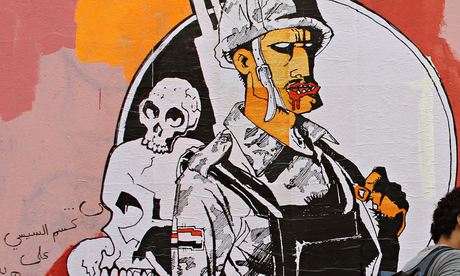
The Army Above All, by the Egyptian street artist Ganzeer

Some of the world's leading political artists are stepping up their efforts to produce street works protesting against the actions of Egypt's likely next president, Abdel Fatah al-Sisi.

International graffiti stars such as Sampsa, Ganzeer and Captain Borderline and the painter Molly Crabapple have begun to create designs incorporating the slogan "Sisi war crimes" in cities across Europe, the US and north Africa.

The artists say their initiative aims to encourage fiercer international criticism of Sisi's behaviour. World leaders court Egypt's former army chief despite his having ushered in an era of increased oppression after removing the country's former president Mohamed Morsi last July.

"We hope these works will alter the narrative about Sisi," said Ganzeer, one of the Egyptian artists who rose to global prominence following the country's 2011 revolution.

"It seems like Sisi will easily fool the international community that the majority of Egyptians side with him. All the images getting out there are of squares filled with Sisi supporters, with little to no news of the other side, unless it's of [Morsi's Muslim] Brotherhood. But there are people out there who are opposing who are not part of the Brotherhood."

Sisi's many supporters would dispute Ganzeer's perspective, as it is commonly believed inside Egypt that foreign politicians and journalists have sided against the government that Sisi installed last summer.

Ganzeer and his colleagues, however, feel the international community has done little to censure him and is fully reconciled to his expected election as president next month. They believe that more should therefore be done to shake it from its apathy.

"No Egyptian president will be able to survive without the support of international politicians," Ganzeer said.

The Finnish graffiti star Sampsa was the first artist to create anti-Sisi work outside Egypt. Best known for work that promotes fairer copyright law, Sampsa painted silhouettes signifying the bodies of dead Egyptians on Parisian pavements and a building in New York. The French artist Levalet, the Tunisian calligrapher El Cid and others also have works planned, and the Captain Borderline collective, the founders of Europe's largest street-art festival, plan to collaborate with Ganzeer on a large mural in Munich.

This work in Paris by Finland's Sampsa incorporates the slogan 'Sisi warcrimes'
  New-York-based Molly Crabapple will draw work inspired by the cages Egyptian dissidents are locked inside at trial hearings. "I'm disgusted with the way that the Egyptian revolution has been overtaken by a murderous military dictatorship that is in many ways worse than [ousted dictator Hosni] Mubarak," she said.

Ganzeer and his fellow Egyptian artists Zeft and Ammar Abou Bakr will continue to create anti-authoritarian works in Cairo, despite working in a context that is increasingly dangerous – a factor other street artists said had motivated them to show solidarity.

"These guys are the pioneers of modern-day political street art," said Sampsa. "The big stars [outside Egypt] don't give a shit about changing anything these days. But the guys down in Egypt, their work has a point. Their political art comes hand-in-hand with activism."

Previously largely free of artistic expression, Egypt's walls exploded with murals and slogans following Mubarak's removal in February 2011 and the graffiti was portrayed internationally as a symbol of the country's revolutionary gains.

Vote for the Pimp, by Ammar Abou Bakr

Making graffiti was never easy in the months that followed. The authorities often whitewashed the murals and suspicious bystanders sometimes mobbed the artists, but Ganzeer said it had never been as hard as it was now. The increased policing of public space, a new law curbing protests and a more aggressive public have made artists far more wary.

"The output now is much fewer and far between. People are still doing things, but maybe not with the same outpouring we saw in 2011 when there were new pieces every week," he said. Ganzeer was arrested in spring 2011 for posting anti-military stickers in public.

Like many of his colleagues, Ganzeer has often created work against the Muslim Brotherhood, but he now fears being taken for a member of the widely loathed group.

"The moment anyone sees you on the street, you're associated with the Brotherhood, and attacked very easily unless you can persuade them that you're creating something pro-military. So it's very difficult to create opposition work that hasn't just been made quickly."

To protect themselves, he and others have developed a technique that sees them add explicitly anti-authoritarian details to their designs only at the last possible moment.

While painting a recent mural on Mohamed Mahmoud Street, a road leading from Tahrir Square that is famous for revolutionary graffiti, Ganzeer easily persuaded passersby that the cartoon soldier he had drawn next to a pile of skulls was mourning the deaths of innocent Egyptians. It was only when he added blood to the soldier's mouth and then scarpered that the image, entitled The Army Above All, took on a more sinister meaning.

Since Sisi deposed Morsi last July following days of mass demonstrations, at least 16,000 Egyptian dissidents have been arrested, and thousands killed during protests. The crackdown initially focused on Morsi's Islamist supporters before expanding to secular-leaning activists.

The government and a sizeable section of society blame the violence on the Brotherhood, and say strong policing is necessary to quell a wave of terrorist activity. Ministers also maintain the country is on the path to democracy, and use May's presidential election to support their claims.

"This is not going to be an autocracy," Egypt's foreign minister, Nabil Fahmy, told the Guardian on Sunday. "If you're not doing it right, we will hold you accountable."


*Street art by Ganzeer, Sampsa & Ammar Abu Bakr
 

Sunday, March 30, 2014

General Sisi mocked as pimp in hashtag campaign

Al Jazeera
Sisi mocked in Egypt internet campaign

Presidential hopeful subject of sarcastic "vote for the pimp" movement on social media, leading to calls for a ban.

March 30, 2014

 
Opponents of Abdel Fattah al-Sisi have launched an internet campaign against his bid to become the Egyptian president, leading to calls from the pro-Sisi camp for a ban on social media.

The Twitter hashtag, roughly translated from Arabic as "Vote for the Pimp", is being used on Facebook and Twitter in several languages to mock Sisi's announced plans to run in the presidential poll in April.

According to the tracking website, Keyhole, the hashtag achieved more than 100 million impressions within days of creation, and generated tens of thousands of messages on Twitter. Keyhole states that 23 percent of the hashtag's impressions came from outside Egypt.

"The power cuts four times a day, therefore #vote_for_the_pimp," read one of the tweets.

The word "pimp" is extremely offensive in Egyptian culture, but its use also mockingly references the North American meaning: showy, impressive, the boss of a gang.

It comes in response to pro-Sisi hashtags over the past months, including "I will vote for Sisi" and "Complete your good deed", reflecting the general's soaring popularity among many Egyptians.

The use of the phrase has also broken beyond the realms of the internet: Footage taken by activists during Friday rallies in Egypt shows protesters chanting "Vote for the pimp, a president for Egypt."

Graffiti has also appeared in Egypt carrying the phrase.

But calls were made by several talk-show hosts condemned the campaign.

Khairy Ramadan, a CBC TV host, said it was a "character assassination ... supported by the terrorist Muslim Brotherhood", and called for Twitter to be blocked.

Emad Adeeb, another host, said Egypt should follow the example of Turkey, whose prime minister, Recep Tayyip Erdogan, blocked Twitter and the video sharing website, Youtube, after leaks of sensitive information.

“Erdogan has shut down Twitter altogether simply because they described him a thief,” he said.

The presidential election will come almost 10 months after Sisi, as defence minister and army commander, led military efforts to remove from power the country's first elected civilian president, Mohamed Morsi.


*Photo of Sisi propaganda memorabilia courtesy of REUTERS

Thursday, October 31, 2013

CC on the walls: Graffiti mirrors Egypt's political tug-of-war

Mada Masr
CC on the walls: Cairo's graffiti mirrors political tug-of-war 

Thursday, October 17, 2013

Jano Charbel


Cairo’s streets have been overtaken by a new kind of political rhetoric. A barrage of hastily scrawled “anti-coup” graffiti covers walls, billboards, sidewalks, garbage cans, trees — almost any surface that can be written on or spray-painted.

This new wave of political graffiti is the handiwork of supporters of deposed President Mohamed Morsi. And it has come to dominate the political graffiti and street art scene that flourished after the January 25 uprising, but went dormant after Morsi’s ouster on July 3.

Protests demanding Morsi’s reinstatement clearly denounce the interim government and the military’s intervention in politics, which demonstrators call a coup. But above all, they staunchly oppose Defense Minister Colonel General Abdel Fattah al-Sisi, who is the target of most of their graffiti messages.

Anti-coup and pro-Morsi graffiti is perhaps most prevalent in Cairo’s eastern district of Nasr City, where troops forcefully dispersed the largest pro-Morsi sit-in outside the Rabea al-Adaweya Mosque on August 14, resulting in more than 600 deaths, thousands of injuries and hundreds of arrests.

Virtually every street in Nasr City is covered with graffiti denouncing military rule, the “bloody military coup” and Sisi, whose name has been abbreviated to the Roman letters CC.

The most common graffiti messages claim that “CC is a traitor,” “CC is a killer” and “CC is here” — the latter message commonly painted on garbage cans.


The words “anti-coup” written in English are also seen frequently, as are “coup = terrorism” and the popular chant by Muslim Brotherhood supporters: “Depart oh Sisi, Morsi is my president.”

The only form of expression left

On October 6, the Muslim Brotherhood and their allies in the umbrella group that calls itself the Anti-Coup Alliance organized protests across the country. When some tried to enter Tahrir Square, they clashed with security forces and scattered to surrounding neighborhoods, where they also faced off with residents of the areas.

Marching through Nasr City with a small group of around 100 Morsi supporters, one protester swiftly spray-painted his graffiti on a billboard: “Down with military rule.”

The young man refused to be interviewed and angrily demanded that he not be photographed while spray-painting.

Standing by his side, another young Morsi supporter who identified himself only as Mahmoud said, “They’ve killed and arrested us. They’ve censored and banned all our media outlets. And so we are left only with our peaceful protests and peaceful expression.”

According to Mahmoud, “These writings are the means by which we deliver our messages of opposition against the bloody coup.”

Both of them quickly walked away to catch up with the advancing march.
 
But where is the art?

Meanwhile, the street artists of the 2011 uprising appear to have either abandoned their art, chosen to remain silent or been forced underground in the months since mass protests led to the Armed Force’s removal of the former president.

“Nowadays, the politically charged atmosphere is not conducive to making attractive or artistic graffiti and murals,” says Alexandria-based artist Aya Tarek. “Graffiti is presently viewed as being garbage, something that should be cleaned up or covered up.” 

Indeed, authorities have whitewashed older murals and street art commemorating the 2011 uprising and its subsequent struggles — images that had become iconic of the fight and those who lost their lives for it.

For Tarek, the new types of graffiti that are taking the place of the old murals are “more like vandalization rather than art.”

The activists involved in these new graffiti campaigns appear to be more interested in publicly posting their messages than in the aesthetic value of their graffiti. In Cairo, they have produced no murals and very few stencils, forms which became prevalent over the past three years.

The most common stencils include Morsi’s bearded and bespectacled face along with the four finger salute signifying Rabea (four) al-Adaweya, with the letters “R4BIA” beneath the hand.

According to the revolutionary street artist Omar Mostafa, the graffiti painters of the Brotherhood and Anti-Coup Alliance “use quick freehand writings.”

“They don’t produce murals or intricate street art, as they are afraid of being arrested,” he says. “These people don’t have the opportunity to stand by and prepare a time-consuming mural. If they attempted to do so they would be attacked by the populace and arrested by the police.”

It does appear to have become more dangerous to make street art in recent months. On the 40th anniversary of the October 6 War, authorities arrested the anti-authoritarian and anti-Morsi street artist Ahmed Naguib as he was painting graffiti critical of the police near Tahrir Square on Mohamed Mahmoud Street — a veritable open air street art gallery.

A few weeks earlier, on September 19, security forces arrested two members of the Ultras White Knights after they spray-painted messages critical of the police near the Zamalek Sporting Club in Cairo. Security forces also reportedly arrested a number of Morsi supporters while painting “anti-coup” messages, but the total number of these arrests is not known.

But Mostafa doesn’t think the need for speed is an excuse. “They’re using our earlier paint-and-run tactics. Moreover, their graffiti lacks originality and artistic value,” he claims.

Mostafa argues that the four-fingered “R4BIA” insignia, especially its yellow and black colors, was inspired by previous street art associated with the No to Military Trials campaign.

Street artist Amar Abu Bakr agrees that the pro-Morsi camp is recycling previously used ideas and art forms.

“Nevertheless, this is their way of expressing themselves following the crackdown at Rabea, just as we expressed ourselves through street art and murals of martyrs on Mohamed Mahmoud Street,” after bloody clashes took place there in 2011 and 2012, he says.
 
Sectarian street messages

Despite being victims of violent crackdowns, the Anti-Coup Alliance has also produced more divisive and intolerant messages.

Immediately after security forces forcefully dispersed the Rabea and Nahda Square protest camps, a series of nationwide attacks targeted tens of churches, Coptic homes and properties.

While the Muslim Brotherhood and its political wing, the Freedom and Justice Party, officially denounced these sectarian attacks, pro-Morsi graffiti around the Rabea sit-in carries clear sectarian messages.

Pro-Morsi Islamists condemned the Coptic Pope Tawadros II and the Grand Sheikh of Al-Azhar for openly siding with General Sisi’s removal of Morsi.

After the military stepped in on July 3, messages of a sectarian nature sprung up around Nasr City: “CC is the dog of Tawadros,” along with “CC is the dog of the cross” and “Down with the pope’s rule.”

Most of these were painted over when sectarian assaults escalated after the August 14 dispersals.
More recently, the symbol of the cross has been replaced by that of the Jewish Star of David, with newer graffiti reading “CC = Star of David” or “CC is the agent of Star of David.”
 
Cat and mouse

Often, graffiti messages from opponents and supporters on both sides are layered as the political fight plays out on the walls of the city.


Anti-coup graffiti is sometimes painted over altogether. In some cases, the letters “CC” are visibly crossed out and replaced with “Morsi.” Other times, words denouncing Sisi are erased while the letters “CC” are left and placed inside a heart shape.

“Wipe it off and I’ll paint it again” reads one message on the walls where pro-Morsi graffiti was whitewashed.

Around the Ettehadiya Presidential Palace, a military stronghold and bastion of pro-Sisi sentiments, pro-army graffiti screams “God damn Rabea” along with an assortment of anti-Morsi messages.

Describing such graffiti as an eyesore, Tarek says, “All these accusations and curses, back and forth, are merely insults written on walls, not street art. I wouldn’t even call it graffiti.”

“I want to re-enter and revive the street art scene, using good materials to make quality art. Yet collective street art events are not taking place because of the current unrest and instability,” she says.

Tarek aspires to create beautiful art on Egypt’s streets to replace the now-prevalent political graffiti which is scribbled on walls, blotched-over and re-painted.

“My work is not political, it is purely artistic,” she says.

Mostafa points out that “the present political situation is unclear and uncertain. The state’s so-called ‘war on terrorism’ and other propaganda is being instilled in the populace — so if we are involved in street art critical of the security forces, then we will be accused of being members of the Muslim Brotherhood, or terrorists.”

He believes there will be a “resurgence of proper street art in the near future when the political situation becomes clearer and more settled.”

Abu Bakr and other street artists are working on a large mural on Qasr al-Nil Street in downtown Cairo. He insists the street art scene has not died.

“People need to know who killed the martyrs, and people need art in their everyday lives — not merely for those who can afford to go to an enclosed art gallery, but for everybody walking or driving past on the streets.”

“We are not hiding,” he says, “Anti-graffiti laws will not keep us from expressing ourselves through street art.”


*Photos by Jano Charbel

Sunday, September 29, 2013

Egyptian Arrested for Naming Donkey After General Sisi

Associated Press

Egyptian Arrested for Naming Donkey After General

 September 21, 2013

MARIAM RIZK


CAIRO (AP) - A farmer in southern Egypt was arrested Saturday after putting the military chief's name and an army-style cap on his donkey, and eight people were detained elsewhere in the country for spraying anti-military graffiti.

The arrests point to a long-standing taboo in Egypt against criticizing the country's powerful military, an offense magnified amid the ongoing crackdown on supporters of the country's ousted President Mohammed Morsi and his Muslim Brotherhood.

The farmer, Omar Abul-Magd, was arrested late Friday in Qena province for allegedly insulting Gen. Abdel-Fattah el-Sissi when he rode the donkey through town, reported the state MENA news agency.

El-Sissi led the military's popularly-backed ouster of Morsi in July and has been hailed by millions of Egyptians as an icon. His detractors, however, have called him a traitor and a murderer for overseeing the coup and the subsequent attacks on Morsi's mostly Islamist supporters, including an August raid on two pro-Morsi sit-ins in Cairo that set off violence that killed hundreds nationwide.

At least one of the eight people arrested on Saturday for spraying graffiti against el-Sissi was detained in Cairo, said security officials, speaking on condition of anonymity because they were not authorized to talk to the media.

Earlier this week, a military court ordered five pro-Morsi protesters to serve from two to three years in prison for chanting against the army. Three of them were tried in absentia.

The court said the defendants spread hate speech and false rumors against the military through loud speakers.

Rights advocates fear Egypt's interim, military-backed authorities are using a state of emergency that grants police broad powers of arrest to silence critics.

For decades, any critical mention of the country's army or its top generals was unthinkable in Egypt.

After the popular uprising that ousted autocratic President Hosni Mubarak in 2011, criticism of the military grew as Egypt's powerful generals took over. Activists began lashing out at the ruling generals for trying civilians in military courts and using violence against protesters.

In one case, former lawmaker and rights advocate Ziad el-Oleimi came under fire for referencing an Egyptian proverb that some saw as an insult to then-military ruler Field Marshal Hussein Tantawi. El-Oleimi, who was earlier beaten by military police during a protest after he was elected to parliament, had referred to Tantawi as a donkey during a rally.

Thursday, May 30, 2013

Activist stands trial for insulting dictator Morsi

Associated Press

Activist to be tried for insulting Egypt president

May 02, 2013

Adel Dorra

TANTA, Egypt (AP) — Prominent Egyptian activist Ahmed Douma was arrested and immediately referred to trial for allegedly insulting the country's president in a TV interview, a prosecutor said Thursday.

Douma is to stand trial on Sunday — less than a week after being arrested. He is the first prominent opposition activist to be tried on charges of insulting Islamist President Mohammed Morsi.

There have been a myriad of complaints levied against journalists and TV personalities, including well-known satirist Bassem Youssef, for insulting Morsi.

Rights groups say such charges restrict freedom of expression.

"The crime of insulting the president is vague and undefined," the Egyptian Organization of Human Rights, one of Egypt's oldest such groups, said in a statement on Thursday. "Most criminal codes in the world have abolished such crime."

In Egypt, such a crime is punishable by up to three years in prison. A teacher in southern Egypt was sentenced to six years in prison in September for insulting Islam's prophet Muhammad and Morsi in comments posted on Facebook. A prominent TV presenter was acquitted on charges of insulting the president and spreading false information following an appeal.

Government prosecutor Mohammed el-Taneekhi said Douma was arrested Tuesday after a member of Morsi's party, the Muslim Brotherhood, in Tanta complained that Douma had called Morsi a "killer" and a "criminal."

In his comments, Douma, a prominent activist who was among those at the forefront of the 2011 uprising against longtime autocratic leader Hosni Mubarak, blamed Morsi for a violent security crackdown on protesters in the coastal city of Port Said that left 40 people dead. Douma, in his interview on Sada el-Balad private TV in February, also held Morsi responsible for an attack by Brotherhood members in December on a sit-in by anti-government protesters outside Morsi's office.

"He is a president that is lacking legitimacy after the first blood was shed in the streets during his reign," Douma said in the interview.

"He is ruling Egypt forcefully. ... I don't see a president ruling Egypt. I see someone called Mohammed Morsi, a criminal evading justice, who is hiding in the presidential palace," Douma said, prompting a co-guest, a pro-Morsi lawmaker, to leave the studio in protest.

"There must be respect for state symbols," lawmaker Leila Sami, said before leaving.

Douma, who is also a poet, has been a vocal critic of Morsi and his government since the president was elected last summer.

He was beaten up in March during a rally outside the Muslim Brotherhood's office by the group's guards for painting graffiti they deemed offensive. The incident prompted a major rally a few days later leading to the worst clashes between Morsi supporters and critics in months.

Following these clashes, Douma was summoned for questioning on accusations of inciting violence, but he refused to turn himself in, questioning the legitimacy of the order by the prosecutor general. A court order recently annulled the presidential appointment of the chief prosecutor, a decision that he plans to appeal.

Douma also was imprisoned under the ousted regime of President Hosni Mubarak for criticizing the ex-president's policies and for illegally traveling to the Gaza Strip and blogging from there during an Israeli offensive.

Rawda Ahmed, a lawyer for the Arab Network for Human Rights Information which is part of Douma's defense team, said the activist was swiftly referred to trial before his lawyers had a chance to see the charges or find out where he was held. She said that instead of a customary bail, the prosecutors decided to keep Douma locked up until his trial "because he is causing them a big headache."

Ahmed said such court cases have been increasing, and were in part encouraged when the presidency itself filed such complaints against at least four journalists. The human rights network said in a recent report that the number of court cases and complaints involving charges of insulting the president during Morsi's 10 months in power is four times the number filed during Mubarak's entire rule of nearly 30 years.

Deputy prosecutor general Hassan Yassin told The Associated Press the complaint against Douma had been filed and investigated for a while, and that only after he was custody on Tuesday, did the prosecutors send it to trial. He noted that the presidency has dropped all its complaints against journalists accused of insulting the president.

At least one journalist, however, face trial in a case filed by citizens accusing them of insulting the president and spreading false information.

Morsi supporters say they find scathing criticism of Morsi offensive.


*Additional reporting by Sarah El Deeb.

Monday, December 31, 2012

Initiatives grow to fight sexual harassment in Tahrir

Egypt Independent

Hands off: Initiatives grow fighting sexual harassment in Tahrir and elsewhere

Sat, 08/12/2012 

Jano Charbel


“Don’t go there” and “Stay out for your own safety” have been the menacing messages from alarmist male protesters with which many women are welcomed into Tahrir Square, the cradle of the Egyptian revolution.

The reason: rampant cases of sexual harassment, assaults and even rape of women in and around the square.

Seen as a way of deterring women from participating in protests, sexual harassment has become a focus for activist groups, filling the gap of inaction by the state.

“Harassers are not allowed entrance” was the message hung up by some of these groups in the square. But the problem is bigger than banners.

The problem

Tahrir, which was the focal point of the uprising that deposed Hosni Mubarak last year and remains a central gathering point for major protests since the 25 January revolution, has been plagued with numerous incidents of sexual harassment and physical assaults against women, including female protesters, journalists and passers-by.

These cases appear to be perpetrated by individuals as spontaneous outbursts of mob violence, and organized harassers working in tandem to assault females in the square.

Dina Farid, founder and coordinator of the Banat Misr initiative, says “there is a concerted effort to scare away people from the square — especially female protesters.” The group has reported about a dozen cases of sexual harassment or assault within just three days.

“We have reported both individual [and] isolated acts of harassment and organized mob harassment,” Farid says, clarifying that mobs of harassers act in groups to encircle and assault females.

Operation Anti-Sexual Harassment Coordinator Aalam Wassef also suggests there is a deliberate attempt to scare women away from the square.

“Harassers are targeting women with the intent of making the square feel threatening and unsafe,” he says, adding that organized harassers also seek to tarnish the image of Tahrir Square.

“Some cases of harassment are spontaneous, like the everyday cases of harassment against women that take place across Egypt’s streets,” Wassef says.

However, many cases of mass harassment are attributed to “mob mentality,” or, in some cases, “mobs that work in coordination to collectively harass women.”

“In previous occupations of Tahrir Square, we’ve noticed that coordinated and organized mobs of harassers often carry weapons with them. They are quite likely paid and armed to do so,” Wassef says.

He comments that organized acts of sexual harassment or assault were utilized against protesters during the rule of ousted President Hosni Mubarak, the Supreme Council of the Armed Forces and presently under the regime of President Mohamed Morsy.

Reem Labib, another volunteer from Operation Anti-Sexual Harassment, also sees a conspiracy in the widespread harassment in Tahrir.

“Egyptian women are subjected to harassment on a daily basis, yet organized harassers in the square utilize violence to target not only women, but also the revolution. They use both physical and psychological violence against protesters in the square,” Labib says.

In her film “Sex Mobs and Revolution,” filmmaker Ramita Navai reveals that harassers hailing from a low-income Cairo neighborhood were previously paid by men tied to the Mubarak regime to disrupt protests, and that they are still paid to do the same. But they refuse to identify who is paying them now.

Perpetrators’ use of arms is further fueling suspicion about conspiracy, while the victim can be a mother, a veiled or a conservatively dressed woman.

“Some of the [group] harassers apprehended have been found to be carrying knives, while others have been found with drugs and pills,” says Farid.

Mohamed al-Azaly, lawyer and volunteer with Banat Misr, says that “while some have been found carrying drugs, most of the harassers are sober and are well aware of the acts they are committing against women.”

“It doesn’t make a difference whether a woman has her hair uncovered, or is wearing a hijab or even a niqab,” Azaly says. “All these women have been harassed here in the square.”

He says he had helped pull out two women donning the full face veil from a collective assault against them in the square.

“They were a mother and her daughter, both of whom were dressed in conservative Islamic attire, and nonetheless they were attacked,” Azaly says.

“Many of the women harassed have violently had their clothes ripped off in these assaults,” Farid adds.

Solutions

Over the course of the past week, three volunteer groups have emerged in Tahrir to patrol and protect women and girls from sexual harassment and assault in and around the square. 

Their work includes both prevention by monitoring and protection by helping out victims and intercepting the attackers.

The first to make its appearance was Banat Misr Khatt Ahmar — literally translated as Egypt’s Girls Are a Red Line — which has been involved in monitoring incidents of harassment around downtown Cairo since the Eid al-Adha holiday in late October.

Banat Misr resumed its operations, this time exclusively in Tahrir, on 29 November. The group has about 30 members, including males and females, all of whom wear white T-shirts with the group’s logo clearly emblazoned on them.

There are clearly more male volunteers in this group than females. The female volunteers are said to be more involved in the counseling and psychological assistance of women subjected to harassment or assaults in the square.

Azaly explains the group’s tactics in weeding out harassers from the square.  

“Together, we rush to the scene of the harassment. We form a cordon around the harassers and pull them out. We then take them to our tent, where we have them call their parents, or wives if they are married, to come claim them from the square.”

Azaly adds that if the harassers do not cooperate, they send them to Qasr al-Nil Police Station, and that most of these harassers are “either released the same day, or are held in detention for a day or two.”

“As of yet, no victims have been willing to press charges against their harassers — perhaps from fear of stigmatization, a drawn-out judicial process or other considerations,” Azaly concludes. “We hope that women will be willing to follow through with these legal steps against their harassers. If so, then the harassers may truly be held accountable and brought to justice.”

Farid says they take photos of the perpetrators to identify them in the future, and to keep them away from the square, but says they have not taken down their names or personal ID information.

The Operation Anti-Sexual Harassment group, also known in Arabic as Quwwa Ded al-Taharosh, made its first appearance on 30 November, when protests returned to Tahrir Square after Morsy’s controversial constitutional declaration, through which he claimed additional powers for himself. Mosireen, a revolutionary media collective, and other volunteers established the group.

Consisting of 30-some members, Operation Anti-Sexual Harassment also wear white T-shirts or sweatshirts with a red logo reading “Against Harassment” on the front and “A Square Safe for All” on the back. It uses the same group tactics employed by Banat Misr in weeding out harassers.

Wassef says this group reported about five cases of harassment on its first day alone.

Both Banat Misr and Operation Anti-Sexual Harassment have provided the public with social networking sites and telephone hotlines through which people can report cases of harassment or assault and other related information.

A third volunteer group known as Tahrir Bodyguards could not be reached for comment. It has been reported that this group has built wooden watchtowers from which to monitor incidents of harassment within the square.

Protesters have climbed these watchtowers and protested from above, yet no volunteers could be seen on these towers.

Wassef explains that there should be wariness about the terminology in use, which reflects the depth of the problem. He explains that the word taharosh, or sexual harassment, has replaced the much milder word, mo’aksa — roughly translated as heckling or chiding — to describe “these unwelcomed actions” against women and girls.

In his group’s experience, there are several degrees of sexual harassment, ranging from verbal to touching or groping, stripping and other forms of violent action, as well as rape.

“Rape does not necessarily involve penetration with the harassers’ genitals. Rape can be perpetrated with fingers or other objects,” Wassef explains.

Nonetheless, many activists continue to use the term “sexual harassment” as opposed to “sexual assault,” even when describing cases where women have been physically or sexually attacked.     

But other than volunteer-based initiatives to combat sexual assault, more wide-ranging activities are needed to end this plague.

Wassef thinks the state, through its Egyptian Radio and Television Union, could be the most effective in combating sexual harassment.

“If only they’d launch anti-harassment ads, public service announcements, documentaries and awareness-raising programs, then we would have a very effective tool with which to confront harassers,” says Wassef. “Yet the authorities lack the will to do so.”

Banat Misr’s hotlines can be reached at 012-8034-4414 or 010-1687-6333.

Operation Anti-Sexual Harassment’s hotlines can be reached at 011-5789-2357, 012-0239-0087or 010-1605-1145.

This piece was originally published in Egypt Independent's weekly print edition.

 

Thursday, November 29, 2012

Egypt: The legacy of Mohammed Mahmoud Street

BBC News

Egypt: The legacy of Mohammed Mahmoud Street

A year on from clashes between protesters and security services in central Cairo, the BBC's SHAIMAA KHALIL reports on the impact they had on the country's ongoing transition to democracy.


The walls lining Mohammed Mahmoud Street look like a mural chronicling the battles it has seen.
The names and faces of those who died in street battles with security forces feature heavily.

"Glory to the martyrs," one piece of graffiti says. "Take to the streets," urges another.

Some of the paintings are of those who lost their eyes.

The eye patch has become a prominent symbol of resistance since the Mohammed Mahmoud clashes erupted last November.

The critical location of Mohammed Mahmoud street - just off Tahrir Square and leading to the interior ministry - made it a constant scene of ongoing battles between protesters and security forces.
But on 19 November 2011, those clashes took on a new level of violence.

For about six days Egypt's riot police, the Central Security Forces (CSF), suppressed protests in Tahrir Square and Mohammed Mahmoud Street.

The protests started after the security forces dispersed a sit-in organised by families of those killed or injured in the uprising in Tahrir Square in January and February 2011.
 
News of what had happened to the families spread quickly and people started heading to the square.
More than 40 people were killed in what was to become one of the most violent clashes since the fall of President Hosni Mubarak in February.


'EYE SNIPER'

Three main things made the November clashes stand out.

First, the ferocity of riot police in response to protesters.

The security forces have said that they used force to protect their headquarters, the interior ministry. But many saw this as them avenging their lost pride after they were forced to withdraw from the streets in January 2011 during the 18-day revolution which toppled Mubarak.

Secondly, the use of tear gas.


This in itself was not new, but the intensity with which it was used was. Protesters reported severe symptoms after inhaling tear gas.

One medical volunteer at a field hospital on the edge of the square said at the time that he saw people suffering problems with their nervous system and having epileptic fits.

Others said people were coughing up blood and collapsing.

Some suggested that the Egyptian security forces had been using stronger kinds of gas.
In the end, there was no solid evidence that anything other than CS gas (the chemical compound used in most tear gas canisters) had been used.

But scenes of young men and women being carried away on motorcycles - which became improvised ambulances at that time - became a very prominent image of the Mohammed Mahmoud clashes.

Thirdly, the "eye sniper": the phenomenon of the many protesters who were shot in the eye.

One of those was Ahmed Harara, who has become one of the most famous faces of the revolution.

Ahmed had lost an eye on 28 January and was known around Tahrir Square for wearing an eye patch which carried that date.

On 19 November, Ahmed was shot in his other eye.

A famous YouTube video showing an officer aiming his rifle at a protester as his colleagues cheered him on for "getting the boy's eye" led to calls for his arrest and investigations into what is now known as the eye sniper.


POLITICAL MILESTONE 


The irony was that all of this was happening as Egypt was preparing for the first democratic parliamentary elections in its history.

But Egypt's political milestone faded in the background of yet another wave of violence.

Instead of taking to the polls, many protesters in Tahrir Square called for the cancellation of the elections and deemed them pointless so long as the Supreme Council of the Armed Forces (SCAF) was in power and protesters were being killed.

Others insisted on voting, saying that this was the moment they have been waiting for - that for the first time, their vote counted for something.

In some streets in Cairo, especially the ones closer to Tahrir Square, banners calling for the end of military rule and saying that the "revolution was ongoing" hung side-by-side with election campaign posters.

The parliament that has come out of these elections was annulled, then reinstated, then annulled again.

It is one of the many confusing political manoeuvres Egyptians have been trying to get to grips with.
The ruling military did hand power to Egypt's first democratically elected President, Mohammed Mursi.

A few months after that, the leadership of the military council was forced into retirement.


Despite all these changes, Egypt remains at a very delicate point in its history.

The dwindling economy, security vacuum and general sense of frustration and mistrust in the country's leadership are all reminders of how challenging life is in Egypt.

And a year on from the Mohammed Mahmoud clashes, Egyptians are also reminded that potential violence lurks in country's volatile streets.

*Photos courtesy of BBC, REUTERS, AP 

Wednesday, November 28, 2012

Persistent battle against rampant sexual harassment in Egypt

Palestinian News Network

The Persistent Battle on Rampant Sexual Harassment in Egypt

Saturday, 10 November 2012

Alessandra Bajec


735 police complaints about harassment were recorded over the four-day Eid al-Adha which ended last 29th October, according to a statement released by the Egyptian government.

Sexual harassment continues to hit Egypt with increasing reports of incidents taking place across the country. Yet, Egyptians today acknowledge this long-standing problem exists, and growing social mobilization has brought together men and women in the fight against harassment.

Sexual harassment remains a widespread plague in Egypt facing girls and women on the streets, in public places, at police stations.

In past years, there have been major incidents of male mobs attacking women over holiday celebrations. In 2006, a group of girls were sexually assaulted during Eid el-Fitr, raising alarm on the epidemic for the first time.

Since the Egyptian revolution, sexual violence became more prominent amid several instances of crowds aggressing women in Tahrir Square.

Since 2011, numerous cases of violence and torture against female protesters by the Supreme Council of Armed Forces and Ministry of Interior have been reported, involving beatings, clothes stripping, and virginity tests.

Tarek Mustafa, Program Officer at Nazra Feminist Studies, highlights the politicization of sexual harassment at a time when police forces are using women’s sexuality as a tool to oppress the masses.

The 2001 revolution has brought with it a wave of realization of rights. Today, Egyptians no longer stay silent in the face of injustice, women are out on the streets and push their battle on the political agenda.

After being a ‘taboo’ for years, harassment has become an open debate. The anti-harassment movement in Egypt developed around 2005, when the Egyptian Center for Women’s Rights (ECWR) started a campaign against sexual harassment.

Nihal Saad Zaghloul is one of the founders of Haraket Basma (‘Imprint Movement’). She points to HarassMap as the first concrete effort to act for women’s safety. Launched in 2010, the site is a social initiative enabling women to instantly report sexual assaults in Egypt via SMS messaging. By mapping those reports, the system helps women through advice on how to file a police report, find psychological help and self-defense classes. 

Dina Hussein, lawyer and coordinator of Nefsi (‘I wish’) mentions human chains, marches, online campaigns, and social media platforms among the mediums used to promote the battle on sexual violence. Furthermore, she refers to campaigns to raise awareness inside metro stations, at schools and universities, in poor neighborhoods.

More and more initiatives have been launched by women’s groups, feminist organizations and youth groups.

During Eid holiday last August, Basma organized volunteer patrols at metro stations, in coordination with metro authorities. Volunteers were instructed to stop harassers and report them to the appropriate authorities. The patrolling was very successful in preventing many incidents, and helped the police arrest several harassers.

Nazra’s Program Officer talks about a tweet forum, co-organized by Nazra in December 2011, explaining how the patriarchal protection model fails to solve the problem, and needs to be replaced by a feminist discourse arguing for women empowerment.

Over the past year, several art campaigns have been organized in Cairo to shed light on the topic including ‘Female Graffiti’ last March. Mustafa recalls ‘Enough’, a group exhibition held last June-August, organized by Darb 1718 art space and Harassmap, featuring artists who tried to break social taboos around the issue through visual art.

A strong supporter of women’s rights, Mustafa denounces harassment carried out by men of any socio-economic class, including violence in workplaces and night clubs which is hardly ever talked about.

Hussein recognizes there are more cases reported by women now, however certainly less than the actual incidents. Nevertheless, she thinks official complaints will help to press for an anti-sexual harassment law.

Besides the lack of appropriate legislation, there is no supportive network in place. One main issue is the general public does not do anything when a woman is subjected to harassment, most people refuse to help as eye-witnesses.

Similarly, the police often do not interfere to stop or take legal action against harassers.

Basma’s director stresses the need to work collectively to make harassment socially unacceptable and step in, instead of leaving women alone.

Nefsi’s coordinator points out that harassment, directed at both Egyptian and foreign women, not only has a direct psycho-social impact, it affects the country’s economy, tourism, hitting on the production amid rising unemployment.

Sexual harassment is only a manifestation of decades of bad governing, corruption, political and social oppression. Under Mubarak, there were rare talks on the topic, the widespread mentality was driven to blame the victim and exempt the perpetrator, the woman was relegated to the bottom of society.

As a result, the entire upbringing of Egyptian people has been damaged, and harassment has become socially and culturally enrooted.

While Egypt’s grassroots movement is using every possible means to put an end to sexual harassment, the new government is called to tackle this social, cultural and political issue on more than just one level.

From introducing a law to criminalize harassment to increased enforcement, raising awareness in cooperation with civil society and concerned government agencies, to promoting efficient upbringing in families, educational institutions and in social environment, President Morsi and his government are left with the big task to ensure the problem is seriously addressed once for all. 

Graffiti artists defend murals near Tahrir with 'Quranic verses'

Ahram Online
Popular pro-revolution graffiti artist, Ammar Abu Bakr, uses Quranic verses to mock Friday Sharia protesters after reports his work was defamed by some demonstrators


Minor clashes erupted in Mohamed Mahmoud Street near Tahrir Square on Friday between revolutionary Graffiti-supporters who gathered to close down the street to protect art work on its wall from potential vandalism, and Salafist demonstrators.

According to an Ahram Online reporter on the ground, dozens of young protesters gathered at Mohamed Mahmoud Street and attempted to form a popular committee to ban Salafists from entering the street.

The clashes allegedly started after rumors circulated that Salafist protesters erased the graffiti of the Egyptian uprising's martyrs on the street and replaced them with Quranic verses.

According to Al-Ahram Arabic news website, the verses were drawn by pro-revolution graffiti artist Ammar Abu Bakr and his partners on Thursday night.

The graffiti artists used Quranic verses to communicate with the Islamists "in their own religious language," according to Abu Bakr.

One illustration mockingly denounced "those who spread immorality around the world," describing the Friday Sharia protesters as shameful.

Thousand of Salafists gathered in Tahrir square Friday to demand a Sharia-based constitution.


*Photo courtesy of AhramOnline

Wednesday, October 31, 2012

Preserving Egypt's revolutionary graffiti

Associated Press
October 7, 2012


Graffiti has been among the most powerful art forms and tools of Egypt’s revolution and the turbulent months since, but it also has proven to be its most vulnerable and ephemeral.

For nearly two years, the slogans, portraits and artwork that went up on walls around the country depicting the goals, heroes and events of the uprising have been erased nearly as quickly.

So a group of artists, photographers and a publisher joined hands to preserve the images. “Wall Talk” - their newly released 680-page book - collects hundreds of photos of graffiti dating from the Jan. 25, 2011 eruption of the revolt against then-President Hosni Mubarak until today. The result is a street history that chronicles image by image the evolution of Egypt’s upheaval, which has yet to settle.

In a sign of the continuing resonance of graffiti, the artists have recently turned to a new target: Newly elected Islamist President Mohammed Mursi.

Last month, a giant mural of revolution graffiti on a street off Tahrir Square, the focus of the revolution’s protest demonstrations, was partially painted over, and within hours, artists refilled much of it with new images, some of them denouncing Morsi and his Muslim Brotherhood.

“You are a regime that is frightened by paint brushes and pens, you oppress and stamp on the oppressed. If you were doing the right thing, you would not be afraid of what’s painted ... but you are a coward in your heart of hearts,” reads a rhyming Arabic verse, addressing the president, one of the new images on the street, where some of the deadliest clashes between protesters and security forces took place last year.

But already the whitewashing has returned, erasing a portrait ridiculing Mursi, showing him with a smug smile and the inscription, “Happy now, Mursi?”

“Wall Talk” publisher Sherif Boraie says graffiti was the vehicle that delivered clear, strong and angry messages during the anti-Mubarak uprising and afterward. Now it reflects the depth of frustration over the perceived failure of the revolution to realize its main goals, he said. He sees the latest to go up as even angrier.

“We are in a difficult period, and the youth are very angry, while avenues for expression for them are limited,” he said. “Will the anger continue to simmer indefinitely without boiling over? I don’t think so.”

The book includes a chronology of events of the past two years, but the images speak most strongly to the arc Egypt has taken. The pictures also show graffiti’s increasing sophistication. 

Graffiti was almost never seen in Egypt during Mubarak’s 29-year rule, where police kept a tight grip and where society generally frowns on street art of any kind. But it was the ideal medium for the leftist and progressive youth activists who led the protests against Mubarak.

“It’s an important part of history,” said one prominent artist whose graffiti appears in the book and who identifies himself only by his pen name “Ganzeer,” Arabic for chain. “Many of the graffiti photographed and published in the book have been removed or painted over.”

During the 18 days of massive protests against Mubarak’s rule, much of the work was simply scrawled slogans, like the simple word “Erhal,” the Arabic word for “Leave!” next to images of Mubarak.

After Mubarak stepped down on Feb. 11, 2011, the message and the images changed, with a colorful burst of optimism. There were the clinched fists symbolizing power and images suggesting unity and harmony between the nation’s Muslim majority and Christian minority, with high expectations and a sense of confidence that if people power can bring down Mubarak’s dictatorship, it can do anything.

“It’s just the beginning,” read the English words alongside drawings of women with long hair in the black, red and white colors of Egypt’s flag on one Cairo wall, shown in the book. The exuberant slogan “Hold your head high, you are Egyptian” was found on walls around the capital. One graffito was written on the pavement, reading: “Don’t look down, freedom is ahead of you.”

But very quickly the word on the walls turned to revolt once more - this time against the military council of generals that took power after Mubarak’s ouster and ruled until Morsi was elected this year and was inaugurated in late June. Protests repeatedly broke out against their rule and were met by bloody crackdowns.

Graffiti portraits mocked the council’s head, Field Marshal Hussein Tantawi - who was later removed by Morsi - and other generals, unprecedented in a nation where the military has held immense powers since a 1952 coup and was considered above questioning.

Throughout the past 19 months, graffiti has also sought to keep alive the spirit of the young activists’ vision of the revolution despite continual setbacks - including by enshrining their heroes.
Slogans often went beyond current events to encourage change in a society accustomed to dictatorship. “The truth is not cruel, but freeing oneself from ignorance is as painful as going into labor,” one cries out. “Chase after the truth until you are breathless. Endure pain so you can be born again.”

A common theme was elaborate portraits of the “martyrs,” the hundreds of protesters killed in multiple crackdowns. Some shown in the book are idealized, even giving them an angel’s wings. Others depict them casual and smiling, as if they are standing right next to you.

A frequently depicted heroine is Samira Ibrahim, a young woman who went public with accusations that soldiers conducted humiliating “virginity tests” on her and other detained female protesters. One image shows her face, in her conservative headscarf, over rows of soldiers, proclaiming, “Above the military.”

“Graffiti has won us freedoms we had never dreamed of before,” said Mohammed Hashem, a prominent publisher whose office in downtown Cairo has been among the most favorite meeting places for leftist revolutionaries. “It has been the strongest voice of the revolution.”

Ironically, graffiti has also broken into an Egyptian art world long dominated by elites who tended more to traditional landscapes or abstract art.

In a first, Ganzeer adapted his graffiti work to traditional tools - oil on canvas, wood or water colors- and took it to a gallery in Cairo’s upscale Zamalek district this week. He called the show “The Virus Is Spreading,” a name he said he chose to suggest the spread of graffiti from being a street art to a genre that could win acceptance and respect.

“It is an art that is totally different from the art sanctioned by the Mubarak regime,” said Ganzeer, whose work is on offer for anywhere between $400 and $5,000.

Another prominent graffiti artist, known by his signature of Sad Panda, exhibited alongside Ganzeer. But he sees attempts to preserve graffiti as, at least in some ways, conflicting with the genre’s very nature. Like Ganzeer, he does not give his real name to the public for fear of retribution.

“Every art form has its rules. When I paint on wall, I commit my art to the street. The street owns it. The street and whoever in it can do what they want with it,” he said. He shot to prominence with his images that always included a big-bellied panda with a sad but pensive face. In reality, he recounts, he was called panda by school friends because he was overweight, and he added the “sad” because it reflects what he describes as his “black disposition.”

“To me, politics is absurd, stupid and sad. It is all about winning power,” Sad Panda said. “But I did take part in the revolution. I cannot be living in a nation that has a revolution and not participate.”


*Photo courtesy of REUTERS