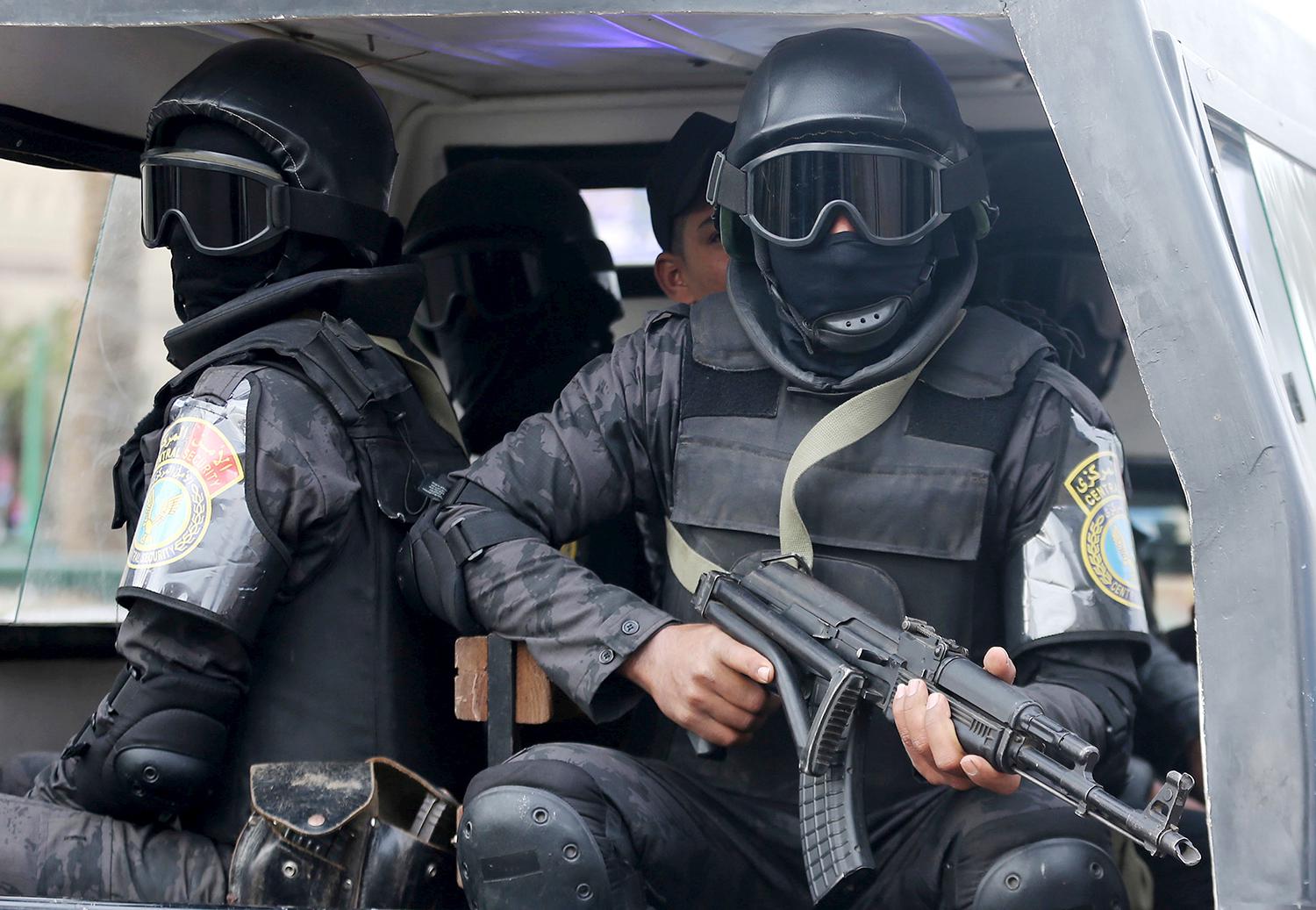
Beatings, Electric Shocks, Stress Positions Routinely Used Against Dissidents
September 6, 2017
Under President Abdel Fattah al-Sisi, Egypt’s
regular police and National Security officers routinely torture
political detainees with techniques including beatings, electric shocks,
stress positions, and sometimes rape, Human Rights Watch said in a new
report released today.
Prosecutors typically ignore complaints from detainees about
ill-treatment and sometimes threaten them with torture, creating an
environment of almost total impunity, Human Rights Watch said.
Under President Abdel Fattah al-Sisi, Egypt’s regular police and
National Security officers routinely torture political detainees with
techniques including beatings, electric shocks, stress positions, and
sometimes rape.
“President al-Sisi has effectively given police and National
Security officers a green light to use torture whenever they please,”
said Joe Stork,
deputy Middle East director at Human Rights Watch. “Impunity for the
systematic use of torture has left citizens with no hope for justice.”
The report documents how security forces, particularly officers of
the Interior Ministry’s National Security Agency, use torture to force
suspects to confess or divulge information, or to punish them.
Allegations of torture have been widespread since then-Defense Minister
al-Sisi ousted former President Mohamed Morsy in 2013, beginning a
widespread crackdown on basic rights. Torture has long been endemic in
Egypt’s law enforcement system, and rampant abuses by security forces
helped spark the nationwide revolt in 2011 that unseated longtime leader
Hosni Mubarak after nearly 30 years.
Human Rights Watch interviewed 19 former detainees and the family of a 20th detainee who were tortured between 2014 and 2016, as well as Egyptian defense and human rights lawyers. Human Rights Watch also reviewed dozens of reports about torture produced by Egyptian human rights groups and media outlets.
The techniques of torture
documented by Human Rights Watch have been practiced in police stations
and National Security offices throughout the country, using nearly
identical methods, for many years.
Under international law, torture is a crime of universal
jurisdiction that can be prosecuted in any country. States are required
to arrest and investigate anyone on their territory credibly suspected
of involvement in torture and to prosecute them or extradite them to
face justice.
Since the 2013 military coup, Egyptian authorities have arrested or charged probably at least 60,000 people, forcibly disappeared hundreds for months at a time, handed down preliminary death sentences to hundreds more, tried thousands of civilians in military courts,
and created at least 19 new prisons or jails to hold this influx. The
primary target of this repression has been the Muslim Brotherhood, the
country’s largest opposition movement.
Human Rights Watch found that the Interior Ministry has developed an
assembly line of serious abuse to collect information about suspected
dissidents and prepare often fabricated cases against them. This begins
at the point of arbitrary arrest, progresses to torture and
interrogation during periods of enforced disappearance, and concludes
with presentation before prosecutors, who often pressure suspects to
confirm their confessions and almost never investigate abuses.
The former detainees said that torture sessions begin with security
officers using electric shocks on a blindfolded, stripped, and
handcuffed suspect while slapping and punching him or beating him with
sticks and metal bars. If the suspect fails to give the officers the
answers they want, the officers increase the power and duration of the
electric shocks and almost always shock the suspect’s genitals.
Officers then employ two types of stress positions to inflict severe
pain on suspects, the detainees said. In one, they hang suspects above
the floor with their arms raised backwards behind them, an unnatural
position that causes excruciating pain in the back and shoulders and
sometimes dislocates their shoulders.
In a second, called the “chicken”
or “grill,” officers place suspects’ knees and arms on opposite sides of
a bar so that the bar lies between the crook of their elbows and the
back of their knees and tie their hands together above their shins. When
the officers lift the bar and suspend the suspects in the air, like a
chicken on a spit, they suffer excruciating pain in shoulders, knees,
and arms.
Security officers hold detainees in these stress positions for hours
at a time and continue to beat, electrocute, and interrogate them.
“Khaled,” a 29-year-old accountant, told Human Rights Watch that in
January 2015, National Security officers in Alexandria arrested him and
took him to the city’s Interior Ministry headquarters.
They told him to
admit to participating in arson attacks on police cars the previous
year. When Khaled denied knowing anything about the attacks, an officer
stripped off his clothing and began shocking him with electrified wires.
The torture and interrogations, involving severe electric shocks and
stress positions, continued for nearly six days, during which Khaled was
allowed no contact with relatives or lawyers. Officers forced him to
read a prepared confession, which they filmed, stating he had burned
police cars on the orders of the Muslim Brotherhood.
After 10 days, a team of prosecutors questioned Khaled and fellow
detainees. When Khaled told one prosecutor that he had been tortured,
the prosecutor replied it was none of his business and ordered Khaled to
restate the videotaped confession, or else he would send him back to be
tortured again.
“You’re at their mercy, ‘Whatever we say, you’re gonna do.’ They
electrocuted me in my head, testicles, under my armpits. They used to
heat water and throw it on you. Every time I lose consciousness, they
would throw it on me,” Khaled recalled.
Egypt’s history of torture stretches back more than three decades,
and Human Rights Watch first recorded the practices documented in this
report as early as 1992.
Egypt is also the only country to be the subject of two public
inquiries by the United Nations Committee against Torture, which wrote
in June 2017 that that the facts gathered by the committee “lead to the
inescapable conclusion that torture is a systematic practice in Egypt.”
Since the military unseated former president Morsy in 2013, the
authorities have reconstituted and expanded the repressive instruments
that defined Mubarak’s rule. The regularity of torture and the impunity
for its practice since 2013 has created a climate in which those who are
abused see no chance to hold their abusers to account and often do not
bother even filing complaints to prosecutors.
Between July 2013 and December 2016, prosecutors officially
investigated at least 40 torture cases, a fraction of the hundreds of
allegations made, yet Human Rights Watch found only six cases in which
prosecutors won guilty verdicts against Interior Ministry officers. All
these verdicts remain on appeal and only one involved the National
Security Agency.
Al-Sisi should direct the Justice Ministry to create an independent
special prosecutor empowered to inspect detention sites, investigate and
prosecute abuse by the security services, and publish a record of
action taken, Human Rights Watch said. Failing a serious effort by the
Sisi administration to confront the torture epidemic, UN member states
should investigate and prosecute Egyptian officials accused of
committing, ordering, or assisting torture.
“Past impunity for torture caused great harm to hundreds of
Egyptians and laid the conditions for the 2011 revolt,” Stork said.
“Allowing the security services to commit this heinous crime across the
country invites another cycle of unrest.”
*Photo by Mohamed Abd El Ghany, courtesy of Reuters
Egyptian
authorities say police have fired tear gas to disperse a rock-pelting
crowd of residents on a River Nile island in Cairo, clashes that left
one person killed and 50 others injured.
CAIRO (AP) — Egyptian police on Sunday fired tear gas to
disperse a rock-pelting crowd of residents defending their homes on a
Nile River island against bulldozers sent by the government to demolish
their illegally-built dwellings. The clashes left one person dead and 50
others injured.
The violence on the island of el-Waraq on the southern
fringes of Cairo is likely to stain a nationwide campaign launched this
summer by Abdel-Fattah el-Sissi, Egypt's general-turned-president, to
restore government control over state-owned land.
El-Sissi has vowed in televised comments to show no
lenience to anyone taking illegal advantage of state-owned property,
saying the law would prevail regardless of how powerful or wealthy the
offenders were. Anyone using land that does not rightfully belong to
them, he angrily said, is a "common thief."
Illegal use of state land is widespread in Egypt, as well
as building on agrarian land in violation of the law. Since el-Sissi
launched his campaign earlier in the summer, local media has been
showing images of police and army troops demolishing buildings illegally
built or operating without a license, attempting to project an image of
a government keen on protecting what is being billed as "people's
property."
To el-Waraq's middle class and poor residents, however,
the sight of bulldozers coming to demolish their homes may have been
more than they could bear at a time when they, like most Egyptians, are
struggling to cope with soaring prices for food and services, a result
of ambitious reforms introduced by el-Sissi's government to revive the
country's battered economy.
"Get lost! Get lost!" the protesters shouted at the
scores of policemen who descended on the island early Sunday, backed by
bulldozers, scores of riot policemen and led by senior police generals.
The protesters, mostly young males, succeeded in forcing the bulldozers
to turn away, but clashes soon began.
The Health Ministry said a resident died and another 19
were wounded in the clashes. It did not say how the man, Sayed
el-Tafshan, died, but a photo of his body posted on social media
networks showed chest wounds compatible with birdshot.
The Interior Ministry, which controls the police, said its forces only used tear gas.
A ministry statement said a total of 31 people —
policemen as well as contractors who arrived with them on the island —
were injured in the clashes. The injured policemen included two
generals.
Ten residents were arrested for their part in the violence, it added.
Video clips posted on social media networks showed
hundreds of angry islanders, mostly young men, at the man's funeral,
marching through farm fields while chanting "We will sacrifice the
martyr with our soul and blood."
The statement said the residents attacked police with
firearms, birdshot guns and rocks, and that police responded with tear
gas. It said up to 700 building and land violations were recorded on the
island. It acknowledged the death of one islander and that 19 others
were injured.
In el-Waraq, a mostly agricultural island with shoddily
built apartment blocks, residents maintain that their homes are legal,
citing the government's supply of drinking water and electricity.
One of the Nile's largest islands in Egypt, it is home to nearly 200,000 people and is linked to the mainland by six ferries.
"How is my home illegal when you have for years provided
me with water and electricity," said resident and civil servant Mahmoud
Essawi. "It's our land and we are not leaving."
In a separate development, Egypt's military said its jet
fighters destroyed 15 all-terrain vehicles carrying weapons and
explosives along with "criminal elements" after they were detected
getting ready to cross the Libyan border into Egypt.
A military statement Sunday said the warplanes monitored
and "dealt" with the vehicles over the past 24 hours, but it did not say
whether the airstrikes targeted them while on Egyptian soil. It also
did not mention Libya by name, making only a thinly veiled reference to
the North African nation.
(ANSA) - Rome - Egyptian authorities have turned
down a request from Rome prosecutors probing the Cairo torture
and murder of Giulio Regeni to be present at the questioning of
Egyptian police officers who carried out investigations into the
Friuli-born Cambridge University researcher.
They said Egyptian law forbids the presence of foreign
magistrates during judicial activity.
Regeni's parents Claudio and Paola were informed of the
refusal during a meeting Friday with Rome chief prosecutor
Giuseppe Pignatone and his assistant Sergio Colaiocco.
Cairo prosecutors have, however, sent their Italian
counterparts a second report on testimony from the seven
policemen who probed Regeni, who disappeared on January 25 2016
and whose mutilated body was found on the road to Alexandria
eight days later.
The testimony is a summary of what the agents said and not
their testimony in full, judicial sources said.
Italian magistrates are hoping for a third tranche of
documents, starting with questioning of the national security
chief who investigated Regeni a few days before his
disappearance, as well as testimony given in March 2016 by the
agent who searched the home of the alleged head of a kidnapping
gang suspected of abducting and robbing foreigners.
Regeni, 28, went missing in the Egyptian capital on January
25, 2016, on the heavily policed fifth anniversary of the
uprising that ousted former strongman and president Hosni
Mubarak.
His severely tortured, mutilated body was found on February
3 in a ditch on the city's outskirts.
Egypt has denied speculation its security forces, who are
frequently accused of brutally repressing opposition, were
involved in the death of the Cambridge doctoral student.
Regeni was researching street vendors' trade unions, a
sensitive topic.
Egyptian and Italian prosecutors have been working on the
case but Rome has yet to send a new ambassador to Cairo in
protest at the lack of progress.
"Italy has mourned the killing of one of its studious young
people, Giulio Regeni, without full light being shed on this
tragic case for a year and despite the intense efforts of our
judiciary and our diplomacy," President Sergio Mattarella said
on the first anniversary of Regeni's disappearance.
"We call for broader and more effective cooperation so that
the culprits are brought to justice".
Premier Paolo Gentiloni expressed his support for Regeni's
family and said his government was determined to get to the
truth.
Foreign Minister Angelino Alfano echoed his words and said
that the young man's death "deprives all of us of a generous
heart that could have done a great deal for others".
The message on the foreign ministry website said that "the
tragic death of Giulio Regeni is still an open wound not only
for his family, who remain in our thoughts, but for our entire
country."
A video recently surfaced in which the head of the Cairo
street traders' union, Mohammed Abdallah, secretly filmed
Regeni asking him questions about the union using a police
shirt-button microcamera.
Abdallah said he was doing his patriotic duty because Regeni,
he said, was a spy.
Egypt has furnished several explanations for Regeni's death
ranging from a car accident to a gay fight to a kidnapping, all
of which have been dismissed by Italy.
Suspicion has fallen on seven members of the Egyptian police
and intelligence services who used Abdallah as an informant and
who later were responsible for wiping out the alleged kidnapping gang.
Regeni's personal documents were allegedly found in the house
of the sister of one of the alleged gang's members.
There seem to have been signs of Egyptian cooperation on
Giulio Regeni's death thanks to the work of Rome prosecutors but
there is absolutely no evidence of true cooperation from
Egyptian authorities, Regeni's parents said recently.
Paola and Claudio Regeni urged that Italy's ambassador to
Cairo not return to Egypt, since this "would give a signal of
detente that must not be given", and stressed the importance of
not sending Egypt spare parts for F35 fighter jets until justice
has been served.
U.N. High
Commissioner for Human Rights Zeid Ra'ad al-Hussein said on Monday that
heavy-handed security measures by Egypt were fostering the very
radicalisation it was looking to curb.
Egypt
last month was shaken by one of the bloodiest attacks in years when
Islamic State suicide bombers targeted two Christian churches, killing
45 people. President Abdel Fattah al-Sisi declared a three-month state
of emergency hours later.
Zeid
condemned the church attacks at a news conference in Geneva but said
that Egypt's approach to combating Islamist militants was exacerbating
the problem.
"...a state of
emergency, the massive numbers of detentions, reports of torture, and
continued arbitrary arrests - all of this we believe facilitates
radicalisation in prisons," Zeid said.
She said "the crackdown on civil society" was "not the way to fight terror."
Responding,
Foreign Ministry Spokesman Ahmed Abu Zeid called the remarks an
"irresponsible" and "unbalanced" reading of the situation in Egypt,
where society is targeted by "terrorist operations," according to a
statement from the ministry.
Abu
Zeid defended the emergency law as passed by an elected parliament
subject to "rules and restrictions" set out by the constitution.
"We
don't see the High Commissioner criticizing other states implementing
states of emergency that are dealing with similar conditions," the
statement said.
Sisi, elected in 2014 in part on a pledge to
restore stability to a country hit by years of turmoil since its 2011
uprising, has sought to present himself as an indispensable bulwark
against terrorism in the Middle East.
Rights groups, however, say they face the worst crackdown in their history.
"National security yes, must be a priority for every country, but again not at the expense of human rights,” said Zeid.
*Photo by Pierre Albouycourtesy of REUTERS **Reporting by Stephanie Nebehay; Writing by Eric Knecht; Editing by Robin Pomeroy
Activists in the United States have launched a campaign to highlight
rampant human rights abuses in Egypt in the run-up to President Abdel
Fattah al-Sisi's White House meeting next week.
The "Freedom First"
campaign run by US-Egyptian former political prisoner, Mohamed Soltan,
kicked off on Thursday after activists put up thousands of anti-Sisi
regime posters in Washington DC.
"This campaign is an effort to harness that same energy and build on
it to do the same for others who remain in the grips of injustice," Soltan told The New Arab
A press statement said: "President Trump is scheduled to meet with
Sisi, who Trump has called a 'fantastic guy' with whom he has 'good
chemistry'."
"Sisi has also overseen horrific human rights abuses, including the massacre of more than 1,000 activists in a single day, and the jailing of more than 40,000 activists and journalists without charge or trial," it added.
The campaign hopes to raise awareness about the tens of thousands of
prisoners of conscience in Egypt and the at least seven US nationals
unjustly imprisoned on politicized charges.
One Egyptian-US dual citizen being held is activist Aya Hegazy,
who worked with homeless children until police raided her charity in
May 2014 and arrested her and the staff at the Belady Foundation for
Street Children.
Hegazy has since been imprisoned on charges of exploiting minors and
encouraging them to join political protests led by the banned Muslim
Brotherhood.
Soltan, whose father is a leading Brotherhood official, was arrested
in August 2013 and sentenced to life in prison for allegedly attempting
to "destabilize" the country.
He was deported
to the US in June 2015 after going on a 489-day hunger strike, causing
relatives to fear for his life. His father, Salah was sentenced to death
in the same trial as his son and remains imprisoned in Egypt.
"I never lose sight of the immense effort it took on the part of
thousands of people, many of whom had never met me, to save my life,"
Soltan said.
Soltan had originally planned to kick off the campaign with ad spaces
on the Washington DC Metro, however, the transport network rejected the ads, arguing they violated its ban on "issues-oriented advertising."
In 2013, then-army chief Sisi led a military coup against Egypt's
first freely elected leader - the Muslim Brotherhood's Mohammed Morsi -
amid mass protests against his presidency.
The overthrow unleashed a deadly crackdown on Islamists, with more
than 800 peaceful protesters killed in a single day when police
dispersed a Cairo sit-in demanding Morsi's reinstatement.
Egyptian courts have since sentenced hundreds of Islamists to death,
including Morsi and other senior Muslim Brotherhood leaders.
This week, the White House announced
that Sisi would make an official visit to visit US President Donald
Trump on April 3 to "discuss a range of bilateral and regional issues".
The hashtag #FreedomFirst
has gained traction on Twitter shortly after it was introduced on
Thursday with social media activists calling attention to individual
cases of political prisoners under the Sisi regime.
After six years of procedural and legal maneuvers, former Egyptian president Hosni Mubarak is free.
The top Egyptian appeals court acquitted him of involvement in the
killing of protesters during the 2011 popular revolt. Mubarak’s expected
freedom comes as many leaders of that revolt languish in Egyptian
prisons. The other members of Mubarak’s regime put on trial in 2011 have
also been set free. How did we get to this place?
In the weeks
and months following the toppling of the former Egyptian strongman in
2011, calls for justice on Cairo’s Tahrir Square turned into unified
demands for prosecutions of Mubarak and other officials responsible for
human rights abuses and economic crimes.
By August 2011, Mubarak, his
sons and a number of his top officials were on trial, accused of
corruption and ordering security forces to use lethal force against
protesters during the revolution.
The sight of Mubarak in the
defendant’s cage became a defining image of the Arab Spring. The trial
stunned Egyptians, many of whom doubted until the last minute that their
autocratic leader would be brought to justice.
Egypt is not
unique. Oppositions throughout the world have to balance the desire for
justice with the political constraints inherent in the absence of an
all-out revolution, coup or military victory.
Retributive measures are
frequently replaced with more lenient policies. The possibilities for
accountability are determined by the distribution of power among key
actors prevailing at the moment of transition. The greater the strength
of old elites vis-à-vis the new ones, the less likely are criminal
trials and other forms of retributive justice.
The Mubarak trial
began primarily in the context of a revolutionary moment in which the
power of the “street” was at its peak and the then-ruling military
council faced intense popular pressure to prosecute Mubarak and his top
officials. Yet, even when the revolutionary logic was at its height,
protesters had to contend with the Supreme Council of Armed Forces’s
(SCAF) determination to use its powers to protect its privileges and to
move the country toward elections on its own terms.
The
Mubarak trial was one of concessions made by the SCAF in a bid for
legitimacy. After the parliamentary elections of December-January
2011-2012 conferred electoral legitimacy upon the Muslim
Brotherhood-affiliated Freedom and Justice Party (FJP), the party sought
to negotiate the terms of the forthcoming handover of power with the
SCAF in anticipation of the central role it hoped to play in governing
the country.
Yet, the military allowed the trial to go forward, and even
after 2013, President Abdel Fatah al-Sissi appeared in no hurry to free
Mubarak. Why?
Interest in ensuring stability, building its
legitimacy and protecting its extensive economic and political
privileges drove the military’s approach. Key military figures, al-Sissi
included, have also attempted to co-opt the “spirit” of the revolution,
which was broadly popular, for their own purposes.
For example, the
military has simultaneously detained and repressed young revolutionary
protesters while at the same time going to great lengths to attempt to
co-opt the revolutionaries and the revolution, even giving special
medals to the martyrs who died during the uprising. The military’s
decision to allow the trial to move forward was part of broader goals
than just stability and momentarily pacifying protesters.
Indeed, the
military sought longer-term legitimacy from the “street” by co-opting
the revolution and buying support for an early transition plan. As such,
the military largely conceded to demands for justice in an ad hoc, reactive way, such as allowing for Mubarak’s prosecution after days of large demonstrations.
The decision to place Mubarak and his associates on trial was a clear
response to rising public pressure — and it also created a lasting
perception of the trial as political spectacle. That political
perception underscored how hastily prepared the trial was.
It was not
clear until the last moment that the trial would actually go forward.
Public pressure was central to Mubarak’s trial in the first place — and
it raised questions as to whether any judge would be able to render a
verdict without regard to public opinion.
Judges were fully
aware that anything less than a guilty verdict would lead to massive
street demonstrations. Despite this public pressure for a conviction,
state officials effectively blocked the prosecutor from gathering
sufficient evidence to establish Mubarak’s alleged role in ordering the
killings.
As the initial symbolic force of the trial started to
wane, its shallow nature did not escape the notice of those who paid the
highest price for it. As a mother of one of the victims said,
“We didn’t ask them for financial compensation or pensions. They are
doing that only to pacify people’s anger. All we want is fair trials.”
Beyond popular anger at the shortcomings of the Mubarak trial remained
broader concerns about more far-reaching reforms.
The
shortcomings of the Mubarak trial, and his ultimate acquittal, may lead
one to argue that the prospects for transitional justice were
inherently limited in the aftermath of a popular, but still incomplete,
political revolution. The truth is that the Mubarak trial was possible
precisely because its genesis was associated with a time when the
revolutionary logic of the Egyptian transition ruled.
Under its
subsequent, negotiated, logic (and then its rollback after 2013), the
possibilities for transitional justice greatly diminished. The sight of
Mubarak being rolled into the defendant’s cage to be tried for his
crimes was a powerful symbol of what 2011 represented for Egyptians and
other Arabs.
Never before had an Arab leader been held
accountable in such a visible way. Yet, the fact that the trial was
ultimately shallow, and that the conviction was ultimately overturned,
is an equally potent indicator of just how short the revolution fell of
accomplishing its goals of justice.
Ex-president acquitted this month on all charges of murdering protesters before he was ousted in Arab spring uprising in 2011
Ruth Michaelson
Friday 24 March 2017
Egypt’s former dictator Hosni Mubarak
has left the Cairo military hospital where he had been held in custody
for much of the past six years, and returned to his home in the Cairo
suburb of Heliopolis, his lawyer said.
Mubarak, 88, was acquitted by Egypt’s highest appeals court on 2 March of conspiring to kill protesters in the final verdict in a long-running case that originally resulted in him being sentenced to life in prison in 2012
over the deaths of 239 people in Arab spring protests against his rule.
A separate corruption charge was overturned in January 2015.
He left the Maadi military hospital on Friday morning and returned to
his home, where he had breakfast with his family and a number of
friends, according to a report in the privately owned newspaper al-Masy
al-Youm. His lawyer, Farid al-Deeb, told the paper that Mubarak thanked
those who had supported him throughout his trial.
The strongman, who ruled Egypt
for nearly three decades, often appeared in a frail state during his
court appearances, attending on a stretcher and wearing dark sunglasses,
but the appearances put paid to repeated rumors of his death.
Mubarak was also healthy enough to appear at the window of his
hospital room to wave to supporters gathered outside on occasions
including his birthday and the anniversary of Egypt’s 1973 war with
Israel.
For those who worked to topple the former dictator,
Mubarak’s freedom marks a grim moment in Egypt’s modern history. Yet
some reacted with little more than resignation as his release became
imminent, numbed by the years of political turmoil since his fall.
Mubarak’s democratically elected successor, Mohamed Morsi, was overthrown in a popularly backed military coup in 2013. Many see echoes of Mubarak’s style of leadership in Egypt’s current leader, the former general Abdel Fatah al-Sisi.
“I’m neither sad nor disappointed,” said Tarek el-Khatib, whose
brother, Mustafa, was killed in the struggle to topple Mubarak. “I’d
have been surprised had things happened otherwise. Politically,
everything flew in this direction and paved the way for the normality of
this moment.”
Over the past six years there have been repeated efforts to punish
family members and business associates who profited from Mubarak’s
regime, largely without lasting consequence. Mubarak’s sons, Alaa and
Gamal, were freed
in October 2015, with a judge stating that they had served adequate
jail time on charges of corruption and embezzlement of public funds.
The notorious steel tycoon Ahmed Ezz, formerly the secretary general
of Mubarak’s now defunct National Democratic party, was named as an
honorary leader of a political party in 2016, although he had previously
served three years on corruption charges.
Despite describing
the revolution that ended Mubarak’s rule as “a turning point in Egypt’s
history,” Sisi and his military-backed government are regarded as the
autocrat’s political heirs.
“I think that Mubarak’s release was something expected as his
students are ruling the country,” said Mahienour el Massry, an activist
and lawyer who served 15 months in prison under Sisi’s rule. “The same
regime, the same corruption, the same brutality.
“Mubarak might be released, but in the eyes of those who believe in
the revolution he will always be a criminal killer and the godfather of
corruption,” she said. “This might be another round that we have lost,
but we will keep on fighting to change the inhuman regime that releases
criminals and imprisons innocent people.”
Others were less hopeful. Mubarak’s freedom meant the families of
those killed were “now praying for divine justice”, said Mohsen Bahnasy,
a human rights lawyer who served as a member of the commission of
inquiry into military abuses committed during the 2011 revolution.
Egypt’s highest appeals court previously rejected demands by the
families of those killed during the uprising to bring civil suits
against Mubarak for his role in the deaths of protesters. An official
inquiry later concluded that 846 people died and a further 6,467 were
injured during the revolution, as Egyptian security forces violently suppressed the protests which packed Cairo’s central Tahrir Square.
“The Mubarak acquittal is of significant symbolic value in that it
reflects an absolute failure of Egyptian judicial and legal institutions
to hold a single official accountable for the killing of almost 900
protesters during the January 25 revolution. It is indicative of a
deeper, compounded crisis of transitional justice,” said Mai el Sedany, a
legal expert with the Washington thinktank the Tahrir Institute for
Middle East Policy.
“This is a clear message to all Egyptians that no one will be held
accountable for any corruption or oppression in this country – the state
is loyal to its men and will continue to be,” said Khatib. “Don’t dream
of any revolution again.”
Mubarak’s release comes amid an economic crisis following years of
political tumult and worsening security. Egyptians complain of empty
pockets and rumbling bellies as inflation exceeds 30% and the government
tightens its belt in return for loans from the International Monetary
Fund.
“The economic crisis we are living in and the high prices take
priority over everything, as does the fear of terrorism. That is what
preoccupies ordinary citizens, not Mubarak,” said Khaled Dawoud, an
opposition politician who opposed the Islamists but also condemned the
bloody crackdown on them.
“When you see the group of people who show up and cheer and support
him, you are talking about 150, 200 people,” he said, referring to
occasional shows of support outside the Maadi hospital when Mubarak was
there.
*Additional reporting by Sharif Abdel Kouddous in Cairo* *Photos by Mohamed Abd El Ghany and Youssef Boudlal courtesy of Reuters
Former Egyptian president cleared of involvement in death of protesters during 2011 uprising that ended his reign
Egypt’s top appeals court has found Hosni Mubarak
innocent of involvement in the killing of protesters during the 2011
uprising that ended his 30-year rule, marking the final ruling in a
landmark case.
Mubarak was the first of the leaders toppled in a wave of Arab
uprisings to face trial. In scenes that captivated Egyptians, he
appeared in a courtroom cage on charges ranging from corruption to
complicity in the murder of protesters.
The case has traced the trajectory of Egypt’s Arab spring, with Mubarak originally sentenced to life in prison in 2012
for conspiring to murder 239 demonstrators during the 18-day revolt –
an uprising that sowed chaos and created a security vacuum but also
inspired hope for an era of democracy and social justice.
But an appeals court ordered a retrial that culminated in 2014 in the
case against the former president and his senior officials being dropped. An appeal by the public prosecution led to Thursday’s final retrial by the court of cassation.
The 88-year-old ailing former leader resides in a Cairo military hospital, where he served a three-year sentence for a separate corruption case. The military overthrew Mubarak’s successor, the Islamist Mohamed Morsi, in 2013.
After a hearing that took most of the day, Judge Ahmed Abdel Qawi
announced to cheers of approval from the Mubarak supporters who filled
the courtroom: “The court has found the defendant innocent.”
The court also rejected demands by lawyers of the victims to reopen
civil suits. That left no remaining option for appeal or retrial,
according to a judicial source.
The families of those killed, who had attended the trial early on,
were not present on Thursday. Their lawyers condemned the verdict as
politically motivated.
“This ruling is not fair and not just. The judiciary is politicised,” said Osman al-Hefnway, a lawyer for the families.
Mubarak’s supporters cheered “long live justice” as the verdict was read out and unfurled posters of the former leader.
*Photos courtesy of Reuters and the Associated Press
CAIRO
— The Egyptian police on Thursday shut down the offices of an
organization that treats victims of torture and violence in the latest
escalation of a harsh government crackdown against human rights defenders and civil liberties groups.
In
justifying the sweeping measures, Egyptian officials say they need to
regulate Western-funded groups that threaten the stability of the
Egyptian state and aid terrorism. Critics say Mr. Sisi is seeking to
consolidate his control by silencing even the mildest sources of
dissent.
Since
coming to power in 2013, his government has locked up tens of thousands
of opponents and effectively outlawed public protests. Now, many fear, President Trump’s support for Mr. Sisi could embolden the Egyptian leader to go further.
Mr. Trump has embraced Mr. Sisi as a “fantastic guy” and invited him to the White House. Mr. Sisi was notably silent about Mr. Trump’s recent ban on travelers from seven predominantly Muslim countries.
Al
Nadeem Center, which was founded in 1993, has been fighting for
survival since last February, when the government first threatened to
close it, citing vague health regulations. The center has provided
therapy to about 1,000 victims of police abuse, its founders say, and
cataloged instances of police torture, unlawful killings and illegal
abductions.
Such abuses have a strong political resonance in Egypt. Public anger at widespread police misconduct was a leading cause of the January 2011 uprising that ousted President Hosni Mubarak.
Early
on Thursday, about 50 police officers turned up at the center’s offices
and put wax seals on the doors, said Magda Adly, a founding member of
Al Nadeem. “I don’t understand how a regime with an army and a police
force can be scared of 20 activists,” she said in a phone interview.
Al
Nadeem had challenged an order to close issued by an administrative
court in Cairo last February. That case is still being heard, so it was
not clear why the police decided to enforce the order on Thursday. In a
statement, Amnesty International said the closing represented “yet
another shocking attack on civil society” by Mr. Sisi’s government.
“The
move exposes the chilling extremes to which the authorities are
prepared to go to in their relentless and unprecedented persecution of
human rights activists,” said Najia Bounaim, Amnesty’s deputy regional
director, at the group’s regional office in Tunis.
Mr. Sisi has struggled to deal with a painful economic crisis
in recent months. Yet he faces little opposition in the news media or
in Parliament, which is filled with his supporters. In recent months
lawmakers drafted a bill that would place further stringent restrictions
on the operation of aid groups in Egypt and that has met with stiff
criticism from Egypt’s Western allies.
Mr. Sisi has not indicated whether he intends to sign the bill into law.
Among
the groups singled out by the government measures is Nazra for Feminist
Studies, which campaigns for gender equality and helps victims of
sexual violence. Along with its founder, Mozn Hassan, it received the
2016 Right Livelihood Award, known to some as the Alternative Nobel Prize.
Since
last year, Nazra’s bank accounts have been frozen, and Ms. Hassan has
been prohibited from leaving Egypt. The group has laid off most of its
50 staff members and has been forced to leave its office. Ms. Hassan
faces criminal charges that carry a potential sentence of life
imprisonment if she is convicted.
“This
is the harshest crackdown on the human rights movement in Egypt since
the 1980s,” Ms. Hassan said. “It’s so clear from the presidential
rhetoric that they do not want us to exist. They want to destroy us.”
*Photo by Mohamed El Raai, courtesy of Associated Press
Cairo — Egyptian security forces arrested dozens in central
Cairo on Wednesday, the anniversary of a soccer riot that killed over 70
fans in 2012.
Lawyer Mokhtar Mounir told The Associated Press that over 80
people were taken into custody, with some arrests made near the club
grounds belonging to the Al-Ahly team.
Most of the victims of the rioting five years ago were fans
of Al-Ahly. The rioting was Egypt's worst soccer disaster to date and
one of the world's deadliest.
The lawyer said the police likely made the arrests Wednesday
on suspicion those detained had planned to stage a protest. Public
gatherings without a permit are banned under Egypt's draconian
anti-terrorism laws.
Mounir said the detainees were undergoing security checks
and officials would determine whether to release them or press charges.
In 2015, a court declared Al-Ahly's hardcore "Ultras Ahlawy" fan group a
terrorist organization.
The arrests came as Egyptians gathered in cafes all over the
country to watch the national team play Burkina Faso in the first
semifinals match of the African championship in Gabon. At least a dozen
police and security forces' vehicles as well as armed troops were
stationed near the Al-Ahly club grounds in the evening Wednesday.
In 2015, an Egyptian criminal court in the Mediterranean
city of Port Said sentenced 11 people to death over the riot. No
officials or security personnel were among the convicted. A court is set
to review the appeals of the convicted later this month.
Italy’s Parliament has announced it will host an event for the
campaign working to establish a scholarship fund in the name of slain
researcher Giulio Regeni, which would allow an Egyptian student to study at the United World College (UWC) of the Adriatic to obtain the two-year International Baccalaureate (IB) diploma.
The campaign
organizers have told Mada Masr that they will launch their fundraising
efforts during the parliamentary event, relying on crowdfunding to
supply the necessary money for the 2018 scholarship and a matching funds
program through which institutions and corporations can donate money
to ensure the scholarship’s continuation.
Regeni, the 28-year-old
student whose body was found in a ditch in a Cairo suburb on February 3,
2016 exhibiting signs of torture, studied at UWC-USA in New Mexico.
The
idea was suggested by Regeni’s former UWC-USA classmates, Federico
Torracchi and Lorenzo Bartolucci, according to the Italian La Repubblica newspaper.
The
scholarship fund “sends a message that counters hatred,” Bartolucci
told La Repubblica. “Giulio wanted to improve people’s lives. We want to
remind people about who he was and what he did before he died.”
Regeni, a
Cambridge University doctoral student, was researching labor issues and
writing his PhD dissertation on Egypt’s independent trade union
movement. He was conducting field research in Egypt through a one-year
visiting scholar program at the American University in Cairo. He
went missing on January 25, 2016, as he was traveling from his
apartment in Cairo’s Dokki neighborhood in the direction of Tahrir
Square amid a heavy security presence for the fifth anniversary of the
January 25 revolution.
Regeni’s body was found bearing signs of
torture, evident from cigarette burns, cuts, bruises and his de-nailed
fingers — all hallmarks of Egyptian security forces’ torture practices.
However, Egypt’s Interior Ministry has repeatedly denied responsibility
for his torture and death and sought to distance themselves from the
case, causing strained diplomatic relations between Egypt and Italy.
The initial police investigations to
emerge from Egypt claimed that Regeni had died in a traffic accident,
despite subsequent autopsy reports, which confirmed he was tortured over
a period of several days.
Egypt’s Interior Ministry later claimed
security forces had shot and killed five members of a gang that it
claimed often stole the identities of foreign nations and with whom
Regeni’s personal belongings were allegedly found. However, the family
members of the five men strongly denied these claims.
Italian
politicians and investigators have persistently urged Egyptian
authorities to hand over all evidence concerning the case, and to
cooperate more fully on ascertaining details concerning his death.
United World Colleges has played a prominent role in providing Egyptian students with education opportunities for the last 30 years.
*Photo by Riccardo Antimiani, courtesy of CameraPress/Redux
An interview with TD Paul Murphy on the Irish delegation's visit to Egypt
January 14, 2017
Jano Charbel
A delegation of eight Irish parliamentarians
departed from Egypt on Friday evening, following a five-day visit in
which they met with senior state leaders – including President Abdel
Fattah al-Sisi, and parliamentary speaker Ali Abdel Aal, among others –
in hopes of securing the release of Irish-Egyptian political detainee
Ibrahim Halawa.
The delegation was also able to meet with the
21-year-old Halawa himself, who has been imprisoned for the past three
and half years in Egypt while he awaits trial.
Giving Mada Masr an account of what took place in the closed-door meetings is Irish lawmaker Paul Murphy, who is a member of the Anti-Austerity Alliance and
Ireland’s Socialist Party. Murphy also hails from the same constituency
as Halawa’s family, Firhouse, a southern suburb of the Irish capital
Dublin.
Murphy explains that the cross-party Irish delegation,
in which he was a representative, was able to meet with Halawa at Wadi
al-Natrun Prison on Tuesday.
The parliamentarian, or TD (Teachta Dála),
as they are known in Ireland, tells Mada Masr, “Physically, he looked
okay. He said he was very happy to see us and to know that there is a
lot campaigning and solidarity for him.”
According to Murphy,
Halawa’s extended detention – he has been in jail since he was
17-years-old – has had a clear physical and psychological toll on him.
Halawa has recently started his third hunger strike since he was incarcerated in 2013.
“He had fainted on Monday
due to low glucose levels,” Murphy says. Fearing for his life and
well-being, all eight TDs called on Halawa to call off his hunger
strike. “He said he would consider it.”
“He’s desperate to leave,” Murphy says, adding that Halawa “wanted to come to Ireland with us on Friday.”
But this seemed impossible, as the Irish-Egyptian’s trial — which includes nearly 500 other defendants — has been postponed 17 times.
Halawa
and his three sisters — Somaia, Fatima and Omaima — were arrested in
Cairo on August 17, 2013, on charges of participating in a violent
protest at Al-Fath Mosque in Cairo’s Ramses neighborhood, in the wake of
large demonstrations protesting the military-backed ouster of former
Islamist President Mohamed Morsi.
His sisters were released shortly
thereafter, but Halawa was remanded in custody. Along with 493 other
defendants, including another 11 minors, he faces charges ranging from
protesting illegally and destroying public property to attacking
security forces and committing murder.
The charges against him may carry
the death penalty.
On the Facebook group Free Ibrahim Halawa,
his lawyer and family have denied all these accusations, as well as any
link between Halawa and the now-outlawed Muslim Brotherhood.
The
following day after the prison visit, the delegation met with President
Abdel Fattah al-Sisi in Cairo at the Ettehadiya Presidential Palace,
where they discussed the case.
However, in the meeting with Sisi on Wednesday, Murphy comments that it was the president who started the conversation about Halawa.
Murphy says that Sisi claimed that “if he had the power to, he would free Ibrahim,” adding that “he would do it in a second.”
The
Irish TD explained that Sisi “emphasized the independence of the
judiciary in Egypt,” saying that Halawa “must first be convicted by
court, before he could do anything about it,” in reference to issuing
him a presidential pardon.
Murphy says that there is the possibility of a scenario similar to that of Australian journalist Peter Greste, who was deported
from Egypt in 2015, in light of Presidential Decree 140/2014 — a law
that allows for the deportation of foreign nationals at any point during
their prosecution or detention upon the request of their native
countries.
Halawa “never had an Egyptian passport, and was born in
Ireland,” Murphy explains, a fact which may potentially facilitate his
deportation from Egypt upon Ireland’s request. Murphy adds that Halawa
“recently signed a waiver form giving up his Egyptian citizenship, which
may indicate that he could be deported.”
The Irish TD also
spoke of his meeting with parliamentary speaker Ali Abdel Aal, “who
emphasized that he would do everything that he could to have him
released, adding that he would seek to expedite the judicial process”
for Halawa’s trial.
RTÉ
reported that the Irish delegation was invited to “discuss parliamentary
relations” and to “build stronger cooperation in areas such as
agriculture, trade, and tourism.”
When asked if he thinks that
this is a good time – in terms of the Egyptian government’s track record
on democracy and human rights – to be normalizing relations with Egypt,
Murphy replies, “Ibrahim’s case is just one of many issues of
violations here. We have a duty to raise issues of human rights and
democracy, along with the new NGO law, among others. We will be raising the issue of these violations with our counterparts in Egypt.”
In
terms of other issues discussed, Murphy says that the Irish delegation
communicated with Egypt’s Minister of Agriculture, “to follow up on the
level of the food safety cooperation between both countries,” and the
strengthening of bilateral trade links.
Murphy adds that the
delegation also met with the heads of Egypt’s different parliamentary
committees and agreed to establish cordial ties among Irish and Egyptian
MPs in the future.
“We had been engaging in soft-diplomacy until
now,” he says. “We hope that our visit will have some positive
effect,” noting that the case is closely monitored in Ireland, thanks in
large part to the campaign efforts of Halawa’s sisters.
According
to investigations conducted by Amnesty International, Halawa is “a
prisoner of conscience, imprisoned solely for peacefully exercising his
right to freedom of expression and assembly.”