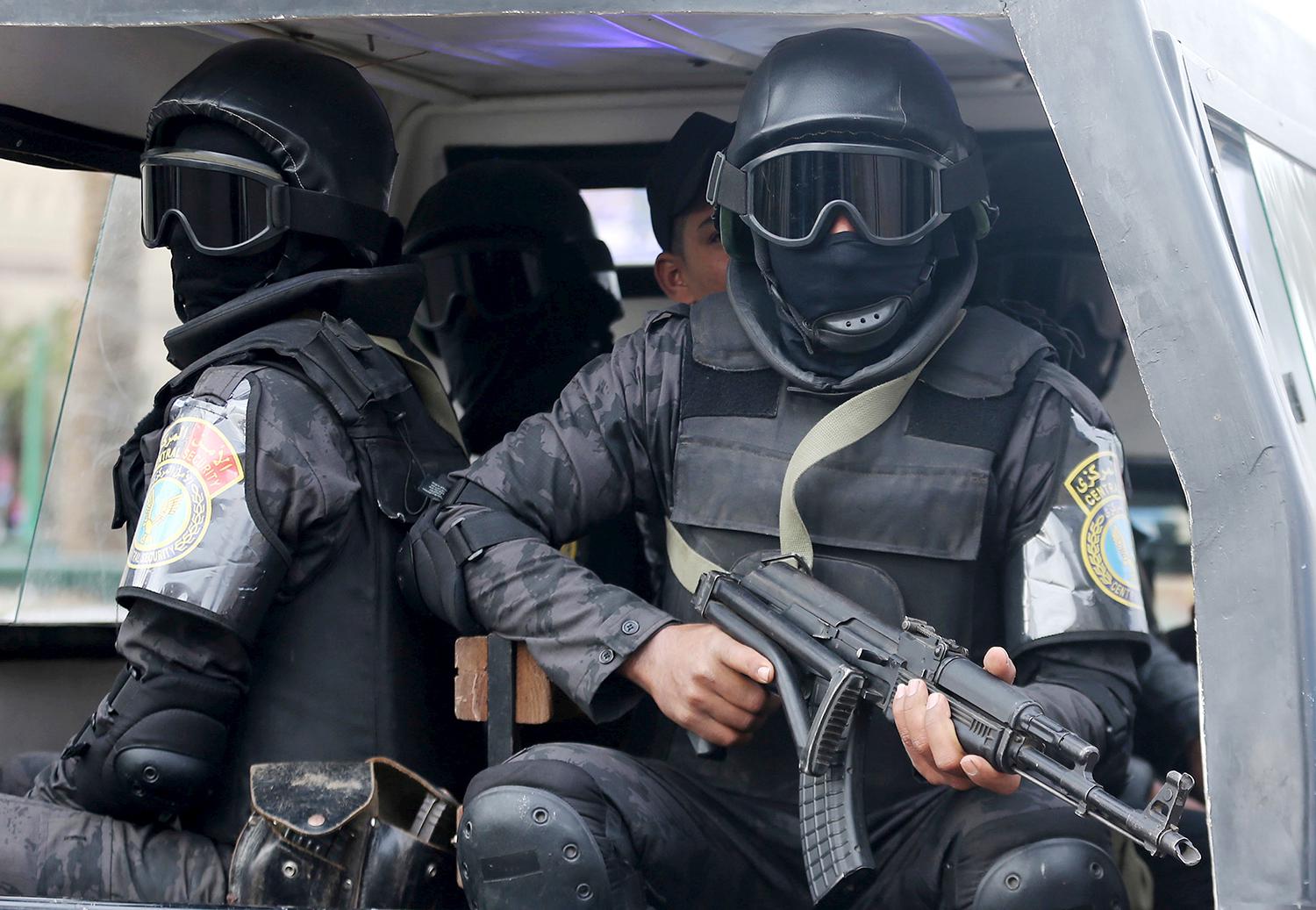
Beatings, Electric Shocks, Stress Positions Routinely Used Against Dissidents
September 6, 2017
Under President Abdel Fattah al-Sisi, Egypt’s
regular police and National Security officers routinely torture
political detainees with techniques including beatings, electric shocks,
stress positions, and sometimes rape, Human Rights Watch said in a new
report released today.
Prosecutors typically ignore complaints from detainees about
ill-treatment and sometimes threaten them with torture, creating an
environment of almost total impunity, Human Rights Watch said.
Under President Abdel Fattah al-Sisi, Egypt’s regular police and
National Security officers routinely torture political detainees with
techniques including beatings, electric shocks, stress positions, and
sometimes rape.
“President al-Sisi has effectively given police and National
Security officers a green light to use torture whenever they please,”
said Joe Stork,
deputy Middle East director at Human Rights Watch. “Impunity for the
systematic use of torture has left citizens with no hope for justice.”
The report documents how security forces, particularly officers of
the Interior Ministry’s National Security Agency, use torture to force
suspects to confess or divulge information, or to punish them.
Allegations of torture have been widespread since then-Defense Minister
al-Sisi ousted former President Mohamed Morsy in 2013, beginning a
widespread crackdown on basic rights. Torture has long been endemic in
Egypt’s law enforcement system, and rampant abuses by security forces
helped spark the nationwide revolt in 2011 that unseated longtime leader
Hosni Mubarak after nearly 30 years.
Human Rights Watch interviewed 19 former detainees and the family of a 20th detainee who were tortured between 2014 and 2016, as well as Egyptian defense and human rights lawyers. Human Rights Watch also reviewed dozens of reports about torture produced by Egyptian human rights groups and media outlets.
The techniques of torture
documented by Human Rights Watch have been practiced in police stations
and National Security offices throughout the country, using nearly
identical methods, for many years.
Under international law, torture is a crime of universal
jurisdiction that can be prosecuted in any country. States are required
to arrest and investigate anyone on their territory credibly suspected
of involvement in torture and to prosecute them or extradite them to
face justice.
Since the 2013 military coup, Egyptian authorities have arrested or charged probably at least 60,000 people, forcibly disappeared hundreds for months at a time, handed down preliminary death sentences to hundreds more, tried thousands of civilians in military courts,
and created at least 19 new prisons or jails to hold this influx. The
primary target of this repression has been the Muslim Brotherhood, the
country’s largest opposition movement.
Human Rights Watch found that the Interior Ministry has developed an
assembly line of serious abuse to collect information about suspected
dissidents and prepare often fabricated cases against them. This begins
at the point of arbitrary arrest, progresses to torture and
interrogation during periods of enforced disappearance, and concludes
with presentation before prosecutors, who often pressure suspects to
confirm their confessions and almost never investigate abuses.
The former detainees said that torture sessions begin with security
officers using electric shocks on a blindfolded, stripped, and
handcuffed suspect while slapping and punching him or beating him with
sticks and metal bars. If the suspect fails to give the officers the
answers they want, the officers increase the power and duration of the
electric shocks and almost always shock the suspect’s genitals.
Officers then employ two types of stress positions to inflict severe
pain on suspects, the detainees said. In one, they hang suspects above
the floor with their arms raised backwards behind them, an unnatural
position that causes excruciating pain in the back and shoulders and
sometimes dislocates their shoulders.
In a second, called the “chicken”
or “grill,” officers place suspects’ knees and arms on opposite sides of
a bar so that the bar lies between the crook of their elbows and the
back of their knees and tie their hands together above their shins. When
the officers lift the bar and suspend the suspects in the air, like a
chicken on a spit, they suffer excruciating pain in shoulders, knees,
and arms.
Security officers hold detainees in these stress positions for hours
at a time and continue to beat, electrocute, and interrogate them.
“Khaled,” a 29-year-old accountant, told Human Rights Watch that in
January 2015, National Security officers in Alexandria arrested him and
took him to the city’s Interior Ministry headquarters.
They told him to
admit to participating in arson attacks on police cars the previous
year. When Khaled denied knowing anything about the attacks, an officer
stripped off his clothing and began shocking him with electrified wires.
The torture and interrogations, involving severe electric shocks and
stress positions, continued for nearly six days, during which Khaled was
allowed no contact with relatives or lawyers. Officers forced him to
read a prepared confession, which they filmed, stating he had burned
police cars on the orders of the Muslim Brotherhood.
After 10 days, a team of prosecutors questioned Khaled and fellow
detainees. When Khaled told one prosecutor that he had been tortured,
the prosecutor replied it was none of his business and ordered Khaled to
restate the videotaped confession, or else he would send him back to be
tortured again.
“You’re at their mercy, ‘Whatever we say, you’re gonna do.’ They
electrocuted me in my head, testicles, under my armpits. They used to
heat water and throw it on you. Every time I lose consciousness, they
would throw it on me,” Khaled recalled.
Egypt’s history of torture stretches back more than three decades,
and Human Rights Watch first recorded the practices documented in this
report as early as 1992.
Egypt is also the only country to be the subject of two public
inquiries by the United Nations Committee against Torture, which wrote
in June 2017 that that the facts gathered by the committee “lead to the
inescapable conclusion that torture is a systematic practice in Egypt.”
Since the military unseated former president Morsy in 2013, the
authorities have reconstituted and expanded the repressive instruments
that defined Mubarak’s rule. The regularity of torture and the impunity
for its practice since 2013 has created a climate in which those who are
abused see no chance to hold their abusers to account and often do not
bother even filing complaints to prosecutors.
Between July 2013 and December 2016, prosecutors officially
investigated at least 40 torture cases, a fraction of the hundreds of
allegations made, yet Human Rights Watch found only six cases in which
prosecutors won guilty verdicts against Interior Ministry officers. All
these verdicts remain on appeal and only one involved the National
Security Agency.
Al-Sisi should direct the Justice Ministry to create an independent
special prosecutor empowered to inspect detention sites, investigate and
prosecute abuse by the security services, and publish a record of
action taken, Human Rights Watch said. Failing a serious effort by the
Sisi administration to confront the torture epidemic, UN member states
should investigate and prosecute Egyptian officials accused of
committing, ordering, or assisting torture.
“Past impunity for torture caused great harm to hundreds of
Egyptians and laid the conditions for the 2011 revolt,” Stork said.
“Allowing the security services to commit this heinous crime across the
country invites another cycle of unrest.”
*Photo by Mohamed Abd El Ghany, courtesy of Reuters
(ANSA) - Rome - Egyptian authorities have turned
down a request from Rome prosecutors probing the Cairo torture
and murder of Giulio Regeni to be present at the questioning of
Egyptian police officers who carried out investigations into the
Friuli-born Cambridge University researcher.
They said Egyptian law forbids the presence of foreign
magistrates during judicial activity.
Regeni's parents Claudio and Paola were informed of the
refusal during a meeting Friday with Rome chief prosecutor
Giuseppe Pignatone and his assistant Sergio Colaiocco.
Cairo prosecutors have, however, sent their Italian
counterparts a second report on testimony from the seven
policemen who probed Regeni, who disappeared on January 25 2016
and whose mutilated body was found on the road to Alexandria
eight days later.
The testimony is a summary of what the agents said and not
their testimony in full, judicial sources said.
Italian magistrates are hoping for a third tranche of
documents, starting with questioning of the national security
chief who investigated Regeni a few days before his
disappearance, as well as testimony given in March 2016 by the
agent who searched the home of the alleged head of a kidnapping
gang suspected of abducting and robbing foreigners.
Regeni, 28, went missing in the Egyptian capital on January
25, 2016, on the heavily policed fifth anniversary of the
uprising that ousted former strongman and president Hosni
Mubarak.
His severely tortured, mutilated body was found on February
3 in a ditch on the city's outskirts.
Egypt has denied speculation its security forces, who are
frequently accused of brutally repressing opposition, were
involved in the death of the Cambridge doctoral student.
Regeni was researching street vendors' trade unions, a
sensitive topic.
Egyptian and Italian prosecutors have been working on the
case but Rome has yet to send a new ambassador to Cairo in
protest at the lack of progress.
"Italy has mourned the killing of one of its studious young
people, Giulio Regeni, without full light being shed on this
tragic case for a year and despite the intense efforts of our
judiciary and our diplomacy," President Sergio Mattarella said
on the first anniversary of Regeni's disappearance.
"We call for broader and more effective cooperation so that
the culprits are brought to justice".
Premier Paolo Gentiloni expressed his support for Regeni's
family and said his government was determined to get to the
truth.
Foreign Minister Angelino Alfano echoed his words and said
that the young man's death "deprives all of us of a generous
heart that could have done a great deal for others".
The message on the foreign ministry website said that "the
tragic death of Giulio Regeni is still an open wound not only
for his family, who remain in our thoughts, but for our entire
country."
A video recently surfaced in which the head of the Cairo
street traders' union, Mohammed Abdallah, secretly filmed
Regeni asking him questions about the union using a police
shirt-button microcamera.
Abdallah said he was doing his patriotic duty because Regeni,
he said, was a spy.
Egypt has furnished several explanations for Regeni's death
ranging from a car accident to a gay fight to a kidnapping, all
of which have been dismissed by Italy.
Suspicion has fallen on seven members of the Egyptian police
and intelligence services who used Abdallah as an informant and
who later were responsible for wiping out the alleged kidnapping gang.
Regeni's personal documents were allegedly found in the house
of the sister of one of the alleged gang's members.
There seem to have been signs of Egyptian cooperation on
Giulio Regeni's death thanks to the work of Rome prosecutors but
there is absolutely no evidence of true cooperation from
Egyptian authorities, Regeni's parents said recently.
Paola and Claudio Regeni urged that Italy's ambassador to
Cairo not return to Egypt, since this "would give a signal of
detente that must not be given", and stressed the importance of
not sending Egypt spare parts for F35 fighter jets until justice
has been served.
U.N. High
Commissioner for Human Rights Zeid Ra'ad al-Hussein said on Monday that
heavy-handed security measures by Egypt were fostering the very
radicalisation it was looking to curb.
Egypt
last month was shaken by one of the bloodiest attacks in years when
Islamic State suicide bombers targeted two Christian churches, killing
45 people. President Abdel Fattah al-Sisi declared a three-month state
of emergency hours later.
Zeid
condemned the church attacks at a news conference in Geneva but said
that Egypt's approach to combating Islamist militants was exacerbating
the problem.
"...a state of
emergency, the massive numbers of detentions, reports of torture, and
continued arbitrary arrests - all of this we believe facilitates
radicalisation in prisons," Zeid said.
She said "the crackdown on civil society" was "not the way to fight terror."
Responding,
Foreign Ministry Spokesman Ahmed Abu Zeid called the remarks an
"irresponsible" and "unbalanced" reading of the situation in Egypt,
where society is targeted by "terrorist operations," according to a
statement from the ministry.
Abu
Zeid defended the emergency law as passed by an elected parliament
subject to "rules and restrictions" set out by the constitution.
"We
don't see the High Commissioner criticizing other states implementing
states of emergency that are dealing with similar conditions," the
statement said.
Sisi, elected in 2014 in part on a pledge to
restore stability to a country hit by years of turmoil since its 2011
uprising, has sought to present himself as an indispensable bulwark
against terrorism in the Middle East.
Rights groups, however, say they face the worst crackdown in their history.
"National security yes, must be a priority for every country, but again not at the expense of human rights,” said Zeid.
*Photo by Pierre Albouycourtesy of REUTERS **Reporting by Stephanie Nebehay; Writing by Eric Knecht; Editing by Robin Pomeroy
CAIRO
— The Egyptian police on Thursday shut down the offices of an
organization that treats victims of torture and violence in the latest
escalation of a harsh government crackdown against human rights defenders and civil liberties groups.
In
justifying the sweeping measures, Egyptian officials say they need to
regulate Western-funded groups that threaten the stability of the
Egyptian state and aid terrorism. Critics say Mr. Sisi is seeking to
consolidate his control by silencing even the mildest sources of
dissent.
Since
coming to power in 2013, his government has locked up tens of thousands
of opponents and effectively outlawed public protests. Now, many fear, President Trump’s support for Mr. Sisi could embolden the Egyptian leader to go further.
Mr. Trump has embraced Mr. Sisi as a “fantastic guy” and invited him to the White House. Mr. Sisi was notably silent about Mr. Trump’s recent ban on travelers from seven predominantly Muslim countries.
Al
Nadeem Center, which was founded in 1993, has been fighting for
survival since last February, when the government first threatened to
close it, citing vague health regulations. The center has provided
therapy to about 1,000 victims of police abuse, its founders say, and
cataloged instances of police torture, unlawful killings and illegal
abductions.
Such abuses have a strong political resonance in Egypt. Public anger at widespread police misconduct was a leading cause of the January 2011 uprising that ousted President Hosni Mubarak.
Early
on Thursday, about 50 police officers turned up at the center’s offices
and put wax seals on the doors, said Magda Adly, a founding member of
Al Nadeem. “I don’t understand how a regime with an army and a police
force can be scared of 20 activists,” she said in a phone interview.
Al
Nadeem had challenged an order to close issued by an administrative
court in Cairo last February. That case is still being heard, so it was
not clear why the police decided to enforce the order on Thursday. In a
statement, Amnesty International said the closing represented “yet
another shocking attack on civil society” by Mr. Sisi’s government.
“The
move exposes the chilling extremes to which the authorities are
prepared to go to in their relentless and unprecedented persecution of
human rights activists,” said Najia Bounaim, Amnesty’s deputy regional
director, at the group’s regional office in Tunis.
Mr. Sisi has struggled to deal with a painful economic crisis
in recent months. Yet he faces little opposition in the news media or
in Parliament, which is filled with his supporters. In recent months
lawmakers drafted a bill that would place further stringent restrictions
on the operation of aid groups in Egypt and that has met with stiff
criticism from Egypt’s Western allies.
Mr. Sisi has not indicated whether he intends to sign the bill into law.
Among
the groups singled out by the government measures is Nazra for Feminist
Studies, which campaigns for gender equality and helps victims of
sexual violence. Along with its founder, Mozn Hassan, it received the
2016 Right Livelihood Award, known to some as the Alternative Nobel Prize.
Since
last year, Nazra’s bank accounts have been frozen, and Ms. Hassan has
been prohibited from leaving Egypt. The group has laid off most of its
50 staff members and has been forced to leave its office. Ms. Hassan
faces criminal charges that carry a potential sentence of life
imprisonment if she is convicted.
“This
is the harshest crackdown on the human rights movement in Egypt since
the 1980s,” Ms. Hassan said. “It’s so clear from the presidential
rhetoric that they do not want us to exist. They want to destroy us.”
*Photo by Mohamed El Raai, courtesy of Associated Press
Italy’s Parliament has announced it will host an event for the
campaign working to establish a scholarship fund in the name of slain
researcher Giulio Regeni, which would allow an Egyptian student to study at the United World College (UWC) of the Adriatic to obtain the two-year International Baccalaureate (IB) diploma.
The campaign
organizers have told Mada Masr that they will launch their fundraising
efforts during the parliamentary event, relying on crowdfunding to
supply the necessary money for the 2018 scholarship and a matching funds
program through which institutions and corporations can donate money
to ensure the scholarship’s continuation.
Regeni, the 28-year-old
student whose body was found in a ditch in a Cairo suburb on February 3,
2016 exhibiting signs of torture, studied at UWC-USA in New Mexico.
The
idea was suggested by Regeni’s former UWC-USA classmates, Federico
Torracchi and Lorenzo Bartolucci, according to the Italian La Repubblica newspaper.
The
scholarship fund “sends a message that counters hatred,” Bartolucci
told La Repubblica. “Giulio wanted to improve people’s lives. We want to
remind people about who he was and what he did before he died.”
Regeni, a
Cambridge University doctoral student, was researching labor issues and
writing his PhD dissertation on Egypt’s independent trade union
movement. He was conducting field research in Egypt through a one-year
visiting scholar program at the American University in Cairo. He
went missing on January 25, 2016, as he was traveling from his
apartment in Cairo’s Dokki neighborhood in the direction of Tahrir
Square amid a heavy security presence for the fifth anniversary of the
January 25 revolution.
Regeni’s body was found bearing signs of
torture, evident from cigarette burns, cuts, bruises and his de-nailed
fingers — all hallmarks of Egyptian security forces’ torture practices.
However, Egypt’s Interior Ministry has repeatedly denied responsibility
for his torture and death and sought to distance themselves from the
case, causing strained diplomatic relations between Egypt and Italy.
The initial police investigations to
emerge from Egypt claimed that Regeni had died in a traffic accident,
despite subsequent autopsy reports, which confirmed he was tortured over
a period of several days.
Egypt’s Interior Ministry later claimed
security forces had shot and killed five members of a gang that it
claimed often stole the identities of foreign nations and with whom
Regeni’s personal belongings were allegedly found. However, the family
members of the five men strongly denied these claims.
Italian
politicians and investigators have persistently urged Egyptian
authorities to hand over all evidence concerning the case, and to
cooperate more fully on ascertaining details concerning his death.
United World Colleges has played a prominent role in providing Egyptian students with education opportunities for the last 30 years.
*Photo by Riccardo Antimiani, courtesy of CameraPress/Redux
Mohand Ehab died on Monday due to complications related to leukemia, a
disease that he long suffered from untreated while held in an
Alexandria Governorate prison, before being allowed to seek care in a
New York City hospital.
The 19-year-old’s name emerged as a trending hashtag on Egyptian social media networks, with another hashtag, Sisi killed Mohand, placing the blame for his death on Egyptian president Abdel Fattah al-Sisi.
According to Ehab’s personal account,
he suffered medical neglect and mistreatment in detention, which made
treatment abroad necessary and ultimately led to his death in a New York
City hospital bed. Recounting his time in prison, Ehab detailed being
subjected to torture, degrading treatment and verbal abuse deriding him
and his family.
Ehab was arrested in January 2015, while on his way to film a protest
in Alexandria, and subsequently imprisoned in March of that year. In
May 2015, Ehab narrated the story of his poor medical treatment
in Alexandria’s Borg al-Arab Prison. “I began to vomit and bleed from
my nose,” he wrote, adding that he was incapable of holding things in
his hands or using the toilet on his own.
When authorities at Borg al-Arab Prison agreed to transfer him to the
prison’s hospital, Ehab recalled medical staff misdiagnosing him with a
number of maladies. “You have anemia, they said. Then they told me you
have typhoid. Then, that I have a viral liver infection,” he wrote.
Ehab wrote that other hospitals affiliated to the prison also failed
to properly diagnose him, and it was not until his father took blood
samples to a testing clinic that he was told he was suffering from
leukemia.
Prison authorities agreed to transfer Ehab to a state-owned hospital
in June 2015, where he received chemotherapy. He was released from
custody the following month, amid public campaigns advocating that he
receive proper medical treatment. A month later, Ehab’s parents
transferred him to a hospital in the United States.
Doctor Taher Mokhtar, a member of the Medical Neglect in Prisons is a Crime
campaign, spoke with Mada Masr regarding the paucity of information
made available to the public concerning deaths in prison hospitals,
among other issues surrounding health care in Egypt’s detention
facilities.
“There are no clear or undisputed figures regarding deaths in
hospitals. There may be dozens who have died in the past few years. I’ve
received several reports myself about detainees dying in prisons due to
medical negligence and a lack of healthcare,” Mokhtar said.
The physician called the medical negligence that led to Ehab’s death
the latest in a long string of similar incidents, where prisoners are
denied access to proper healthcare is “as a form of punishment.”
“Some detainees suffer even worse and more painful fates” than that
of Ehab, according to Mokhtar, claiming that some of those held in
prison never receive care in hospitals.
While acknowledging prison conditions vary across Egypt, Mokhtar
asserted that violations are particularly acute in three of Egypt’s
prisons: the Aqrab maximum security prison
in the Cairo Governorate, the Borg al-Arab Prison in Alexandria and
Mansoura Prison in the Daqahlia Governorate. At Aqrab Prison, families
are frequently denied visitation access and are thus unable to provide
detainees with needed medicine.
“In prison there are fewer opportunities to receive medical attention
coupled with a slower response time in transferring detainees who
require medical assistance to hospitals,” explained Mokhtar, stating
that the conjunction of these two features often results in the
deterioration of prisoners’ health and, in some cases, death. “These are
recurring phenomena and are not at all the exception to the rule.”
Mokhtar, who was jailed from January to August,
asserted that Ehab’s case is extraordinary in that prisoners are rarely
released because of medical concerns. “Several families have requested
that their loved ones receive medical attention and proper healthcare,
but they are frequently denied these services. As a result of this
intentional mistreatment, several people have recently died in prison
custody, due to intentional delays or the withholding of medical care,
especially in those cases involving critical health conditions.”
Further, there is a lack of awareness regarding the right to health
care and disproportionate treatment among certain segments of the
general prison population.
“I’ve been jailed myself, in Torah Prison, and, from what I
personally witnessed, I can tell you that prisoners accused of ordinary
misdemeanors or felonies are treated worse than political prisoners.
Generally, they are also not as aware of their rights as prisoners. On
the other hand, political prisoners are treated better as there is more
attention and a media spotlight focused on them. Plus, they tend to be
more aware of their right to healthcare while in detention,” stated
Mokhtar.
To better safeguard the health of those detained in Egypt’s prisons,
Mokhtar recommended that the Egyptian government institute a series of
reform policies, ranging from allowing representatives from the Doctors
Syndicate and the state-appointed National Council for Human rights to
visit prisons to expanding the prison healthcare budget and developing
mechanisms to hold medial practitioners in correctional facilities
responsible.
“The Interior Ministry must first treat prisoners as humans and
recognize their right to healthcare, regardless of the offense which
they have committed or are accused of. However, the ministry’s doctors
are usually also police officers, and thus they may be more prone to
punish prisoners than the average doctor,” Mokhtar concluded.
In a message
from his New York City hospital room that was recorded before he died,
Ehab said that he dreams of the release of all wrongfully jailed
political detainees and prisoners of conscience.
Human rights lawyer Zyad Elelaimy also addressed Ehab’s death. “There are many others like Mohand in prison,” Elelaimy wrote in a Facebook post.
“These brave ones,” who are subjected to abuse and mistreatment, in an
attempt to “diminish them both physically and psychologically, so that
they leave prison in Mohand’s condition, or psychologically damaged to
the extent that they can no longer stand on their feet again.”
*Photo courtesy of Mohand Ehab's family via Facebook
Almost
half of European Union (EU) member states have flouted an EU-wide
suspension on arms transfers to Egypt, risking complicity in a wave of
unlawful killings, enforced disappearances and torture, Amnesty
International said today.
Despite the suspension imposed after
hundreds of protesters were killed in a show of grossly excessive force
by security forces in August 2013, 12 out of 28 EU member states have
remained among Egypt’s main suppliers of arms and policing equipment. It
is feared that EU foreign ministers could soon decide to scrap the
current, already insufficient, suspension.
“Almost three years on from the mass
killings that led the EU to call on its member states to halt arms
transfers to Egypt, the human rights situation has actually
deteriorated,” said Magdalena Mughrabi, interim Deputy Middle East and
North Africa Program Director at Amnesty International.
“Internal repression by the security
forces remains rife, and there has been virtually no accountability.
Excessive use of force, mass arbitrary arrests, torture, and enforced
disappearances having become a part of the security forces’ modus
operandi.
“EU states transferring arms and
policing equipment to Egyptian forces carrying out enforced
disappearances, torture and arbitrary arrests on a mass scale are acting
recklessly and are risking complicity in these serious violations.”
EU COMPLICITY IN REPRESSION
In 2014 alone, EU states authorized 290 licenses for military
equipment to Egypt, totaling more than €6 billion (US$6.77). The items
have included: small arms, light weapons and ammunition; armored
vehicles; military helicopters; heavier weapons for use in
counter-terrorism and military operations; and surveillance technology.
The EU countries who have been
supplying arms to Egypt through exports or brokering since 2013 are:
Bulgaria, Cyprus, Czech Republic, France, Germany, Hungary, Italy,
Poland, Romania, Slovakia, Spain and the UK.
According to Privacy International, companies from several EU countries, including Germany, Italy and the UK,
have also supplied the Egyptian authorities with sophisticated
equipment or technologies destined for use in state surveillance, which
Amnesty International fears may be used to suppress peaceful dissent and
violate the right to privacy.
EGYPT'S VIOLENT CRACKDOWN ON DISSENT
In recent years, the Egyptian authorities have presided over a
crackdown under the guise of restoring stability in the country after
the military ousted President Mohammed Morsi in July 2013. Heavy-handed
measures including the use of arbitrary and excessive force with
firearms, armored vehicles and other equipment, have resulted in the
unlawful killing of hundreds of protesters. Thousands more people have
been arrested and faced mass trials which are grossly unfair. Detainees
have routinely reported torture and other ill-treatment.
The security forces have
both threatened and used armed force to strike fear into those who would
peacefully challenge the government’s legitimacy or openly criticize its
policies. Meanwhile, the repressive new Protest Law (November 2013) and
Counter-terrorism Law (August 2015) have effectively sanctioned the use
of excessive force.
Egyptian security forces are routinely
armed with pistols and rifles. They often use batons, shotguns, water
cannon and tear gas, supported by various types of armored vehicles, to
disperse protests and other politically charged public gatherings. The
2013 Protest Law allows security forces to respond “proportionately” to
the use of firearms by protesters in order to protect lives, money and
property – but this is interpreted in flagrant violation of
international standards which only permit security forces to use lethal
force in response to an imminent threat to life or serious injury.
Since the law came into force,
security forces have used excessive force to ruthlessly dismantle
protests, often with lethal results. In January 2015 at least 27 people
died in protest-related violence, many at the hands of armed security
forces. They included Shaimaa Al-Sabbagh, a political activist, poet and
a young mother, who was shot dead by a police officer in central Cairo.
Despite images of her dying moments going viral and sparking
international outrage, the member of the security forces originally
found responsible for her death has had his conviction overturned by
Egypt’s highest court and now must face a retrial.
Armed security forces have also
conducted mass arrests of the government’s critics and political
opponents. Almost 12,000 people were arrested on suspicion of
“terrorism” in the first 10 months of 2015 alone, according to an
Interior Ministry official quoted in the Egyptian press. In January 2016
more than 5,000 residences in central Cairo were raided by armed
security forces in a security sweep around the fifth anniversary of the
2011 uprising, with many activists detained.
Armed security forces arrested
hundreds of people while dispersing mostly peaceful protests on April 25
against the government’s decision to transfer two Red Sea islands to
Saudi Arabia. Those arrested in the crackdown around the protests
included human rights defenders, journalists and activists.
On May 14, courts sentenced more than 150 people to between two and five-years’ imprisonment for involvement in the protests.
A wave of enforced disappearances has seen hundreds of people
abducted by armed security forces over the past year. They are held
incommunicado for extended periods without access to their families or
lawyers, and tortured by state security forces into “confessing” to
terrorism-related offenses.
There has been no accountability for
serious human rights violations committed during and since the 2011
uprising. So far, the Egyptian authorities have failed to conduct
effective, independent and impartial investigations into the hundreds of
cases of enforced disappearances, torture and unlawful killings
documented by human rights groups.
MILITARY OPERATIONS IN SINAI
The Egyptian army has been increasingly engaged in military
operations against armed groups, which have launched attacks against
civilians and security forces, particularly in the north of the Sinai
Peninsula. The Egyptian military is known to have used heavy weapons in
such operations, including armored vehicles, tanks, Apache gunships and
F-16 fighter jets.
Amnesty International is concerned about the total lack of transparency over the army’s operations against armed groups.
A media blackout has been imposed on
reporting about military operations in the Sinai, and journalists and
independent civil society organizations have been banned from entering
the area.
Meanwhile, EU states have signed off on transfers of heavy
weapons and equipment purportedly to help Egypt’s fight against
“terrorism,” despite a lack of transparency and human rights guarantees
regarding their use. This is particularly concerning given the complete
lack of accountability for gross human rights violations perpetrated
during the army’s rule following the 2011 uprising.
EU FUELING INTERNAL REPRESSION
While the records show that many EU states have all but ignored the
2013 call for a suspension of transfers of arms used for “internal
repression” in Egypt, there are fears that upcoming talks could result
in a further loosening or even a discontinuation of the suspension. This
follows last year’s decision by the U.S. to resume military aid to
Egypt to the tune of $1.3 billion annually.
“Supplying arms that are likely to
fuel such internal repression in Egypt is contrary to the Arms Trade
Treaty, to which all EU states are party, and flouts the EU’s Common
Position on arms exports,” said Brian Wood, Head of Arms Control and
Human Rights at Amnesty International.
“The EU should immediately impose an
embargo on all transfers of the types of arms and equipment being used
by Egypt to commit serious human rights violations. The EU and its
members must stop rewarding bad behavior by Egypt’s police and military
with a bonanza of arms supplies.”
Some of Egypt’s biggest suppliers of arms that could be used for internal repression include:
Bulgaria issued a total of 59 licenses for
€51,643,626 worth of military equipment to Egypt in 2014 with over €11
million for small arms/light weapons and ammunition. Exports to Egypt
included 10,500 assault rifles, 300 light machine guns and 21
sub-machine guns.
The Czech Republic has been a consistent supplier of
small arms to Egypt. In 2014 the Czech government issued 26 licenses for
military goods to Egypt worth €19.9 million – the majority for small
arms and ammunition. The Czech authorities reported to the UN that they
exported 80,953 pistols and revolvers to Egypt between 2013 and 2015.
Egypt’s Interior Ministry had also ordered 10 million 9mm caliber
cartridges from Czech arms companies in February 2014.
France issued export licenses worth more than €100
million in 2014 under the category of “bombs, torpedoes, rockets,
missiles and other explosive devices” and “ground vehicles and
components”. Exports have included more than 100 Sherpa trucks, which
are advertised for use by law-enforcement officials.
Italy issued 21 licenses of military equipment
totaling €33.9 million in 2014, nearly half of which was small arms. In
2015, Italy sent more than €4 million worth of small arms and related
parts and accessories, and has already registered the export of €73,391
worth of pistols or revolvers to Egypt in 2016.
Amnesty International is calling on the EU and all EU member states to:
Impose and fully implement a binding embargo on transfers of security and policing equipment to Egypt of
the types of arms used to commit or facilitate serious violations of
human rights.
Failing to do so would risk ongoing breaches of the EU’s
Common Position on arms exports, as well as the human rights provisions
of the global Arms Trade Treaty.Impose a ‘presumption of denial’ policy on transfers of arms intended for use by Egypt’s armed forces and air force.
Reports
of some aerial attacks that resulted in fatalities and serious injuries
have not been effectively, independently and impartially investigated.
Human rights violations committed by the armed forces during the
uprising in 2011 and in the year of military rule that followed also
have not been effectively investigated.
Any potential export to Egypt of
such items should not be authorized unless a thorough human rights risk
assessment demonstrates that the Egyptian armed forces’ recipient will
use the equipment lawfully, including by upholding its international
human rights law obligations,and unless a binding guarantee to that
effect is agreed by the exporting state with the Egyptian government.
Maintain this embargo and ‘presumption of denial’ policy until
the Egyptian authorities put in place effective safeguards to prevent
further serious violations by security forces, and carry out
full, prompt, independent and impartial investigations into violations
since the 2011 uprising with the aim of prosecuting those responsible
for crimes in fair trials.
The Front to Defend Egyptian Protesters published a report on Thursday, documenting 1,277 arrests and detentions between April 15 and 27, the period coinciding with popular mobilizations against Egyptian authorities prompted by the transfer of Tiran and Sanafir islands to Saudi Arabia.
The
list issued by the front documents cases spanning across 22 Egyptian
cities wherein 577 individuals have been referred to the prosecution and
619 have been released. The legal status of 81 cases is unclear,
according to the front's lawyers.
Those arrested are predominately men and include 52 minors.
Yasser
Azzam, who was arrested in Dokki on April 25, was released on Thursday
from a Central Security Forces camp. He told Mada Masr that he was kept
in a 12-square-meter cell with another 40 inmates. The men were forced
to sleep on the floor, as the camp authorities did not provide beds or
mattresses.
"We demanded to go to the bathroom, so Central
Security Forces came to our cells trying to scare us. But we continued
protesting until they let us use the bathroom," Azzam said.
While
in detention, Azzam states he was asked about his opinion on "the
January 25 revolution, the June 30 events, President Abdel Fattah
al-Sisi and the government’s performance."
Fatemah Serag, a lawyer
and member of the front, notes that wide ranging suspicion led to the
high number of arbitrary arrests from places far from demonstration
sites and the subsequent release of 60 percent of those arrested.
Other lawyers have criticized the prosecution’s handling of arrests and referrals to investigation.
Lawyer
Yasmine Hossam Eddin told Mada Masr that the prosecution issued "false
visit permits" to family members of those arrested on April 15 and that
are currently being detained in the Tora prison.
"In the Agouza
Police Station [where some protesters have been detained], I saw how
prosecutors were screaming at arrested youth as though they were
policemen and not investigators," Hossam Eddin said.
Lawyer Ahmad
Othman told Mada Masr that prosecutors present at the Agouza Police
Station and the Dokki Police Station did not intervene when police
officers prevented defense lawyers from attending detainee’s
interrogation sessions.
"The prosecution also refused to record
how those arrested were held longer than the 24-hour legal period
between their arrests and referral to investigation. It also refused to
record how arrest warrants were issued after the detainees were in fact
arrested...[and] to record the fact that National Security Agency
members interrogated those arrested before they were referred to
prosecution," Othman stated.
The prosecution has also refused
lawyer’s requests to record incidents of torture that occurred in
detention centers, lawyer Sameh Samir told Mada Masr. "We don't want the
prosecutors to do anything beyond recording these facts in the cases
files," he said.
Prosecutors have also often interrogated
detainees inside police stations where they have faced torture, a
practice contested by lawyers. While it is not illegal to conduct
interrogations there, lawyers state that the non-neutral setting is
inappropriate for the legal process.
"There is almost an agreement
that the prosecution is not a neutral player in human rights cases,"
says Association for Freedom of Thought and Expression lawyer Hassan
al-Azhari.
Azhari called for lawyers to protest the prosecution’s
actions by boycotting interrogations in an attempt to showcase the
process’s lack of credibility.
During the reign of ousted
President Hosni Mubarak, police officers and state security officers
were often hired as prosecutors. The practice is widely contended to be
the reason for the prosecutor’s lack of independence from the executive
branch.
Amid
growing hostility to media criticism of President Abdel Fattah
el-Sisi’s government, Egypt has fallen one place in the 2016 World Press
Freedom Index that Reporters Without Borders (RSF) published today.
The
Egyptian media environment is dynamic and the media reflect the
country’s polarization between support for Sisi and opposition, but the
authoritarian regime has used the fraught security situation to crack
down on critical journalists in the name of stability and national
security.
Now ranked 159th out of 180 countries, Egypt had fallen steadily in
the Index since the end of the Mubarak era, when it was ranked 127th out
of 173 countries. Under President Mohammed Morsi, Egypt was ranked
158th of 178 countries in 2012 and 2013.
With more than 20 journalists currently detained on trumped-up
charges, Egypt is now one of the world’s biggest prisons for media
personnel although, in an interview for CNN last September, President Sisi claimed that his country’s journalists enjoyed “unprecedented” freedom of expression.
A few days before the interview, Sisi pardoned two Al-Jazeera
journalists who had been sentenced to three years in prison in August
2015 after being convicted, at the end of a second trial, of supporting
terrorism, spreading false news and working without permission.
Some journalists have been held provisionally for extremely long periods without seeing a judge.
They include Mahmoud Abou Zeid,
a photographer also known as Shawkan, who was arrested while covering
the eviction of deposed President Morsi’s supporters from Cairo’s Rabaa
Al-Adawiya Square in August 2013.
He was due to go on trial along with more than 700 other defendants
in December 2015, but the start of the trial was postponed until March.
According to the relatives of detained journalists, some have been badly
tortured in prison while others have been denied adequate medical care
although very ill.
Journalists who criticize Sisi or his government are liable to be
harassed, fired or even jailed. And in response to Jihadi violence in
the Sinai Peninsula, the government has imposed “correct” media coverage
of armed attacks and bombings.
After creating a “Fact check Egypt” unit in June 2015 to verify media
reports and point out (alleged) mistakes, the government went one step
further in the anti-terrorism law adopted in August. Under article 33,
the media are now obliged to limit themselves to the government’s
version of terrorist attacks. Reporters who fail to comply can be fined
the equivalent of more than a year’s salary.
Published annually by RSF since 2002, the World Press Freedom Index
measures the level of freedom available to journalists in 180 countries
using the following criteria – pluralism, media independence, media
environment and self-censorship, legislative environment, transparency,
infrastructure, and abuses.
*Photo of journalists' protest courtesy of Shbabbek.com
Hundreds of people have taken to the
streets of Egypt's capital, Cairo, to protest after a tea vendor was
allegedly shot dead by police.
The unrest erupted after a
policeman allegedly killed the man and wounded two others during an
argument over the price of a cup of tea.
The policeman has been arrested and the case referred to prosecutors.
Video footage showed angry protesters overturning a police vehicle while chanting "the police are thugs."
Egypt has seen a series of allegations of police brutality in recent months, stoking public anger.
The
interior ministry said that Tuesday's incident in the eastern suburb of
Rehab began with an argument over the price of a cup of tea between
several policeman and a street vendor.
One policeman opened fire, killing the vendor and wounding two passersby, it added.
Photographs showed what appeared to be a man lying still on the floor, covered in blood, surrounded by angry onlookers.
Witnesses said the protest began shortly after the incident.
"Security
forces brought in two riot police vehicles and an armoured truck and
the victim's family is here and pelting them with rocks," one witness
told the Reuters news agency.
"Security forces are retreating and promising justice but the crowd is demanding police hand over the killer."
In
February, there was a protest outside the Cairo security directorate
after a policeman reportedly shot dead a driver in a street in an
argument over a fare.
There were also riots in Ismailia and the
southern city of Luxor after at least three people died in police
custody in a single week in November.
The government has also been forced to repeatedly deny allegations that security services were responsible for the killing of Italian academic Giulio Regeni in Cairo earlier this year.
Officials have blamed a criminal gang for his abduction and torture.
Thousands of
Egyptians angered by President Abdel Fattah al-Sisi's decision to hand
over two islands to Saudi Arabia called on Friday for the government to
fall, chanting a slogan from the 2011 Arab Spring uprising.
Their
protests signaled that the former general, who is also under mounting
criticism over the struggling economy, no longer enjoys the broad public
support that let him round up thousands of opponents after he seized
power in 2013.
In the evening, riot
police who had surrounded the site of the biggest demonstration, in the
heart of downtown Cairo, dispersed the crowd with tear gas, Reuters
witnesses said.
Egyptian security forces detained a total of 119 protesters at several demonstrations, according to security officials.
Sisi's
government prompted an outcry in Egyptian newspapers and on social
media last week when it announced an accord that put the uninhabited Red
Sea islands of Tiran and Sanafir in Saudi waters.
"The
people want the downfall of the regime!" protesters cried outside the
Cairo press syndicate, using the signature chant of the 2011 revolt
against then-president Hosni Mubarak, who later stepped down.
They
also chanted: "Sisi - Mubarak", "We don't want you, leave" and "We own
the land and you are agents who sold our land." In other parts of Cairo,
police fired tear gas at protesters, security sources said.
The
U.S. government, which sees Cairo as a critical Middle East ally, will
continue to watch carefully the situation in Egypt, the White House
said.
Saudi and Egyptian officials
say the islands belong to the kingdom across the Red Sea and were only
under Egyptian control because Riyadh had asked Cairo in 1950 to protect
them.
Saudi Arabia and other
wealthy Gulf Arab states showered Egypt with billions of dollars in aid
and grants after Sisi toppled President Mohamed Mursi of the Muslim
Brotherhood in 2013, following mass protests against him.
But a sharp drop in oil prices and differences
with Cairo over such regional issues as the war in Yemen have raised
questions over whether strong Gulf Arab support can be sustained.
MISHANDLED CRISES
Egyptians
are eager for an economic revival after years of political upheaval.
But the islands issue seems to have hurt their national pride, prompting
thousands to return to the streets to confront their leader.
There
are no signs that Sisi's rule is under immediate threat. However, even
local media, which once suggested he could do no wrong, have been
attacking the president.
Critics say the
government has mishandled a series of crises, from an investigation into
the killing of Italian graduate student Giulio Regeni, 28, in Cairo, to
a bomb that brought down a Russian airliner in the Sinai Peninsula last
October.
Torture marks on Regini's
body prompted human rights groups to conclude he died at the hands of
security forces, which Egypt denies. That revived complaints of police
brutality, one of the issues that led Egyptians to challenge Mubarak's
30-year rule.
Sisi has made
fighting corruption a top priority. But he drew fire last month after
sacking Hesham Geneina, Egypt's top auditor, who had stirred controversy
by publicly concluding that state corruption had cost the country
billions of dollars.
In a tweet, Geneina described the protests as the "purest, bravest and most noble demonstration of Egyptians" in decades.
Many
Egyptians enthusiastically welcomed Sisi when he took over. They turned
a blind eye as Islamists and other opponents were rounded up, swelling
the number of political prisoners to about 40,000, according to
estimates by human rights groups.
PATIENCE WITH SISI FADING
A
growing number are now losing patience over corruption, poverty and
unemployment, the same issues that led to Mubarak's downfall, while Sisi
has appeared increasingly authoritarian in televised speeches.
"We
want the downfall of the regime," said Abdelrahman Abdellatif, 29, an
air conditioning engineer, at the Cairo protest. "The youth of the
revolution are still here ... We are experiencing unprecedented fascism
and dictatorship."
There were also Sisi supporters, including a woman wearing a shirt with an image of the former military intelligence chief.
In
Alexandria, around 500 people gathered near a railway station.
Meanwhile, 300 Sisi supporters holding up photographs of him
demonstrated outside a mosque in the port city.
Calls
for protests have gathered thousands of supporters on Facebook,
including from the outlawed Brotherhood, which accused Sisi of staging a
coup when it was ousted and rolling back freedoms won after hundreds of
thousands of Egyptians protested five years ago in Cairo's Tahrir
Square against Mubarak.
*Photos courtesy of Reuters **Additional reporting by Ahmed Mohamed Hassan, Ola Noureldin, Ali
Abdelaty and Omar Fahmy in Cairo and Roberta Rampton in Washington;
Writing by Michael Georgy; Editing by Larry King