Showing posts with label IMF. Show all posts

Thursday, August 31, 2017

Strike at Egypt's largest textile mill empowers workers with sense of hope

Socialist Worker
Strike gives hope in Egypt’s textile mills
 
The Mahalla textile strike shows the potential for Egyptian workers to fight in the face of repression

August 29, 2017


Tom Kay 


A recent 14-day strike by Egyptian textile workers was an impressive display of workers’ organisation and resilience in the face of Abdel Fatah el-Sisi’s military regime.

At its height, the strike involved 16,000 workers at the state-owned Misr Spinning and Weaving Company in Mahalla in northern Egypt.

It was suspended on Tuesday of last week after management agreed to consider the workers’ demands.

When workers launched their strike on 7 August, bosses had insisted that their demands would not be met.

The Misr Spinning and Weaving Company chair threatened to lock out workers.

But this threat was met by a demonstration of thousands of workers and their families through Mahalla.

There were also signs that their action could spread. Some 3,000 workers at the nearby Al-Nasr Processing and Dyeing factory joined the strike, and other factories reported slowdowns.

This clearly made bosses nervous, with Al-Nasr management quickly making promises to resolve the dispute.

The Misr Spinning and Weaving Company chairman instructed factory management to open dialogue with the workers.

Before the strike was suspended bosses had ramped up their rhetoric, branding it as “led by terrorists”. This is a reference to the banned Muslim Brotherhood organisation.
Promised

But last Sunday a leaflet signed by the company’s commissioner-general and a group of local MPs promised to consider workers’ demands within the week.

Workers responded by suspending their strike. But they made clear that it will restart after the Eid Al-Adha festival, ending on 4 September, if the promises prove hollow.

While the outcome of the dispute is yet to be seen, it is hugely important.

The Mahalla workers refused to be intimidated by the security forces, and have successfully forced Egypt’s largest state-owned company to consider their demands.

This may seem a small step, but is significant in a country where strikes are illegal and strike leaders and thousands of activists have been jailed.

Workers’ demands included payment of a delayed 10 percent bonus and increasing the monthly food allowance. These issues point to bigger problems the regime is facing.

It has recently pushed through series of “economic reforms” in exchange for a $12 billion International Monetary Fund (IMF) loan.

The IMF declared the Egyptian Central Bank’s governor its “Central Bank Governor of the Year” for the role he played in pushing through the free market reforms.

But these measures have seen inflation jump as high as 30 percent, plunging millions deeper into poverty.

Further laws favourable to foreign investors are expected soon. But alongside more attacks, there is a potential for a fightback.

Recent weeks have seen wildcat strikes by Egyptian train drivers over safety and large protests by residents of Warraq Island in Cairo. The regime is trying to demolish their homes and sell land to investors.

Resistance at Mahalla has often played an important role in Egypt, including during the 2011 revolution.

Mass strikes and uprisings in the city can give confidence to workers and poor people across Egypt to fight.

Friday, March 31, 2017

Toppled dictator Mubarak freed after 6 yrs in luxury hospital ward

The Guardian
Hosni Mubarak: Egypt's toppled dictator freed after six years in custody 

Ex-president acquitted this month on all charges of murdering protesters before he was ousted in Arab spring uprising in 2011


Friday 24 March 2017


Egypt’s former dictator Hosni Mubarak has left the Cairo military hospital where he had been held in custody for much of the past six years, and returned to his home in the Cairo suburb of Heliopolis, his lawyer said.

Mubarak, 88, was acquitted by Egypt’s highest appeals court on 2 March of conspiring to kill protesters in the final verdict in a long-running case that originally resulted in him being sentenced to life in prison in 2012 over the deaths of 239 people in Arab spring protests against his rule. A separate corruption charge was overturned in January 2015.

He left the Maadi military hospital on Friday morning and returned to his home, where he had breakfast with his family and a number of friends, according to a report in the privately owned newspaper al-Masy al-Youm. His lawyer, Farid al-Deeb, told the paper that Mubarak thanked those who had supported him throughout his trial.

The strongman, who ruled Egypt for nearly three decades, often appeared in a frail state during his court appearances, attending on a stretcher and wearing dark sunglasses, but the appearances put paid to repeated rumors of his death.

  
Mubarak was also healthy enough to appear at the window of his hospital room to wave to supporters gathered outside on occasions including his birthday and the anniversary of Egypt’s 1973 war with Israel.

For those who worked to topple the former dictator, Mubarak’s freedom marks a grim moment in Egypt’s modern history. Yet some reacted with little more than resignation as his release became imminent, numbed by the years of political turmoil since his fall.

Mubarak’s democratically elected successor, Mohamed Morsi, was overthrown in a popularly backed military coup in 2013. Many see echoes of Mubarak’s style of leadership in Egypt’s current leader, the former general Abdel Fatah al-Sisi.

“I’m neither sad nor disappointed,” said Tarek el-Khatib, whose brother, Mustafa, was killed in the struggle to topple Mubarak. “I’d have been surprised had things happened otherwise. Politically, everything flew in this direction and paved the way for the normality of this moment.”

Over the past six years there have been repeated efforts to punish family members and business associates who profited from Mubarak’s regime, largely without lasting consequence. Mubarak’s sons, Alaa and Gamal, were freed in October 2015, with a judge stating that they had served adequate jail time on charges of corruption and embezzlement of public funds.

The notorious steel tycoon Ahmed Ezz, formerly the secretary general of Mubarak’s now defunct National Democratic party, was named as an honorary leader of a political party in 2016, although he had previously served three years on corruption charges.

Despite describing the revolution that ended Mubarak’s rule as “a turning point in Egypt’s history,” Sisi and his military-backed government are regarded as the autocrat’s political heirs.

“I think that Mubarak’s release was something expected as his students are ruling the country,” said Mahienour el Massry, an activist and lawyer who served 15 months in prison under Sisi’s rule. “The same regime, the same corruption, the same brutality.

“Mubarak might be released, but in the eyes of those who believe in the revolution he will always be a criminal killer and the godfather of corruption,” she said. “This might be another round that we have lost, but we will keep on fighting to change the inhuman regime that releases criminals and imprisons innocent people.”

Others were less hopeful. Mubarak’s freedom meant the families of those killed were “now praying for divine justice”, said Mohsen Bahnasy, a human rights lawyer who served as a member of the commission of inquiry into military abuses committed during the 2011 revolution.

Egypt’s highest appeals court previously rejected demands by the families of those killed during the uprising to bring civil suits against Mubarak for his role in the deaths of protesters. An official inquiry later concluded that 846 people died and a further 6,467 were injured during the revolution, as Egyptian security forces violently suppressed the protests which packed Cairo’s central Tahrir Square.

“The Mubarak acquittal is of significant symbolic value in that it reflects an absolute failure of Egyptian judicial and legal institutions to hold a single official accountable for the killing of almost 900 protesters during the January 25 revolution. It is indicative of a deeper, compounded crisis of transitional justice,” said Mai el Sedany, a legal expert with the Washington thinktank the Tahrir Institute for Middle East Policy.

“This is a clear message to all Egyptians that no one will be held accountable for any corruption or oppression in this country – the state is loyal to its men and will continue to be,” said Khatib. “Don’t dream of any revolution again.”

Mubarak’s release comes amid an economic crisis following years of political tumult and worsening security. Egyptians complain of empty pockets and rumbling bellies as inflation exceeds 30% and the government tightens its belt in return for loans from the International Monetary Fund.

“The economic crisis we are living in and the high prices take priority over everything, as does the fear of terrorism. That is what preoccupies ordinary citizens, not Mubarak,” said Khaled Dawoud, an opposition politician who opposed the Islamists but also condemned the bloody crackdown on them.

“When you see the group of people who show up and cheer and support him, you are talking about 150, 200 people,” he said, referring to occasional shows of support outside the Maadi hospital when Mubarak was there.


*Additional reporting by Sharif Abdel Kouddous in Cairo*
*Photos by Mohamed Abd El Ghany and Youssef Boudlal courtesy of Reuters

Nationwide bread protests as gov't moves to cut subsidies

Middle East Eye
Egypt bread riots: Protests erupt after subsidy cut hits poor

Crowds take to streets in Alexandria, Giza and other areas after government cuts supply of subsidised bread amid economic crisis

Tuesday 7 March 2017


Egyptians took to the streets in several cities on Tuesday in angry demonstrations at government cuts to bread subsidies in the face of a deep economic crisis and food rationing.

Reports and videos on social media showed crowds in central Alexandria protesting after bakeries refused to take paper subsidy cards, which many poor Egyptians use to gain a government ration of bread. Protests were also reported in Minya, Desouk, and the Imbaba suburb of Cairo.

They come days after the minister of supplies, Ali Moselhy, cut by two thirds the number of subsidised loaves bakeries were allowed to dole out per day to cardholders. A separate electronic card scheme was not affected.

Protesters clashed with police and blocked the main street in Imbaba as they demonstrated against the government decision.

Montaser Awad, who was protesting in Giza, told Middle East Eye: "Most of the families in poor areas have paper cards. We have been trying for years to get the electronic card, but you have to bribe the employees to follow up.”

Somaya, a housewife from Imbaba, said that by 10am, all 500 of the subsidised loaves had been handed out, meaning she could not get her daily 20 loaves for her family.

"The government is trying to limit the spending, so they apply pressure on the poor. I get 20 loaves for a family of five," she said.

Somaya said people expressed their frustration at those in control, and then turned their attention to police when they arrived.

Social media reports suggested police had fired warning shots over the heads of demonstrators in Imbaba, although Middle East Eye is unable to verify the reports.

Said, who works at the Monera al-Gharbiya government supplies office, said that the problem has been taking place for two days now. He added that several people from the ministry and the province came here to negotiate with the locals but in vain.

The office where Said works was stormed by the citizens while chanting against the government. "There were about a hundred, men and women. I cannot blame them. But we are just servants at the government. We face the same problems at our houses.”

Said explained that the orders were to stop dealing with the paper cards. “We used to distribute 1,500 loaves but now we only do 500 now," he said.

"These types of cards are called the golden cards, which include the paper cards and the poor who don't have any cards."

“The reason why the government is doing this is because they saw that the amount of bread consumed by these golden cards are huge. They decided to cut it.”

Abdel Sabour, another protester, managed to get five of the 20 loaves he had hoped for. "I haven't had breakfast. The government has to withdraw this decision."


Police officials and national security agents have asked protesters to return home, saying their demands would be satisfied if they stopped protesting, according to tweets from protesters.

Social reports said the rail link between Cairo and Minya in Upper Egypt had also been blocked by protesters.

Protesters also blocked railway station in Desouk, 80km east of Alexandria in the Kafr el-Sheikh province.


"We want to eat! We want bread!" protesters chanted in what appeared to be peaceful protests, according to Egyptian journalists on the ground.

The government recently lifted subsidies on staple foods, and has suffered shortages of other basic foodstuffs, as Egypt faces a currency crisis and rampant inflation that has hit more than 20 percent.
Moselhy replaced Major General Mohammed Ali el-Sheikh as minister of supplies in February following widespread shortages of sugar.

The Egyptian minister of foreign affairs, Sameh Shoukry, was in Brussels on Monday to discuss the social and political situation of the country with EU member state foreign ministers.

Shoukry said he hoped the EU would understand "the nature of the reform process undertook by Egypt" and said he understood the existing political and security challenges.


*Read also: Supply Ministry rescinds cuts in bread subsidies following protests

Tuesday, February 28, 2017

Drop Charges; Change Laws that Restrict Right to Organize & Strike

HUMAN RIGHTS WATCH
Drop Charges; Change Laws that Restrict Right to Organize, Strike


*Photo courtesy of Reuters

Friday, May 31, 2013

Egypt suffers worst economic crisis since 1930s

The Guardian

Egypt 'suffering worst economic crisis since 1930s'

Former finance minister and economist say Egypt is in dire predicament as foreign investment and tourism collapse

May 16, 2013

Egypt is suffering its worst economic crisis since the Great Depression, a former finance minister of the country and one of its leading economists have warned.

In terms of its devastating effect on Egypt's poorest, the country's current economic predicament is at its most dire since the 1930s, Galal Amin, professor of economics at the American University in Cairo, and Samir Radwan, finance minister in the months after Egypt's 2011 uprising, said in separate interviews with the Guardian.

Since the fall of Hosni Mubarak in 2011, Egypt has experienced a drastic fall in both foreign investment and tourism revenues, followed by a 60% drop in foreign exchange reserves, a 3% drop in growth, and a rapid devaluation of the Egyptian pound. All this has led to mushrooming food prices, ballooning unemployment and a shortage of fuel and cooking gas – causing Egypt's worst crisis, said Amin, "without fear of making a mistake, since the 30s."

"Nobody cares about the poor now," Amin said. During comparable crises in the late 1960s, the mid-70s and the late 80s, Amin and Radwan argued that Egypt's poorest were variously shielded from absolute hardship either by state subsidies, overseas aid, comparatively low unemployment, or by remittances from expatriates in the Gulf states. But now one in four young Egyptians is unemployed, household remittances are low, and there is a shortage of subsidised goods.

"You are talking about nearly half of the population being in a state of poverty," said Radwan, a development economist. "Either in absolute poverty or near-poor, meaning that with any [economic] shock, like with inflation, they will fall under the poverty line." Currently, 25.2% of Egyptians are below the poverty line, with 23.7% hovering just above it, according to figures supplied by the Egyptian government.

For most Egyptians, rising food prices are the most critical problem. Some goods have doubled in price since last autumn – catastrophic for the quarter of families that already spend 50% of their income on food.

For Hoda Goma, a Cairo architect, the situation is having a serious effect on her two eight-year-old sons. "They're getting worse at school," she said. "They're getting ill more often. They have these black patches under their eyes and their teeth have got worse."

It is down to their diet, Goma explained. She cannot afford to feed them what they need. Six months ago she spent half her salary on food. Now she says it is closer to four-fifths – not because she is earning less, but because rising food prices show no sign of slowing down.

"Prices are on fire," said grocer Walid Ali. Just last week, Ali would buy a kilo of mandarins for four Egyptian pounds – or 40 British pence – from wholesalers, and sell them for six (60 British pence). "Now I buy them for six and sell them for eight."

As a result, consumers are either buying less, or not buying at all. "It's impossible," said Ali. "I've lost half my customers. People can only afford to buy basic foods." At his two-storey market in central Cairo, the top floor is now entirely empty. Neighbours said all stall-holders on the upper level had been forced to close in recent months.

Inflated food prices are not a new phenomenon in a country that is the world's biggest importer of wheat, where the population has long risen more rapidly than production, and where up to half of the produce rots in the heat on the way to market. But the recent rate of inflation has been significantly raised by Egypt's disastrous economic predicament.

Most problematically, the value of the Egyptian pound has fallen by 12% against the dollar since December. For two years, Egypt's central bank had used its foreign currency reserves to arrest the slide – but with those reserves having shrunk by around 60% since 2011, the bank had to abandon the tactic last winter. As a result, the pound's value has this year fallen further and faster. In turn, it has become much more expensive to import foreign goods – catastrophic for a country that buys in 60% of its wheat, and whose farmers also often rely on imported fertiliser, fuel and animal feed.

"They have a serious crisis on their hands," said the EU's envoy to Egypt, James Moran, who noted that Egypt's foreign reserves had fallen from $36bn (£24bn) three years ago to $14.4bn last month. "This gives you less than three months' import coverage – and in an import-dependent economy, this is quite dangerous."

"We are suffering," said Ali Eissa, the chairman of Nahdet Misr, a farm company which grows potatoes and oranges on 3,000 acres across Egypt. "It's impacted most of our fertilisers, machines, tractors – all their prices have dramatically increased."


The pound's devaluation has also made it harder for the Egyptian government to import fuel. The state has subsidised diesel (along with goods such as bread, cooking gas and fertiliser) since the dictatorship of Gamal Abdel Nasser. But with those subsidies now accounting for over a fifth of the Egyptian budget, and with a budget deficit of 13%, the state cannot afford to support the population at the level it once did. As a result, there are daily shortages at pumps across Egypt, long queues – and, at times, fatal fights.

"Last month, we couldn't find any diesel," said Eissa, who was consequently forced to turn to the black market, where he says fuel prices are between 40% and 80% higher than their legal rate. "The worst thing is that most of the black market quantities are mixed with water – which is breaking a lot of our machines. We have to change the filter, get them maintained, stop the irrigation, stop the tractors."

In turn, farmers must sell their crops for higher prices – and with the government also under pressure to cut subsidies, food is therefore increasingly unaffordable for the poorest Egyptians. "The rich can take care of themselves," said Karim Abadir, professor of econometrics at Imperial College London, and a co-founder of the Free Egyptians, an opposition party. "But the poor of Egypt are really, really poor.

Their daily diet is just bread. First of all, that's a terrible diet. Secondly, they're not even going to afford that. And the government has nothing in place to provide them with a safety net when they have to raise prices and cut subsidies."

So far, Mohamed Morsi's Islamist-led government has attempted to keep Egypt afloat with short-term measures. It has accepted loans and grants worth more than $5bn from Gulf states such as Qatar, and interest-free fuel handouts from neighbouring Libya.

Domestically, it has avoided major economic reforms that might cause short-term upheaval – perhaps fearing bread riots similar to those experienced in 1977, when the then dictator Anwar Sadat first temporarily tinkered with subsidies.

Instead, Morsi has focused mainly on meaningless initiatives such as tax rises on peripheral imports such as shrimp and nuts, or closing shops early at night to save electricity. Morsi has also attempted to legalise the controversial sukuk, an Islamist form of government bond that may help to bring in more short-term cash.

"There is no vision, there is no vision whatsoever," said Radwan of the government's current economic ministers. The Egyptian finance ministry did not make any official available for interview.

Along with Amin, Radwan said the initial route out of the crisis was obvious. The government needed to take the lead in restoring calm to the polarised Egyptian street and its tumultuous political sphere. National stability would give investors the confidence to reopen the 1,500 factories that have closed since 2011, and encourage tourists – whose spending was once worth $1bn a month to the Egyptian economy – to return.

"Restore stability, restore tourism, and restore confidence from investors," summarised Amin. Such a process would raise employment, and so lift millions from poverty, gradually allowing the government to end food subsidies for those who would no longer need them.

"It has to be spread over a period of time otherwise the social consequences would be very dire," said Amin. "As you succeed in raising the income of the poor, you [can] reduce the subsidy."

The delivery of a much-delayed $4.8bn International Monetary Fund loan – and a further $12bn in contingent loans from the EU and elsewhere – depends on Egypt's agreement to such reforms. Without the loan, foreign investment – which has fallen by 56% since 2011 – is also unlikely to return.

Radwan said: "I regard the IMF loan, which I was the first to negotiate, and it was turned down, as the key. Not because of the sum. But because if you sign with the IMF, it means you have a sound financial and monetary programme to get you out of the crisis."

Not everyone agrees. Amin sees the loan as too small to make much difference in itself. Instead, he suggests Egypt should enact the reforms the IMF suggests without taking on the debt itself.

"What is the use of this $4.8bn sum?" Amin asked. "It is a big sum, but it still less than what tourism used to bring you. The conclusion is that the loan from the IMF is neither necessary nor sufficient. Not necessary because by attacking the real problems, you can dispense with it – and not sufficient, because if you don't attack the real problems it doesn't help you very much. It's only short-term relief."

Whatever happens, while politicians prevaricate, ordinary Egyptians are being ever more compromised by the soaring cost of living. Mostafa, a 30-year-old driver, started dealing hashish late last year when his wife became pregnant, realising his monthly earnings of 1,500 Egyptian pounds, or £150, would not be enough to feed his enlarged family.

"Without the drug dealing, I would only have 300 Egyptian pounds [£30] to pay for everything after rent and food," Mostafa said. "How would I be able to support my new children?"

Economists often predict a so-called "revolution of the hungry", should conditions worsen further. But for Radwan, Egypt is already at that stage: robbery rose 350% in 2012 as Egyptians took wealth redistribution into their own hands.

"The elite sits there saying the revolt of the hungry is coming," said Radwan. "What do you mean it's coming? Are you waiting for a violent, bloody destruction of the Bastille? It's already there."


*Additional reporting by Mowaffaq Safadi
*Photos courtesy of Khaled Elfiqi (EPA) & Khaled Desouki (AFP)

Dictator Morsi adds more Islamists to cabinet

REUTERS
Egypt's Mursi brings more Islamists into cabinet

Tuesday May 07, 2013

Tom Perry and Yasmine Saleh

CAIRO (Reuters) - Egyptian President Mohamed Mursi increased the influence of his Muslim Brotherhood over government in a cabinet reshuffle that replaced two ministers involved in crucial talks with the IMF over a $4.8 billion loan.

The changes fell well short of the opposition's demand for a complete overhaul of Prime Minister Hisham Qandil's administration and the installation of a neutral cabinet to oversee parliamentary elections later this year.

It looked unlikely to help build the political consensus the International Monetary Fund is seeking for reforms needed to secure a loan seen as vital to easing Egypt's deep economic crisis - an unaffordable budget deficit and a plunge in the value of its currency. The government is struggling to seal a deal that would require it to implement austerity measures.

Qandil, a technocrat appointed premier last year, named nine new ministers. They included Amr Darrag, a senior official in the Brotherhood's Freedom and Justice Party, as planning minister. The outgoing minister, Ashraf al-Arabi, had played a central role in the IMF talks.

Another Brotherhood member, Yehya Hamed, was named investment minister, and Ahmed el-Gezawi, an FJP member, took over agriculture, lifting the movement's share to around a third of the cabinet's 35 portfolios.

Fayyad Abdel Moneim, a specialist in Islamic economics, was appointed as finance minister, replacing Al-Mursi Al-Sayed Hegazy, another expert on Islamic finance who was appointed in January - the last time Qandil reshuffled the cabinet.

"The reshuffle is unlikely to signal any real shift in policy, particularly from an economic perspective," Said Hirsh, a London-based economist, said.

"If anything it deals a blow to demands for political consensus which the government seems to have ignored."

The changes underscored the polarized state of an Egyptian political scene split between Mursi and his Islamist allies and opposition parties that accuse him and the Brotherhood of trying to dominate the post-Hosni Mubarak order.

Mursi announced on April 20 he would carry out the reshuffle to replace a government widely criticized for failing to get the economy moving nine months into his presidency.

The United States, which gives Egypt $1.3 billion in military aid each year, has grown more critical of Mursi of late, listing a lack of political inclusivity as a concern.

"COSMETIC CHANGE"

Essam el-Erian, deputy head of the Freedom and Justice Party, told Al Jazeera's Egyptian news channel the aim of the reshuffle was to "confront the economic crisis and to conclude the agreement with the IMF with new spirit and a new vision, and to confront the energy crises", a reference to fuel shortages.

The National Salvation Front (NSF), a loose alliance of opposition parties, wants Mursi to install a neutral government and replace the public prosecutor before elections that are expected to get under way in October.

"The changes will only deepen the political crisis and state of polarization and block the way to any possible real national dialogue," said Hussein Abdel Ghani, an NSF member.

Yasser El-Shimy, Egypt analyst with the International Crisis Group, said: "They might be getting people who will do a better job but it does not address the political crisis in any meaningful way, and I'm not sure it's meant to.

"They have absolutely no doubt that they will be able to ride this wave of instability," he said.

The reshuffle left the ministers of interior, defense and foreign affairs unchanged.

Ahmed Suleiman was named as justice minister, replacing Ahmed Mekky, who resigned last month in protest at efforts by Mursi's Islamist allies to purge the judiciary. A former assistant to Mekky, Suleiman has been critical of some of Mursi's toughest opponents in the judiciary.

Sherif Haddara, chairman of the Egyptian General Petroleum Corporation, was named as minister of petroleum, responsible for meeting the fuel needs of the cash-strapped state as summer approaches. The state, which subsidizes diesel, cooking gas and other fuels, has been struggling to finance energy imports.


*(Additional reporting by Shaimaa Fayed and Patrick Werr; Editing by Mark Heinrich)

Tuesday, April 30, 2013

Labor strikes & social struggles increase exponentially

Ahram Online

Monday 29 Apr 2013

Salma Shukrallah and Randa Ali
 
Egypt saw almost four times as many workers' protests last year – in both public and private sectors – as it did in 2010, according to new report by local NGO


The Egyptian Centre for Social and Economic Rights (ECESR) on Sunday issued a new report documenting labour strikes that took place in Egypt last year.

According to the report, in 2012, Egypt witnessed 1,969 protests by workers - in the government, public and private sectors - marking a considerable increase compared to 2010, when only 530 protests were recorded.

The 2012 protests listed in the report represent one of the highest levels of social struggle worldwide and include demonstrations, sit-ins, road blockages and strikes.

Thirty-six percent of these protests were staged to demand better pay, the report stated, going on to note that roughly five major labour protests per day were currently taking place in Egypt.

The report went on to assert that some 380 protests had been held to protest unemployment or demand permanent work contracts.

Another 70, meanwhile, had been prompted by arbitrary practices by management against workers.

The report further cited around 111 protests against 'corrupt' or 'failed' managements. It cited another 29 industrial actions in which workers demanded the re-operating of factories and companies, in addition to the reopening of companies that had been renationalized via court order.

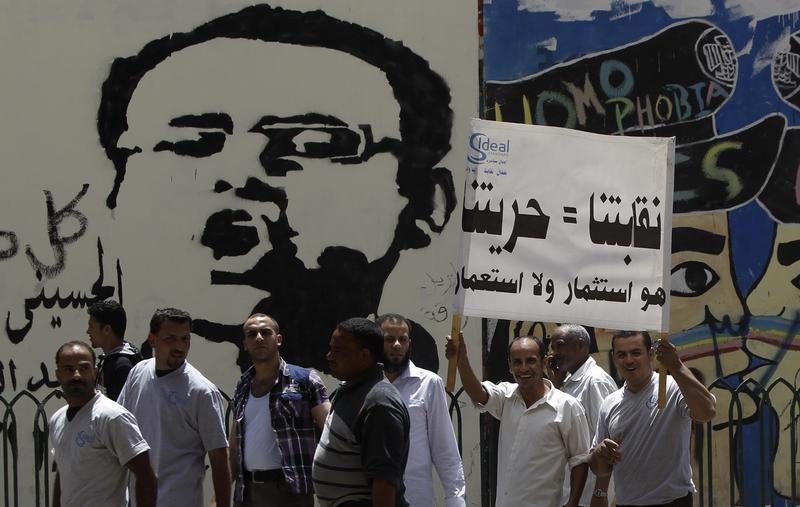
Labour rights activists and ECESR lawyers have succeeded in winning court verdicts ordering the renationalisation of several privatised companies, including the Steam Boilers Company, Omar Effendi, Ideal, Assiut Cement, Nile Ginning Cotton Company, Shebin El-Kom Textiles Company, and Tanta for Flax and Oil.

Many of these verdicts, however, were never applied. Recently, Prime Minister Hisham Qandil was slapped with a suspended one-year jail sentence for failing to implement an administrative court ruling ordering the renationalisation of Egypt's Tanta Flax and Oil Company.

According to a recent report by the International Development Centre, an Egyptian rights organisation, Egypt is currently witnessing a sharp spike in labour and other social protests, with 1,354 protests recorded in March alone compared to 864 protests during the previous month. This means an average of 44 protests per day, or 1.8 protests every hour.

The report also states that the protests were held by 40 different social categories, with most being staged by politically unaffiliated individuals.

The vast majority of protests involved labour rights and rising fuel prices, the report added.

Within the past two years, the report went on, major strikes in Egypt involved railway workers, public transport workers, doctors and police officers.

After the January 25 Revolution ousted former president Hosni Mubarak, expectations were high that many of Egypt's social and economic woes – which many saw as the triggers of the uprising – would be minimised, and that demands for better working conditions and pay would be met.

According to the ECESR report, however, the number of strikes increased when President Mohamed Morsi won the elections, after which hopes were high for economic stability following months of uncertainty.

However, since 2011, Egypt has instead seen weak economic growth and rising costs of living. Government attempts to reduce subsidies have also led to rising prices for basic utilities, including electricity and natural gas.

What's more, the local currency has suffered a sharp devaluation this year due to dwindling foreign currency reserves.

The government is currently trying to modify an economic reform plan in hopes of obtaining a $4.8 billion loan from the International Monetary Fund after the latter deemed an earlier plan 'weak.' A modified version of the plan is expected to further reduce energy subsidies and raise sales taxes.


*Photo courtesy of Mai Shaheen

Egypt's Islamist dictator & the Christian problem


“Any attack on Egypt’s Christians is an attack on me personally,” said President Mohamed Morsi during his 100th day as president speech last September, a statement which he again reiterated when he spoke to Pope Tawadros II, the pope of the Coptic Orthodox Church, last night after 8 hours of attacks on St Mark’s Cathedral, during which he stayed silent, as he usually does.

Given how wildly unpopular our president is, people on Facebook were joking whether or not this statement should be considered inciting violence against Egypt’s Christians.  We are Egyptians. We make jokes when we are horrified, but what happened yesterday is no laughing matter.

Yesterday the Coptic cathedral was attacked after a funeral for four Christians who were killed two days earlier in sectarian clashes in the town of Al-Khosous that also left one Muslim killed. The funeral was attended by hundreds of Christians and sympathetic Muslims, who started chanting for the removal of Morsi and his Muslim Brotherhood buddies from power, which apparently was unacceptable to “some people.”

Those “people” started attacking the emerging mourners the moment they stepped out of the cathedral, and shortly after, they were joined by riot police with armed vehicles, who stood next to the attackers and shot teargas canisters into the cathedral.

So, not only was the cathedral not getting protected by the Egyptian police as it was being attacked by thugs, the police were actively providing cover to the attackers, and tear-gassing the trapped inside mourners. The country was watching, half in horror and the other half probably in glee, as the police of the Islamist state of Egypt actively joined a mob in their attack on the cathedral.

To put things into perspective, St Mark’s Cathedral is the heart and brain of the Egyptian Coptic Church. It is where the pope lives and works, and the home of one of the oldest churches in recorded history, and the only church worldwide that has equal standing with the Roman Catholic Church in terms of history and influence over Christianity.

The cathedral runs the affairs of Egypt’s Coptic minority, as well as churches in over 150 countries, and it was being attacked by the police of our Muslim Brotherhood president. It should be noted that worldwide, in countries where there is active civil war and genocide churches are places of refuge for victims, because of their holy standing as places of worship. We don’t care about that in Egypt. Over here, we attack cathedrals after funerals with mourners inside, and the state helps.

The Muslim Brotherhood-dominated Ministry of Interior naturally released a statement, blaming the Christian mourners for the clashes, and claiming to be doing its best to stop the clashes. Known Islamist activist Abdelrahman Ezz, who incited the attack on the Itihadiya protesters back in December and was never investigated, was openly calling and encouraging the attack on the cathedral, citing it as proof that the church has “militias” and “weapons.”

Joining the crazy wagon was the Salafi TV channel Al-Hafez, which aimed to capitalise on the situation by having a text message-poll on “whether or not a civil war between Muslims and Christians will erupt in Egypt”, with each text message costing the sender 3 EGP.

The following day, the foreign relations secretary of the ruling Freedom and Justice Party, Mohamed Soudan, sent an email blaming all that took place around the cathedral on the Coptic mourners, who claimed that the Christians finally showed the weapons they were hiding inside the churches, and that, and I quote here, “ they seem to be up to something.” And yet when I posted yesterday on Twitter my belief that the Morsi administration doesn’t care about the Egyptian Christian population at all, Brotherhood apologists abroad accused me of having a Kanye West “Bush moment”. Fine, let’s go over the evidence, shall we?

Since Morsi took office, the following attacks took place on the Coptic churches: 5 November, Muslims tried to seize the lands belonging to the Central Shobra Al-Khaima church; 15 February, the Seresna Church in Fayoum was attacked; 26 February, the administrative building of the Abu Maqar church in Shobra AlKhaima was attacked; 1 March, the Kom Ombo church in Aswan was attacked while on the same day the administrative building of the Beni Suef Central church was ransacked. Those are only the attacks on the churches and their properties, the same Church that Morsi never visited, never met with its leader and whose pope’s coronation he didn’t attend.

This is the same President Morsi that openly espoused anti-Semitic and hateful views on video and then claims to be taken out of context. This is the same president whose people during the constitutional crisis openly stated that he enjoys the support of 90% of all Egyptians and that the protesters were pushed by the church.

This is the same president who during his reign , Beshoy Kamel was sentenced to six years for insulting “Islam and the president’s family” on Facebook, Alber Saber was arrested for “blasphemy” on Facebook , and 10-year-old Nabil Nagy Rizk and 9-year-old Mina Nady Farag from Beni Suef were arrested in October 2012 on charges of tearing up the Quran. The children were illegally arrested, and Morsi didn’t move a finger to release them. They were, after all, Christians.

Needless to say that in none of those incidents of church attacks, no one was seriously charged. Needless to say that the Brotherhood apologists in the west will claim that he doesn’t fully control the Interior Ministry or its actions, despite the ministry’s defense of the Muslim Brotherhood Guidance Council office (which is neither a state institution nor a holy place) and vicious attacks against anti-Brotherhood protesters.

The ministry can apparently be ordered to protect the two-year-old Guidance Council office but cannot protect the almost 2,000-year-old church represented by the cathedral.

The Brotherhood apologists will blame all of this on the remnants of the old regime in the Ministry of the Interior, and cite that Morsi is not yet in complete control of it. If this is him without complete control of the Interior Ministry, I openly dread the day he does control it.

In other news, during those clashes, European Union officials were in Egypt discussing with the president and opposition figures the parliamentary elections and how they intend to monitor them, with the Egyptian newspaper citing Catherine Ashton promising to help Egypt get that IMF loan, so that the EU, alongside the US can continue to prop the Muslim Brotherhood regime as it continues its reign of terror.

I have a suggestion, EU: How about we resort to your magical ballot box to solve Morsi’s Christian problem once and for all? We can start a referendum asking whether or not to burn all of Egypt’s churches and kick all the Christians out. I am positive it will pass with a stunning rate, and then the state can persecute the Egyptian Christians and attack their churches legitimately. After all, the ballot box has spoken. Dear EU, you can monitor that if you like.

Sunday, March 31, 2013

Over 4,500 factory closures since revolution, hundreds of thousands laid-off


Tue, 26/03/2013

Jano Charbel


Time and time again, officials have accused ongoing protests, workers’ strikes and labor action of halting the so-called wheel of production. The counter argument has also been reiterated, attributing the ailing economy to the government’s myriad bad decisions and their mismanaged implementation.

Production implies industry, and industry refers to the thousands of factories in Egypt, all of which have suffered in one way or another as a result of an economic slowdown, a mounting funding crisis on the national level, diminished foreign reserves and feeble capital inflows.

The dynamic only exacerbates already existing problems in the country’s industrial sector, incurring further discontent among workers. These sector-specific troubles are reflective of, and further compounded by, broader economic turmoil.

Since the January 2011 uprising, at least 4,500 factories have been shut down, with hundreds of thousands of workers laid off, according to a study conducted by a labor rights group in February.
As Egypt’s dire economic conditions worsen, further closures and layoffs are expected.

The study by the Center for Trade Union and Workers’ Services, or CTUWS, an independent NGO, was conducted in 74 industrial zones across the country. In terms of the effect on joblessness, the findings appear to correspond with official statistics compiled by the Central Agency for Public Mobilization and Statistics.

The agency’s statistics indicate that Egypt’s unemployment rate has risen to a record 13 percent, roughly 3.5 million people from a total workforce of some 27 million.

Adel Zakariya of CTUWS says hundreds of thousands of workers have been rendered jobless since the onset of the revolution. While an exact number is tough to determine, he says the mass of layoffs is “unprecedented.”

“The exact number of sacked workers is difficult to gauge at any given point of time. For example, we find that sacked workers from a certain food-processing company may relocate to another such company within the same industrial zone in which they worked,” he says. “A lack of employment contracts and masked or seasonal unemployment make it nearly impossible to assess the exact numbers of unemployed workers.”

More closures, not less

Nearly all factories that have been shut down since the revolution are private-sector companies, Zakariya says. “We’ve witnessed partial company closures, including the closures of some factories and production lines within these companies, along with total company closures.”

While he recognizes that there were hundreds of factory closures during former President Hosni Mubarak’s rule, the “rate has increased exponentially since the revolution.”

The 4,500 factory closures cited in the study is not comprehensive; it is a result of the number of factories surveyed in industrial zones that the CTUWS has been monitoring. The actual sum, Zakariya predicts, is likely significantly higher.

“Numerous different industries have been hit by these closures. Perhaps the hardest-hit industry is textiles,” he says, though “the textile industry has been in a steady state of decline since Mubarak.”

A combination of mismanagement, corruption and indebtedness of public-sector textile companies led to broad privatization measures in the early 1990s. Dozens of these companies slashed the workforce they inherited from the public sector, and, after their privatization, appear to have been similarly mismanaged.

The Cairo Administrative Court nullified some privatization contracts over the past two years, leaving companies such as Indorama Shebin Textile, Nile Cotton Ginning, and Tanta Flax and Oils in limbo, as the state has declined to re-nationalize them.

The steady decline of Egypt’s cotton industry also prompted the import of lower-grade cotton, leading to a deterioration in the quality of domestically manufactured textiles. In turn, hundreds of thousands of textile workers have been rendered jobless, while more recent economic factors threaten to further increase unemployment rates.

The textile industry has suffered most in the private-sector industrial zones of Sadat City and 10th of Ramadan City, while metallurgical industries have been impacted most in Obour City.

Financial obstacles

The surge in the number of factory closures is attributed to factors that have impinged on the economy at large. Zakariya cites “difficulties in procuring financing and bank loans, which have in turn negatively affected production and exports, along with some capital flight from Egypt amid the climate of political instability in the country since the revolution.”

Industry insiders and bankers have cited a shortage of dollars with a depreciating pound and scarce foreign reserves as reasons for the banking sector’s increasing hesitancy in providing funding and lines of credit. This affects the ability of ailing companies and factories to obtain rescue loans or financial support, and also stymies the import-export flow of goods.

Zakariya admits that financial problems may be compounded by workers’ strikes and industrial actions. “But although strikes do negatively affect production, these industrial actions are at the bottom of the list of factors leading to factory closures,” he says.

A statement issued last month by Finance Minister Morsy Hegazy said Egypt incurs losses of about LE100 million per day due to labor strikes and political unrest.

One private-sector company with a number of factories blames industrial action for its problems, and last month its owner took drastic measures to make his point heard.

Farag Amer, chairman of the Faragello Food Industries Company board of directors, wrote a widely circulated statement in late February accusing President Mohamed Morsy’s regime of failing to respond to what he called “blackmail and the moral deviance” of workers, who launched “unwarranted strikes in contravention to the provisions of law.”

On 20 February, Amer imposed a lockout, and shut down his factories across the country following industrial action by workers in Alexandria.

The Faragello administrative board ordered the sacking of 27 striking workers, including 17 union leaders, according to workers and independent union organizers.

A senior administrator from the Faragello company, who spoke on condition of anonymity, tells Egypt Independent, “We’re back to operations as usual. All our companies and factories across the country have returned to work.

“We had shut down operations for only a few days in light of the illogical demands raised by newly employed workers, calling for unrealistic bonuses and pay raises,” he says, but did not comment on the dismissal of unionists and striking workers from the company.

But Zakariya says political as well as financial factors motivated the temporary closure. While it’s not clear what the company owners’ affiliations are, they appear to be seeking Morsy’s intervention in dealing with striking workers and independent unionism in their company.

“Faragello’s administration is involved in a game of political maneuvers with the new regime ... playing its political pressure cards with the regime, because they want to eliminate strikes and independent labor unions,” he claims.

The Faragello administrator went on to say, “We demand security and stability for our industries, and for the country as a whole.”

However, he adds, the company may deal with problems such as lack of diesel and fuel to power the factories in the future.

Egypt’s diesel crisis has extended far beyond affecting drivers and causing winding traffic jams around gas stations. It is now halting work at some factories, disrupting transportation of school buses and, more critically, failing to meet the needs of power plants as the heavy energy-consuming summer months approach.

“Given the national outlook for diesel and fuel shortages, along with associated electricity blackouts, we are expecting additional factory closures and even more layoffs. Whether these closures will be permanent or temporary, partial or complete, we’ll have to wait and see,” Zakariya says.

Factories in Sadat City and 10th of Ramdan are edging closer toward possible closures due to the diesel crisis, he adds.

Government response

Government officials have attempted to address the numerous factory closures, while simultaneously proposing plans to create thousands of new jobs. On 6 March, the Cabinet claimed the government helped secure 522,000 job opportunities, including 345,000 locally and 177,000 for Egyptians abroad.

In a televised interview 25 February, Morsy said 119 new factories commenced operations in Egypt that month, with about 300 more factories in the pipeline. The Finance, Manpower, Investment and Youth ministries proposed an ambitious plan to jointly create 700,000 new jobs this year.

However, union organizer Tallal Shokr, board member of the Egyptian Democratic Labor Congress, is skeptical of these grand proclamations.

“The government claims that it has secured hundreds of thousands of job opportunities for Egyptians, and claims that it will create hundreds of thousands more — these are baseless claims, merely for media consumption,” Shokr says. “The reality is that unemployment has reached a record high, and new job opportunities are not being provided, at least not on the scale that the government is claiming.”

He cited as further setbacks the state’s move toward cutting public spending in an attempt to rein in the widening deficit, as well as plans to curb subsidies and a number of expected measures associated with the US$4.8 billion International Monetary Fund loan being negotiated.

“In light of current economic conditions, the government will not be able to provide the 700,000 new jobs that it speaks of. The best it can do is to provide contracts for those who are already employed and claim that they have created all these new jobs,” he adds.


*This piece was originally published in Egypt Independent's weekly print edition.
**Photo courtesy of Al-Masry Al-Youm