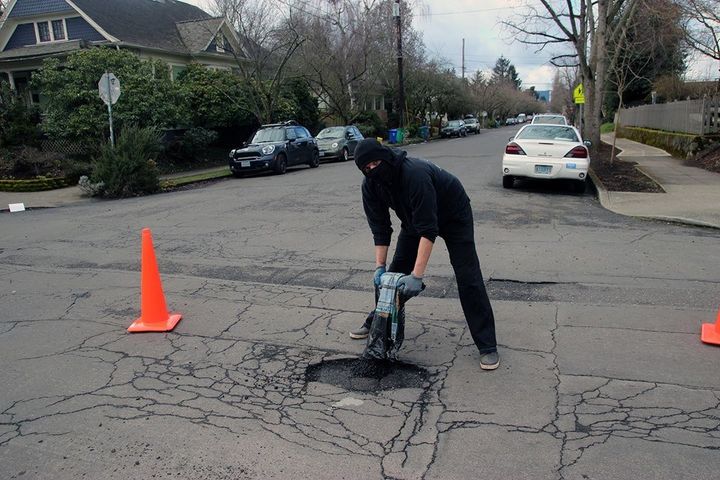
In 1977, the Sex Pistols said anarchy was about destroying the passerby. In 2017, anarchy is apparently about fixing potholes.
A
group of anonymous anarchists in Portland, Oregon, ― where else? ― have
taken their version of anarchy to the streets to help their local
communities by fixing unsafe potholes themselves. The project, which
began in late February, is the coolest thing to happen to punk after
Green Day officially ruined it for everyone.
“The
roads in Portland were getting worse and worse, and like everyone else,
we were just waiting for someone else to fix it,” a member with the
Portland Anarchist Road Care, or PARC, told The Huffington Post in an
email. “We sort of reflected on the situation, and asked ourselves the
questions made famous by John Lewis: ‘If not us, then who? If not now,
then when?’ Two days later we were patching holes.”
On Facebook, PARC is keeping their more than 4,000 followers updated with their progress. So far, they said they’ve repaired five potholes. They said they believe in community solutions over “hierarchical institutions like government.”
It
might seem confusing. Anarchism usually tends to conjure up images of
angry men in Guy Fawkes masks setting things on fire. But that’s not
what PARC is about.
"Many
of the critiques we have received from the left have said we should be
tearing the streets up, rather than paving them,” PARC told HuffPost.
“We find this view ableist, classist and antisocial. To us, anarchy is
about building community and creating networks of solidarity and mutual
aid."
The
anarchists have also faced criticism from ― you guessed it! ― the
government. Dylan Rivera with the Portland Bureau of Transportation told
HuffPost that fixing potholes should be left to professionals.
“Patching
can pose a risk to the individuals doing the patching because there’s
traffic moving on these streets, and they may not have the proper
equipment or training to make a safe work zone for themselves.”
What
the anarchists are doing is illegal, Rivera said. But he sympathizes
with them, saying he understands the public frustration with potholes,
especially after a heavy rain and snow-battered winter.
“Portlanders
are very community minded,” Rivera said. “They express themselves in
many ways, whether its parades or helping neighbors out in snowstorms,
and so we see what these folks are doing as really an extension of the
community mindedness of Portlanders.”
Rivera also mentioned that earlier this month, the city spent a full day to fill more than 900
of the dangerous road hazards. Rivera said weather conditions also need
to be dry for city workers to fix the potholes. PARC disagrees.
“[The
PBC] use the excuse of not being able to pour hot asphalt in the rain,
but there are alternatives,” PARC said. “The method we use, called cold patching,
is less permanent than the hot asphalt that is traditionally used, but
it is able to be used in the rain. There are steel road plates that
could be laid over the worst of the potholes, which measure easily over
ten feet long.”
Rivera
said the city has used cold patching in the past before, but not often
because it’s a temporary solution. Instead of fixing paved roads, which
are maintained by the city, Rivera suggested the anarchists could offer
help to neighbors who live on gravel roads as they’re not maintained by
the city. He said as long as the property owners are agreeable to it,
citizens can help patch those holes up.
PARC said they have received an influx of volunteers to help, and plan to “mobilize hundreds of people all across the city.”
“[Anarchy]
is about claiming communal ownership over our spaces, be they public,
work, educational, or otherwise,” PARC said. “Our work directly puts
that ideology into practice. They are our roads, we use them every day,
and we will fix them together.”
The No to Military Trials for
Civilians campaign said on Monday that 3000 civilians were tried in
military courts in the last five months, since President Abdel Fattah
al-Sisi passed new legislation treating certain state facilities as
military institutions.
The findings formed part of the campaign’s
fourth annual conference, which included testimonies from those who have
been through military trials and their families.
Campaign member
Sara al-Sherif says this constitutes a “dramatic” increase in an already
endemic practice, presenting a greater challenge for the campaign, as
public outrage has been more recently directed at harsh rulings by
civilian courts.
She says people claim, “civilian judiciaries
issue death penalties and life sentences without restriction, in
contrast to verdicts by military judiciaries that are swift and will
never be worse than what is already practiced in civilian courts,” but
maintains this is not accurate, given the nature of military courts and
the verdicts they have issued.
Lawyer Ahmed Heshmat raises
concerns over the independence of military courts in the first place.
“The law that enabled military courts to try civilians stipulated that
this judiciary is independent, but it is not independent at all.
Military judges are employees of the Defense Ministry, and as such they
have to adhere to the demands of their superiors.”
“Verdicts
issued by military courts should be approved by the military leader or
his deputy, and he has the right to request the amending of a sentence,
or a retrial if the defendants were acquitted,” he adds.
Heshmat
also questioned the legal procedures for military trials. Verdicts by
military courts are all issued as if the defendants are present, even if
they are actually absent.
Since Sisi’s decree, the number of
civilians referred to military courts has increased, especially among
students arrested on campuses for protesting, many of who have been
handed lengthy prison sentences. Universities are now considered
military institutions under the new law.
An activist in the
“Horreya” (freedom) campaign, concerned with the detention of students,
Seif al-Islam Farag, said that the campaign has recorded the cases of
160 students referred to military tribunals, including 48 students from
Mansoura University, 31 from Al-Azhar University and 14 from Monufiya
University.
He added that the sentences against many of these
students are not based on reality, as in the example of student Ahmed
Shokier, who was sentenced to life in prison, when he had actually
passed away one month before the incident for which he was
convicted took place. Another student in Port Said was referred to 11
military tribunals.
Mother of 16-year-old Youssef Shaaban, who was
arrested in September, says her son was tortured to make him confess to
crimes he didn’t commit, including killing a police officer. The
grieving mother says she is not able to visit her son in prison as no
one knows his whereabouts.
Father of 19-year-old Ain Shams student
Mohamed al-Araby, said that he was surprised when five police officers
stormed his house and arrested his son. They said his son had published a
video concerning the military and would face charges of “spreading
false news about the Armed Forces.” The father was told his son would
return home in a few hours, but he never came back.
“Days later, I
found a lawyer asking for a lot of money to defend my son who was
facing a military trial. When I went to military prosecution, they
said there is no need to hire a lawyer, as the case would be heard by a
misdemeanor court and not a criminal one. I have just realized that the
case was referred to criminal court,” Araby’s father added.
Araby
himself spent many weeks in military prison before he was referred to
Tora, with signs of torture on his face, according to his father.
The
No to Military Trials campaign organizers pleaded with local media to
raise the issue of military trials for civilians, which they say
threatens everyone under the new legislation.
Dwarfism-rights activists
succeed in establishing associations, a trade union, and constitutional
amendment safeguarding their rights
Tuesday, March 17, 2015
Jano Charbel
During the Old
Kingdom of Ancient Egypt people with dwarfism were believed to be
celestially-gifted little people - some of whom became renowned royal
court officials, while many others were employed in esteemed
occupations. In modern day Egypt, however, the story is very different.
Currently
estimated to number around 75,000 nationwide - Egyptians with dwarfism
suffer discrimination, marginalization, unemployment, and poverty. They
are subjected to ridicule in schools, workplaces, and in public on a
daily basis. *Dwarfs also cite a lack of affordable healthcare and easily
accessible transportation, amongst other grievances.
It is on
the basis of confronting such discrimination, and a host of
socio-economic obstacles, that groups of Egyptian dwarfs have begun to
unite their ranks in recent years.
The 'Association for the
Welfare of Dwarfs in Alexandria' (AWDA) was officially established in
this Mediterranean city in December 2012, while the 'Independent Trade
Union of Dwarfs' was established in March 2014 and officially registered
with the Ministry of Manpower. This labor union for dwarfs is the only
such organization in the Arab World, and perhaps worldwide.
AWDA
currently boasts a general assembly membership of around 120 - with
smaller branches in Cairo, along with the Suez Canal cities of Port Said
and Ismailiya.
This while the newly established 'Independent
Trade Union of Dwarfs' currently has a membership of some 50 members,
with only one union committee - which is also headquartered in
Alexandria.
The Association for the Welfare of Dwarfs describes
itself as being a venue for social, cultural and sports events. While
the Trade Union of Dwarfs is concerned with its members' employment,
vocational training programs, professional skills, workplace
discrimination, and other labor-related issues.
Both the association and the union are open to the membership of any Egyptian with dwarfism.
While
there is no official national census data or other records indicating
the exact number of the dwarfism community countrywide. By AWDA's rough
estimates there are some 400,000 Egyptians (the vast majority of whom
are of full-stature) whose families include at least one person with
dwarfism. Families headed by dwarf parents are particularly prone to
economic hardships in contemporary Egypt.
CONSTITUTIONAL RECOGNITION
The
association won an unprecedented victory last year when Egyptians with
dwarfism were recognized in a constitutional amendment including them in
employment quotas. The amendment also granted special consideration to
the community in terms of their socio-economic rights.
Thanks to AWDA’s advocacy, the 2014 Constitution now stipulates in Article 81:
“The
state is committed to ensuring the rights of persons with disabilities
and dwarfs in terms of healthcare, economic and social rights, in the
fields of culture, entertainment, sports and education. Along with the
provision of job opportunities for them, the allocation of employment
quotas, the creation of public facilities and an environment whereby
they may exercise all their political rights so as to facilitate their
integration amongst other citizens — in keeping with the principles of
equity, justice and equal opportunities.”
A 5 percent employment quota is specifically stipulated for both public and private sector enterprises, in accordance with the labor law.
Previous
constitutions provided these rights to citizens with disabilities, but
never contained provisions specifically for dwarfs. Employers would thus
often exclude people with dwarfism from such quotas, on the basis that
they were not mentally or physically disabled.
Essam Shehata and
his wife Nisreen Hamed were the driving force behind the amendment.
Tireless activists for the dwarfism community since the 1980s and
co-founders of AWDA, the couple successfully lobbied lawyers and other
Constituent Assembly members to include these provisions during the
constitution drafting process.
Shehata, AWDA's Director and the
President of the Union for Dwarfs, told Mada Masr that the new provision
of constitutional article 81 is not being enforced, however.
"Neither the state nor private businessmen are standing with us in terms of the providing employment opportunities for dwarfs."
Shehata added that political parties have also neglected the rights of Egyptians with dwarfism.
Some
AWDA members have successfully maintained steady jobs in the public
sector, working as customs officials, employees at the Alexandria Port
Authority and in the healthcare sector. Yet these cases are the
exception, not the rule.
Ahmed Fouad - who has dwarfism - is
employed at the Health Ministry explained that public sector employers
would typically not classify dwarfs amongst the ranks of the physically
or mentally disabled, especially prior to the issuing of the (January)
2014 Constitution with its Article 81.
Fouad explained that - in
his experience - "We would often find that employers do recognize the
five percent quota for disabled persons. But instead of providing such
people with jobs at their workplaces, they are paid to stay at home." He
went on to criticize such practices as being dismissive and
non-constructive acts of charity.
Fouad emphatically added:
"We're not asking for charity, we are asking for our rights and for
equal opportunities in our country."
BARRED FROM THE WORKFORCE
Unemployment or precarious employment is often cited as the most pernicious problem facing the dwarfism community.
AWDA
co-founder and secretary for women’s and children’s affairs, Nisreen
Hamed points out that the association’s professional skills workshops —
such as courses in cellphone repairs and maintenance — have “proven that
dwarfs are mentally and physically capable of performing technical work
exactly like fully grown people."
Sami Ramsis has been out of
work for three years. “I've been repeatedly seeking employment at the
Ministry of Manpower's bureaus,” he says. “But the employees there
ridicule me, saying normal people can't even find employment, let alone
dwarfs.”
Ramsis feels like he's stuck in a cycle of social
exclusion. "Since I can’t find a job, I can't buy or rent an apartment
for myself,” he continues. “Since I don't have any steady income or an
apartment, I can't get married or have a family of my own.”
And
even if a person with dwarfism does get a job, he or she is then
confronted with the problem of how to get there — many report that most
forms of public transportation are inaccessible.
"I have no
problem riding the tramway, but some buses and microbuses are very
difficult to climb aboard. They are not easily accessible to people our
height," AWDA member Qadria Mahrous says.
Other association
members say they hope government officials or private donors will help
to subsidize the purchase of cars or motorcycles that are modified for
their height, so as to increase their mobility - and, by extension,
their prospects for employment.
BUILDING COMMUNITY
AWDA
may still have a long way to go when it comes to tackling issues of
national infrastructure and transportation — but it has been successful
in creating a community center, and offering the services and activities
that Egyptian dwarfs can’t find elsewhere.
AWDA offers some
medical services to its members, who often struggle with access to
healthcare. Hamed explained that there are a multitude of different
forms of dwarfism. Her association provides human growth hormone
injections for those children whose specific form of dwarfism is caused
by hormonal imbalances or nutritional deficiencies.
Hamed added:
“from childhood dwarfs are ridiculed at school, then in adulthood
suffer discrimination in employment,” she asserts.
“We've been
calling on the Ministry of Education to raise awareness, to increase
tolerance and acceptance of dwarf children in schools,” Hamed
explains. “We want to end the physical and verbal bullying of dwarf
students by their classmates.”
She hopes that increased efforts
on the part of education officials will help to foster a sense of social
integration and belonging that would ultimately lead to greater success
later in life.
And aside from these crucial services, the social
experience the association provides makes a major impact on its
members’ lives.
"I enjoy the sense of community, and the company of
friends I've made here. We can relate to each other's daily grievances,”
says Mahrous.
The association convenes for its general assembly
meetings on the first Friday of every month. Mahrous expressed her
appreciation for the trips, excursions, (limited) health care
assistance, pilgrimages to Mecca/Medina, Ramadan food packages, along
with vocational training and job skills that AWDA offers its members.
These
activities have helped to build a close, tight-knit community — Hamed
proudly notes that at least six couples with dwarfism met and got
married through the association. Several of AWDA's married members have
subsequently produced offspring who are of full-stature.
Shehata
is currently working to establish a National Day for Egyptian Dwarfs
on March 27 to raise awareness regarding the community, and its needs
and aspirations. AWDA is preparing events including football matches
between teams of dwarfs, together with songs, dances, competitions, and
cultural shows - by performers with dwarfism.
At the
association's headquarters, five costumed AWDA members are rehearsing an
Upper Egyptian stick dance and a Nubian jig in traditional costumes.
They smile joyfully for their photo shoot, and say they’re excited to
perform in front of an audience. They even hope to perform
professionally in the future.
But the rehearsals might be in vain if Shehata doesn’t secure the funds required for such a national event.
"If
we don't have sponsors to promote or financially assist us with these
events, then we won't be able to be able to go ahead with them,” he
explains. “Our plans for this National Day of Egyptian Dwarfs may have
to be put on hold."
While the Association for the Welfare
of Dwarfs in Alexandria does not have an official webpage, pertinent
information on the Egyptian little people community can be found on the Dwarves Dot Com Facebook page.
*In interviews with Mada Masr, members of the community referred to
themselves as "qezm/aqzam," literally "dwarf/dwarfs." This term has been
contested globally, with some preferring to use "people of
short-stature" or "little people," as there is no agreement on whether
or not dwarfism is a disability. **Photos by Jano Charbel
Photographs, videos, and witness statements strongly indicate that a member of Egypt’s
security forces was responsible for fatally shooting a female protester
in a downtown Cairo square on January 24, 2015, Human Rights Watch said
today.
Evidence analyzed by Human Rights Watch shows a uniformed police officer
apparently directing a masked man who fires a shotgun toward a group of
about two dozen peaceful protesters whom police were dispersing from
Talaat Harb Square. Shaimaa al-Sabbagh, 32, is seen immediately falling
to the ground following the shot. She died later from what medical
authorities described as “birdshot” injuries. Prosecutor General Hisham
Barakat announced an investigation into al-Sabbagh’s death the same day.
“The prosecutor general needs to follow through on his pledge to bring
those responsible for al-Sabbagh’s death to justice,” said Sarah Leah Whitson,
Middle East and North Africa director. “The world is watching to see
whether this case breaks the pattern of impunity for rights abuses that
has marred Egyptian justice since the 2011 uprising.”
The prosecutor general said that investigators would review all the
available evidence, including surveillance camera footage and official
logbooks detailing the weapons used by security forces, and would
question the police who dispersed the protest. In a statement, Barakat
confirmed his office’s “commitment to apply the law to everyone with all
firmness and without discrimination and present the perpetrators of the
incident – whoever they were – to criminal prosecution.”
However, Barakat also said that “preliminary investigations” had
found that the police had only used teargas, and only after the
protesters had failed to respond to police orders to leave and had
injured police with rocks and fireworks. On January 28, 2015, an
official from the Interior Ministry, which oversees the police, told the media
that the projectile that killed al-Sabbagh was not a type that the
security forces use and suggested that videos of her being shot were
fabricated.
On January 31, the Qasr al-Nil district prosecutor’s office, which is
investigating the incident, ordered the arrest of the vice president of
al-Sabbagh’s political party, 60-year-old Zohdi al-Shami, who had been
present at the protest and had gone to the prosecutor to offer
testimony.
Prosecutors questioned al-Shami as a suspect for about nine
hours before ordering his arrest, according to one of al-Shami’s
lawyers, Mohamed Abd al-Aziz. They presented a report from the National
Security Investigations Service that said al-Shami is suspected of
having carried a weapon to the protest, Abd al-Aziz told Human Rights
Watch.
Prosecutors have also charged nearly a dozen people involved in the
protest with breaking an anti-protest law passed in November 2013 than
bans all unauthorized gatherings, according to some of those charged.
One witness told Human Rights Watch that the district prosecutor
investigating the killing initially attempted to arrest her when she
offered her statement.
Human Rights Watch interviewed four witnesses to the shooting and
analyzed 18 photographs and three videos. This evidence shows that the
security forces deployed in Talaat Harb Square that day used excessive
force in response to a small, peaceful march organized by the Popular Socialist Alliance Party, and fired teargas and birdshot at the protesters apparently without warning.
One video that shows security forces dispersing the protest captured
what appears to be the moment that al-Sabbagh was shot. Four gunshots
are audible in the video. The first two were fired in quick succession
at the outset of the dispersal, with the third shot nine seconds later
and the fourth shot seven seconds after that.
When the first two shots
were fired, protesters on the sidewalk carrying a large red banner had
begun moving away, southwest along Talaat Harb Street toward Tahrir
Square. Their banner can be seen near the door of the Air France office
that faces Talaat Harb Square. Based on published photographs showing
both al-Sabbagh and the banner at this position, al-Sabbagh was standing
and was not wounded at that time.
In the video, the protesters can be seen walking southwest farther along
Talaat Harb Street, pursued by the police, when the third shot is
heard. At that moment, a masked man in dark clothes is seen standing
beside a uniformed officer, identified as a police brigadier general, in
the street. The masked man adopts a shooting stance and points his
firearm in the protesters’ direction as the police officer runs toward
and points at the protesters. Three photographs published by local media
organizations also show this moment, with the police officer and the
gunman, from different angles.
Hisham Abd al-Hamid, spokesperson for the Justice Ministry’s Forensic
Medical Authority, told the television channel Al-Hayat in a January 24, 2015 interview
that al-Sabbagh had been shot in the back and neck by birdshot from a
distance of about eight meters. A forensic medical report documenting
al-Sabbagh’s death, photos of which were posted
on Twitter, states that al-Sabbagh died after being shot in the back,
causing lacerations to her lungs and heart and massive bleeding in her
chest.
The United Nations Basic Principles on the Use of Force and Firearms by
Law Enforcement Officials, which set out international law on the use of
force in law enforcement situations, provide that security forces shall
as far as possible apply nonviolent means before resorting to the use
of force. Whenever the lawful use of force is unavoidable, the
authorities should use restraint and act in proportion to the
seriousness of the offense. Lethal force may only be used when strictly
unavoidable to protect life.
“The claim that these protesters attacked police or that the images of
al-Sabbagh’s death are fabricated simply defies all available evidence
and smacks of an attempted cover up,” Whitson said. “After so many
protesters have died exercising their basic rights, the prosecutor
general needs to step up and ensure that those responsible for this
death are held to account.”
EVIDENCE FROM WITNESSES
Azza Soliman, a 48-year-old lawyer and director of the Center for
Egyptian Women’s Legal Assistance, told Human Rights Watch that she was
at a café across the street with her son and watched the 25 to 30
protesters, some of whom carried flowers and were chanting. Before the
dispersal began, she went out to greet friends she saw among the
protesters. Within about five minutes, Soliman said, she heard sirens
and saw security force personnel, some wearing masks and carrying
shotguns, approach the protest and fire both teargas and shotguns in the
direction of the protesters.
Osama Hammam, a photographer who was covering the protest, confirmed to Human Rights Watch the details of an account he posted to Facebook, in which he described security forces firing teargas and shotguns at the protest without warning.
“The demonstration was simply 30 people carrying some roses, half of
them were old guys, and the street was empty,” he wrote to Human Rights
Watch. “And the police were on the sidewalk on the opposite side.”
Human Rights Watch stabilized and enhanced the video to analyze the
moment of the third shot. In the enhanced video, al-Sabbagh can be seen
falling to the ground immediately after the shot is heard. Two
protesters, one wearing a black jacket and identified as Sayyid Abou
al-Ela, a fellow member of her party, and one wearing a green sweater,
reach down to assist her. Two additional photographs from two different
angles show al-Sabbagh falling at this moment and the men reaching down
to help.
An Egyptian newspaper photographer who was taking pictures of the
dispersal from a short distance away told Human Rights Watch that the
man wearing the black mask, who was standing to his left, fired the shot
that hit al-Sabbagh.
He said that the protesters, 20 to 25 people by
his estimate, had been chanting slogans of the 2011 uprising – not
against the authorities. The security forces had fired on the
demonstrators with teargas and shotguns without warning within two
minutes of the marchers’ arrival at Talaat Harb Square, he said.
The video clearly shows that the fourth and final shot – identical in
sound to the previous three – was fired by the masked man toward an
unseen location farther down Talaat Harb Street, in the direction of
Tahrir Square, not toward al-Sabbagh. She can be seen at the same moment
lying on the sidewalk as al-Ela tries to assist her.
The video then shows the masked man hand his shotgun to another member
of the police in exchange for what appears to be a grenade launcher. The
masked man then fires again toward the unseen location farther down
Talaat Harb Street. Unlike the previous four shots, this weapon emits a
different sound and a large muzzle blast containing gray smoke,
suggesting that it fired a large projectile, such as a teargas grenade.
The shotgun the masked man carried appears to have been equipped with a
launching cup attached to the barrel, which is used to fire teargas
grenades and other projectiles if a specific cartridge meant for such
purposes is loaded into the shotgun.
However, the launching cup would
not have obstructed the man from “shooting through” with birdshot.
Furthermore, no smoke or projectile is visible after the apparently
fatal third shot fired in al-Sabbagh’s direction, suggesting that the
shotgun was not loaded with tear gas at that time.
In an account of the incident posted on the Tahrir News
website, al-Ela wrote that he heard the sound of birdshot hitting the
windows of the Air France office after the shot fired in the protesters’
direction and saw al-Sabbagh bleeding from her face.
Al-Ela carried
al-Sabbagh across Talaat Harb Street before another friend carried her
through a nearby alley as the two tried to hail a car to take her to a
hospital, he wrote. A police officer and a police brigadier general
arrived and arrested al-Ela and at least three other men, as al-Sabbagh
tried to hold al-Ela’s hand, he wrote.
Al-Ela confirmed his written account in a later interview with Human
Rights Watch. He said that after the dispersal, police arrested a number
of witnesses and others who were attempting to help al-Sabbagh and held
them for two days.
On the second day, the prosecutor questioned them as
if they were suspects, al-Ela said, and they provided their
testimonies. According to the Popular Socialist Alliance Party, the
prosecutor released seven people that day without bail, including the
party’s general secretary, after charging them with breaking the law
banning protests.
Al-Ela said he believed the men stationed in Talaat Harb Square that day
included regular police and plainclothes detectives, masked men not
wearing insignia, and members of the Central Security Forces, a
paramilitary riot police force often charged with securing government
buildings and embassies.
The police brigadier general seen pointing at
the protesters was the highest-ranking officer present, he said.
Soliman, who witnessed the incident with her son, went to Zeinhom
Morgue, where al-Sabbagh’s body was transported, to offer her testimony,
according to an account she posted on Facebook and later confirmed in
an interview with Human Rights Watch.
She went to the district
prosecutor’s office, and when the prosecutor called Soliman, who was
accompanied by a lawyer, he took her testimony but subsequently accused
her of participating in what he described as an “unauthorized march” and
threatened to arrest her.
The police report of the march, he told her,
said protesters had used rocks and fireworks against the police, she
told Human Rights Watch.
Soliman told Human Rights Watch that the prosecutor charged her with
breaking the protest law and resisting the authorities and had also made
similar charges against four other witnesses who came forward. She said
it was unclear whether the prosecutor would pursue the charges or drop
them.
Dozens of police officers and soldiers faced charges related to the
killing of at least 846 protesters during the 2011 uprising, but only
three low-ranking security force personnel were ever convicted and
sentenced to prison.
Since the mass killings of July and August 2013,
which left at least 1,150 protesters dead, the authorities have not
brought charges against any member of the security forces for killing
protesters.
The official Fact-Finding Committee tasked with
investigating the 2013 incidents, which included the worst mass killing
in Egypt’s modern history, completed its investigation in November 2014
and did not recommend any charges. The prosecutor general has not
announced an investigation.
Given the Egyptian government’s failure to hold authorities responsible, Human Rights Watch has previously called for a commission of inquiry at the United Nations Human Rights Council to investigate.
*Photos courtesy of REUTERS & Youm 7 Newspaper, respectively
CAIRO (AP) — Egypt's highest appeal court on Tuesday upheld
convictions and three-year prison sentences for three prominent
activists for violating the country's draconian law on protests, their
lawyer said.
The three — Ahmed Maher, Ahmed Douma and Mohammed
Adel — have already spent over a year in jail, following their arrest on
charges of breaking a 2013 law that criminalizes political gatherings
of more than 10 people without government permission and imposes tough
penalties on violators.
The decision by Cairo's Cassation Court
left the three without any other legal options, said Tarek al-Awadi,
their lawyer. The court also ordered the three to be on probation for
three years after serving their sentences.
The decision is likely
to fuel more criticism of the protest law, even among allies of
President Abdel-Fattah el-Sissi, and the police's heavy-handedness in
implementing it.
The criticism was reignited after Saturday's
killing of a female protester who died as police dispersed a small rally
on the eve of the anniversary of the 2011 protests that led to the
ouster of Hosni Mubarak. On Sunday, at least 20 people were killed,
including 3 policemen, in violent protests.
The Committee to
Protect Journalists said Monday that at least 11 cases of journalists
being detained, a reporter beaten by protesters and two photographers
injured by birdshot, were documented by local groups on the anniversary.
Images
of Shaimaa el-Sabbagh, with blood running down her face as she was
lifted off the ground by a colleague amid a security chase, struck a
nerve with Egyptians who have grown accustomed to violent clashes with
police.
The protest she took part in was peaceful and small,
organized by a leftist political party that had been allied with
el-Sissi and the military in the 2013 overthrow of Islamist President
Mohammed Morsi. Her killing also raised calls for abolishing or amending
the protest law, which also gives police the right to use force to
disperse protesters.
Thousands have been arrested according to the law, mostly Islamists.
*Photo by Mohamed Omar, Courtesy of Daily News Egypt
Prosecutors Should Investigate Excessive Use of Force
January 26, 2015
(New York) – The death of at least 20 people in Egypt
during clashes with security forces surrounding the commemoration of
the 2011 uprising underscores the need for an independent investigation
into the authorities’ excessive use of force.A woman and 17-year-old
girl were killed ahead of the January 25 anniversary while participating
in apparently peaceful protests, and at least 18 died on the
anniversary.
Sondos Reda Abu Bakr, 17, and Shaimaa al-Sabbagh, 32, were killed on
January 23 and 24 when security forces broke up protests in which
they were participating, according to eyewitnesses, media reports,
videos, and photographs reviewed by Human Rights Watch.
In al-Sabbagh’s
case, clear evidence – including videos of the gathering before, during
and after its dispersal – shows that police responded to a small,
peaceful protest with excessive force, leading to al-Sabbagh’s death.
“Four years after Egypt’s revolution, police are still killing protesters on a regular basis,” said Sarah Leah Whitson,
Middle East and North Africa director. “While President Sisi was at
Davos burnishing his international image, his security forces were
routinely using violence against Egyptians participating in peaceful
demonstrations.”
Since former Defense Minister Abdel Fattah al-Sisi came to power
following a July 2013 military coup that removed former President
Mohamed Morsy, Egyptian security forces have carried out widespread
killings of more than 1,000 Egyptian protesters.
Most of those killed
were supporters of Morsy or opponents of the coup who died in Rabaa and Nahda squares
in the capital on August 14, 2013 – the worst mass killings in Egypt’s
modern history. In November 2013, the government put in place an
anti-protest law that forbids impromptu demonstrations and gives the
Interior Ministry wide authority to forcefully disperse unauthorized
gatherings.
On January 25, 2014, the third anniversary of the uprising,
at least 64 people died across Egypt in clashes between protesters and security forces.
On January 23, in the buildup to the fourth anniversary of the uprising,
police violently dispersed an anti-coup march in Alexandria, according
to the Freedom and Justice Party, the Brotherhood’s political wing.
Abu
Bakr, a student, was participating in the march when she was shot and
killed, the party said in a Facebook post. A Health Ministry official in Alexandria told the Reuters news agency that Abu Bakr was one of two people taken to hospital for gunshot wounds.
On January 24, police similarly dispersed a peaceful protest led by the
Socialist Popular Alliance Party in Cairo’s downtown Talaat Harb Square,
firing tear gas and birdshot, arresting at least six people and leaving
al-Sabbagh dead, according to eyewitnesses and other evidence. The
party had organized the march to commemorate the January 25 revolution
and remember its “martyrs.”
Human Rights Watch reviewed numerous publicly available media documenting the protest, including four videos – one of which appears to show al-Sabbagh seconds after being shot – and 21 still photographs, 15 of which show the protest as it is being dispersed.
Though none of the videos or photographs show when and how she was shot,
they do show that at least some of the security forces present in the
square were carrying shotguns and automatic rifles. Two photos, which
seem to have been taken at or around the moment al-Sabbagh fell, show
armed police chasing her and others.
Hisham Abd al-Hamid, spokesman for the Justice Ministry’s Forensic Medical Authority, told the television channel Al-Hayat in a live interview
that al-Sabbagh had been shot in the back and neck by birdshot from
around 8 meters.
Abd al-Hamid said the type of “light” birdshot that
killed al-Sabbagh could have been used by police or civilians. He also
said that Qasr al-Nil district prosecutors had asked him not to publish
the autopsy report because the prosecutor general was issuing a
publication ban on the case, according to the Aswat Masriya news service.
Osama Hammam, a photojournalist documenting the protest, wrote on Facebook
that the marchers, about 30 people, carried a wreath and stood on a
sidewalk after reaching the square, chanting, “bread, freedom, social
justice” – a popular protest slogan.
Video posted to YouTube
by the quasi-official Middle East News Agency shows the protesters,
also holding a large banner, marching through the street and standing
and chanting peacefully near the square.
Another video,
which also appears to show al-Sabbagh moments after being shot, shows
the crowd chanting peacefully. Police stationed in the square – where
they had dispersed protesters who fired fireworks at them on January 22 – suddenly fired tear gas at the group, Hammam wrote, and the protesters began to walk away.
“Suddenly I received birdshot and began to run, not understanding
anything that was happening,” Hammam wrote. “I took some pictures as I
ran and when I felt the firing stop I looked and saw Shaima al-Sabbagh
fall to the ground.”
Graphic videos posted to YouTube show a colleague of al-Sabbagh and another man
carrying her away from the square and seeking help. Al-Sabbagh appears
to be unconscious, and blood can be seen flowing from her mouth and
nose.
A forensic medical report documenting al-Sabbagh’s death, a photo of which former member of parliament Ziad al-Alimi posted on Twitter,
states that al-Sabbagh died after being shot in the back, causing
lacerations to her lungs and heart and massive bleeding in her chest.
Security officials denied that police had shot al-Sabbagh. Assistant Interior Minister Abd al-Fattah Othman told
the Agence France-Presse news agency that security forces had only used
tear gas to disperse the protest. “It was a small protest that did not
require the use of such weapons, only two tear gas canisters were
fired,” he said.
Another Interior Ministry statement claimed that the protesters had used fireworks against security forces, Ahram Online reported.
Maj. Gen. Hany Abd al-Latif, spokesman for the Interior Ministry, said
security forces were working to speedily bring al-Sabbagh’s killers to
justice and told a privately owned television channel that a group of
protesters caught on tape carrying rifles had fired the gunshots, according to Aswat Masriya. Abd al-Latif “warned” that Muslim Brotherhood members were using such gatherings to “drive a wedge between the police and the people,” the newspaper Al-Watan reported.
None of the publicly available media reviewed by Human Rights Watch showed any protester with a weapon or fireworks.
On January 25, Prosecutor General Hisham Barakat announced
the opening of an “immediate and extensive” investigation into
al-Sabbagh’s death and ordered members of the security forces who
participated in the incident to be questioned.
Barakat said he had also
ordered the unit’s logbooks, which detail what kinds of weapons and
ammunition they used, to be preserved, and that a team of criminal
forensic experts had viewed the scene of al-Sabbagh’s death and her
autopsy report.
Prosecutors seized footage from three security cameras
in the area and questioned five other eyewitnesses as well, according to a report in Al-Youm Al-Sabaa newspaper. They released all six of those arrested during the dispersal.
Prime Minister Ibrahim Mehleb said
whoever was responsible for al-Sabbagh’s death would be punished and
that “the state after [the] January 25 [, 2011 uprising] respects the
law and applies it to everyone.”
International human rights treaties ratified by Egypt oblige the
government to safeguard the right of peaceful assembly and to restrict
it only when required by law and when necessary to achieve a greater
public good. When dispersing a demonstration or responding to acts of
violence, security forces should abide by the United Nations Basic
Principles on the Use of Force and Firearms by Law Enforcement Officers.
Governments and law enforcement agencies must ensure that there is an
effective review process and independent administrative or prosecutorial
authorities to exercise jurisdiction in such cases. Those affected by
the use force should have access to a judicial process.
Such provisions apply to all demonstrations, and Egyptian prosecutors
should ensure that the other deaths that occurred before and during the
January 25 anniversary are investigated fairly and impartially.
Egypt’s successive prosecutors general have failed to hold government
and law enforcement officials accountable for mass, unlawful killings
since the 2011 revolution. Only three low-level officers have served
prison sentences for killings in 2011.
No police officer or security
official has been prosecuted for the mass killings of July and August
2013. A judge convicted four police officers for the August 18, 2013
fatal tear-gassing of 37 detainees at Abu Zaabal Prison, but an appeals
court has ordered them retried. The official June 30 Fact-Finding
Committee, established to investigate the violence surrounding Morsy’s
removal, did not recommend any prosecutions.
Human Rights Watch has called for
the United Nations Human Rights Council to establish a commission of
inquiry to investigate widespread killings of protesters since July
2013.
Ahmed Douma was found to have “insulted the court” after he accused the judge of making anti-opposition comments on Facebook.
David Mack
December 9, 2014
One of the more prominent young democracy
activists in Egypt, Ahmed Douma, was sentenced to three years in jail on
Tuesday for contempt of court, multipleoutletshave reported.
Douma, an activist aligned with Egypt’s secular and liberal democracy
movement, was jailed for “insulting the court” after he accused Judge
Mohamed Nagy Shehata of bias against the opposition.
He questioned whether the judge was using a Facebook account to
denounce opposition members, a popular theory among activists on social
media.
The judge reportedly denied having an account,
saying only people like Douma and “his friends” use the site, according
to the English-language site Ahram Online.
The judge then found Douma to be in contempt of court, imposing the
jail sentence and fining him almost $1,400. Douma responded by shouting,
“Down, down, military rule!” from his court-room cage, according to Reuters.
Last month, Egypt’s lawyers union publicly criticized Judge Shehata for “disparaging” and “terrorizing” Douma’s defense team.
Douma had been on trial with more than 260 other defendants, accused of attacking a government building in December 2011.
He was a leading figure in the 2011 uprising that toppled former
leader Hosni Mubarak, but also took part in later demonstrations against
Islamist President Mohamed Morsi, as well as the current role played by
the military in Egypt.
In June, Judge Mohamed Nagy Shehata also presided over the notorious trial
in which three Al Jazeera journalists – an Australian, a Canadian, and
an Egyptian – were jailed from seven to 10 years – on evidence widely
denounced as ridiculous – for supposedly supporting the Muslim
Brotherhood.
Last week, Shehata sentenced 188 defendants to death for an alleged attack on a police station in 2013.
*Photo of Douma by Amr Dalsh, courtesy of Reuters
**Photo of Judge Nagy Shehata courtesy of Getty Images
By late Wednesday evening, police forces had arrested dozens in Cairo
and Alexandria who were commemorating the third anniversary of the
bloody clashes that took place on Mohamed Mahmoud Street, just off
Tahrir Square, in 2011.
The exact numbers of arrested protesters and activists were not confirmed, but estimates claim at least 50, possibly many more.
The privately owned Youm7 news portal, citing sources from the Cairo
Security Directorate, reported that 47 protesters were arrested in the
capital alone. Whereas the mainstream Sada al-Balad reported that 50
“trouble-makers” were arrested from around Downtown Cairo’s Talaat Harb
Square.
Small groups of protesters were forcefully dispersed earlier on
Wednesday in downtown Cairo. Another group was dispersed while
protesting on Stanley Bridge in the Mediterranean City of Alexandria.
Riot police forces are reported to have fired teargas canisters and
warning shots into the air, and hit largely peaceful protesters with
batons while dispersing protests. However, no fatalities were reported
during Wednesday’s crackdown.
The arrest of at least four activists was confirmed in Alexandria,
including leftist activist Mahienour Al-Massry, lawyer Mohamed Ramadan,
and fellow protesters Noha Kamel, Sherif al-Gamal, and Mahmoud Barry.
The Revolutionary Socialists Movement, of which Massry is a member, confirmed on their official Facebook page that the detainees were transferred to the nearby Raml First Police Station.
Massry was released from prison on September 21, after being issued a
suspended sentence for participating in a street protest in Alexandria.
Lawyers from the Arabic Network for Human Rights Information (ANHRI)
tweeted updates about the detainees in Cairo, reporting that the vast
majority of those arrested were being held in the Abdeen and Qasr al-Nil
Police Stations.
Officers at Cairo’s Azbakiya Police Station denied the presence of any arrested protesters Wednesday evening.
According to ANHRI's lawyers, none of the detainees have yet been
referred to the office of the General Prosecutor for investigation.
(Beirut) – A Cairo court of minor offenses handed down three-year
sentences to 23 people for breaking an anti-protest law that allows Egyptian authorities broad powers to ban
or disperse most public demonstrations.
One of those sentenced on
October 20, 2014, Yara Sallam, is a researcher with the Egyptian
Initiative for Personal Rights, one of the country’s leading human
rights organizations. The court also fined the defendants 10,000 EGP
(US$1,400) each.
Police arrested
the group on June 21 at a peaceful protest where they were calling for
the repeal of the law, which then-interim President Adly Mansour issued by decree on November 24, 2013. The defendants can appeal the verdict.
“It’s back to business as usual in Egypt, with the Egyptian government
brazenly trampling on the rights of its citizens and Western governments
supporting it,” said Sarah Leah Whitson,
Middle East and North Africa director. “The Sisi government will
clearly go to any length to crush domestic opposition, whether secular
or Islamist.”
Rights activists estimate that authorities have arrested hundreds for
breaking the law, which grants the Interior Ministry an absolute right
to ban protests or public meetings on the basis of “serious information
or evidence that there will be a threat to peace and security,” without
requiring any proof.
In June 2014, the United States released $575 million in military aid to
Egypt that it had frozen since a July 2013 military coup led by current
President Abdel Fattah al-Sisi that ousted former President Mohamed
Morsy.
It did so on the basis of a national security exception to
requirements that the State Department certify that Egypt was “taking
steps to support a democratic transition… and for the development
of…basic freedoms, including civil society and the media.”
The region's leftists meet in Tunis to share concerns, hopes
October 13, 2014
Jano Charbel
Why is the leftist movement in the Arab World weak, divided and
marginalized? Why have leftist movements not landed themselves in power
in any country since the so-called Arab Spring? What hopes lie in store
for them?
While leftists played an active role in the 2011 uprisings and in the
events that led up to them, they have since been eclipsed by the
better-organized political Islamists, military authorities, businessmen
and members of the ancien régimes.
These were some the questions and thoughts put up for debate at the
¨Contemporary Leftist Politics in the Arab World” conference held in
Tunis last Thursday. The event touched on what the broader leftist
movement across the region has been grappling with as the possibilities
of the 2011 uprisings continue to unfold.
The conference was organized by the Germany-based Rosa Luxemburg
Foundation in Tunisia. Named after the communist leader Rosa Luxemburg
— who was killed alongside many of her fellow leftist insurgents in
January 1919 at the hands of German troops following an attempted
workers' uprising in Berlin — the foundation inaugurated its first
office in the North Africa region on October 8.
The conference builds on two books published by the foundation this
month in Arabic and English mapping out the different leftist movements
in several Arab countries, while attempting to draw new lessons from
past histories.
Speaking in Tunis, renowned Egyptian labor lawyer, human rights
activist and former presidential candidate Khaled Ali declared, “The
time for socialist politics is approaching.”
That statement, however, came against a backdrop of self-criticism that loomed behind many discussions at the conference.
Ali, the founder of the Bread and Freedom Party, said that the
emergence of the left ¨depends on the ability to respond to the demands
of the populace and the streets.¨
“We should overcome our infighting and schisms, we must move beyond
talk of shortcomings and failures. Social and economic struggles lay
ahead of us, therefore we must be prepared and organized. We must shirk
violence, even if it is directed against us,” Ali said.
He added that
there are ¨generational conflicts¨ between the political outlooks of
younger and older leftists.
The Arab left ¨is stuck in an ongoing struggle between Islamist states
and military states,” Ali continued. “Both sorts of states threaten to
bury the peoples' revolutionary demands.”
He also slammed the position of some leftist figures and groups
vis-a-vis the Egyptian military’s ascent to power over the past year.
“Some have chosen to side with [President Abdel Fattah] al-Sisi in
hopes of wiping out Islamist politics,” Ali explained. “Others have
sided with him in hopes of landing themselves in office, or winning
parliamentary seats in the upcoming elections.”
Egypt’s problems were echoed by representatives of the leftist movement in the occupied Palestinian territories.
Bassem Salhy of the Palestinian People's Party (PPP) explained that the
leftist movement there is fragmented amongst several small parties —
primarily the Popular Front for the Liberation of Palestine, the
Democratic Front for the Liberation of Palestine, small communist
parties and the PPP.
“We've been seeking to unite our ranks for years, but have been unable
to do so. Therefore, we are presently just seeking coordination amongst
these different factions — for this is the least we can strive to
achieve,” he said.
Echoing Ali’s thoughts, Salhy hoped that the Palestinian left will not
be eclipsed by the Islamist Hamas Party and the liberal Fatah Party.
But unity is difficult to realize, he pointed out, "especially in light
of the fact that the Israeli occupation is actively seeking to thwart
efforts toward unity and reconciliation — even amongst Hamas and Fatah.”
“We need to step away from classical and outdated leftist politics. We
need to move toward the politics of socialist renewal and
reinvigoration,” Salhy concluded.
Another Egyptian socialist activist, Mohamed al-Agaty, argued that the
left is not short of ideas — it just hasn’t been given a chance to
implement them.
¨Many alternatives were proposed by leftist and progressive groups
since the January 25 revolution, nearly all of which were ignored or
sidelined,” Agaty said.
With the exception of a handful of elected parliamentarians and
appointed ministers who served brief and interrupted terms, the Egyptian
left did not succeed in influencing state policies.
However, participants chose to refer to their ¨shortcomings¨ rather than using the word “failures.”
Ahmed Abdel Hameed, a member of the Revolutionary Renewal Group, listed
several reasons underlying those “shortcomings” in the Egyptian
context, including a historical disillusionment with the politics of the
Soviet Union and its subsequent collapse, ¨the rigid bureaucracy of old
and new leftist parties alike, outdated classical centralism, the
inability of leftist groupings to unite in viable political fronts or
coalitions.¨
Leftists must learn from these mistakes and undo them if they seek to rise to prominence in the region, Abdel Hameed argued.
Despite these complications, Ali expressed hope for the new left in
terms of their contemporary social, political and economic stances.
¨Leftist youth in Egypt have sided with recent student protests,¨ he
pointed out, and the right to protest regardless of political
allegiances. “Leftist youth in Egypt have taken an open stance against
the new Protest Law, which greatly empowers the police, restricts the
right to protest and the freedom of assembly."
But many at the conference contended that taking part in formal
political processes is an important element for the success of the left.
Agaty said that the setbacks suffered by the Egyptian left were at
least partially attributed to ¨repeated boycotts of elections and
referendums that have kept leftists from interacting with voters and the
general populace.¨
Egyptian leftists remain divided as to whether or not to run their
candidates — or even to cast their ballots — in light of the draconian
political conditions currently prevailing in the country.
State officials have still not specified the exact dates for Egypt's
parliamentary elections, which are already overdue according to the
provisions of the new Constitution.
Tunisian representatives at the conference appeared more determined
with regards to fielding their candidates in their parliamentary
elections, which are slated for October 26.
Leftists in Tunis, where a unified left-leaning coalition called the
Popular Front has been gaining traction since 2012, appeared more united
and prepared for these upcoming legislative elections.
A spokesperson for the Popular Front, Mawloudi al-Qassoumi, explained
that this coalition initially included 11 constituent groupings, which
have now dropped to nine, including Marxist and Nasserist parties,
pan-Arab populists and others.
However, there are a host of other leftist, labor and communist groups
which are not affiliated to this front, and which have already fielded
their candidates.
¨The absence of a cohesive or unified left means a weakened stance, and
an inability to realize the revolutionary demands of the populace,”
Qassoumi said.
Despite their relative optimism with regards to the upcoming
parliamentary elections, Tunisian leftists expressed concern that the
Islamist Ennahda Party would win a majority of votes and seats.
¨We must move beyond sloganeering and merely chanting revolutionary
demands,” Qassoumi urged.
“Otherwise, we shall continue to fail and lose
opportunities to reach out to the general population.”
*Photo by Jano Charbel
Author's note: Amongst the most serious shortcomings/failures of leftist movements in the Arab world is their inability to coordinate with local labor movements, trade unions, farmers' organizations, student unions, neighborhood-watch committees, environmental activists, squatter communities, etc.
Nearly none of the participants at this conference in Tunis mentioned these civil society groups, nor did they mention their inability to coordinate with them.
Most participants had state-centric outlooks and proposals - focusing on elections and representative democracy. Many of these participants spoke of leftist political parties, their role in parliamentary/presidential elections and "representative democracy." Nearly none spoke of direct democracy, or grassroots independent organizations.
A nationwide hunger strike is gaining support in Egypt against the country's controversial ProtestLaw
September 14, 2014
Cairo, Egypt - As Egypt's President Abdel Fattah
el-Sisi heads to New York next week for the UN General Assembly, he
leaves behind a country with a growing movement of hunger strikers
calling for the release of detainees jailed under a controversial
Protest Law.
Several political parties and journalists began a symbolic nationwide hunger strike
on Saturday to demand the release of detainees held for violating a law
enacted last year that has been criticised by both domestic and
international human rights groups, as well as prominent political
figures, as curtailing peoples' right to protest.
Laila Soueif, an assistant professor of mathematics at Cairo
University, whose two children, Sanaa and Alaa, are in jail for
demonstrating against the law, has been on hunger strike with her only
child that remains out of jail, Mona Seif, since September 4.
"I'm on a hunger strike until my children are released, and all those in
their two cases are released with them," she said. "The circle of
people joining our hunger strike increases every day. We haven't reached
the stage yet to achieve what is needed, but as long as more people
keep joining our protest then this is a success."
The nationwide strike coincided with the court session of Soueif's
daughter, Sanaa, a human rights defender, and 22 other detainees. They
were jailed on June 21 after they denounced the law in front of the
Ettehadiya presidential palace in Cairo. Their case has been adjourned
until October 21, with all the detainees - which include prominent human
rights activists, lawyers and journalists - remaining in jail.
Sanaa's brother, prominent blogger Alaa Abdel Fattah, is also in jail
in a separate case. In June, Alaa and 24 others were sentenced to 15
years in prison for participating in a protest outside the Shura
Council, Egypt's consultative assembly, last year.
Taher Abul-Nasr, the lead defence lawyer, told the court the video
was taken from a computer seized from the couple's home without a search
warrant, and called the material irrelevant and defamatory. None of the
video evidence presented showed Abdel Fattah or any other defendants in
the case. The retrial is set to resume on September 15.
Alaa and Sanaa's father, Ahmed Seif, an internationally-respected
human rights lawyer who was on their defence team, died on August 27. In
January, at a press conference while Alaa was in jail, Seif addressed
his son: "I wanted you to inherit a democratic society that guards your
rights, my son, but instead I passed on the prison cell that held me,
and now holds you."
Sanaa and Alaa have joined at least 63 other detainees who are refraining from food in jail, according to the Freedom to the Brave
campaign group, which was formed in January to call for the release of
the increasing number of people they say are being unjustly detained.
"The hunger strikes are an expression of desperation, because of the
extreme level of political and human rights abuses in Egypt," said
Michele Dunne, a senior associate at the Carnegie Endowment for
International Peace, a Washington DC based think-tank.
"It's become so difficult to protest in the ways Egyptians were used
to in the past, because of the very draconian Protest Law. Even the
media is more closed, and civil society is under threat," Dunne said.
Egypt has come under increased criticism by domestic and
international human rights groups since the army deposed former
President Mohamed Morsi in July 2013, after a wave of mass protests
calling on him to resign. Sisi, then acting as the country's defence
minister, led Morsi's ouster.
In a joint statement on June 10, Amnesty International and Human
Rights Watch said Sisi would be taking office as president "in the midst
of a human rights crisis as dire as in any period in the country's
modern history."
They criticised excessive use of force by security forces, leading to
the worst incident of mass unlawful killings in Egypt's recent history,
unprecedented large-scale death sentences, mass arrests and torture.
They described it as hearkening "back to the darkest days of former President Hosni Mubarak's rule".
The Protest Law was enacted in November 2013 by Egypt's then interim
president, Adly Mansour, banning protests without prior police
notification. "The draft law seeks to criminalise all forms of peaceful
assembly, including demonstrations and public meetings, and gives the
state free hand to disperse peaceful gatherings by use of force," read a
joint statement issued in November 2013 by 19 Egyptian rights organisations.
The legislation has been used against supporters of the now-banned
Muslim Brotherhood group and Morsi, as well as secular political
activists and youth protesters that led the 2011 uprising against
Mubarak.
Supporters of the law say it is necessary to stabilise a country that
has been rocked by protests since 2011. When Sisi was campaigning for
the presidency in May, he defended the law, saying that "irresponsible" demonstrations threaten the state, according to the state-owned Ahram Online news website.
Since the 2011 uprising, Egypt's economy has been stuck in its
deepest slump in two decades, according to Bloomberg News, as tourists
and investors have been deterred by political instability.
But as domestic and international rights groups have criticised
recent moves by the government to impose greater state control over
non-governmental organisations, Sisi does not seem shaken.
"Sisi and the Egyptian government have been quite insensitive to
protests. It's quite unlike the Supreme Council of the Armed Forces,
which ruled after Mubarak stepped down, and before Morsi's election.
Those leaders felt they were on shaky grounds, and they often did
respond to street protests. That doesn't seem to be the case here,"
Dunne said.
Laila Soueif, the sister of prominent novelist Ahdaf Soueif, said she
had no faith in Egypt's judiciary and is relying entirely on public
opinion to help release the detainees. "In order to protect the progress
we have made in our rights and freedoms, we need a new system of
government around the world, based not on repression, but on negotiation
and compromise," she said.