Showing posts with label Homeless. Show all posts

Monday, August 31, 2015

What Sisi didn't say about labor conditions in constructing "New Suez Canal"

Mada Masr
What Sisi didn't say about labor conditions in constructing the New Suez Canal

August 7, 2015 

Jano Charbel


President Abdel Fattah al-Sisi omitted to mention the 10 workers who died and 145 who were injured while working on the New Suez Canal project from August 2014 to August 2015.

During the canal's inauguration speech on Thursday, Sisi and the Chief of the Suez Canal Authority (SCA), Mohab Mamish, paid tribute to those who died as “Egypt’s martyrs” in terrorist acts, including members of the police and Armed Forces, but didn't mention those who died during construction of the new passageway.

They glossed over the hazardous and precarious working conditions under which thousands labored for a year in order to build a 72 kilometer-long expansion of the existing Suez Canal.

Using patriotic rhetoric, Sisi and Mamish praised the timely efforts of all those who were involved in the mega project, including around 44,000 workers, military engineers, machinists, technicians, and Suez Canal employees.

Spokesperson for the Health Ministry Hossam Abdel Ghaffar, told Mada Masr that of the 10 workers, including one medical doctor, who died while working on the new project, five are reported to have died of natural causes, such as pre-existing medical conditions and heart attacks, while the five others are reported to have died in industrial accidents on site.

145 others were injured and required medical attention. The Health Ministry’s crews reported treating 103 workers who collapsed due to sunstroke. Another 41 were treated for venomous scorpion stings and one worker received medical attention after being bitten by a wild dog.

While the exact compensations paid per death or injury have not been disclosed, the ministry points out that comprehensive health insurance was provided for all those working on the New Suez Canal.

Abdel Ghaffar added, that from its very beginning, dozens of field hospitals and mobile medical units covered the entire project site, providing round the clock service for those working on and around it.

Seoud Omar, an independent union organizer and SCA employee in Suez City, commented that thousands of the SCA’s fulltime employees received “decent salaries and bonuses in light of this new project, with some professions and ranks being particularly well paid — to the tune of several thousand pounds per month.”

However, Omar continued, “The situation for thousands of other part-time workers and precarious laborers was less rewarding, in terms of their hourly pay rates, lengthy work schedules and very strenuous working conditions.”

Omar commented that several private contractors, who recruited the workers, in coordination with SCA, imposed harsh working and living conditions on the workers.

In his speech for the inauguration of the New Suez Canal, Mamish acknowledged the hard labor associated with the project. He stated that, from the very start of the project, no holidays were taken and 24-hour daily work shifts continued non-stop. Yet the SCA chief did not delve into the details of everyday working conditions.

Abdel Aziz Abdel Gawwad, a SCA employee and dredger-operator from Ismailia, who worked on the New Suez Canal, indicates that he and all his fellow workers were paid above the national minimum wage (amounting to at least LE1,200 per month) while working on the project.

However, working hours could extend from 10 to 12 hours per day, while conditions were often back-breaking.

Abdel Gawwad indicated that part-time workers employed by private contractors had even harder working conditions, often sleeping in the open, with little access to running water or restrooms.

It is reported that in many cases, such temporary and non-unionized workers, who were typically involved in the dry-digging phase of the project, often had to pay for their own food and drinking water purchased from local vendors, at above-market prices.

These workers often complained of exposure to intense heat during the day and cold at night, while also being exposed to snakes, scorpions and wild dogs, along with mosquitoes and other insects. It is not known if all these workers received full remuneration, or adequate compensation for their labor.

Another point not mentioned by Sisi or Mamish during their inaugural speeches, is that several hundred locals were denied work on the New Suez Canal project for unspecified “security reasons.”

This exclusionary policy is reportedly linked to the forced relocation of some 2,000 local residents, who were displaced by the canal's construction since September 2014.

Sisi claimed that this is just one of many national projects to be undertaken in the future, particularly along the Suez Canal. The government asserts that one million jobs will be created in light of the planned development in the canal zone.

Sisi also stated that the state’s public works project aims to realize the goal of “social justice and human dignity.”

However, the validity of his claims, whether in terms of job creation, social justice or human dignity, have yet to be assessed.

Sisi concluded his speech on Thursday by mentioning that historically, the Suez Canal “has left its fingerprints on the geography of world and on the map of humanity.”

Also unacknowledged by Sisi were the tens of thousands of locals pushed into forced labor, along with hired hands, who died between 1859–1869 to construct the 160 km-long Suez Canal.

While the SCA’s official website does acknowledge the exploitation of thousands of workers associated with the building of the original canal, it doesn't mention the number of those who died in its construction, estimated to be around 120,000.

*Photo courtesy of Reuters/New Suez Canal Facebook page

Tuesday, March 31, 2015

Sisi to squander $45 Billion in attempt to build new capital city?


The Guardian

A new New Cairo: Egypt plans £30bn purpose-built capital in desert


The currently nameless city of five million would be home to 660 hospitals, 1,250 mosques and churches, and a theme park four times the size of Disneyland – all to be completed within seven years. Could it happen?

A scale-model of Egypt's planned new capital, on display at the Egyptian Economic Development Conference at Sharm el-Sheikh

Egypt’s capital has moved two-dozen times in the country’s 5,000-year history, but its current seat of power has remained unchanged since AD 969. That was the year when Fatimid invaders began to build a grand enclosure to house their new mosques and palaces – a private city known to its residents as al-Qahera, and eventually to the world as Cairo.

But a millennium on, and nearly 20 million inhabitants later, Cairo’s time might finally be up – if Egyptian officials are to be believed. The government has announced plans to pass Cairo’s baton to another foreign-helmed development. Just as al-Qahera once was, this new capital is to be built from scratch – in this case by the Emirati businessman behind the Burj Khalifa – on virgin sands to the east of its predecessor.

“Egypt has more wonders than any other country in the world, and provides more works that defy description,” said the bombastic housing minister, Mostafa Madbouly, as he unveiled the £30bn project in front of 30 visiting emirs, kings and presidents, and hundreds of would-be investors. “This is why it is necessary for us as Egyptians to enrich this picture – and to add to it something that our grandchildren will be able to say enhances Egypt’s characteristics.”

The scale of the plans certainly defy historical norms. If completed, the currently nameless city would span 700 sq km (a space almost as big as Singapore), house a park double the size of New York’s Central Park, and a theme park four times as big as Disneyland – all to be completed within five to seven years.

According to the brochure, there will be exactly 21 residential districts, 25 “dedicated districts”, 663 hospitals and clinics, 1,250 mosques and churches, and 1.1m homes housing at least five million residents.
In terms of population, that would make it the biggest purpose-built capital in human history – nearly as large as Islamabad (population: an estimated 1.8 million), Brasilia (2.8 million), and Canberra (380,000) put together.

In certain quarters in Egypt, these astonishing numbers have been hailed by those who desperately hope a new capital can symbolise a process of national renewal under President Abdel Fatah al-Sisi, after several years of deep social division, political upheaval and economic crisis.

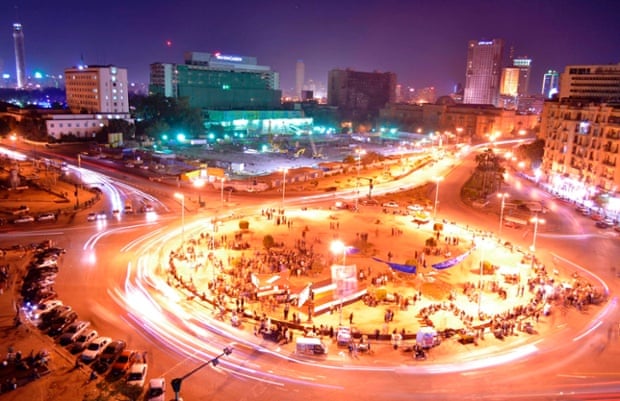
Traffic in Tahrir Square. Cairo's population is forecast to double by 2040.

Writing in a state-owned newspaper, columnist Sayed el-Bably confidently said the city exemplified how the economic conference at which it was announced would allow Egypt to “convert dreams into facts and projects”. In a nod to failed attempts to build a new capital under Hosni Mubarak, Bably said that Egyptians can now “think, dream, and look forward to the completion of what we previously thought was impossible.”

But the problem for the likes of Bably and Madbouly is that there are also those who doubt this particular dream will ever reach reality.

“Based on historic and global track records, trying to build a new city from scratch is a massive gamble,” says Brent Toderian, Vancouver’s former chief planner, and a consultant for several cities outside of the Middle East. “The most concerning thing to me was the speed at which this is intended to be built – five to seven years. That’s incredibly fast. And if you build it that fast, it will be a ghost town, like most other development plays have been.”

Toderian cites less ambitious projects in China – places like Caofeidian, which hoped to attract a million residents but ended up with only a few thousand. Dubai is an obvious counter-example of success.

But elsewhere in the UAE, the new “city” called Masdar (founded, incidentally, by the minister now driving Emirati investment in Egypt, Sultan al-Jaber) was supposed to house 50,000 people by now. Instead, it has just a few hundred.

Pressed by the Guardian, Madbouly said he already had the money to build at least 100 sq km of the new capital, including a new parliament. “We are committed for the first phase,” he says. “We have already a very clear plan.”

But in Egypt, even the best urban plans have tended to go awry. Egypt has a history of building unfinished towns in the desert, the product of a decades-old belief that satellite developments will curb overcrowding in its main cities. In theory, the strategy is based in logic: around 96% of Egyptians live on just 4% of Egyptian land, and as the population mushrooms, relocating some of the former might solve the congestion in the latter.

But experience, time and again, has suggested otherwise. These 22 existing “new towns” – some of them more than 30 years old – still collectively hold little more than a million residents, and contain thousands of empty homes. Far from Cairo’s madding crowds, they are in theory an attractive prospect for many Egyptians. But in practice, most cannot afford to move there.

In the most notorious example, New Cairo, a recent suburb to the east of its namesake, was meant to attract several million residents. But after a decade and a half it still only holds a few hundred thousand – an irony lost on Egypt’s investment minister, Ashraf Salman, when he quipped that Cairo’s yet-to-be-named replacement would be “the new New Cairo.”

David Sims, a Cairo-based urban planner, has spent years cataloguing the failures of Egypt’s satellite cities, culminating in last week’s well-timed publication of his latest book – Egypt’s Desert Dreams: Development or Disaster? Sims leans towards the latter.

“It’s just a bunch of crazy figures,” he says. “The scale is huge, and there are questions like: how are you going to do the infrastructure? How are you going to get the water? How will they move all these ministries? In other words, I think it’s just desperation. It will be interesting to see if anything comes of it, but I rather doubt it.”

The reason earlier desert settlements failed to attract residents is largely due to a lack of infrastructure and employment. Places like New Cairo have not provided enough jobs for poorer residents, or affordable transport to areas where they could find more work.

“There is a demand to live there, but it’s a demand from a very specific group of people, and it’s not a very big demographic,” says Nick Simcik Arese, an anthropologist at the Oxford Programme for the Future of Cities, and a former resident of, and researcher in, the new desert town of Haram City.

“People do want to abandon Cairo and live in their secessionary envelope. But to do that you need a car, and that means you have to have a certain income to live there.”
Historically, the Egyptian government has forced people to live in areas on Cairo’s periphery, by evicting them from poor inner-city areas, and relocating them to the desert towns. But once there, their lives exemplify why the crowds have not followed in their wake. “Governments think they can just move people to new areas, but actually people go where they want to go,” said Simcik Arese.

“For a lot of people, their homes are also their workshops, and that can’t happen out in the desert tower blocks. Their entire business and support system collapses. Their access to clients, materials, and supplies evaporates.”

For Herbert Girardet, the author of a dozen books on urban theory, this isn’t the most urgent concern. He feels Egypt’s new capital stands a good chance of providing better employment opportunities than its predecessors, mainly because Egypt’s vast government will be relocated there. Instead, his biggest worries lie in the city’s carbon footprint. Its architects claim it will uphold “the highest stands of sustainability.” But in the rush to design it, Girardet wonders if the finer details of waste disposal and green power were lost.

“What happens to the waste of this city, where does its energy come from? You have to ask whether these ideas are built into the concept or not,” says Girardet, who sets out a vision for green urban planning in his new book Creative Regenerative Cities.

“It’s true that Cairo as a city is massively congested, and there is probably a need for a new capital city. But it seems to me that it would be a city driven above all else by developers keen to create prestige, rather than long-term sustainability.”

Even if he’s wrong, the sustainability of the existing capital would still stay unaddressed. In justifying the desire for a new city, Madbouly said that something had to be done to lighten the load on Cairo, whose projected population will be 40 million by 2050. But Cairo’s plight will ironically worsen if resources and attention are diverted to new projects elsewhere, as one Egyptian commentator argued this weekend.

Writing for Cairobserver, a blog about the current capital, Khaled Fahmy, a history professor at the American University in Cairo, said: “Assuming that the aim of building a new administrative capital is to alleviate the pressure from downtown Cairo where the majority of government offices are located, and assuming, for argument’s sake, that the 5 million inhabitants will actually be moved from overcrowded city, what will happen to the rest of us?”

The fear is that Egypt’s capital, if it gets built, will be just as exclusive and private a city as al-Qahera was when it began back in 969.


*Additional reporting: Manu Abdo
**Photos courtesy of Reuters

Friday, October 31, 2014

Army forcefully displaces 10,000 residents & destroys 100s of homes by Gaza border

Associated Press 
Egyptian army demolishes homes along Gaza border

Thursday - October 30, 2014


EL-ARISH, Egypt - With dynamite and bulldozers, Egypt's army demolished dozens of homes along its border with the Gaza Strip on Wednesday, after the military ordered residents out to make way for a planned buffer zone meant to stop extremists and smugglers.

The plan to clear 10,000 residents from some 800 houses over just several days has angered the area's population, which has long held grievances with Cairo.

"To throw 10,000 people into the street in a second, this is the biggest threat to national security," said Ayman Mohsen, whose sister left her house about 350 yards from the border. Speaking to the Associated Press via online messages, he said the army told residents to leave on Tuesday within 48 hours, and that houses would be blown up even if people remained inside.

Over the last decade, the northern region of the Sinai Peninsula has become a hub for Islamic extremists, although insurgency has spiked since last year's military ouster of Islamist President Mohammed Morsi. It has also spread to other parts of Egypt, with extremists targeting police in Cairo and the Nile Delta.

The move to set up the planned 8-mile buffer zone, which will be 500 yards wide, comes after extremists attacked an army checkpoint near Sheikh Zuweyid town last week, killing 31 soldiers. No group claimed responsibility.

After the attack, Egypt declared a three-month state of emergency and dawn-to-dusk curfew there and indefinitely closed the Gaza crossing, the only non-Israeli passage for the crowded strip with the world.

Mona Barhomaa, an activist who lives 800 yards from the border and who is not affected by the evacuation order, said she supported the demolitions.

"The tunnels to me are like windows that for years my neighbors have used to infiltrate my house," she said, referring to the underground passageways used to smuggle goods and weapons. "The tunnels led us into this hellish situation."

Many residents were angered by the short notice and poor local organization, as well as a hostile media campaign unleashed days earlier that saw private and public television commentators equating opposition to the plan with treason.

Tanks and armored vehicles sealed off all of Rafah as thick gray smoke rose in the sky each time demolition charges went off and another house was toppled.

The corridor will eventually be monitored by surveillance cameras and feature a water-filled trench that will be 40 yards wide, 20 yards deep, and run all along the border to the Mediterranean Sea, officials said.


*Photo by Said Khatib, courtesy of AFP/Getty Images 

Saturday, November 19, 2011

'Occupy London' Homeless get tent of their own

The Independent
Homeless get tent of their own at St Paul's
Saturday 05 November 2011

Charlie Cooper


Protest leaders set up welfare centre to provide influx of rough sleepers with food and shelter

Under the shadow of St Paul's Cathedral, the Occupy London protest camp has become a beacon for all manner of people. There are the protesters and campaigners who come to offer support and hear the speeches.

There are the bemused tourists. And then there are the people who feel as if they have nowhere else to go.

Protesters yesterday said they will set up a "welfare centre" within the camp to offer help and support to those of London's homeless who are increasingly coming to the site seeking food, warmth and sometimes just distraction. Organisers are appealing to charities and individuals with expertise in social work, counselling, drug and alcohol services, welfare housing and mental health issues to work voluntarily at the proposed centre.

The welfare centre will occupy a tent within yards of the cathedral's front door and organisers hope to have it up and running within days. There is an increasingly established network of start-ups insitutions in the camp. There is already, a "university" in a white marquee, a bookshop, a kitchen and even a visitor information centre.

Malcom Blackman, who has been living at the camp since it began, said "more and more" homeless people had been coming. "We have lot of people coming by, stumbling round the tents at night," he said. "There's a lot of friendly people here and food. There was a concern that it would undermine the image of the camp. But so far we've met every obstacle we've come up against, and the welfare centre will be a good way to address this one."

James McMahon, a 48-year-old homeless man has lived in the area around St Paul's for more than 10 years. He is given free food from the kitchen tent, donated by well-wishers, cooked by the resident chefs, and served free to all comers. Now he has a roof over his head, albeit a canvas one. "I asked for a tent and was given one," he said.

"There's a community here. I have welcomed these people to my home and they have welcomed me. There's people I can sit with, eat with and have a conversation with. It's the most human contact I've had in 10 years." Mr McMahon said that the only aggression he had encountered in the camp had come from "drunken people in suits" who pass the camp at night, shouting abuse and one time kicking tents.

St Paul's have not commented on the protesters' plan, but Anglican think-tank Ekklesia said that the idea represented the best of Christian values.

Yesterday the camp set up an internet link with activists in Syria, and listened to an address from former Labour Cabinet minister Tony Benn, who urged them to "keep hope and carry on".

City of London authorities are understood to be seeking a High Court injunction if the protest camp is not cleared soon. But, Mr Blackman said: "Now's the time to dig in. We've had some difficulties but now is the time to show the world that peaceful protest can still work."