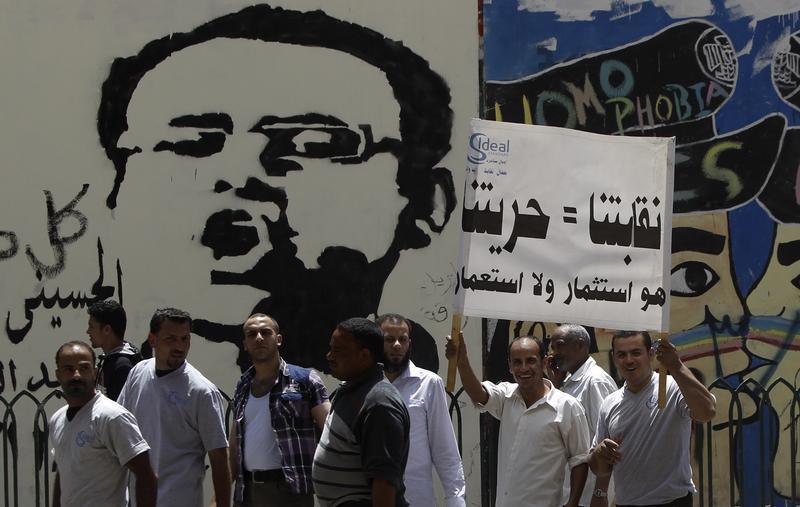
Drop Charges; Change Laws that Restrict Right to Organize, Strike
Since May 2016, police have arrested scores of striking workers from
various industries. Most were later released, but prosecutors have
referred dozens for trial, including some before a military court.
“Arresting workers for striking is another example of how Egyptian
authorities are determined to stifle all space for peaceful
mobilization,” said Joe Stork, deputy Middle East and North Africa director at Human Rights Watch.
In January 2017, prosecutors charged 19 striking workers at an oil
products factory in Suez with inciting a strike and halting production,
though all were acquitted in a trial later that month. In December 2016,
security forces arrested at least 55 striking workers at the Egyptian
Fertilizers Company, and prosecutors summoned eight for investigation.
On September 26, Kamal Abbas, a member of the government-sponsored
National Council for Human Rights and head of the independent Center for
Trade Union and Workers’ Services (CTUWS), wrote to the Interior
Ministry regarding the National Security Agency’s “disappearance” of six workers
from the Public Transport Authority following raids on their homes two
days earlier.
On September 28, following a news conference by families
of the missing workers, the six workers appeared before prosecutors who
accused them of belonging to an unidentified banned group.
In May,
military prosecutors referred 26 Alexandria Shipyard Company workers to a
military court on charges of inciting strikes.
The January strike in Suez followed a sit-in at the privately owned
IFFCO oil products factory in the last week of December seeking an equal
distribution of bonuses between workers and supervisors. The workers
decided to strike after Interior Ministry officers arrested two members of the IFFCO Independent Workers’ Union who had been participating in the sit-in, according to a workers’ statement published in local newspapers.
The CTUWS said that National Security officers demanded that union
leaders end the strike and then police arrested 13 striking workers on
January 2. Prosecutors summoned another 10 for questioning on the same
day and referred 19 to a minor offenses court on charges of inciting a
strike, halting production, and sabotaging factory properties.
Though
the court acquitted the workers, the factory administration can appeal
the decision. Activists told Human Rights Watch that, according to
workers, 26 people were later fired, including the 19 who were
acquitted.
Union leaders at the IFFCO factory demanded a larger share of bonuses
after the prices of everyday goods in Egypt rose dramatically when the
government floated the Egyptian pound in early November, a requirement
for a US$12 billion International Monetary Fund (IMF) loan package.
Since then, the pound has lost more than 100 percent of its value, and
the IMF has estimated that inflation will rise to 18 percent.
Egyptian authorities greatly restrict the ability of workers to
mobilize independently, and the penal code criminalizes strikes and
workplace sit-ins in articles 124 and 125, with sentences of up to two
years, despite several administrative court rulings that have upheld the
right to strike.
Kamal Abbas, the CTUWS leader, told Human Rights Watch that the
government-controlled Egyptian Trade Union Federation (ETUF) sent a
letter to the administration of the Suez oil products factory saying
that the independent workers’ union, which had signed two collective
bargaining agreements with administrators in 2012 and 2015, was illegal.
The IFFCO Independent Workers’ Union could be shut down as a result.
The government has never legalized the independent labor unions that
proliferated after the 2011 uprising, while officially recognized
unions have not held elections for 11 years, and successive governments
have appointed union leaders, most recently in January.
In June, an administrative court sent the current, restrictive 1976
law on unions for review, stating that “the [ETUF] was not capable of
expressing workers’ grievances and hopes whether before the state or
business owners.” To Human Rights Watch’s knowledge, the Supreme
Constitutional Court has yet to take up the case.
In April 2016, Human Rights Watch called on the Egyptian authorities to legalize independent unions
and criticized a draft law that would dissolve independent unions and
restrict workers’ rights. The cabinet approved a modified draft in July
and sent it to parliament
on January 25. The current draft would not recognize existing
independent unions and would impose prison sentences for establishing
unions that do not follow the new law.
The sharp devaluation of the Egyptian pound also led to strikes in
November and December at two privately owned fertilizer companies in the
Suez governorate, Egyptian Fertilizers Company and the Egyptian Basic
Industries Corporation, the independent news website Mada Masr reported.
Police dawn raids ended both sit-ins, and police rounded up at least 55
workers, one worker participating in the sit-in told Human Rights
Watch. Central Security Force riot police put the arrested workers
inside vans and dropped them in a deserted area three hours later, the
worker said.
Prosecutors detained two for several weeks
before releasing them on bail, and the factory administration dismissed
six with no explanation, the worker said. The two factories have no
unions.
A representative for the Egyptian Fertilizers Company told Human
Rights Watch that police tried for 10 days to convince workers occupying
control rooms to leave before “very peacefully” ending the sit-in.
The
workers returned to work the following morning. He said that halting
production was a crime and acknowledged that prosecutors summoned
several workers, but said the administration had not made complaints
against them during the investigations. Workers denied the
administration’s allegations that they stopped the production or
occupied the control room.
Dawn raids also led to the arrest of six Public Transport Authority
workers from their homes in Cairo on September 24, ahead of a planned
strike demanding bonuses. Authorities did not acknowledge their
whereabouts for four days, CTUWS leader Kamal Abbas told Human Rights
Watch, adding that lawyers had not been allowed to obtain a copy of
prosecution documents as required by law.
Prosecutors accused the six of
joining a banned group that prosecutors did not identify, inciting
strikes, and disturbing public order, pro-government news websites
reported. Two of the workers remain in pretrial detention, while
authorities released four pending investigation.
Egypt’s military has also suppressed workers’ actions. In
Alexandria, 26 workers of the military-owned Alexandria Shipyard Company
have been on trial before a military court since June 21, 2016. A report by the Egyptian Center for Economic and Social Rights
(ECESR) said the workers had organized a brief protest inside the
company’s premises on May 23 and 24, to demand bonuses, promotions, and
safety equipment and tried to negotiate with General Abd al-Hamid
Essmat, the company’s executive.
On May 25, military prosecutors ordered 13 workers held pending
investigation. One, a woman, was released on bail. Thirteen others were
arrested weeks later. Fatma Ramadan, the head of an independent union
and a workers’ rights researcher, told Human Rights Watch that military prosecutors relied entirely on a memo from the company
to charge the workers with inciting strikes and abstaining from work.
Human Rights Watch was not able to review the memo. After several days,
the company allowed 1,100 of 2,800 workers to return, the ECESR said.
The shipyard administration told workers they would be released if
they resigned, said Abbas and an ECESR lawyer. All the prosecuted
workers resigned and were released on bail in groups in October, November, and December, but they still face trial.
Military prosecutors referred the striking workers to military court
under the Military Code of Justice, which covers civilian workers in
military-owned institutions and does not establish any workers’ rights.
The current draft unions law would not change this.
Egypt’s constitution grants freedom of association and the right to
strike. Egypt is a state party to the International Covenant on
Economic, Social and Cultural Rights, article 8 of which establishes the right to strike,
as well as the right to form and join trade unions and national and
international confederations. Egypt is also a member of the
International Labour Organization and has ratified its eight fundamental conventions.
Parliament should ensure that the draft union law under
consideration meets Egypt’s obligations under international human rights
law by allowing free and fair union elections and ensuring
straightforward legalization procedures for all existing independent
unions. Civilian workers in military institutions should be allowed
association rights and should never be tried before military courts.
Human Rights Watch wrote to IFFCO, the Public Transport Authority,
and the Alexandria Shipyard Company, regarding the incidents but
received no responses.
“Instead of arresting and prosecuting workers, the government should
amend its laws to guarantee workers’ rights to effective bargaining and
mobilization which are essential to effective economic reform,” Stork
said.
Recent nationwide labor protests have found themselves confronted by
extraordinary measures of repression as the country continues to weather
economic struggles, austerity measures and rising inflation.
The
Egyptian government has deployed security forces to quash any suggestion
of labor action in the public or private sector, arresting workers and
subsequently imposing exceptional legal measures to punish those
detained.
Since 2016, the state has increasingly moved toward suppressing labor protests. According to an annual report published
by the Egyptian Center for Economic and Social Rights (ECESR), there
were 726 labor protests over workplace demands, claims of administrative
mismanagement and corruption in 2016. These protests have particularly
been driven by grievances over working conditions and demands for
increased wages and bonuses in light of recent economic reform policies.
However, the ECESR report also noted that 2016 saw a decline in the total number of labor protests compared to 2015, in which there were 933 labor protests. In 2014, there were 1,609 labor protests, while, in 2013, there were 2,239.
The state’s crackdown has prompted solidarity campaigns and petitions — in Egypt and abroad —
demanding that the criminal charges against dozens of workers be
dropped. Addressed to executive authorities, the petitions have been signed by hundreds of rights workers, labor unions and federations, denouncing the deployment of security forces to suppress protesting workers.
ALEXANDRIA SHIPYARD COMPANY WORKERS
“Undoubtedly,
Egypt has been witnessing increased repression against workers protests
since 2013,” says ECESR lawyer Mohamed Awwad.
According to a report
issued by the Center for Trade Union and Workers Services (CTUWS),
security forces have forcibly dispersed seven labor protests over the
past year, while 28 workers have been prosecuted and nine others are
standing trial. The report adds that corporations have also dismissed
271 workers, union members and labor leaders due to their involvement in
labor action.
The state’s initial response to a potential problem in the cog of military production — the Alexandria Shipyard Company has been managed by the Defense Ministry since 2007 —
was particularly extreme, Awwad says, as the workers had not forced a
work stoppage but had organized a sit-in on May 23 and 24, 2016. They
were demanding an increase in salary to align with the national minimum
wage, payment of overdue bonuses and for work at stalled production
lines to recommence.
Military police forces were deployed to the
shipyard on May 24, where they surrounded the workers’ sit-in.
Of
the Alexandria Shipyard Company’s 2,300 workers, some 1,200 have still
not been allowed to recommence work with the company since its
management imposed a lockout on May 24
and therefore cannot collect their full salary. Awwad says that 32
workers, including the 26 standing trial, remain barred from entering
the company’s premises. The state has also moved to force 19 of the
workers standing trial to tender their resignations in exchange for
bail.
“There is increasing pressure from military officials upon the remaining workers to submit their resignations,” says Awwad.
PUBLIC TRANSPORT AUTHORITY WORKERS
Another
significant case centers on the ongoing trial of six Public Transport
Authority (PTA) workers who had planned to strike on September 24, the
first day of the academic year, but were arrested in dawn raids.
The
public bus drivers had prepared to strike to demand increased bonuses
and for the PTA to be placed under the authority of the Transportation
Ministry.
The six PTA workers were jailed and are being prosecuted
on charges of inciting unrest within a state institution, instigating
protests against the state, obstructing public transport, forming a
terrorist cell within the PTA and belonging to an outlawed organization,
a reference to the Muslim Brotherhood.
After being detained for
over three months, four of the six workers were released on bail, while
two remain jailed in Tora Prison pending investigations.
“My
father was arrested at home,” says Seif, the son of jailed PTA worker
Abdel Khaleq. “They came for him even though the strike never took
place. There wasn’t even a protest. Why is my father in prison when
strikes are a legitimate and legally stipulated right?”
IFFCO OILS COMPANY
The
latest crackdown took place in the Suez Governorate on January 2, when
police forcefully dispersed a sit-in at the privately owned IFFCO Oils Company, a subsidiary of the Dubai-based IFFCO Group, arresting scores of workers, 21 of whom are now standing trial for “instigating a strike,” while two remain jailed pending investigations.
Security forces were deployed in response to a complaint filed at the local police station
in which the company’s management accused the workers of striking and
obstructing production, a charge which is increasingly being leveled
against workers who embark on industrial action.
Seoud Omar,
a Suez-based trade unionist and regional labor organizer, says these
kinds of industrial action are staged over “‘bread and butter”’ issues
and are typically apolitical in nature. “Labor strikes are not criminal
actions,” he asserts. “There is no terrorism, political conspiracy, or
plots against the ruling regime in these non-violent labor protests.”
While
Omar has seen violence used to suppress labor movements in the past,
the recent developments add a new dimension. “The use of violence on the
part of Ministry of Interior is not new,” he says. “But the increased
use of its police forces in so many different locations is.”
Omar
argues that “police are clearly acting on behalf of business interests
and against workers’ basic rights,” a fact, he argues, is clearly
illustrated in the raid of the IFFCO Oils Company.
Ahmed Bakr, the
secretary general of the Independent Union of IFFCO Employees, says
that since January 2, 27 workers have been barred from entering the
company, of which 21 are standing trial, including all nine elected
members of the company’s trade union committee. Bakr himself is among
those facing prosecution.
The initial court hearing before the Suez Criminal Court is scheduled for January 29,
which is the same day that the court is expected to issue a verdict in
the case. Bakr calls this unprecedented, asking why he and his
co-workers are not being granted an opportunity to defend themselves in
court. “It appears that the authorities are sending a message that they
won’t tolerate strikes or any labor union organization in the Suez
area.”
According to Bakr, the crackdown was not limited to the 12
workers arrested at the factory, as security forces arrested three
others in dawn raids. He adds that several of his co-workers were
interrogated by National Security Agency representatives.
“Are
protests over bonuses now a threat to national security?” he asks. “We
were arrested and are now on trial like criminals because we exercised
our legally protected rights.”
EGYPTIAN FERTILIZERS COMPANY
Another notable security crackdown took place on December 5, when police raided the Egyptian Fertilizers Company (EFC) and Egyptian Basic Industries Corporation (EBIC), both of which are owned by business magnate Nassif Sawiris — Egypt’s richest man, worth an estimated $US6.1 billion.
Workers at both of Sawiris’ fertilizer companies were striking to demand higher wages in light of the flotation and devaluation of the Egyptian pound.
The coordinated police raids resulted in the arrests of around 200
striking workers, who were released within hours. Two other EFC workers
were taken to Attaqa Police Station and released the following day after
paying LE 10,000 bail each. A total of six EFC workers — all of whom
have been sacked in light of this strike — will appear before the Suez
Criminal Court on January 28 on charges of “instigating a strike” and “halting production.”
Following
the forced dispersal of these strikes, a half-page notice was published
in the December 25 issue of the state-owned Al-Ahram newspaper under
the headline, “Message of thanks and appreciation from workers at EFC.”
The notice asserted that, “all workers at the Egyptian Fertilizers
Company express their utmost sorrow and pain regarding recent
incidents,” a reference to the strike. “Workers consider themselves to
be strategic partners with the owners of capital.”
Yasser
al-Geneidy, who was arrested in the raid, points out that he wrote this
apology together with a co-worker, under pressure from company
administrators. “We were told to formulate this apology as a
precondition to being reinstated,” he says.
A management official is said to have paid for this ad, which cost around LE133,000.
“Many workers objected to the wording of the statement, but we did so
in hopes of keeping our jobs,” according to Geneidy. “We have apologized
but have not been reinstated, and now we are standing trial.”
Geneidy concludes, “Nassif [Sawiris] is much bigger and stronger than us. What can you do with a billionaire who is actually helping to fund the state? Who do you think they are going to side with?”
Omar
predicts that rising inflation rates and stagnating wages, coupled with
the state’s austerity measures and crackdown on workers’ protests, will
result in significant labor unrest across Egypt.
“Take it from
me,” Omar says. “After all these years in the labor movement, I can
safely tell you that there will be a massive wave of worker protests
affecting the country soon.”
___
*Seoud Omar passed away just a few days after Mada Masr conducted this interview with him.
Police arrested a number of workers as they forcefully dispersed two
sit-ins at fertilizer companies in Suez governorate on Monday, while in
Cairo, a third sit-in by workers at Tanta Flax and Oils Company was
called off.
Security forces were deployed early on Monday morning
to the town of Ain al-Sokhna to disperse sit-ins involving around 1,000
workers at the Egyptian Fertilizers Company (EFC) and the Egyptian Basic Industries Corporation (EBIC), both owned by billionaire Nassif Sawiris.
Dozens
of protesting workers were briefly detained in the crackdown, with two
remaining in police custody. Suez-based trade unionist and regional
labor organizer Saud Omar told Mada Masr that security forces initially
arrested a large number of workers during the sit-in, but later released
them, with the exception of Mohamed Hashim and Yasser Geneidy, who were
referred to the district prosecutor pending investigations.
Security
forces arrested two other workers, Hossam Mohamed and Mohamed Nassar,
last week. District prosecutors ordered the extension of their detention
by 15 days on Sunday, pending investigation into charges of inciting
workers to strike.
Workers
demands at both the EFC and EBIC are the same, Omar explained, as both
companies are administered by Sawaris’ management. Workers began
protests and strikes after company administrators deducted some of their
bonuses, and workers’ grievances increased after the government’s
decision to float the Egyptian Pound against the US Dollar early last
month.
Both companies manufacture fertilizer products that are
exported to foreign markets, which should mean higher profits following
the floatation of the pound, as workers highlighted.
Two weeks
ago, worker-representatives informed the local office of the Ministry of
Manpower that they would embark on work stoppages before entering into
collective negotiations with company administrators. However, managers
refused to negotiate before the strike was called off and work resumed.
Both
companies filed complaints about strike leaders with security forces,
according to Omar, who explained that workers resumed their sit-ins on
Monday morning, demanding increased wages and the immediate release of
their coworkers.
TANTA FLAX WORKERS' SIT-IN
Also on Monday, a delegation of dozens of workers from the Tanta Flax and Oils Company
called off their sit-in. Striking workers had been occupying part of
the ground floor of the state-controlled Egyptian Trade Union Federation
(ETUF), but suspended their action in light of “pressure from security
forces,” according to workers.
The sit-in started on Sunday
afternoon, as former workers awaited compensation payments from the
Ministry of Public Works. Ministerial officials promised pay-offs of
LE65,000 per worker in August, in exchange for them giving up their
demands to be reinstated in their jobs.
Seeking their
end-of-service compensations, representatives of some 243 workers, who
were forced into early retirement following the privatization of the
company, were due to meet with officials from the Ministry of Public
Works on Tuesday. But the meeting was pushed back, according to one of
the main workers negotiating with officials, Gamal Othman. Frustrated
coworkers questioned Othman’s decision to agree to suspend the sit-in.
“I
understand there were threats, along with concerns that the police
would storm our sit-in and arrest us. But we’ve accomplished nothing
here,” said Othman’s coworker Abdel Aziz Mohamed, who added, “We agreed
to give up our jobs in exchange for compensation. Now we have neither.”
According to workers’ accounts, the state-owned Holding Company for Chemical Industries
(which currently owns and manages the Tanta Flax and Oils Company) had
initially proposed the end-of-service compensations nearly four months
ago. But officials said they would only release the payments after
receiving clearance from the Finance Ministry that it would cover the
full amount of around LE16 million. Spokesperson for the Ministry of
Finance, Ayman al-Kaffas, however, told Mada Masr that he had no
knowledge of any such agreement.
Over 400 workers were pushed into
early retirement following the privatization of the Tanta Flax and Oils
Company in 2005. After years of trying to be reinstated, nearly half of
these workers are now seeking compensation packages. Many are currently
receiving pensions amounting to a maximum of LE700 per month.
In
September 2011, an administrative court ruled in favor of the company’s
workers, nullifying the privatization contract for the Tanta Flax and
Oils Company. The government sought to overturn the verdict, but it was
upheld by a higher-level administrative court in September 2013. The
court ruled that the company had been sold for far less than its actual
worth, and that there were administrative and contractual violations
involved.