
AMNESTY INTERNATIONAL
Egypt urged to lift state of emergency
11 May 2010
Amnesty International deplores Tuesday’s renewal of the state of emergency by the Egyptian authorities, who rushed through parliament a two-year extension to emergency laws that have been used to crackdown on peaceful opposition protests.
Egyptian authorities claim emergency powers, which have been in place for 29 years, are necessary to combat terrorism and drug trafficking but in practice they have been used to crack down on peaceful dissent and to detain people without charge or trial for prolonged periods.
"By renewing the state of emergency, the Egyptian authorities have given their security forces, especially the State Security Investigations (SSI) officers, carte blanche to continue to use repressive emergency powers that have clearly led to numerous abuses,” said Hassiba Hadj Sahraoui, Amnesty International's Middle East and North Africa deputy director.
“The authorities have routinely used so-called security concerns to infringe upon human rights.”
“The laws unduly restrict the rights to freedom of association and assembly and facilitate arbitrary detention, torture and unfair trials. We are particularly concerned that this extension comes as Egypt prepares for elections this year; the authorities are notorious for relying on the emergency powers to lock up their opponents.”
The government also continues to crack down on freedom of assembly. In April, peaceful demonstrators calling for political reform and an end to the state of emergency were violently repressed by security forces. Such demonstrations are ongoing across the country.
Amnesty International has documented the arbitrary detention of hundreds of members of the country’s largest organized political opposition, the Muslim Brotherhood, during the run up to elections in 2005.
The organization also documented the banning and violent dispersal of opposition demonstrations.
Egyptian authorities have claimed that the renewed state of emergency will be “relaxed”, with fewer restrictions on freedom of expression.
Emergency powers under the state of emergency allow the authorities to order the detention without charge or trial of anyone suspected on the basis of the mere suspicion of endangering “national security” or “public order”.
Amnesty International has documented many cases where people have been subjected to secret detention, torture or other ill-treatment by SSI, infamous for abuses.
Thousands of people held without charge or trial under the emergency legislation are languishing in Egypt’s jails in degrading or inhumane conditions. Some have been held for more than a decade, including many whose release has been repeatedly ordered by courts.
Amnesty International has also documented how the emergency powers have led to grossly unfair trials in emergency and military courts, which bypass the criminal justice system.
The Egyptian authorities continue to abuse emergency powers to curtail freedom of association. Hundreds of alleged members and supporters of Egypt’s largest organized political opposition, the Muslim Brotherhood, are currently detained.
Amnesty International is further concerned that abuses could be entrenched by draft counter-terror legislation that is intended as a permanent replacement for the state of emergency.
The legislation’s contents remains secretive, despite repeated requests to see and comment on it by Amnesty International and others.
As part of the Universal Periodic Review before the UN Human Rights Council, the Egyptian authorities claimed that the draft legislation respected human rights. However, they also rejected a recommendation for them not to introduce emergency powers into the constitution.
There are legislative elections in Egypt this autumn, followed by presidential elections in 2011.
Monday, May 17, 2010

Tuesday, May 11, 2010
29 Years of Emergency Law - More Than Enough

Around 200 activists, and a handful of opposition MPs, demonstrated outside parliament today demanding the lifting of the Emergency Law which has governed/repressed Egypt for the past 29 years. Activists also denounced the extension of this oppressive law (Emergency Law # 162 of 1958) for another two years.


The Mubarak Regime has argued that this law, which has been continuously renewed since the assassination of Anwar el-Sadat in October 1981, serves to crackdown on terrorists, crime networks and drug-dealers.

In reality the Mubarak Regime has utilized this law to crack down upon social and political opponents of all shades - from Islamists to liberals to leftists. This law is used as a pretext for spying on Egyptian citizens, illegal searches and seizures, for the forced dispersal of street protests and labor strikes, arbitrary and incommunicado detentions, along with torture.

Members of the liberal opposition Ghad Party, the Sixth of April Youth Movement, the Revolutionary Socialists, the Karama Party, the Muslim Brotherhood, and others chanted slogans against the extension of the Emergency Law.

Slogans were also chanted denouncing President/Dictator Hosni Mubarak, Prime Minister Ahmad Nazif, and Interior Minister Habib el-Adly, along with a host of other ministers.

In attempts to intimidate the protesters - thousands of riot police forces were deployed around parliament, and a police cameraman was perched in a tree filming much of the protest.

These tactics, however, did not prevent the disillusioned demonstrators from chanting "Down with Mubarak!" at the top of their lungs; sloganeering, clapping, and pounding on drums in anger.

Meanwhile hundreds of workers, who have been protesting and sleeping-in outside parliament for the past weeks looked on with interest. When this activists' protest quietened down, the voice of angry workers' chants took their place.

This two year extension of the emergency law will ensure that the Shura Council elections of June 2010 will be controlled (and very likely manipulated) by the executive branch of government and its security apparatuses; as will be the parliamentary elections in November 2010, nation-wide trade union elections in 2011, and the decisive presidential election in 2011.
This renewal of the emergency law will also serve to maintain feelings of fear and instability amongst the Egyptian populace - again, in the interests of the ruling dictatorship.
Elton John - Stay Gay, But Boycott Apartheid Israel
Dear Elton John,
I really don't mind if you are flaming gay, and I don't mind if you refer to Jesus Christ as being gay too - that's alright with me.
What is not alright is your performance in Apartheid South Africa (in 1983,) despite the international boycott of that racist state at that time; and what is DEFINITELY not alright is your intention to perform in Apartheid Israel, in June 2010 - despite the current boycott of this racist state.
Yes, Egypt is homophobic, and the cancellation of your concert here was unjust. But what is far more unjust is Israeli Apartheid. This Apartheid system coupled with the military occupation of the West Bank (along with the Golan Heights and Shebaa Farms) and the siege of Gaza are far beyond unjust.
Please don't perform in Tel Aviv - please boycott Apartheid Israel.
JC
***
The Elton John BDS Song
Deutsche Presse Agentur
Elton John concert banned in Egypt
Cairo, May 02, 2010
(DPA) - Egypt's musician's union on Sunday rejected plans for British singer Elton John to perform a private concert scheduled for May 18, because of his "controversial remarks attacking religions".
"How do we allow a gay, who wants to ban religions, claimed that the prophet Eissa (Jesus) was gay and calls for Middle Eastern countries to allow gays to have sexual freedom," head of the Egyptian Musician Union, Mounir al-Wasimi told DPA.
The pop superstar, 63, stirred controversy after his remarks to US celebrity news magazine Parade in February, where he said "Try being a gay woman in the Middle East - you're as good as dead", after saying he believed Jesus was "gay".
Al-Wasimi said that he has begun coordinating with security bodies to ban John's concert, saying that the union is the only body "authorised to allow performances by foreign singers in Egypt".
In 2008, Elton John performed in the United Arab Emirates to a crowd of more than 13,000 fans.
Although some human rights activists claim homosexuality is spreading in Egypt, the topic is a taboo in the country. In 2008, a lesbian scene in an Egyptian film set in Cairo's slums caused uproar.
In 2001, police raided a "gay" floating disco in Cairo. Around 20 of the 52 arrested were jailed for "habitual debauchery" and "obscene behaviour".
Tuesday, May 4, 2010
May 3 - Police Assault Democracy Activists
DAILY NEWS EGYPT
RAW VIDEO - Clashes Break Out Between Protesters & Police
***
The Associated Press
Egyptian Police Beat Anti-Government Protesters
Hadeel Al-Shachli
May 3, 2010
CAIRO -- Egyptian police on Monday beat anti-government protesters who were demanding an end to the country's 30-year emergency law that restricts civil freedoms in the latest challenge to the authorities from the streets of Cairo.
The scuffle erupted after several hundred policemen, dressed in black uniforms, pushed back about 150 protesters who had gathered in the downtown and tried to break through a security barrier.
The police beat members of the pro-reform youth April 6 movement, prompting some demonstrators to hurl sticks and plastic bottles back at the officers. One protester was badly bruised and bloodied, and another was arrested.
"All of a sudden, I felt tens of people on top of me, and while I was down on the ground they kept kicking me," said protester Hasan Mustafa, bleeding from the neck and in a pink T-shirt marked with shoe prints. Pulling up the shirt, he showed the bruising inflicted by police kicking.
Police arrested Ahmed Doma, who friends said had also been detained in an earlier rally.
Monday's demonstration was organized by opposition lawmakers seeking to end the emergency law, which is up for renewal in parliament later in May. The lawmakers were joined by two reformist movements - the Egyptian Women for Change and April 6, which backs the unofficial candidacy of former U.N. nuclear watchdog chief and Nobel Peace Prize laureate Mohammed ElBaradei in Egypt's presidential elections next year.
President Hosni Mubarak has ruled Egypt since 1981 and only introduced multi-candidate presidential elections in 2005. His party has kept a stranglehold on the country's politics, in part thanks to the controversial law.
The bill allows police to jail pro-reform activists, political opponents and journalists, and also allows detention without charge for long periods of time and searches without warrants. It has been strongly criticized by the opposition and human rights groups.
Under the law, demonstrations are illegal. Riot police severely beat protesters and arrested dozens at an April 6 rally last month.
Mubarak's National Democratic Party dominates a rubber-stamp parliament. The opposition expects its numbers in parliament to decline after parliamentary elections later this year because of new political restrictions pushed through as constitutional amendments in 2007.
The lawmakers, who had wanted to march to parliament but were prevented by police, watched the beatings from the sidelines of the protest.
Egypt is to hold presidential elections next year. The constitutional amendments restrict candidates such as ElBaradei from running and allow only candidacies of a few members of approved political parties.
The April 6 youth movement was formed through online social networking sites such as Facebook, taking its name from a general strike it organized in 2008. It periodically organizes pro-reform protests.
Sunday, May 2, 2010
May 2 Protest for Minimum Wage
Around 1,000 workers, professionals, civil servants, and activists demonstrated today, May 2, outside the Council of Ministers in Downtown Cairo. Thousands of troops from the Central Security Forces and police officers were deployed around the Council of Ministers and Parliament.

The primary demand of this Labor Day protest was for a monthly minimum wage of LE 1,200 (only US$ 218); yet other demands were also raised including: the right to establish independent trade unions, the right to strike, the right to adequate insurance and pension plans.
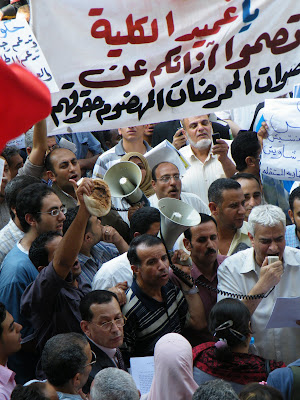
Beyond the demand for a minimum wage, protesters called for the establishment of a maximum wage/income - so as to curb corruption, decrease excessively wide income discrepancies, and to limit the misappropriation of public funds.

Demonstrators chanted slogans against President/Dictator Hosni Mubarak, Prime Minister Ahmad Nazif, Labor Minister Aisha Abdel Hady, Minister of Interior Habib el-Adly, Minister of Investment Mahmoud Mohie el-Dein, and Hussein Megawer, the President of the state-controlled (yellow) Egyptian Trade Union Federation. Slogans were also directed against the repressive Emergency Law which has continuously been imposed upon Egypt since 1981.

Workers from the Mahalla Textile Company, Tanta Flax & Oils Company, Real Estate Tax Authority, Nubariya Company for Engineering & Agricultural Services, the Agricultural Land Development Authority, Information Decision Support Centers, along with steel workers, teachers, lawyers, journalists, students, nurses, pensioners, and disabled persons, amongst others showed up to voice their discontent with the socio-economic status quo.

Activists from the (Nasserist) Karama Party, the Egyptian Movement for Change (Kefaya,) the April 6th Youth Movement, the (social democratic) Tagammu' Party, the (Islamist) Labor Party, the (Trotskyist) Revolutionary Socialists, along with independent activists and bloggers joined in this angry, yet non-violent, Labor Day demonstration.

Following the demonstration, a Labor Day press conference was held at the Journalists' Syndicate which was attended by several hundred workers, professionals, students, labor activists, and the media.

Demands were raised for the right to establish an independent General Union for Pensioners - along the lines of the independent General Union for Employees of the Real Estate Tax Authority, which was established in 2009 as Egypt's first free union since 1957. Similarly, demands for the establishment of an independent General Union of Public Transport Authority Workers were made.

Workers vented their grievances regarding hazardous working conditions, long shifts, exploitation, rising living expenses, pathetic wages, and governmental apathy. One worker from the Nubariya Company for Agricultural & Engineering Services explained "the authorities argue that we are politicized and that certain people, who are not workers, are mobilizing us." He added "we are in fact non-politicized workers. However, there are certain people who are moving us and for whom we do mobilize - these people are our children and our families whom we are no longer able to support."
A female worker from the Agricultural Land Development Authority said "the Authority deducts insurance premiums from our wages each month. Yet we are not covered by any insurance plan." She could not explain were this money was being transfered. "As a result of these deductions from our measly wages, we earn from LE 60 to LE 90 per month" (around $US 11 to $ 16.) "How can an individual subsist on such a wage, let alone feed their family?"

The primary demand of this Labor Day protest was for a monthly minimum wage of LE 1,200 (only US$ 218); yet other demands were also raised including: the right to establish independent trade unions, the right to strike, the right to adequate insurance and pension plans.
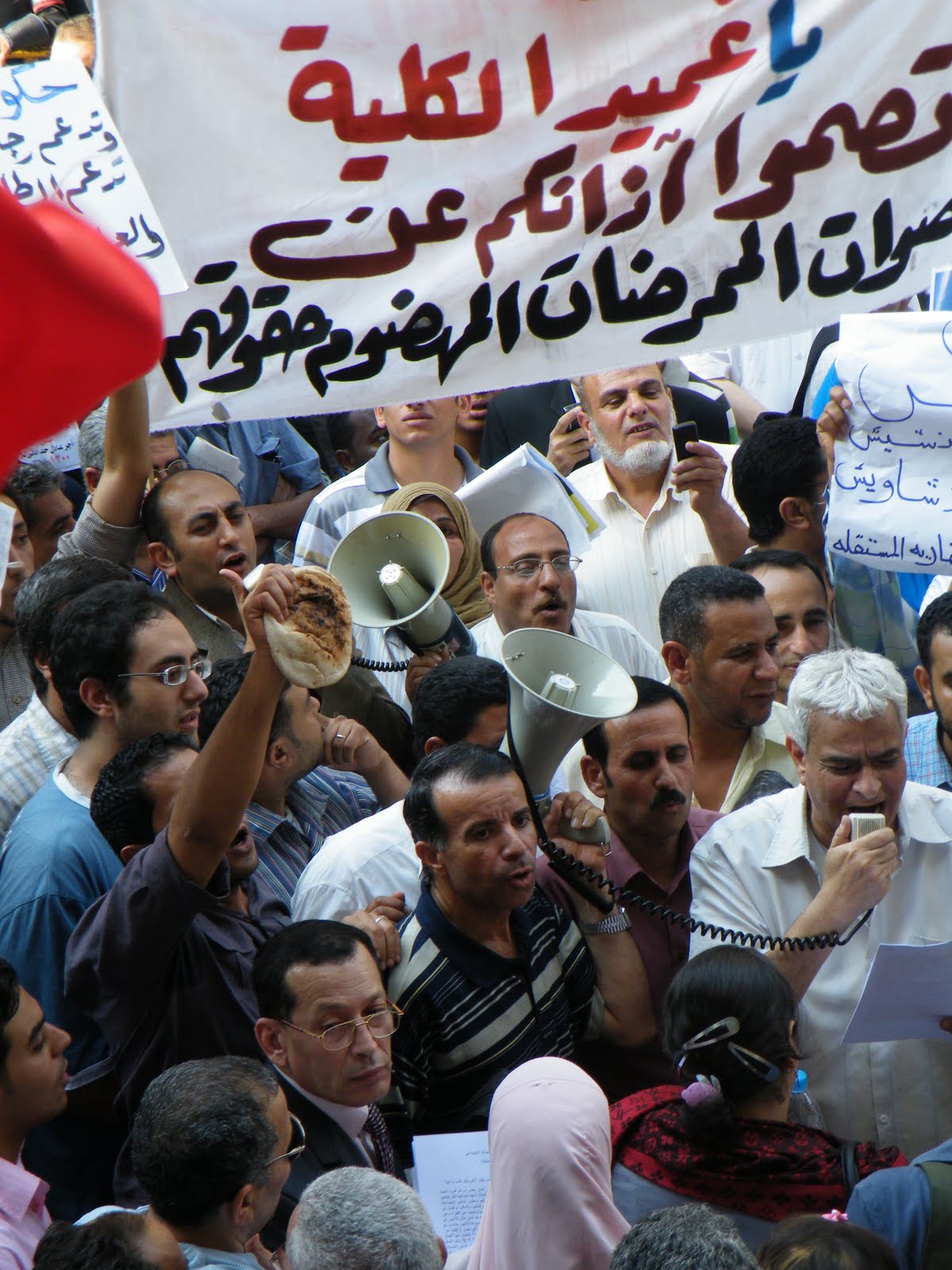
Beyond the demand for a minimum wage, protesters called for the establishment of a maximum wage/income - so as to curb corruption, decrease excessively wide income discrepancies, and to limit the misappropriation of public funds.

Demonstrators chanted slogans against President/Dictator Hosni Mubarak, Prime Minister Ahmad Nazif, Labor Minister Aisha Abdel Hady, Minister of Interior Habib el-Adly, Minister of Investment Mahmoud Mohie el-Dein, and Hussein Megawer, the President of the state-controlled (yellow) Egyptian Trade Union Federation. Slogans were also directed against the repressive Emergency Law which has continuously been imposed upon Egypt since 1981.

Workers from the Mahalla Textile Company, Tanta Flax & Oils Company, Real Estate Tax Authority, Nubariya Company for Engineering & Agricultural Services, the Agricultural Land Development Authority, Information Decision Support Centers, along with steel workers, teachers, lawyers, journalists, students, nurses, pensioners, and disabled persons, amongst others showed up to voice their discontent with the socio-economic status quo.

Activists from the (Nasserist) Karama Party, the Egyptian Movement for Change (Kefaya,) the April 6th Youth Movement, the (social democratic) Tagammu' Party, the (Islamist) Labor Party, the (Trotskyist) Revolutionary Socialists, along with independent activists and bloggers joined in this angry, yet non-violent, Labor Day demonstration.

Following the demonstration, a Labor Day press conference was held at the Journalists' Syndicate which was attended by several hundred workers, professionals, students, labor activists, and the media.

Demands were raised for the right to establish an independent General Union for Pensioners - along the lines of the independent General Union for Employees of the Real Estate Tax Authority, which was established in 2009 as Egypt's first free union since 1957. Similarly, demands for the establishment of an independent General Union of Public Transport Authority Workers were made.

Workers vented their grievances regarding hazardous working conditions, long shifts, exploitation, rising living expenses, pathetic wages, and governmental apathy. One worker from the Nubariya Company for Agricultural & Engineering Services explained "the authorities argue that we are politicized and that certain people, who are not workers, are mobilizing us." He added "we are in fact non-politicized workers. However, there are certain people who are moving us and for whom we do mobilize - these people are our children and our families whom we are no longer able to support."
A female worker from the Agricultural Land Development Authority said "the Authority deducts insurance premiums from our wages each month. Yet we are not covered by any insurance plan." She could not explain were this money was being transfered. "As a result of these deductions from our measly wages, we earn from LE 60 to LE 90 per month" (around $US 11 to $ 16.) "How can an individual subsist on such a wage, let alone feed their family?"
The Origins of Labor Day
Industrial Workers of the World
The Brief Origins of May Day
Eric Chase
Most people living in the United States know little about the International Workers' Day of May Day. For many others there is an assumption that it is a holiday celebrated in state communist countries like Cuba or the former Soviet Union. Most Americans don't realize that May Day has its origins here in this country and is as "American" as baseball and apple pie, and stemmed from the pre-Christian holiday of Beltane, a celebration of rebirth and fertility.
In the late nineteenth century, the working class was in constant struggle to gain the 8-hour work day. Working conditions were severe and it was quite common to work 10 to 16 hour days in unsafe conditions. Death and injury were commonplace at many work places and inspired such books as Upton Sinclair's The Jungle and Jack London's The Iron Heel. As early as the 1860's, working people agitated to shorten the workday without a cut in pay, but it wasn't until the late 1880's that organized labor was able to garner enough strength to declare the 8-hour workday. This proclamation was without consent of employers, yet demanded by many of the working class.
At this time, socialism was a new and attractive idea to working people, many of whom were drawn to its ideology of working class control over the production and distribution of all goods and services. Workers had seen first-hand that Capitalism benefited only their bosses, trading workers' lives for profit. Thousands of men, women and children were dying needlessly every year in the workplace, with life expectancy as low as their early twenties in some industries, and little hope but death of rising out of their destitution. Socialism offered another option.
A variety of socialist organizations sprung up throughout the later half of the 19th century, ranging from political parties to choir groups. In fact, many socialists were elected into governmental office by their constituency. But again, many of these socialists were ham-strung by the political process which was so evidently controlled by big business and the bi-partisan political machine. Tens of thousands of socialists broke ranks from their parties, rebuffed the entire political process, which was seen as nothing more than protection for the wealthy, and created anarchist groups throughout the country. Literally thousands of working people embraced the ideals of anarchism, which sought to put an end to all hierarchical structures (including government), emphasized worker controlled industry, and valued direct action over the bureaucratic political process. It is inaccurate to say that labor unions were "taken over" by anarchists and socialists, but rather anarchists and socialist made up the labor unions.
At its national convention in Chicago, held in 1884, the Federation of Organized Trades and Labor Unions (which later became the American Federation of Labor), proclaimed that "eight hours shall constitute a legal day's labor from and after May 1, 1886." The following year, the FOTLU, backed by many Knights of Labor locals, reiterated their proclamation stating that it would be supported by strikes and demonstrations. At first, most radicals and anarchists regarded this demand as too reformist, failing to strike "at the root of the evil." A year before the Haymarket Massacre, Samuel Fielden pointed out in the anarchist newspaper, The Alarm, that "whether a man works eight hours a day or ten hours a day, he is still a slave."
Despite the misgivings of many of the anarchists, an estimated quarter million workers in the Chicago area became directly involved in the crusade to implement the eight hour work day, including the Trades and Labor Assembly, the Socialistic Labor Party and local Knights of Labor. As more and more of the workforce mobilized against the employers, these radicals conceded to fight for the 8-hour day, realizing that "the tide of opinion and determination of most wage-workers was set in this direction." With the involvement of the anarchists, there seemed to be an infusion of greater issues than the 8-hour day. There grew a sense of a greater social revolution beyond the more immediate gains of shortened hours, but a drastic change in the economic structure of capitalism.
In a proclamation printed just before May 1, 1886, one publisher appealed to working people with this plea:
* Workingmen to Arms!
* War to the Palace, Peace to the Cottage, and Death to LUXURIOUS IDLENESS.
* The wage system is the only cause of the World's misery. It is supported by the rich classes, and to destroy it, they must be either made to work or DIE.
* One pound of DYNAMITE is better than a bushel of BALLOTS!
* MAKE YOUR DEMAND FOR EIGHT HOURS with weapons in your hands to meet the capitalistic bloodhounds, police, and militia in proper manner.
Not surprisingly the entire city was prepared for mass bloodshed, reminiscent of the railroad strike a decade earlier when police and soldiers gunned down hundreds of striking workers. On May 1, 1886, more than 300,000 workers in 13,000 businesses across the United States walked off their jobs in the first May Day celebration in history. In Chicago, the epicenter for the 8-hour day agitators, 40,000 went out on strike with the anarchists in the forefront of the public's eye. With their fiery speeches and revolutionary ideology of direct action, anarchists and anarchism became respected and embraced by the working people and despised by the capitalists.
The names of many - Albert Parsons, Johann Most, August Spies and Louis Lingg - became household words in Chicago and throughout the country. Parades, bands and tens of thousands of demonstrators in the streets exemplified the workers' strength and unity, yet didn't become violent as the newspapers and authorities predicted.
More and more workers continued to walk off their jobs until the numbers swelled to nearly 100,000, yet peace prevailed. It was not until two days later, May 3, 1886, that violence broke out at the McCormick Reaper Works between police and strikers.
For six months, armed Pinkerton agents and the police harassed and beat locked-out steelworkers as they picketed. Most of these workers belonged to the "anarchist-dominated" Metal Workers' Union. During a speech near the McCormick plant, some two hundred demonstrators joined the steelworkers on the picket line. Beatings with police clubs escalated into rock throwing by the strikers which the police responded to with gunfire. At least two strikers were killed and an unknown number were wounded.
Full of rage, a public meeting was called by some of the anarchists for the following day in Haymarket Square to discuss the police brutality. Due to bad weather and short notice, only about 3000 of the tens of thousands of people showed up from the day before. This affair included families with children and the mayor of Chicago himself. Later, the mayor would testify that the crowd remained calm and orderly and that speaker August Spies made "no suggestion... for immediate use of force or violence toward any person..."
As the speech wound down, two detectives rushed to the main body of police, reporting that a speaker was using inflammatory language, inciting the police to march on the speakers' wagon. As the police began to disperse the already thinning crowd, a bomb was thrown into the police ranks. No one knows who threw the bomb, but speculations varied from blaming any one of the anarchists, to an agent provocateur working for the police.
Enraged, the police fired into the crowd. The exact number of civilians killed or wounded was never determined, but an estimated seven or eight civilians died, and up to forty were wounded. One officer died immediately and another seven died in the following weeks. Later evidence indicated that only one of the police deaths could be attributed to the bomb and that all the other police fatalities had or could have had been due to their own indiscriminate gun fire. Aside from the bomb thrower, who was never identified, it was the police, not the anarchists, who perpetrated the violence.
Eight anarchists - Albert Parsons, August Spies, Samuel Fielden, Oscar Neebe, Michael Schwab, George Engel, Adolph Fischer and Louis Lingg - were arrested and convicted of murder, though only three were even present at Haymarket and those three were in full view of all when the bombing occurred. The jury in their trial was comprised of business leaders in a gross mockery of justice similar to the Sacco-Vanzetti case thirty years later, or the trials of AIM and Black Panther members in the seventies. The entire world watched as these eight organizers were convicted, not for their actions, of which all of were innocent, but for their political and social beliefs. On November 11, 1887, after many failed appeals, Parsons, Spies, Engel and Fisher were hung to death. Louis Lingg, in his final protest of the state's claim of authority and punishment, took his own life the night before with an explosive device in his mouth.
The remaining organizers, Fielden, Neebe and Schwab, were pardoned six years later by Governor Altgeld, who publicly lambasted the judge on a travesty of justice. Immediately after the Haymarket Massacre, big business and government conducted what some say was the very first "Red Scare" in this country. Spun by mainstream media, anarchism became synonymous with bomb throwing and socialism became un-American. The common image of an anarchist became a bearded, eastern European immigrant with a bomb in one hand and a dagger in the other.
Today we see tens of thousands of activists embracing the ideals of the Haymarket Martyrs and those who established May Day as an International Workers' Day. Ironically, May Day is an official holiday in 66 countries and unofficially celebrated in many more, but rarely is it recognized in this country where it began.
Over one hundred years have passed since that first May Day. In the earlier part of the 20th century, the US government tried to curb the celebration and further wipe it from the public's memory by establishing "Law and Order Day" on May 1. We can draw many parallels between the events of 1886 and today. We still have locked out steelworkers struggling for justice. We still have voices of freedom behind bars as in the cases of Mumia Abu Jamal and Leonard Peltier. We still had the ability to mobilize tens of thousands of people in the streets of a major city to proclaim "THIS IS WHAT DEMOCRACY LOOKS LIKE!" at the WTO and FTAA demonstrations.
Words stronger than any I could write are engraved on the Haymarket Monument:
THE DAY WILL COME WHEN OUR SILENCE WILL BE MORE POWERFUL THAN THE VOICES YOU ARE THROTTLING TODAY.
Truly, history has a lot to teach us about the roots of our radicalism. When we remember that people were shot so we could have the 8-hour day; if we acknowledge that homes with families in them were burned to the ground so we could have Saturday as part of the weekend; when we recall 8-year old victims of industrial accidents who marched in the streets protesting working conditions and child labor only to be beat down by the police and company thugs, we understand that our current condition cannot be taken for granted - people fought for the rights and dignities we enjoy today, and there is still a lot more to fight for. The sacrifices of so many people can not be forgotten or we'll end up fighting for those same gains all over again. This is why we celebrate May Day.
Egypt: Sweeping Reforms Needed to Protect Workers’ Rights
AMNESTY INTERNATIONAL
Egypt: sweeping reform needed to protect workers’ rights
30 April 2010
Amnesty International urges the Egyptian authorities to lift restrictions on the creation and functioning of independent workers’ unions, and to set up a system which guarantees an adequate minimum wage. The call comes ahead of International Workers’ Day on 1 May and planned strikes by Egyptian workers on 2 May.
“The authorities must mark International Workers’ Day by announcing sweeping legal and institutional reforms to promote and protect labour rights, including by allowing for workers to organize freely and form unions,” said Amnesty International.
“Setting up and enforcing a system to ensure a fair minimum wage, one which ensures that all workers and their families are guaranteed decent living conditions, is a necessary first step to realizing labour rights, as provided by the Egyptian Constitution, the Egyptian Labour Law and in accordance with Egypt’s international obligations.”
Article 23 of the Egyptian Constitution states that a minimum and a maximum wage should be fixed in order to ensure less disparity in income. Egypt is also a state party to the International Covenant on Economic Social and Cultural Rights, which stipulates that states must ensure that all workers get, as a minimum, a fair wage (Article 7). The Committee on Economic, Social and Cultural Rights (CESCR) has repeatedly called on governments to ensure that minimum wages enable workers and their families to enjoy adequate standards of living.
Furthermore Egypt is a party to the C131 Minimum Wage Fixing Convention which requires states to establish a system of minimum wages.
Over the last few years, thousands of protests, strikes and sit-ins have been staged by Egyptian workers in both the public and private sectors, protesting the rising cost of living and demanding better wages and working conditions. These demonstrations, while not authorized, have been largely tolerated by the authorities. Many demonstrators have in recent months aired their grievances in protests in front of government buildings and the Parliament in Cairo. More protests are planned for next week.
“Workers in Egypt have for many years been forced to demand and defend their rights through one single union, the Egyptian Trade Union Federation,” said Amnesty International. “The monopoly of the ETUF over trade unions and its close links with the government has evidently failed on many occasions to support, protect and promote workers’ rights and as such has contributed to impoverish them and their families.”
The workers’ demands are being voiced in this manner because of the perception that the Egyptian Trade Union Federation (ETUF), and local general labour unions affiliated to it, is unable to adequately represent and defend the workers’ interests in light of its close links to the authorities. The ETUF, the only such federation in Egypt, is seen as being too close to the government and the ruling party, the National Democratic Party, and therefore not representative of workers demands. The workers’ actions have also been the result of the lack of independent trade unions that can represent them, negotiate on their behalf or allow them bargain collectively.
In 1957 the Egyptian authorities mandated the ETUF to be the sole trade union structure in the country and curtailed freedom of association by forbidding workers to organize and form unions outside the 23 general labour unions affiliated to the ETUF.
On 26 April, five days before International Labour Day, the Ministry of Manpower and Immigration (MoMM) refused to accept an application by the Pension Holders Union to register as an independent union outside of the ETUF. Representatives of the Pension Holders Union were told that the minister was on sick leave. The Pension Holders Union wanted to follow in the steps of real estate tax collectors who were able, after protracted negotiations with the MoMM, to obtain official recognition of their own independent union in April 2009. The Independent General Union of Real Estate Tax Authority Workers (IGURETA) is the first independent trade union in Egypt in more than 50 years.
The right to strike is effectively limited by Egyptian law and is subject to approval by a two-thirds majority by the general union’s executive committee, and further ratification by the ETUF. By restricting workers’ rights to strike and organize freely, the Egyptian authorities are not only breaching their obligations to uphold the right to freedom of association, they are also preventing workers from improving their economic conditions and to move out of poverty.
In its concluding observation on Egypt in 2000, the CESCR called on the Egyptian authorities to amend the Penal Code to allow for the right to strike and expressed concerns about the-then proposal to amend the Labour Law to limit the rights to strike and to ban labour committing from negotiating collectively on behalf of workers.
The restrictions on the rights to strike and to freely organize and form unions are part of wider limitations imposed on freedom of association and assembly in Egypt. Non governmental organizations (NGOs) operate under a very restrictive law on associations (Law 84 of 2002). In 2007, the Centre for Trade Unions Workers Services, a leading workers’ advice centre, was closed – only reopening a year later after wining a lawsuit. The current proposed amendments to the law on associations are said to impose still further restrictions and to control the activities of NGOs and associations through increased administrative measures. These further restrictions are purportedly being imposed for security reasons.
“The authorities must end the use of security as a pretext to clamp down on freedom of association. Social stability and security cannot be guaranteed without first giving workers their full rights which guarantee adequate living conditions for themselves and their families.”
BACKGROUND
On 30 March 2010, an administrative court ruled against the government’s decision to abstain from putting into operation the National Council for Wages, a body which is mandated with setting a minimum wage, in accordance with the Labour Law of 2003. The court ruled in favour of two workers supported by the Egyptian Centre for Economic and Social Rights.
The National Council of Wages, established by the Labour Law of 2003 and headed by the Minister of Economic Development, is responsible for setting minimum wages at the national level, taking into account the cost of living, and for finding means and measures that ensure a balance between prices and wages.
Subscribe to:
Posts (Atom)





