
Showing posts with label Occupation. Show all posts

Sunday, April 30, 2017

1,000+ Palestinian prisoners launch hunger strike in Israel

The Independent
Over 1,000 Palestinian prisoners go on hunger strike in Israel

Strike comes as prisoners demand an end to detention without charge


Caroline Mortimer


More than 1,500 Palestinian prisoners being held in Israeli jails have gone on hunger strike to demand better conditions in one of the largest protests in recent years.

Prisoners are demanding more contact with relatives, better access to medical treatment and an end to the Israeli practice of detention without trial.

Strikers have also said they want access to more television channels and compassionate release for disabled prisoners or those sufferings from chronic illnesses.

Protesters have launched sympathy marches in several major towns in the West Bank, such as Hebron and Ramallah.

Qadoura Fares, an advocate for prisoners' rights, said 6,500 Palestinians are currently held by Israel. Palestinians marked Monday as Prisoners' Day.

Mr Fares said hundreds of prisoners launched a 28-day strike in 2012. In 2014, dozens of detainees held without trial went on hunger strike for two months.

Israel’s controversial “administrative detention” policy sees a varying number of Palestinians held without charge in prisons, often accused of links to militant group Hamas.

Two leading Israeli human rights groups describe the conditions in prisons such as Shikma Prison in southern Israel as “hellish”, with some inmates reportedly shackled to chairs during interrogation and held in solitary confinement in cramped and foul smelling cells no more than two metres long.
Currently 500 Palestinians are being held in this way, according to Mr Fares.

The protest was led by Marwan Barghouti, 58, a leader from the mainstream Fatah movement of the Palestine Liberation Organisation, serving five life terms after being convicted of murder in the killing of Israelis in a 2000-2005 uprising known as the Second Intifada.

In an opinion piece in The New York Times on Monday, Barghouti said a strike was the only way to gain concessions after other options had failed.

"Through our hunger strike, we seek an end to these abuses... Palestinian prisoners and detainees have suffered from torture, inhumane and degrading treatment and medical negligence. Some have been killed while in detention," he wrote.

The strike, if sustained, could present a challenge to Israel and raise tensions between the two sides as the 50th anniversary of the Israeli occupation of the West Bank, East Jerusalem and the Gaza Strip approaches in June.
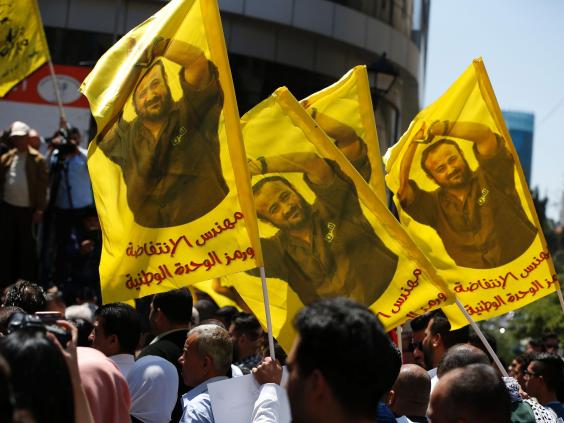

palestinian-protest2.jpg


Israeli troops and settlers pulled out of the Gaza Strip in 2005 but started a naval blockade after Hamas seized control of the territory in 2007.

Peace talks on the creation of a Palestinian state between Israel and Palestinian President Mahmoud Abbas broke down in 2014.

Meanwhile, tensions have been exacerbated by the decision to allow the first new Israeli settlements in the West Bank for two decades.

The UN Secretary-General Antonio Guterres condemned the decision as “threatening peace and undermining the two-state solution”. Building new settlements in the occupied territories is considered a violation of international law.

Israel denies Palestinian inmates are mistreated and Public Security Minister Gilad Erdan said the Barghouti-led protest was "prompted by internal Palestinian politics and therefore includes unreasonable demands".

Opinion polls suggest Barghouti is the top contender to succeed Mr Abbas as president.

Palestinians consider those held in Israeli jails as national heroes. Long-term mass hunger strikes by Palestinian prisoners are rare, but in past cases of individual inmates who stopped eating for weeks, detention terms were shortened or not renewed after they were hospitalised in critical condition.

Mr Erdan said a field hospital would be erected next to one prison - an apparent move to preempt transfers to civilian medical facilities, which could draw wider media attention.


*Photos by Abbas Momani courtesy of Getty Images

Tuesday, February 28, 2017

5 times in 20 months, Sisi meets reps from Zionist groups

Mada Masr
Sisi meets reps from US-based Zionist groups 5 times in 20 months

Sunday - February 19, 2017


President Abdel Fattah al-Sisi met with representatives from US-based pro-Israel organizations in Cairo on Sunday, for the fifth time in 20 months.

A delegation from the Conference of Presidents of Major American Jewish Organizations, which includes several groups supporting the Israeli military and self-professed Zionist organizations based in the United States, visited Cairo to discuss a number of issues with President Sisi, according to statements issued by the presidency that were published in Egyptian newspapers.

Sisi first met with a number of similar groups in Cairo in July 2015, followed by meetings in February and December 2016, and more meetings on the sidelines of the 71st United Nations General Assembly session in September 2016 in New York.

Sunday’s meeting included discussions on regional developments, including the situations in Libya and Syria, according to several Egyptian media outlets, as well as a review of counter-terrorism measures and efforts to prevent the funding of militant organizations in the region.

The Conference of Presidents of Major American Jewish Organizations (AIPAC) includes the following groups: The American Israeli Public Affairs Committee (AIPAC), Friends of the Israel Defense Forces (FIDF), the Zionist Organization of America (ZOA), the Association of Reform Zionists of America (ARZA), the Zionist Organization of the Conservative Movement (MERCAZ USA), Religious Zionists of America (RZA) and the American Friends of the Likud (AFLikud).

AIPAC describes itself as America’s bipartisan lobby to support Israel, while the FIDF advocates educational and training initiatives for Israeli military personnel, along with the provision of material assistance for Israel’s troops, support for Israeli widows and orphans and medical assistance for wounded members of the Israeli Defense Forces.

The ZOA describes itself as a group that promotes Jewish identity in Israel and other occupied Arab territories and helps prepare new generations of Israeli leaders.

ARZA works to provide material support to its partner organizations in Israel, along with promoting travel and tourism to the occupied territories, while MERCAZ USA promotes unity among Jews worldwide, with Jerusalem as the capital of the “homeland.”

In February 2016, AIPAC issued a statement after meeting with Sisi that said the two-hour meeting covered a wide range of domestic and international issues, including Egypt’s relations with the US and Israel, regional threats, especially those posed by terrorist organizations and their supporters, and Iran.

“The Jewish leaders said that they had an open and very productive discussion and that they were impressed by the President’s analysis on a wide variety of issues,” the statement added.

In December 2016, Egypt’s Minister of Defense Sedky Sobhy and Foreign Minister Sameh Shoukry joined Sisi in meeting the American Jewish Committee (AJC). 

According to a statement issued by the AJC, they “conferred with President Sisi and senior Egyptian officials on the importance of strengthening US-Egyptian ties and the mutual benefits of increasingly close strategic cooperation between Egypt and Israel.”

Saturday, December 31, 2016

US absention allows UNSC to demand end to Israel's settlements

The Guardian
US abstention allows UN to demand end to Israeli settlements

Donald Trump and Israel had urged Washington to use its veto to stop historic security council resolution


The United Nations security council has adopted a landmark resolution demanding a halt to all Israeli settlement in the occupied territories after Barack Obama’s administration refused to veto the resolution.
A White House official said Obama had taken the decision to abstain in the absence of any meaningful peace process.

The resolution passed by a 14-0 vote on Friday night. Loud applause was heard in the packed chamber when the US ambassador, Samantha Power, abstained.

All remaining members of the security council, including the UK, voted in support. Egypt, which had drafted the resolution and had been briefly persuaded by Israel to postpone the vote, also backed the move.

Friday’s vote was scheduled at the request of four countries – New Zealand, Malaysia, Senegal and Venezuela – who stepped in to push for action a day after Egypt put the draft resolution on hold.

Israel recalled its ambassadors to New Zealand and Senegal in protest on Saturday.

Palestinian president Mahmoud Abbas’s office said the vote was “a big blow” to Israeli policy and a show of “strong support for the two-state solution”.

The resolution says Israel’s settlements on Palestinian territory occupied since 1967, including East Jerusalem, have “no legal validity” and demands a halt to “all Israeli settlement activities,” saying this “is essential for salvaging the two-state solution.”


The resolution reiterated that Israeli settlement was a “flagrant violation” of international law.
The United States vetoed a similar resolution in 2011, which was the sole veto cast by the Obama administration at the security council.

The abstention decision underlined the tension between Obama and the Israeli prime minister, Benjamin Netanyahu, who had made furious efforts to prevent such a move.

A resolution requires nine votes in favour and no vetoes by the United States, France, Russia, Britain or China in order to be adopted. Among those who welcomed the resolution was UN secretary general Ban Ki-moon.

“The secretary general takes this opportunity to encourage Israeli and Palestinian leaders to work with the international community to create a conducive environment for a return to meaningful negotiations,” said his spokesman, Stephane Dujarric.

Explaining the US abstention, Power said the Israeli settlement “seriously undermines Israel’s security”, adding : “The United States has been sending a message that the settlements must stop privately and publicly for nearly five decades.”

Power said the US did not veto the resolution because the Obama administration believed it reflected the state of affairs regarding settlement and remained consistent with US policy.

“One cannot simultaneously champion expanding Israeli settlements and champion a viable two-state solution that would end the conflict. One had to make a choice between settlements and separation,” Power said.

The US decision to abstain was immediately condemned by Netanyahu’s office as “shameful” which pointedly referred to Israel’s expectation of working more closely with Donald Trump.

“Israel rejects this shameful anti-Israel resolution at the UN and will not abide by its terms,” a statement from Netanyahu’s office said. “The Obama administration not only failed to protect Israel against this gang-up at the UN, it colluded with it behind the scenes.

“Israel looks forward to working with president-elect Trump and with all our friends in Congress, Republicans and Democrats alike, to negate the harmful effects of this absurd resolution.”

The Israeli ambassador to the UN, Danny Danon, bluntly told the council that the resolution would not have the hoped-for impact of spurring peace efforts.

“By voting yes in favour of this resolution, you have in fact voted no. You voted no to negotiation, you voted no to progress and a chance for better lives for Israelis and Palestinians, and you voted no to the possibility of peace,” Danon told the council.

The vote will, however, be seen as a major defeat for Netanyahu, who has long had a difficult relationship with the Obama administration.

Netanyahu had tried to prevent the vote by appealing to Trump, who will not be sworn in until late January, and to the Egyptian president, Abdel Fatal al-Sisi.

While the resolution is largely symbolic, it will be seen as empowering an increasingly tough UN over Israel and will give pause to international companies who have interests in the occupied territories.

Originally drafted by Egypt, the original version of the resolution had been supposed to go to a vote on Thursday night, but was withdrawn by Sisi under pressure orchestrated by Israel.

Following the vote Trump, tweeted: “As to the UN, things will be different after Jan 20.”

Commenting on Trump’s attempted intervention, a White House official insisted that until Trump’s inauguration on 20 January there was one US president - Obama.

Pro-Israel senators and lobby groups also weighed in following the vote. The American Israel Public Affairs Committee (AIPAC), one of the most influential lobby groups, said it was “deeply disturbed by the failure of the Obama administration to exercise its veto to prevent a destructive, one-sided, anti-Israel resolution from being enacted by the United Nations security council.”

It also pointedly thanked Trump for his attempts to intervene: “AIPAC expresses its appreciation to president-elect Trump and the many Democratic and Republican members of Congress who urged a veto of this resolution.”

The United Nations maintains that settlements are illegal, but UN officials have reported a surge in construction over the past months.

About 430,000 Israeli settlers live in the West Bank and a further 200,000 Israelis live in east Jerusalem, which Palestinians see as the capital of their future state.

The resolution demands that “Israel immediately and completely cease all settlement activities in the occupied Palestinian territory, including East Jerusalem”.

It states that Israeli settlements have “no legal validity” and are “dangerously imperiling the viability of the two-state solution.”


*Photos courtesy of Reuters

Tuesday, May 31, 2016

Military police deployed to intimidate shipyard workers at sit-in protest

Mada Masr
Nile Cotton, Alexandria Shipyard workers sit in against unpaid wages, state failures

Monday, May 23, 2016

Jano Charbel 


For the second consecutive day, hundreds of workers from two state-owned companies have been challenging the restrictive provisions of Egypt’s protest law by conducting overnight sit-ins to protest against the state’s labor policies.

Although such open-ended sit-ins are banned by the protest law, workers from the Nile Cotton Ginning Company and the Alexandria Shipyard Company have been sitting in outside Parliament, the Ministry of Public Sector Works and at the Port of Alexandria.

The sit-ins were launched against what workers claim is the state’s failure to uphold its own laws and court verdicts.

Military police units have been deployed to the Port of Alexandria in response to the hundreds-strong sit-in held by workers from the Alexandria Shipyard Company, the privately owned Al-Watan newspaper reported on Monday. A senior navy general was also dispatched to try to persuade the workers to end the protests, according to the privately owned Tahrir News.

The shipyard workers have sitting in since Sunday to protest low wages, which fall below the national monthly minimum wage of LE1,200 that was established for public sector workers at the beginning of 2014. They’re also protesting against the non-payment of their annual pre-Ramadan bonuses, and demanding the dismissal of the company’s chief manager.

Representatives from the Armed Forces began attempting to negotiate a settlement with the protesting shipyard workers on Monday, said Tahrir News, but the protesters have reportedly threatened to escalate by going on strike until their demands are met.

Also since Sunday, dozens of workers from the Nile Cotton Ginning Company have been demonstrating in downtown Cairo outside the Parliament building and Cabinet headquarters. They reportedly haven’t been paid for seven months.

On Monday, the workers relocated their sit-in to the newly established Ministry of Public Sector Works in the hopes of receiving a pledge from the state to pay their wages and reopen their factories.

Workers from several branches of the Nile Cotton Ginning Company have held a host of industrial actions over the past four years against the failure to implement of a 2011 Administrative Court verdict that nullified the privatization of their company, and that ordered the company to reopen under state administration.

The court had ruled against Nile Cotton’s privatization in 2011 on the basis that the company was sold for far less than its real market value, and in violation of privatization regulations. The Nile Cotton Ginning Company was privatized in 1997 and sold as a share-holding company registered on the Egyptian Stock Exchange.

In September 2013, the Supreme Administrative Court upheld the 2011 verdict that nullified the sale. A subsequent decree from the prime minister upheld both the 2011 and 2013 court verdicts, and called for the state to reopen the Nile Cotton Ginning Company’s branches under its auspices.

The company’s workers claim that the non-implementation of these rulings is the principle cause for their repeated protests.

The Nile Cotton Ginning Company remains in a legal state of limbo, and many of its regional branches and production lines have come to a complete standstill. With production grinding to a halt, the company’s administrators have been unable to pay their workers.

Across Egypt, stalled companies and faltering industries have translated into the non-payment of wages for thousands of workers. In turn, this has led to a nationwide spike in industrial actions and labor unrest.

There were 493 labor protests from January to April 2016 alone, according to the latest figures issued by the independent nongovernmental organization Democracy Meter. This rate currently represents an average of six industrial actions per day, and a 25 percent increase in labor unrest compared to the same period last year.

A total of 1,117 strikes and other industrial actions were reported across Egypt in 2015, according to Democracy Meter, amounting to an average of three labor protests per day.


*Photo courtesy of Tahrir News

Thursday, April 30, 2015

Saudi-led airstrike kills dozens of workers at Yemeni dairy factory

World Socialist Website

Dozens Killed in Airstrike on Dairy Factory in Yemen

April 02, 2015

Thomas Gaist

 
The Saudi-led war in Yemen continued Wednesday, with the bombing of a dairy and juicing factory near the western port city of Hodeida killing at least 37 workers and injuring 80 others. The factory was hit by two bombs dropped by warplanes from the Saudi-led coalition, according to a Yemeni army newspaper.

According to statistics reported by UNICEF and the Field Medical Organization, the Saudi-led air raids as well as fighting between the Houthis, members of a minority Zaydi Shiite group, and military units loyal to President Abd-Rabbu Mansour Hadi have already killed at least 102 Yemeni civilians, including at least 62 children.

Since Thursday, air force units from Kuwait, Sudan, Jordan, Morocco, United Arab Emirates, Bahrain, Qatar and Egypt have taken part in the assault, in addition to Saudi Arabia.
US officials have confirmed that American forces are playing a direct support role in the operations by providing “logistical and intelligence” aid to the Saudi coalition of Persian Gulf Sunni monarchies.

While care has been taken to ensure that there is “no overt sign of US partnership,” as the Washington Post has noted, the Saudis and their allies are armed to the teeth with new weaponry and are deploying battle tanks, attack helicopters, and state of the art warplanes for a massive onslaught against targets throughout the country.

Coalition planes have launched repeated strikes in support of Hadi loyalists as they engaged in urban gun battles with Houthi riflemen in areas north of Aden. Arab League planes also launched strikes at targets in the central highlands, along the coast, and in the northern and eastern provinces. Strikes are also reportedly planned against the “security belt” of Houthi entrenchments around the outskirts of Sanaa, the capital city.

The Saudi air campaign has failed to halt the southward drive of the insurgents, and Houthi infantry and armor moved into central Aden Wednesday. Houthi forces, which are loosely tied to Iran, seized government fortifications that look down upon the strategic Bab el Mandeb strait Tuesday night.

The occupation by the Houthi forces of a strategically critical portion of the Arabian peninsula, sitting alongside the main US ally in the region and overlooking the narrow waters of the strait where huge volumes of oil, grain, and other commodities pass daily, makes clear the regional and global ramifications of the ongoing crisis.

There have been numerous reports that Saudi Arabia and Egypt would spearhead a ground invasion once military planners have determined that airstrikes on military bases, weapons stockpiles and air defenses have made the Houthis sufficiently vulnerable. Yemeni Foreign Minister Riyadh Yassin, loyal to Hadi, repeated calls for an invasion on the grounds that “at some stage air strikes will be ineffective.”

Plans for the impending invasion reportedly outlined by Saudi military planners would aim to reconquer southern areas of the country from the Shiite militants, and use these areas as staging grounds for the creation of a new proxy army inside Yemen.

US officials announced Tuesday that they would approve arms and equipment shipments to the Egyptian military government of President Abdel Fattah Al Sisi, whose regime has overseen mass killings, detention and torture of tens of thousands since coming to power in 2013. With the shipment of arms and weaponry, the US is giving its assent to preparations for a ground invasion of Yemen, which would draw in troops from throughout the region.

The threat of a massive new ground war in the Arabian peninsula, with the potential to kill tens or hundreds of thousands of Yemenis, comes amid broader preparations for escalating US military intervention in Syria and growing clamor within sections of the US ruling elite for war against Iran.

The Pentagon is deploying the Army’s 5th Special Forces Group to Jordan to establish a “multinational special operations task force,” which will train fighters for the civil war the US has fomented against Syrian President Bashar Al Assad since 2011.

US military leaders are increasingly demanding that the White House authorize the deployment of “large formations” of Special Operations troops to CIA and Pentagon-run training camps in Jordan and Iraq which serve as staging areas for the war against Assad, according to a high ranking Special Forces officer who spoke to Foreign Affairs .

The crisis in Yemen is an acute manifestation of the intensifying breakdown of the US-dominated political order in the Middle East. In spite of intense efforts by the US to prop up the dictatorship of Ali Abdullah Saleh, destabilized by Arab Spring demonstrators in 2011, the longtime leader was pushed from power and eventually replaced by then Vice President Hadi.

While Hadi garners backing from Saudi Arabia and the United States, he lacks any broad support amongst the population within Yemen. Hadi has been forced out of the country less than three years after winning a one-man election, staged as the culmination of a supposedly democratic transition process orchestrated by American imperialism and the Saudi monarchy.

Hadi fled Sanaa for his stronghold of Aden earlier in February and finally last week he fled Yemen for Saudi Arabia after his compound came under attack by planes commanded by forces loyal to Saleh, who has backed the Houthis.

Despite extensive financial and military support for the Yemeni security apparatus and more than a decade of secret US drone strikes inside the country against Al Qaeda in the Arabian Peninsula and other anti-government militias, the Iranian-supported Houthi militants have been able to rapidly overrun much of the country’s western provinces.

In response to the collapse of their puppet government they patched together in 2012, the US and the savage monarchies and dictatorships which serve as its regional gendarmes are now preparing an escalation of the slaughter in Yemen. The response of US imperialism and its proxies to growing disorder is to launch yet another major sub-regional war that has the potential to set off a military conflagration engulfing societies across North Africa and Central Asia.


*Photo courtesy of Euronews

Thursday, July 31, 2014

Collective Punishment in Gaza

 
Collective Punishment in Gaza

July 29, 2014

Rashid Khalidi


Three days after the Israeli Prime Minister Benjamin Netanyahu launched the current war in Gaza, he held a press conference in Tel Aviv during which he said, in Hebrew, according to the Times of Israel, “I think the Israeli people understand now what I always say: that there cannot be a situation, under any agreement, in which we relinquish security control of the territory west of the River Jordan.”
 
It’s worth listening carefully when Netanyahu speaks to the Israeli people. What is going on in Palestine today is not really about Hamas. It is not about rockets. It is not about “human shields” or terrorism or tunnels. It is about Israel’s permanent control over Palestinian land and Palestinian lives.

That is what Netanyahu is really saying, and that is what he now admits he has “always” talked about. It is about an unswerving, decades-long Israeli policy of denying Palestine self-determination, freedom, and sovereignty.


What Israel is doing in Gaza now is collective punishment. It is punishment for Gaza’s refusal to be a docile ghetto. It is punishment for the gall of Palestinians in unifying, and of Hamas and other factions in responding to Israel’s siege and its provocations with resistance, armed or otherwise, after Israel repeatedly reacted to unarmed protest with crushing force. Despite years of ceasefires and truces, the siege of Gaza has never been lifted.

As Netanyahu’s own words show, however, Israel will accept nothing short of the acquiescence of Palestinians to their own subordination. It will accept only a Palestinian “state” that is stripped of all the attributes of a real state: control over security, borders, airspace, maritime limits, contiguity, and, therefore, sovereignty.

The twenty-three-year charade of the “peace process” has shown that this is all Israel is offering, with the full approval of Washington. Whenever the Palestinians have resisted that pathetic fate (as any nation would), Israel has punished them for their insolence. This is not new.

Punishing Palestinians for existing has a long history. It was Israel’s policy before Hamas and its rudimentary rockets were Israel’s boogeyman of the moment, and before Israel turned Gaza into an open-air prison, punching bag, and weapons laboratory.

In 1948, Israel killed thousands of innocents, and terrorized and displaced hundreds of thousands more, in the name of creating a Jewish-majority state in a land that was then sixty-five per cent Arab.

In 1967, it displaced hundreds of thousands of Palestinians again, occupying territory that it still largely controls, forty-seven years later.
 
In 1982, in a quest to expel the Palestine Liberation Organization and extinguish Palestinian nationalism, Israel invaded Lebanon, killing seventeen thousand people, mostly civilians.

Since the late nineteen-eighties, when Palestinians under occupation rose up, mostly by throwing stones and staging general strikes, Israel has arrested tens of thousands of Palestinians: over seven hundred and fifty thousand people have spent time in Israeli prisons since 1967, a number that amounts to forty per cent of the adult male population today.

They have emerged with accounts of torture, which are substantiated by human-rights groups like B’tselem. During the second intifada, which began in 2000, Israel reinvaded the West Bank (it had never fully left.) The occupation and colonization of Palestinian land continued unabated throughout the “peace process” of the nineteen-nineties, and continues to this day.

And yet, in America, the discussion ignores this crucial, constantly oppressive context, and is instead too often limited to Israeli “self-defense” and the Palestinians’ supposed responsibility for their own suffering.

In the past seven or more years, Israel has besieged, tormented, and regularly attacked the Gaza Strip. The pretexts change: they elected Hamas; they refused to be docile; they refused to recognize Israel; they fired rockets; they built tunnels to circumvent the siege; and on and on.

But each pretext is a red herring, because the truth of ghettos—what happens when you imprison 1.8 million people in a hundred and forty square miles, about a third of the area of New York City, with no control of borders, almost no access to the sea for fishermen (three out of the twenty kilometres allowed by the Oslo accords), no real way in or out, and with drones buzzing overhead night and day—is that, eventually, the ghetto will fight back.

It was true in Soweto and Belfast, and it is true in Gaza. We might not like Hamas or some of its methods, but that is not the same as accepting the proposition that Palestinians should supinely accept the denial of their right to exist as a free people in their ancestral homeland.

This is precisely why the United States’ support of current Israeli policy is folly. Peace was achieved in Northern Ireland and in South Africa because the United States and the world realized that they had to put pressure on the stronger party, holding it accountable and ending its impunity.

Northern Ireland and South Africa are far from perfect examples, but it is worth remembering that, to achieve a just outcome, it was necessary for the United States to deal with groups like the Irish Republican Army and the African National Congress, which engaged in guerrilla war and even terrorism. That was the only way to embark on a road toward true peace and reconciliation. The case of Palestine is not fundamentally different.

Instead, the United States puts its thumb on the scales in favor of the stronger party. In this surreal, upside-down vision of the world, it almost seems as if it is the Israelis who are occupied by the Palestinians, and not the other way around. In this skewed universe, the inmates of an open-air prison are besieging a nuclear-armed power with one of the most sophisticated militaries in the world.

If we are to move away from this unreality, the U.S. must either reverse its policies or abandon its claim of being an “honest broker.”

If the U.S. government wants to fund and arm Israel and parrot its talking points that fly in the face of reason and international law, so be it. But it should not claim the moral high ground and intone solemnly about peace. And it should certainly not insult Palestinians by saying that it cares about them or their children, who are dying in Gaza today.


*Photo courtesy of RT News

How Israel Spins its War Crimes

CounterPunch 
 
The Secret Report That Helps Israelis Cover Atrocities
 
July 28, 2014

Patrick Cockburn


Israeli spokesmen have their work cut out explaining how they have killed more than 1,000 Palestinians in Gaza, most of them civilians, compared with just three civilians killed in Israel by Hamas rocket and mortar fire.

But on television and radio and in newspapers, Israeli government spokesmen such as Mark Regev appear slicker and less aggressive than their predecessors, who were often visibly indifferent to how many Palestinians were killed.

There is a reason for this enhancement of the PR skills of Israeli spokesmen. Going by what they say, the playbook they are using is a professional, well-researched and confidential study on how to influence the media and public opinion in America and Europe.

Written by the expert Republican pollster and political strategist Dr Frank Luntz, the study was commissioned five years ago by a group called The Israel Project, with offices in the US and Israel, for use by those “who are on the front lines of fighting the media war for Israel.”

Every one of the 112 pages in the booklet is marked “not for distribution or publication” and it is easy to see why.

The Luntz report, officially entitled “The Israel project’s 2009 Global Language Dictionary, was leaked almost immediately to Newsweek Online, but its true importance has seldom been appreciated. It should be required reading for everybody, especially journalists, interested in any aspect of Israeli policy because of its “dos and don’ts” for Israeli spokesmen.

These are highly illuminating about the gap between what Israeli officials and politicians really believe, and what they say, the latter shaped in minute detail by polling to determine what Americans want to hear.

Certainly, no journalist interviewing an Israeli spokesman should do so without reading this preview of many of the themes and phrases employed by Mr Regev and his colleagues.

The booklet is full of meaty advice about how they should shape their answers for different audiences. For example, the study says that “Americans agree that Israel ‘has a right to defensible borders.’

But it does you no good to define exactly what those borders should be.

Avoid talking about borders in terms of pre- or post-1967, because it only serves to remind Americans of Israel’s military history. Particularly on the left this does you harm.

For instance, support for Israel’s right to defensible borders drops from a heady 89 per cent to under 60 per cent when you talk about it in terms of 1967.”

How about the right of return for Palestinian refugees who were expelled or fled in 1948 and in the following years, and who are not allowed to go back to their homes?

Here Dr Luntz has subtle advice for spokesmen, saying that “the right of return is a tough issue for Israelis to communicate effectively because much of Israeli language sounds like the ‘separate but equal’ words of the 1950s segregationists and the 1980s advocates of Apartheid.

The fact is, Americans don’t like, don’t believe and don’t accept the concept of ‘separate but equal’.”

So how should spokesmen deal with what the booklet admits is a tough question? They should call it a “demand”, on the grounds that Americans don’t like people who make demands. “Then say ‘Palestinians aren’t content with their own state. Now they’re demanding territory inside Israel’.”

Other suggestions for an effective Israeli response include saying that the right of return might become part of a final settlement “at some point in the future.”

Dr Luntz notes that Americans as a whole are fearful of mass immigration into the US, so mention of “mass Palestinian immigration” into Israel will not go down well with them. If nothing else works, say that the return of Palestinians would “derail the effort to achieve peace.”

The Luntz report was written in the aftermath of Operation Cast Lead in December 2008 and January 2009, when 1,387 Palestinians and nine Israelis were killed.

There is a whole chapter on “isolating Iran-backed Hamas as an obstacle to peace”. Unfortunately, come the current Operation Protective Edge, which began on 6 July, there was a problem for Israeli propagandists because Hamas had quarrelled with Iran over the war in Syria and had no contact with Tehran. Friendly relations have been resumed only in the past few days – thanks to the Israeli invasion.

Much of Dr Luntz’s advice is about the tone and presentation of the Israeli case. He says it is absolutely crucial to exude empathy for Palestinians: “Persuadables [sic] won’t care how much you know until they know how much you care. Show Empathy for BOTH sides!”

This may explain why a number of Israeli spokesman are almost lachrymose about the plight of Palestinians being pounded by Israeli bombs and shells.

In a sentence in bold type, underlined and with capitalisation, Dr Luntz says that Israeli spokesmen or political leaders must never, ever justify “the deliberate slaughter of innocent women and children” and they must aggressively challenge those who accuse Israel of such a crime.

Israeli spokesmen struggled to be true to this prescription when 16 Palestinians were killed in a UN shelter in Gaza last Thursday.

There is a list of words and phrases to be used and a list of those to be avoided. Schmaltz is at a premium: “The best way, the only way, to achieve lasting peace is to achieve mutual respect.”

Above all, Israel’s desire for peace with the Palestinians should be emphasised at all times because this what Americans overwhelmingly want to happen. But any pressure on Israel to actually make peace can be reduced by saying “one step at a time, one day at a time”, which will be accepted as “a commonsense approach to the land-for-peace equation.”

Dr Luntz cites as an example of an “effective Israeli sound bite” one which reads: “I particularly want to reach out to Palestinian mothers who have lost their children. No parent should have to bury their child.”

The study admits that the Israeli government does not really want a two-state solution, but says this should be masked because 78 per cent of Americans do. Hopes for the economic betterment of Palestinians should be emphasised.

Prime Minister Benjamin Netanyahu is quoted with approval for saying that it is “time for someone to ask Hamas: what exactly are YOU doing to bring prosperity to your people.”

The hypocrisy of this beggars belief: it is the seven-year-old Israeli economic siege that has reduced the Gaza to poverty and misery.

On every occasion, the presentation of events by Israeli spokesmen is geared to giving Americans and Europeans the impression that Israel wants peace with the Palestinians and is prepared to compromise to achieve this, when all the evidence is that it does not.

Though it was not intended as such, few more revealing studies have been written about modern Israel in times of war and peace.

Israel's assaults on Gaza aim to control Palestinian offshore gas reserves

The Guardian
IDF's Gaza assault is to control Palestinian gas, avert Israeli energy crisis 
 
Israel's defence minister has confirmed that military plans to 'uproot Hamas' are about dominating Gaza's gas reserves
 
Wednesday July 9, 2014
 
Nafeez Ahmed
 

Yesterday, Israeli defence minister and former Israeli Defence Force (IDF) chief of staff Moshe Ya'alon announced that Operation Protective Edge marks the beginning of a protracted assault on Hamas. The operation "won't end in just a few days," he said, adding that "we are preparing to expand the operation by all means standing at our disposal so as to continue striking Hamas."
This morning, he said:
"We continue with strikes that draw a very heavy price from Hamas. We are destroying weapons, terror infrastructures, command and control systems, Hamas institutions, regime buildings, the houses of terrorists, and killing terrorists of various ranks of command… The campaign against Hamas will expand in the coming days, and the price the organization will pay will be very heavy."
But in 2007, a year before Operation Cast Lead, Ya'alon's concerns focused on the 1.4 trillion cubic feet of natural gas discovered in 2000 off the Gaza coast, valued at $4 billion. Ya'alon dismissed the notion that "Gaza gas can be a key driver of an economically more viable Palestinian state" as "misguided." The problem, he said, is that:
"Proceeds of a Palestinian gas sale to Israel would likely not trickle down to help an impoverished Palestinian public. Rather, based on Israel's past experience, the proceeds will likely serve to fund further terror attacks against Israel…
A gas transaction with the Palestinian Authority [PA] will, by definition, involve Hamas. Hamas will either benefit from the royalties or it will sabotage the project and launch attacks against Fatah, the gas installations, Israel – or all three… It is clear that without an overall military operation to uproot Hamas control of Gaza, no drilling work can take place without the consent of the radical Islamic movement."
Operation Cast Lead did not succeed in uprooting Hamas, but the conflict did take the lives of 1,387 Palestinians (773 of whom were civilians) and 9 Israelis (3 of whom were civilians).
Since the discovery of oil and gas in the Occupied Territories, resource competition has increasingly been at the heart of the conflict, motivated largely by Israel's increasing domestic energy woes.

Mark Turner, founder of the Research Journalism Initiative, reported that the siege of Gaza and ensuing military pressure was designed to "eliminate" Hamas as "a viable political entity in Gaza" to generate a "political climate" conducive to a gas deal. This involved rehabilitating the defeated Fatah as the dominant political player in the West Bank, and "leveraging political tensions between the two parties, arming forces loyal to Abbas and the selective resumption of financial aid."

Ya'alon's comments in 2007 illustrate that the Israeli cabinet is not just concerned about Hamas – but concerned that if Palestinians develop their own gas resources, the resulting economic transformation could in turn fundamentally increase Palestinian clout.

Meanwhile, Israel has made successive major discoveries in recent years - such as the Leviathan field estimated to hold 18 trillion cubic feet of natural gas – which could transform the country from energy importer into aspiring energy exporter with ambitions to supply Europe, Jordan and Egypt.

A potential obstacle is that much of the 122 trillion cubic feet of gas and 1.6 billion barrels of oil in the Levant Basin Province lies in territorial waters where borders are hotly disputed between Israel, Syria, Lebanon, Gaza and Cyprus.

Amidst this regional jockeying for gas, though, Israel faces its own little-understood energy challenges. It could, for instance, take until 2020 for much of these domestic resources to be properly mobilised.

But this is the tip of the iceberg. A 2012 letter by two Israeli government chief scientists – which the Israeli government chose not to disclose – warned the government that Israel still had insufficient gas resources to sustain exports despite all the stupendous discoveries. The letter, according to Ha'aretz, stated that Israel's domestic resources were 50% less than needed to support meaningful exports, and could be depleted in decades:
"We believe Israel should increase its [domestic] use of natural gas by 2020 and should not export gas. The Natural Gas Authority's estimates are lacking. There's a gap of 100 to 150 billion cubic meters between the demand projections that were presented to the committee and the most recent projections. The gas reserves are likely to last even less than 40 years!"
As Dr Gary Luft - an advisor to the US Energy Security Council - wrote in the Journal of Energy Security, "with the depletion of Israel's domestic gas supplies accelerating, and without an imminent rise in Egyptian gas imports, Israel could face a power crisis in the next few years… If Israel is to continue to pursue its natural gas plans it must diversify its supply sources."

Israel's new domestic discoveries do not, as yet, offer an immediate solution as electricity prices reach record levels, heightening the imperative to diversify supply. This appears to be behind Prime Minister Netanyahu's announcement in February 2011 that it was now time to seal the Gaza gas deal.

But even after a new round of negotiations was kick-started between the Fatah-led Palestinian Authority and Israel in September 2012, Hamas was excluded from these talks, and thus rejected the legitimacy of any deal.

Earlier this year, Hamas condemned a PA deal to purchase $1.2 billion worth of gas from Israel Leviathan field over a 20 year period once the field starts producing. Simultaneously, the PA has held several meetings with the British Gas Group to develop the Gaza gas field, albeit with a view to exclude Hamas – and thus Gazans – from access to the proceeds. That plan had been the brainchild of Quartet Middle East envoy Tony Blair.

But the PA was also courting Russia's Gazprom to develop the Gaza marine gas field, and talks have been going on between Russia, Israel and Cyprus, though so far it is unclear what the outcome of these have been. Also missing was any clarification on how the PA would exert control over Gaza, which is governed by Hamas.

According to Anais Antreasyan in the University of California's Journal of Palestine Studies, the most respected English language journal devoted to the Arab-Israeli conflict, Israel's stranglehold over Gaza has been designed to make "Palestinian access to the Marine-1 and Marine-2 gas wells impossible."

Israel's long-term goal "besides preventing the Palestinians from exploiting their own resources, is to integrate the gas fields off Gaza into the adjacent Israeli offshore installations." This is part of a wider strategy of:
"…. separating the Palestinians from their land and natural resources in order to exploit them, and, as a consequence, blocking Palestinian economic development. Despite all formal agreements to the contrary, Israel continues to manage all the natural resources nominally under the jurisdiction of the PA, from land and water to maritime and hydrocarbon resources."
For the Israeli government, Hamas continues to be the main obstacle to the finalisation of the gas deal. In the incumbent defence minister's words: "Israel's experience during the Oslo years indicates Palestinian gas profits would likely end up funding terrorism against Israel. The threat is not limited to Hamas… It is impossible to prevent at least some of the gas proceeds from reaching Palestinian terror groups."

The only option, therefore, is yet another "military operation to uproot Hamas."
Unfortunately, for the IDF uprooting Hamas means destroying the group's perceived civilian support base – which is why Palestinian civilian casualties massively outweigh that of Israelis. Both are obviously reprehensible, but Israel's capacity to inflict destruction is simply far greater.

In the wake of Operation Cast Lead, the Jerusalem-based Public Committee Against Torture in Israel (Pcati) found that the IDF had adopted a more aggressive combat doctrine based on two principles – "zero casualties" for IDF soldiers at the cost of deploying increasingly indiscriminate firepower in densely populated areas, and the "dahiya doctrine" promoting targeting of civilian infrastructure to create widespread suffering amongst the population with a view to foment opposition to Israel's opponents.

This was confirmed in practice by the UN fact-finding mission in Gaza which concluded that the IDF had pursued a "deliberate policy of disproportionate force," aimed at the "supporting infrastructure" of the enemy - "this appears to have meant the civilian population," said the UN report.

The Israel-Palestine conflict is clearly not all about resources. But in an age of expensive energy, competition to dominate regional fossil fuels are increasingly influencing the critical decisions that can inflame war.

Wednesday, April 30, 2014

US-based Cargill Co. workers assaulted & besieged in Alexandria

Mada Masr
US-based company workers assaulted, besieged in Alexandria

Saturday, April 26, 2014

Jano Charbel 


The US-based multinational corporation, Cargill, has been criticized both locally and internationally over its heavy-handed response to an ongoing workers’ protest at its plant in Borg al-Arab City, which has been ongoing for over four months. Videos circulating of workers being physically assaulted and having barking dogs unleashed upon them has led to widespread condemnation.

The National Vegetable Oil Company, which is owned by Cargill, is witnessing a wide spectrum of labor violations, including the wholesale sacking of protesting workers and unionists, assaults on protesters using private security contractors and dogs, a virtual siege of the workers’ sit-in with electricity and water being cut off from the company – preventing the entry of food, drink, medicines and visitors to the workers inside – amongst a host of other transgressions.

After protesting (yet not striking) for their overdue bonuses, profit-shares and insurance coverage, workers at this company have been subjected to a lockout since December 15. Moreover, the company administration has since sacked nearly 90 percent of its workforce – including the local labor union committee in its entirety.  

A total of 86 workers were employed at this company, 75 of whom have been punitively sacked for protesting – including all eight members of the union committee. Around 66 workers are still occupying their company grounds and maintaining their sit-in.

Only 11 workers remain employed at the company, although production has come to a complete standstill since mid-December.

Company workers, along with state officials, labor unions, NGOs and rights activists have all spoken out against the punitive measures that the National Vegetable Oil Company has taken against its workforce. Representatives from the US Embassy in Cairo are also reported to be involved in negotiations with the Egyptian employers.

Following an inspection of the company, the Ministry of Manpower’s Regional Bureau in Alexandria issued a written statement on February 10 criticizing Cargill’s administrators for “unnecessarily halting production, as there is no economic justification to do so.”

Mostafa Sebai, chief inspector at the Manpower Bureau in Alexandria, recommended that punitively sacked workers should be reinstated and that overdue payments should be delivered.

Speaking at a labor conference on March 23, sacked worker Alaa Abdel Aleem commented, “We’re being treated like enemy combatants.”

“They’ve tried to terrorize us into withdrawing from the company through the use of armed thugs and dogs. When that failed they tried to impose a siege upon us and to starve us,” he added.

Abdel Aleem added that the physical and psychological health of many of his protesting co-workers remains threatened. The storming of the company grounds by private security forces and their dogs resulted in minor injuries, trauma and psychological harm.

The sacked worker explained that “people are no longer allowed in to visit us or to inspect our conditions. Those of us who leave the sit-in are forcefully prevented from returning and rejoining our co-workers.”

In statements issued during the first week of April, the Ministry of Manpower has denounced the ongoing transgressions against workers’ rights at the National Vegetable Oil Company, and has cited 41 violations of Egypt’s Unified Labor Law 12/2003.

The Ministry has given the company’s administration until mid-April to address these transgressions, or face a referral of these violations to the prosecutor general.

However, the Egyptian Federation of Independent Trade Unions (EFITU) has criticized the Ministry’s “lack of action and its foot-dragging” since December. In a written statement issued on April 15, the EFITU denounced suggestions proposed by the Minister of Manpower, Nahed al-Ashry, to the effect that workers should accept their dismissals, while the company should offer them compensations.

Events at the Cargill-owned company have also drawn a response from the International Labor Organization, whose regional representative, Mohamed al-Taraboulsi, described the administration’s tactics as “a grave violation of international labor laws.”

Speaking at a conference dubbed “Ending the siege on Cargill’s workers” on April 7, Taraboulsi commented that he aspired to resolve the conflict between Cargill’s administrators and its workforce, before raising these violations with the ILO’s general assembly.

Taraboulsi added that the company’s policies should not resort to punitive sacking and physical assaults on workers but through dialogue and negotiations, and that he is willing to provide consultancy and mediation regarding workers’ rights and international labor conventions.


Since the crisis at the National Vegetable Oil Company began in December, sacked workers have received letters of solidarity from some 60 local trade unions and labor rights organizations, along with petitions and campaigns from the International Food Workers’ Union (IUF), the IndustriALL Global Union Federation, and the US-MENA Labor Solidarity Network. Workers from the US, Belgium, Germany and Switzerland have also sent messages of solidarity.

Another sacked worker, Waleed Mossaad, told Mada Masr, “This week we’ve launched an online campaign in both English and Arabic to raise awareness regarding the plight of all workers at the National Vegetable Oil Company.”

Mossaad claims he has forcefully been denied entry back into the sit-in within the company since February.

According to Mossaad, “On February 2, we left the sit-in to meet with then-Minister of Manpower Kamal Abu Eita. Upon returning, we were told that we were not to be allowed back in the company as we had been fired.” Indeed, since January, the administration has posted notices within company gates to all those workers it had laid off.

Mossaad explained that he had sought the ministry’s intercession in resolving the crisis between the workers and administrators. According to Mossaad, the UK-based G4S private security company was hired to forcefully disperse and remove the workers on December 23.

Videos circulating of this attack on December 23 show burly private security forces – many of whom were dressed in black shirts and camouflage pants while swinging clubs in their hands, while others donned orange helmets and handled large black dogs – yet the G4S logo is not visible on their clothes.

Mossaad claims that retired Armed Forces General Sameh Seif al-Yazal, chairman of the G4S Company in Egypt, ordered these private security personnel to forcefully disperse the sit-in. This could not be verified, however.

Several workers are reported to have suffered minor injuries on December 23, while others are allegedly suffering from trauma and psychological breakdowns since dogs were unleashed on them. 

The security company succeeded in removing the workers from their sit-in by the factories, to the garage area within the company gates.

According to Mossaad, from December 23 to March 13, “we had to smuggle food, water and medicine over the company’s gates and through its fences to our coworkers within. We had to run from the dogs and security guards who were constantly threatening us.”

The company’s administration is said to have resorted to another private security company on March 13, the name of which is not known. According to workers, on that day the water supply was turned on in the bathrooms once again.

According to Mossaad, the security guards agreed to let food and medicine in to the protesting workers on March 18.

Mossaad claims that this “easing of the siege” was a result of negotiations between representatives of the US Embassy, the company’s administration and the Ministry of Manpower to end the crisis. 

According to Mohamed Kashef, a researcher with the Egyptian Initiative for Personal Rights, “The administration of the National Vegetable Oil Company has proven to be very obstinate and unyielding towards the basic rights of its workers.”

Kashef explained that the company was very profitable, and that its workers had helped increase productivity. The company’s vegetable oils constitute about 40 percent of the contents of each bottle of state-subsidized cooking oil.

“The most recently employed worker at this company has been there for six years, others have been working there for many more years. Nevertheless, workers have been denied bonuses, profit-sharing, long-term contracts, health insurance, social insurance, medical compensations and, for the past four months, have been denied their union representation, along with their incomes and jobs,” he added.

Kashef added that the company’s administration is seeking to isolate its protesting workers from contact with the outside world, so that their grievances will not be heard. Kashef, along with numerous other researchers, doctors, lawyers, activists and journalists have repeatedly been denied entry into the company gates to meet with the workers within.

The researcher went on to state that “the Cargill Company in America appears out of touch with events at the National Vegetable Oil Company. As for the local Egyptian administrators, they have claimed that the protesting workers are opportunists, demanding things which they are not owed.”

Kashef concluded by saying that the company’s “local administration is not willing, as of yet, to partake in collective bargaining agreements with its workers, or with the Ministry of Manpower. This is why they have arrived at no agreement or compromise in order to settle this labor dispute through dialogue.”

According to Mossaad, “We need to have Cargill in America hear our voices. The workers of the National Vegetable Oil Company are desolate, besieged, gagged, monetarily broke, and are suffering from hunger and illnesses. The company here wants to get rid of us and hire new workers to work for less pay, but nobody should have to put up with such exploitation and blatant disregard for labor rights.” 

Despite repeated attempts to contact the administrators by phone and email, there has been no response. As for Cargill’s representatives in Egypt, they declined to respond to questions via phone and email.

The agricultural and food processing giant Cargill has been operating in Egypt since 1994. Cargill has acquired 98 percent of the National Vegetable Oil Company’s shares since 2004.

Beyond the National Vegetable Oil Company in Borg al-Arab, Cargill owns a grain transport terminal, the National Stevedore Company, in the Alexandrian port of Dekheila. This multinational corporation is also involved in the trade of grains, soybeans, animal feed, and sugar along with sugar-processing. According to Cargill's website, this mammoth corporation employs some 370 people in four locations across Egypt.


*Photos courtesy of MENA Solidarity Network & International Food Workers' Union

Sunday, March 30, 2014

Security break up workers' sit-in at state union federation


Mada Masr

March 12, 2014

Jano Charbel


Security personnel at the state-controlled Egyptian Trade Union Federation (ETUF) forcefully dispersed a sit-in protest of more than 20 workers from the federation’s headquarters Wednesday.
While none of the protesting workers were arrested, a number of minor injuries were reported.

This dispersal ends a 34-day sit-in by workers from the Tanta Flax and Oils Company and the Shebin al-Kom Textile Company at ETUF's headquarters in downtown Cairo to demand the re-nationalization and re-operation of their stalled companies - in accordance with earlier verdicts issued from the Administrative Courts.

The courts ruled that these two companies, along with the Nile Cotton Ginning Company and the Nasr Steam Boilers Company, had been privatized and sold-off for far less than their true market value. 

Protesters have also been demanding their reinstatement, along with hundreds of other workers who had been sacked or forced to retire.

Wednesday’s crackdown comes amidst the new government’s policy of seeking to end strikes and other forms of labor unrest. It also comes amid a recent proposal by the Ministry of Manpower to ban labor strikes for a whole year.

According to Gamal Othman, a sacked worker from the Tanta Flax and Oils Company, the ETUF’s custodial staff informed the protesters in the early afternoon to move out of the halls and chambers where they were staging their sit-in so that they could clean up.

Othman added: “Shortly after that, security personnel and a bunch of hired thugs attacked us. Most of us were not physically assaulted but were threatened by tens of these thugs brandishing knives and blades.”

According to Ragab al-Sheemi, a sacked worker from the Shebin al-Kom Textile Company: “A few workers were assaulted by the ETUF staff. None very seriously, however.”

Sheemi and several other protesters confirmed that, Sameh al-Boghdadi a sacked worker from the Shebin al-Kom Company had been severely assaulted – having been punched, beaten and forcefully thrown out of the ETUF headquarters.

ETUF President Gebali al-Maraghi and the federation’s media spokesperson could not be reached for comment.

The protesters confirmed that immediately after their dispersal, ETUF representatives had filed an official complaint against them at the adjacent Azbakiya Police Station claiming they were conducting an unlawful occupation, and obstructing the federation’s work.

Othman dismissed these claims stating that this occupation was peaceful, that it was a civilized protest held indoors, which did not obstruct traffic on the streets outside or operations within the ETUF’s offices.

The protesters have also sought to file complaints at this police station against ETUF on account of the physical assaults and threats they allege they were subjected to.

Most of the demonstrators have meanwhile returned to their homes in the Nile Delta after over a month-long absence from their families.

Some have proposed relocating sit-ins to their companies' premises. Others expressed their determination to move back to ETUF and continue their occupation until their demands are met.

“The ETUF president and [Minister of Manpower] Nahed al-Ashry claim that they want to get the wheels of production back in motion, yet they are the ones who are obstructing our production and keeping us from returning to our jobs in our factories” said Sheemi.

He explained that the vast majority of factories and production lines at the Shebin al-Kom Textile Company were idle and collecting dust. “We merely need the authorities to respect and uphold judicial verdicts issued in our favor.”

Sheemi explained that the Shebin al-Kom Textile Company used to produce 60 to 70 tons of fabrics per day prior to its privatization in 2007. However the company is currently operating at a fraction of its original capacity and workforce - producing a meager two tons per day.

Workers from Shebin al-Kom have been demanding that the Textile Holding Company – which is responsible for managing this company, along with 31 others – re-operate all factories and reinstate all workers to the company. Yet the Textile Holding Company has not officially responded to these demands.

The Tanta Flax Company, which was privatized in 2005, has almost identical demands. This company is managed by the Chemical Industries Holding Company, yet has not received any responses regarding re-operation of stalled factories or reinstatement of sacked workers.

Although statements issued from the Finance Ministry indicated that the Tanta Flax Company might be up and running by next year, it made no mention of reinstating sacked workers.

The sacked workers repeatedly mentioned that the authorities in charge of these companies were unresponsive.

“ETUF and its president don’t represent Egypt’s workers," claimed Sheemi. "They only represent the interests of the ruling regime and the interests of businessmen.”

Workers from these two companies, along with hundreds of sacked workers from the Nasr Steam Boilers Company and the Nile Cotton Ginning Company, are still studying means to escalate protests.

On Saturday, workers from these companies - along with others - protested outside the Council of Ministers to demand that the newly-appointed government of Ibrahim Mehleb uphold the Administrative Court's verdicts.


*Photo by Jano Charbel

Wednesday, November 28, 2012

Anonymous leaks information of 5,000 Israeli officials

RT News

Anonymous leaks personal information of 5,000 Israeli officials

18 November, 2012


Internet hacktivist group Anonymous has declared cyberwar on Israel, posting personal data of five thousand Israeli officials online.
­

The group used their Anonpaste.me site to address a message to the Israeli government before linking to the page with names, ID numbers and personal emails of 5,000 officials.

The message said: "It has come to our attention that the Israeli government has ignored repeated warnings about the abuse of human rights, shutting down the internet in Israel and mistreating its own citizens and those of its neighboring countries." 

(Screenshot from anonpaste.me)
 
The group also said "Israeli Gov. this is/will turn into a cyberwar."

Earlier, the group hacked over 700 hundred Israeli websites, including the Bank of Jerusalem, the Israeli Defence Ministry, the IDF blog, the President's official website and many others.
Most of the sites remain down.

The country’s finance minister has acknowledged the recent wave of attacks, saying the government is now waging a war on a “second front.”

Over the past four days, Israel has “deflected 44 million cyber-attacks on government websites,” Israeli Finance Minister Yuval Steinitz told AP.


*Photo courtesy of AFP/Hazem Bader

Sunday, March 25, 2012

Egypt: Gas pipeline to Israel bombed for 13th time

Associated Press
Militants attack Egypt gas pipeline for 13th time

March 5, 2012

Ashraf Sweilam


Militants again target Egypt's gas pipeline to Israel for 13th time since Egyptian uprising


EL-ARISH, Egypt (AP) -- Militants again blew up a gas pipeline in Egypt's Sinai Peninsula that transports fuel to neighboring Israel and Jordan, Egyptian security officials said Monday.

The attack on the pipeline was the 13th since the popular uprising that ousted longtime Egyptian leader Hosni Mubarak last year.

Police officials said militants attacked the pipeline just outside the north Sinai city of el-Arish Monday evening. There were no details on the extent of damage. Previous explosions have shut down gas flow for days or weeks.

The officials, who spoke on condition of anonymity in line with police rules, said that the gas was also used by residents in el-Arish.

Residents said they could see large plumes of black smoke and fire from as far as 30 miles (50 kilometers) away.

Officials said the militants buried explosives in the sand in the same area where the pipeline was attacked last month.

The security officials said the bombing came just three days after the pipeline was repaired and shipments to Israel and Jordan resumed.

Previous bombings of the pipeline have been blamed on Islamist militants who have stepped up activity in the Sinai, taking advantage of a security vacuum caused by a thin police presence in the post-Mubarak era.

Saturday, March 24, 2012

Israel illegaly detains 100s without charges/trials

AMNESTY INTERNATIONAL
Israel: Say No to Detention Without Charge or Trial

March 2, 2012

As Palestinian hunger striker Khader Adnan verged dangerously on the border between life and death, much of the world turned its collective gaze toward Israel and the Occupied Palestinian Territory.

Adnan, who was arrested at his home in the occupied West Bank in the middle of the night, had been sustaining a 66 day hunger strike in protest of his treatment by the Israel Security Agency (ISA) and his detention without charge or trial.

Onlookers breathed a collective sigh of relief when Adnan’s lawyer reached an agreement with Israeli authorities on February 21st, prompting the dying man to halt his strike. The state has reportedly agreed not to extend Khader Adnan’s four-month “administrative detention” unless “significant” new evidence emerges, and has said that it will count the days he served in detention before the order was issued on January 10.

He is now due to be released on April 17. However, this is insufficient as Israeli authorities have provided no justification for continuing to hold Adnan. Instead they need to release him now.

For many, Khader Adnan’s case is emblematic of the systemic violation of Palestinian prisoners’ right to a fair trial, and the Israeli authorities’ compromise has been hailed as testament to the power of peaceful protest.

However, the end of Adnan’s suffering is not yet within reach: he remains under constant armed guard and he is still shackled to his hospital bed, despite commitments by the Israeli Prison Service to remove the shackles. He has embarked on a complex recovery process and, as noted by doctors from Physicians for Human Rights-Israel, his life remains in danger.

The hospital staff, who mocked Adnan only days ago, is now expected to care for him during his recovery process. Khader Adnan’s wife Randa was allowed to visit her husband in the hospital during his hunger strike.

She said, “While I was there, he had chest pains and asked a nurse to call Physicians for Human Rights. The nurse yelled at Khader saying that she does not have time for him and that if he needs medical attention he should break his hunger strike. Another doctor mocked him when he asked for water and said that he should also stop drinking water.”

The Israeli authorities allege that Khader Adnan is associated with Islamic Jihad, and cite concerns of his involvement with the military wing known to carry out attacks against civilians. To Amnesty International’s knowledge, however, Adnan has never been convicted of a violent crime.

Adnan’s detention order was originally slated to expire on May 8th, yet there was little guarantee that he actually would have been released. Administrative detention orders can be (and often are) renewed indefinitely.

In fact, among the 300 plus Palestinians who are currently being held under administrative detention, one man has been detained without charge or trial for more than five years. The Israeli authorities use administrative detention to hold prisoners based on “secret evidence,” which they say cannot be revealed for security reasons. As such, detainees and their lawyers are powerless to contest the unarticulated charges or unseen evidence.

Tell Israel to release Khader Adnan and all other Palestinians held in administrative detention!

***