Showing posts with label Housing. Show all posts

Wednesday, September 30, 2015

HRW Report - Forced Evictions in Egypt's Rafah; Army forces 3,200 families out of their homes


In Insurgent Fight, Border Families Left to Fend for Themselves

Summary

“I myself used to make food and tea for the soldiers and they came and sat in the shade of our olive tree when the sun beat down on them … My mother told me: ‘The tree is your responsibility. I fed you from it and raised you on it. Even in times of war, we lived from its oil when nobody could find food.’ Now there’s nothing I can do but hold the tree and kiss it and say, ‘Forgive me, mom, what can I do.’” – Hajja Zaynab

Between July 2013 and August 2015, Egyptian authorities demolished at least 3,255 residential, commercial, administrative, and community buildings in the Sinai Peninsula along the border with the Gaza Strip, forcibly evicting thousands of people. Extended families who had lived side by side for decades found themselves dispersed, forced to abandon the multi-story houses they had built next to their relatives and passed down through generations.

Some families became homeless and lived in tents or sheds on open land or in informal settlements. The Egyptian authorities razed around 685 hectares of cultivated farmland, depriving families of food and livelihood and stripping most of the border of its traditional olive, date and citrus groves. The evictions scattered families among the Sinai’s towns and villages and in some cases as far as Cairo and the Nile Delta.

The Egyptian government has indicated that these evictions could continue.

The Egyptian army began demolishing buildings along the border in July 2013 as part of a reinvigorated but long-considered plan to establish a “buffer zone” with the Gaza Strip. These demolitions rapidly accelerated after October 24, 2014, when the Sinai-based armed group Ansar Beit al-Maqdis, or Supporters of Jerusalem, carried out an unprecedented attack on an army checkpoint in North Sinai governorate, reportedly killing 28 soldiers.

The following month, Ansar Beit al-Maqdis pledged allegiance to the extremist group Islamic State, also known as ISIS, and changed its name to Sinai Province.
President Abdel Fattah al-Sisi, who had taken office in June 2014 after orchestrating the ouster of former president Mohamed Morsy the year before, said in a speech on national television the day after the attack that Egypt was fighting a war “for its existence.” He declared a three-month state of emergency in most of North Sinai and convened the National Defense Council and Supreme Council of the Armed Forces, which agreed on a plan to establish a “secure zone” along the Gaza border.

Five days after the attack, Prime Minister Ibrahim Mehleb issued a decree ordering the “isolation” and “evacuation” of 79 square kilometers stretching along the entire Gaza border and extending between five and seven kilometers into the Sinai. The buffer zone encompassed all of Rafah, a town of some 78,000 people that lies directly on the border, as well as significant agricultural land around the town.

Egyptian authorities justified the buffer zone as a way to defeat the insurgency by shutting down the smuggling tunnels that they said allowed fighters and weapons to pass from Gaza to the Sinai. Since 2007, Gaza, which is governed by the Islamist Palestinian movement Hamas, has been under a strict Israeli blockade. For most of this period, Egypt has cooperated in the blockade by severely restricting the flow of people and goods between Gaza and the Sinai. Tunnels have served as a key supply line between the two sides.

Egyptian officials described the buffer zone as a way to clear the border area for military operations and eliminate this supply line. A statement on the Defense Ministry’s website described the zone as a way to “finally eliminate the problem” of tunnels, “one of the main sources” for armed groups to enter Sinai and supply insurgents with “arms and ammunition.”

Maj. Gen. Abd al-Fattah Harhour, the governor of North Sinai, said the decree was intended “to defend Egypt from terrorism.” One advisor to the military’s Commanders and Staff College told a newspaper that the buffer zone would have two benefits: putting the zone under military court jurisdiction and clearing it of civilians, so that it would “be regarded as an open theater.”


[Satellite images show final building demolition in central Rafah between October 5, 2014 and August 12, 2015. Center Coordinates : Geo-34°14'13.106"E  31°17'15.48"N ; MGRS-36RXV1773762140. Pléiades-1

© CNES 2015/Distribution Airbus DS]
Though the renewed threat of violence from insurgent groups in 2014 provided a useful pretext, the Egyptian government had for years taken steps to prepare a buffer zone. In response to pressure from Israel and the United States to more effectively seal the border, former President Hosni Mubarak had ordered a 150-meter-wide strip of land cleared in 2007, but protests forced the government to abandon the plan before it began.

Two years later, Mubarak’s government tried and failed to build an 18-meter-deep steel wall under the ground along the border.

According to Sinai activists, the government rekindled the idea of a buffer zone in 2012, under President Morsy, when al-Sisi—then defense minister—banned private property ownership on land within five kilometers of Gaza. Al-Sisi declared the land a “strategic area of military importance,” a designation that, under Egyptian law, made it easier for the military to seize property.

The October 2014 buffer zone decree issued by Prime Minister Mehleb, which contained a map, delineated an eviction area that matched al-Sisi’s decree from two years prior.

In the wake of the decree, Egyptian officials gave contradictory statements about the scope of the coming evictions. Though newspapers had published the decree and 79-square-kilometer map in its entirety, Governor Harhour claimed the day before the decree that the military would only clear an area 500 meters from the border.

On November 17, 2014, the military declared that the buffer zone would be expanded to one kilometer. In January 2015, Harhour told a reporter that the buffer zone would likely mean evicting the entire town of Rafah. In August, Harhour confirmed that a further expansion of the buffer zone, to 1.5 kilometers, would encompass about 1,200 more homes.

Furthermore, a Human Rights Watch analysis of satellite imagery showed that the Egyptian authorities actually began large-scale home demolitions on the border more than a year before the October 2014 buffer zone decree was issued and that these demolitions occurred far outside the initial 500-meter strip described in public by officials. These satellite images showed that home demolitions began after the military, led by al-Sisi, ousted Morsy on July 3, 2013.

The authorities destroyed at least 540 buildings along the border in the 16 months between Morsy’s ouster and the October 2014 decree, including 50 that lay more than a kilometer from the border, Human Rights Watch found. Yet on the day of the decree, Governor Harhour claimed that only 122 homes had been destroyed. After the decree, the Egyptian military demolished at least 2,715 more buildings.

About 3,200 families have lost their homes, according to the government.


[Satellite image shows building explosion in central Rafah on morning of November 13, 2014. Center Coordinates: Geo- 34°14'39.018"E  31°16'16.816"N ; MGRS -36RXV1844360341. Pléiades-1
© 2015 CNES/Distribution Airbus DS]

Illegal Demolitions

Human Rights Watch spoke with journalists and activists in the Sinai and 11 families evicted from the buffer zone and analyzed a detailed time series of over 50 commercial satellite images recorded over Rafah between March 11, 2013 and August 15, 2015. Human Rights Watch determined that the large-scale destruction of at least 3,255 buildings in Rafah to counter the threat of smuggling tunnels was likely disproportionate and did not meet Egypt’s obligations under international human rights law or the laws of war.
Since August 14, 2013, the day Egyptian security forces violently dispersed a mass sit-in protesting Morsy’s removal, killing more than 817 people in one day, Egypt has faced an increasingly dangerous insurgency mounted by an array of groups throughout the country but particularly intense in North Sinai.

Little is known about the Sinai insurgents. In November 2014, Western officials told the New York Times that they estimated that the main insurgent group, Sinai Province—then still known as Ansar Beit al-Maqdis—might boast as little as a few hundred fighters or as many as “a few thousand.” The Sinai Province group rarely provides any details about itself. The group has never named a leader nor described its organization, and it has publicly identified fewer than two dozen fighters by name.

Though the group launched sporadic raids and rocket attacks against Israel in the years preceding Morsy’s removal and the mass killing of his supporters, by September 2013, it had turned its attention toward al-Sisi’s government and the military, promising “revenge for Muslims against whoever helped in killing or assaulting them.” The following December, it declared the Egyptian armed forces “unbelievers” who “fight against all who call for the application of Islamic law.”

Since 2013, the insurgents have proven capable of sustaining an increasingly sophisticated campaign against Egyptian military and security forces in North Sinai while also carrying out attacks on security forces and buildings in Cairo, the Western Desert region and elsewhere.

In addition to the October 2014 attack, the group launched large, coordinated assaults on government positions in North Sinai in January 2015 and July 2015, likely killing more than 100 Egyptian soldiers in total, according to local media outlets. The July 1, 2015, attack on army and police positions in the town of Sheikh Zuweid in North Sinai may have been the largest insurgent attack in Egypt’s modern history and marked the first time that insurgents in Sinai succeeded in temporarily seizing populated territory.

Only attacks by Egyptian air force F-16 fighter jets managed to drive the fighters out of Sheikh Zuweid after 12 hours of combat. The Sinai Province group has also used sophisticated guided missiles to destroy tanks, shoot down at least one Egyptian military helicopter and severely damage at least one Egyptian navy vessel.

More than 3,600 people, including civilians, security forces and alleged insurgents, have reportedly died in North Sinai between July 2013 and July 2015, according to media reports and government statements aggregated by the Washington, DC-based Tahrir Institute for Middle East Policy. Roughly 2,650 people, about 73 percent of those who died, have reportedly been killed since the first major attack in October 2014.

This ongoing fighting, primarily between the Egyptian military and the Sinai Province group, may amount to a non-international armed conflict, meaning that the conduct of both sides would be subject to international humanitarian law, also called the laws of war.

Under the laws of war, the Egyptian armed forces may close tunnels that are being used to send arms or materiel to the armed groups it is fighting, respond to attacks on its forces, and take preventive measures to avoid further attacks. But such measures are strictly regulated by the provisions of international humanitarian law, which require all parties to distinguish between civilians and combatants.

Egypt’s military can attack or destroy civilian buildings only when they become military objectives and are making an “effective contribution” to military action. The laws of war also prohibit the forced displacement of civilians “unless the security of the civilians involved or imperative military reasons so demand.”

Human Rights Watch found that the large-scale destruction of homes and other buildings in Rafah did not meet the requirement under the laws of war that Egypt’s army target only specific military objectives. The demolitions made no distinction between tunnels and civilian homes, and less-destructive methods could have effectively restricted, and in fact had reportedly restricted, tunnel smuggling.

For example, in July 2013, when the military first began home demolitions on the Gaza border, the United Nations Office for the Coordination of Humanitarian Affairs in Occupied Palestinian Territory estimated that existing Egyptian efforts to close the tunnels through demolition or flooding had been successful, eliminating perhaps all but 10.

Furthermore, Egypt likely possessed the capability to detect and eliminate specific tunnels without resorting to the arbitrary destruction of a large buffer zone. In 2008 and 2009, according to media reports and the US Defense Department, the US Army Corps of Engineers trained Egyptian troops to use advanced technological equipment that measures ground fluctuations to indicate tunnel digging. In August 2013, the US Defense Department awarded the defense company Raytheon a $9.9 million contract to continue research and development in Egypt on its version of this technology, which is known as a laser radar vibration sensor.

Though the Sinai-Gaza tunnels may qualify as lawful military objectives in some cases, Human Rights Watch also found it unclear to what extent they make an effective contribution to the Sinai Province group’s military capability or to the overall insurgency.

According to both media reports and government statements, most of the heavy weapons in use in the Sinai, including heavy machine guns, shoulder-fired anti-aircraft missiles, and anti-tank missiles, have likely been smuggled from Libya and bought, stockpiled and sold within the Sinai. Israeli and US officials have expressed concern about weapons smuggling from the Sinai to Gaza, but rarely the reverse. Indeed, the buffer zone appears to be as important to Israel’s security as Egypt’s.

“When we take security measures in the Sinai, those measures confirm our sovereignty over the Sinai, which is part and parcel of Egyptian territory. We will never allow anyone to launch attacks from our territory against neighbors or against Israel,” al-Sisi said in a televised November 2014 interview. “The buffer zone should have been established for years already … We took this decision in consultation with the local population. Meetings have been organized to compensate them of course, and to rebuild the city of Rafah to make it more pleasant to live in.”

Whether or not the fighting in North Sinai has reached the level of a non-international armed conflict, international human rights law continues to apply and bind the Egyptian authorities. The demolition campaign since July 2013 has violated these laws, specifically the right to housing laid out in United Nations and African conventions to which Egypt is a party.

This right provides specific protections during evictions, such as: genuine consultation with those being evicted; adequate and reasonable notice; information on the eviction and future use of the land; legal remedies; and legal aid. International law prohibits "forced evictions," defined as the permanent or temporary removal of individuals, families or communities against their will from their homes or land, without access to appropriate forms of legal or other protection.


[Video shows the active deployment of dozens of Egyptian government soldiers and at least three armored personnel carriers (APCs) next to a military base along the border with Gaza. Excavator is visible in adjacent courtyard demolishing a wall and small building. Recorded between February 28 – April 12, 2014. Video Location- Geo-34°14'20.186"E 31°17'41.961"N; MGRS-36RXV1791762959.]


[Two wheeled and tracked APCs parked with soldiers observing residents remove their belongings on to pickup truck before demolition. Recorded between October 20 – 31, 2014. Video location: Geo-34°14'28.365"E 31°17'18.796"N; MGRS: 36RXV1814262246.]


Video shows soldiers setting and wiring the demolition charges in building that is later demolished.


[Video of the building seconds after the detonation of high explosives by government soldiers. Recorded November 1-4, 2014. Video location: Geo-34°14'46.823"E, 31°16'31.159"N; MGRS-36RXV1864460785.]
Egypt is also obliged to protect the right to property, as set out in the African Charter on Human and Peoples’ Rights, to which it is a party. This includes recognizing individuals’ and groups’ property rights over homes and land they have traditionally occupied, whether or not they have written documentation. Evictions should be a last resort and accompanied with fair compensation.

Residents told Human Rights Watch that the Egyptian army provided no written warning of the impending evictions and that many residents heard about the coming demolitions from army patrols, neighbors or media outlets. These residents, often told to pack up their lives and leave within 48 hours, were sometimes made to wait for weeks for the demolition to take place and were forced to live in houses they had hurriedly emptied, amid mostly abandoned neighborhoods where shops had closed and government-supplied water and electricity had been shut off.

The government offered families a small and inadequate one-time payment of 900 Egyptian pounds (US $118) to cover three months of rent as they searched for a new home for themselves and their relatives.

The Egyptian government offered compensation to residents for their homes, but most of the families said that the compensation was not enough to buy property that would equal their previous standard of living and that the process was opaque and lacked any mechanism for objection. Residents were coerced to sign a form that falsely stated they had voluntarily given their property to the state and pledged to not build again within the buffer zone.

Rafah city council employees would not give families their compensation checks if they did not sign the form. The government did not offer any compensation for agricultural land, even land which families farmed or rented to others, considering it “empty.”

The government did not provide compensation to anyone who owned property where a tunnel or tunnel entrance was allegedly found.

The Egyptian government did not appear to have a plan to ensure that the evictions did not interrupt children’s education. The army destroyed at least six schools in the buffer zone, and families told Human Rights Watch that they struggled to place their children in new schools outside the buffer zone. One family said that they had not been able to find a new school; the others said that they had placed their children in schools with the help of family friends in the government.
The Rafah evictions have taken place amid an ongoing counterinsurgency campaign by the Egyptian government involving widespread arrests and attacks on alleged insurgent positions in the area. Since the October 2014 insurgent attack on the army checkpoint, much of North Sinai has been under a curfew and state of emergency.

One resident told Human Rights Watch that the military used dogs to intimidate homeowners during the eviction process, and in one early 2014 case their use was captured on video footage posted to YouTube. Another video provided to Human Rights Watch, filmed in the first week of November 2014, showed a US-made Egyptian army M60 main battle tank firing at a building on the border, apparently in order to demolish it.

In an October 10, 2014, incident widely circulated after also being posted to YouTube, and which Human Rights Watch verified, army soldiers near the Gura checkpoint southwest of Rafah severely beat two Sinai men, one of them apparently already injured and wearing blood-stained clothes, before pushing them into an unmarked room where at least three other people were being held. Civilians have also been intimidated and attacked by insurgents. The Sinai Province group has destroyed the property of alleged government collaborators and killed and on occasion beheaded others.

Few voices in Egypt criticized the evictions, and many Egyptian media outlets called for the armed forces to take harsh measures in North Sinai. After the October 2014 attack, current and former Egyptian security officials appeared on private television news shows saying that “there is no need for [an] understanding” with North Sinai residents and that “these so-called innocent residents are the ones harboring and protecting terrorists.”

The National Council for Human Rights, in its annual report, said that the evictions were legal and the compensation fair. The government in almost all cases denied journalists and human rights groups access to North Sinai. The head of news at Egypt’s state broadcasting authority said the authority’s journalists could not broadcast events in the Sinai without instructions and permission from the armed forces.

The evictions have received virtually no international scrutiny or condemnation. The United States reacted to them with approval. On October 30, 2014, a State Department spokesperson said, referring to the Egyptian government, “we understand the threat that they are facing from the Sinai” and that “Egypt has the right to take steps to maintain their own security.”

Neither Egypt’s Gulf allies nor sympathetic nations in the European Union, including Germany, France and the United Kingdom, have condemned the evictions.

Human Rights Watch calls on the Egyptian government to halt its forced evictions along the Gaza border and study the possibility of destroying tunnels using less destructive means. Human Rights Watch calls on the United States, which supplies much of the military equipment used by Egypt, to ensure that it can undertake robust human rights vetting for the use of all US military assistance and to not supply Egypt with military aid that risks being used in the commission of serious human rights abuses.

Human Rights Watch calls on the United Nations special rapporteur on housing to request an urgent visit to Egypt and on the United Nations Human Rights Council to pass a joint resolution expressing concern about the human rights situation in Egypt.

Monday, August 31, 2015

What Sisi didn't say about labor conditions in constructing "New Suez Canal"

Mada Masr
What Sisi didn't say about labor conditions in constructing the New Suez Canal

August 7, 2015 

Jano Charbel


President Abdel Fattah al-Sisi omitted to mention the 10 workers who died and 145 who were injured while working on the New Suez Canal project from August 2014 to August 2015.

During the canal's inauguration speech on Thursday, Sisi and the Chief of the Suez Canal Authority (SCA), Mohab Mamish, paid tribute to those who died as “Egypt’s martyrs” in terrorist acts, including members of the police and Armed Forces, but didn't mention those who died during construction of the new passageway.

They glossed over the hazardous and precarious working conditions under which thousands labored for a year in order to build a 72 kilometer-long expansion of the existing Suez Canal.

Using patriotic rhetoric, Sisi and Mamish praised the timely efforts of all those who were involved in the mega project, including around 44,000 workers, military engineers, machinists, technicians, and Suez Canal employees.

Spokesperson for the Health Ministry Hossam Abdel Ghaffar, told Mada Masr that of the 10 workers, including one medical doctor, who died while working on the new project, five are reported to have died of natural causes, such as pre-existing medical conditions and heart attacks, while the five others are reported to have died in industrial accidents on site.

145 others were injured and required medical attention. The Health Ministry’s crews reported treating 103 workers who collapsed due to sunstroke. Another 41 were treated for venomous scorpion stings and one worker received medical attention after being bitten by a wild dog.

While the exact compensations paid per death or injury have not been disclosed, the ministry points out that comprehensive health insurance was provided for all those working on the New Suez Canal.

Abdel Ghaffar added, that from its very beginning, dozens of field hospitals and mobile medical units covered the entire project site, providing round the clock service for those working on and around it.

Seoud Omar, an independent union organizer and SCA employee in Suez City, commented that thousands of the SCA’s fulltime employees received “decent salaries and bonuses in light of this new project, with some professions and ranks being particularly well paid — to the tune of several thousand pounds per month.”

However, Omar continued, “The situation for thousands of other part-time workers and precarious laborers was less rewarding, in terms of their hourly pay rates, lengthy work schedules and very strenuous working conditions.”

Omar commented that several private contractors, who recruited the workers, in coordination with SCA, imposed harsh working and living conditions on the workers.

In his speech for the inauguration of the New Suez Canal, Mamish acknowledged the hard labor associated with the project. He stated that, from the very start of the project, no holidays were taken and 24-hour daily work shifts continued non-stop. Yet the SCA chief did not delve into the details of everyday working conditions.

Abdel Aziz Abdel Gawwad, a SCA employee and dredger-operator from Ismailia, who worked on the New Suez Canal, indicates that he and all his fellow workers were paid above the national minimum wage (amounting to at least LE1,200 per month) while working on the project.

However, working hours could extend from 10 to 12 hours per day, while conditions were often back-breaking.

Abdel Gawwad indicated that part-time workers employed by private contractors had even harder working conditions, often sleeping in the open, with little access to running water or restrooms.

It is reported that in many cases, such temporary and non-unionized workers, who were typically involved in the dry-digging phase of the project, often had to pay for their own food and drinking water purchased from local vendors, at above-market prices.

These workers often complained of exposure to intense heat during the day and cold at night, while also being exposed to snakes, scorpions and wild dogs, along with mosquitoes and other insects. It is not known if all these workers received full remuneration, or adequate compensation for their labor.

Another point not mentioned by Sisi or Mamish during their inaugural speeches, is that several hundred locals were denied work on the New Suez Canal project for unspecified “security reasons.”

This exclusionary policy is reportedly linked to the forced relocation of some 2,000 local residents, who were displaced by the canal's construction since September 2014.

Sisi claimed that this is just one of many national projects to be undertaken in the future, particularly along the Suez Canal. The government asserts that one million jobs will be created in light of the planned development in the canal zone.

Sisi also stated that the state’s public works project aims to realize the goal of “social justice and human dignity.”

However, the validity of his claims, whether in terms of job creation, social justice or human dignity, have yet to be assessed.

Sisi concluded his speech on Thursday by mentioning that historically, the Suez Canal “has left its fingerprints on the geography of world and on the map of humanity.”

Also unacknowledged by Sisi were the tens of thousands of locals pushed into forced labor, along with hired hands, who died between 1859–1869 to construct the 160 km-long Suez Canal.

While the SCA’s official website does acknowledge the exploitation of thousands of workers associated with the building of the original canal, it doesn't mention the number of those who died in its construction, estimated to be around 120,000.

*Photo courtesy of Reuters/New Suez Canal Facebook page

Tuesday, March 31, 2015

Sisi to squander $45 Billion in attempt to build new capital city?


The Guardian

A new New Cairo: Egypt plans £30bn purpose-built capital in desert


The currently nameless city of five million would be home to 660 hospitals, 1,250 mosques and churches, and a theme park four times the size of Disneyland – all to be completed within seven years. Could it happen?

A scale-model of Egypt's planned new capital, on display at the Egyptian Economic Development Conference at Sharm el-Sheikh

Egypt’s capital has moved two-dozen times in the country’s 5,000-year history, but its current seat of power has remained unchanged since AD 969. That was the year when Fatimid invaders began to build a grand enclosure to house their new mosques and palaces – a private city known to its residents as al-Qahera, and eventually to the world as Cairo.

But a millennium on, and nearly 20 million inhabitants later, Cairo’s time might finally be up – if Egyptian officials are to be believed. The government has announced plans to pass Cairo’s baton to another foreign-helmed development. Just as al-Qahera once was, this new capital is to be built from scratch – in this case by the Emirati businessman behind the Burj Khalifa – on virgin sands to the east of its predecessor.

“Egypt has more wonders than any other country in the world, and provides more works that defy description,” said the bombastic housing minister, Mostafa Madbouly, as he unveiled the £30bn project in front of 30 visiting emirs, kings and presidents, and hundreds of would-be investors. “This is why it is necessary for us as Egyptians to enrich this picture – and to add to it something that our grandchildren will be able to say enhances Egypt’s characteristics.”

The scale of the plans certainly defy historical norms. If completed, the currently nameless city would span 700 sq km (a space almost as big as Singapore), house a park double the size of New York’s Central Park, and a theme park four times as big as Disneyland – all to be completed within five to seven years.

According to the brochure, there will be exactly 21 residential districts, 25 “dedicated districts”, 663 hospitals and clinics, 1,250 mosques and churches, and 1.1m homes housing at least five million residents.
In terms of population, that would make it the biggest purpose-built capital in human history – nearly as large as Islamabad (population: an estimated 1.8 million), Brasilia (2.8 million), and Canberra (380,000) put together.

In certain quarters in Egypt, these astonishing numbers have been hailed by those who desperately hope a new capital can symbolise a process of national renewal under President Abdel Fatah al-Sisi, after several years of deep social division, political upheaval and economic crisis.

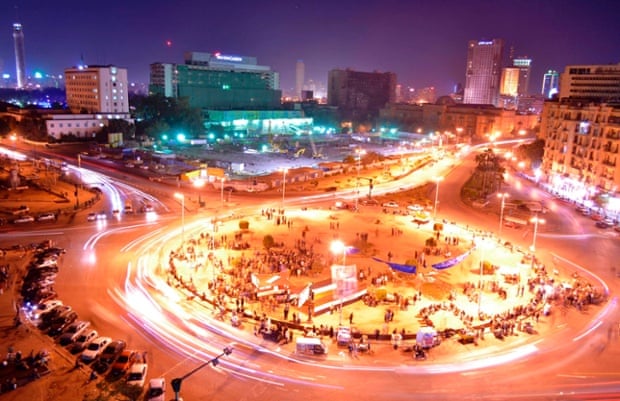
Traffic in Tahrir Square. Cairo's population is forecast to double by 2040.

Writing in a state-owned newspaper, columnist Sayed el-Bably confidently said the city exemplified how the economic conference at which it was announced would allow Egypt to “convert dreams into facts and projects”. In a nod to failed attempts to build a new capital under Hosni Mubarak, Bably said that Egyptians can now “think, dream, and look forward to the completion of what we previously thought was impossible.”

But the problem for the likes of Bably and Madbouly is that there are also those who doubt this particular dream will ever reach reality.

“Based on historic and global track records, trying to build a new city from scratch is a massive gamble,” says Brent Toderian, Vancouver’s former chief planner, and a consultant for several cities outside of the Middle East. “The most concerning thing to me was the speed at which this is intended to be built – five to seven years. That’s incredibly fast. And if you build it that fast, it will be a ghost town, like most other development plays have been.”

Toderian cites less ambitious projects in China – places like Caofeidian, which hoped to attract a million residents but ended up with only a few thousand. Dubai is an obvious counter-example of success.

But elsewhere in the UAE, the new “city” called Masdar (founded, incidentally, by the minister now driving Emirati investment in Egypt, Sultan al-Jaber) was supposed to house 50,000 people by now. Instead, it has just a few hundred.

Pressed by the Guardian, Madbouly said he already had the money to build at least 100 sq km of the new capital, including a new parliament. “We are committed for the first phase,” he says. “We have already a very clear plan.”

But in Egypt, even the best urban plans have tended to go awry. Egypt has a history of building unfinished towns in the desert, the product of a decades-old belief that satellite developments will curb overcrowding in its main cities. In theory, the strategy is based in logic: around 96% of Egyptians live on just 4% of Egyptian land, and as the population mushrooms, relocating some of the former might solve the congestion in the latter.

But experience, time and again, has suggested otherwise. These 22 existing “new towns” – some of them more than 30 years old – still collectively hold little more than a million residents, and contain thousands of empty homes. Far from Cairo’s madding crowds, they are in theory an attractive prospect for many Egyptians. But in practice, most cannot afford to move there.

In the most notorious example, New Cairo, a recent suburb to the east of its namesake, was meant to attract several million residents. But after a decade and a half it still only holds a few hundred thousand – an irony lost on Egypt’s investment minister, Ashraf Salman, when he quipped that Cairo’s yet-to-be-named replacement would be “the new New Cairo.”

David Sims, a Cairo-based urban planner, has spent years cataloguing the failures of Egypt’s satellite cities, culminating in last week’s well-timed publication of his latest book – Egypt’s Desert Dreams: Development or Disaster? Sims leans towards the latter.

“It’s just a bunch of crazy figures,” he says. “The scale is huge, and there are questions like: how are you going to do the infrastructure? How are you going to get the water? How will they move all these ministries? In other words, I think it’s just desperation. It will be interesting to see if anything comes of it, but I rather doubt it.”

The reason earlier desert settlements failed to attract residents is largely due to a lack of infrastructure and employment. Places like New Cairo have not provided enough jobs for poorer residents, or affordable transport to areas where they could find more work.

“There is a demand to live there, but it’s a demand from a very specific group of people, and it’s not a very big demographic,” says Nick Simcik Arese, an anthropologist at the Oxford Programme for the Future of Cities, and a former resident of, and researcher in, the new desert town of Haram City.

“People do want to abandon Cairo and live in their secessionary envelope. But to do that you need a car, and that means you have to have a certain income to live there.”
Historically, the Egyptian government has forced people to live in areas on Cairo’s periphery, by evicting them from poor inner-city areas, and relocating them to the desert towns. But once there, their lives exemplify why the crowds have not followed in their wake. “Governments think they can just move people to new areas, but actually people go where they want to go,” said Simcik Arese.

“For a lot of people, their homes are also their workshops, and that can’t happen out in the desert tower blocks. Their entire business and support system collapses. Their access to clients, materials, and supplies evaporates.”

For Herbert Girardet, the author of a dozen books on urban theory, this isn’t the most urgent concern. He feels Egypt’s new capital stands a good chance of providing better employment opportunities than its predecessors, mainly because Egypt’s vast government will be relocated there. Instead, his biggest worries lie in the city’s carbon footprint. Its architects claim it will uphold “the highest stands of sustainability.” But in the rush to design it, Girardet wonders if the finer details of waste disposal and green power were lost.

“What happens to the waste of this city, where does its energy come from? You have to ask whether these ideas are built into the concept or not,” says Girardet, who sets out a vision for green urban planning in his new book Creative Regenerative Cities.

“It’s true that Cairo as a city is massively congested, and there is probably a need for a new capital city. But it seems to me that it would be a city driven above all else by developers keen to create prestige, rather than long-term sustainability.”

Even if he’s wrong, the sustainability of the existing capital would still stay unaddressed. In justifying the desire for a new city, Madbouly said that something had to be done to lighten the load on Cairo, whose projected population will be 40 million by 2050. But Cairo’s plight will ironically worsen if resources and attention are diverted to new projects elsewhere, as one Egyptian commentator argued this weekend.

Writing for Cairobserver, a blog about the current capital, Khaled Fahmy, a history professor at the American University in Cairo, said: “Assuming that the aim of building a new administrative capital is to alleviate the pressure from downtown Cairo where the majority of government offices are located, and assuming, for argument’s sake, that the 5 million inhabitants will actually be moved from overcrowded city, what will happen to the rest of us?”

The fear is that Egypt’s capital, if it gets built, will be just as exclusive and private a city as al-Qahera was when it began back in 969.


*Additional reporting: Manu Abdo
**Photos courtesy of Reuters

Saturday, November 29, 2014

Fear, violence & hardship part of everyday live in North Sinai towns

Daily News Egypt

Fear, violence and hardship part of everyday life in volatile North Sinai town

Residents of Al-Arish are caught in the fight between militants and the military 


“At 5pm the day ends with the sound of gunshots – a new ritual to remind people that it’s curfew time – and by 7am another round of gunshots informs residents that the curfew has ended,” said the teacher – a mother of two living in Al-Arish, northern Sinai.

Several residents of the town have shared their experiences with the Daily News Egypt of living under curfew. A state of emergency was declared in the area following attacks by militants on 24 October, which left at least 30 army personnel dead. A militant insurgency in Sinai has flared since the military’s ousting of Islamist president Mohamed Morsi in July 2013.

The residents, who all of whom asked to remain anonymous for security reasons, revealed that – even under curfew – explosions are a common occurrence, and the people are living in fear.
 
The teacher’s six year-old daughter wakes up every night crying and screaming, terrorised by the sounds of explosions and gunfire. A few months before the curfew, the family’s house was shot at when the children were at home alone with their mother. “Since then, the nightmares have never left them,” she said.

Residents often feel the need to report a car or a suspicious bag left in the street but, as the mobile phone networks are frequently cut, it has become difficult. “Even when something gets reported, the response from the army or police is very slow,” said the teacher.

According to a pharmacist in his late twenties, the poor mobile coverage is a protective measure used by the authorities to prevent militants from contacting each other. “However, the government is unable to take control of the situation even with this precaution,” he added.

An engineer in his mid-twenties however had a different theory, attributing the network cuts to the authorities’ aim of preventing those living outside of the area from knowing what is really going on in Al-Arish.

The mother teaches at a school in Sheikh Zuweid – a Bedouin town near the border with the Gaza Strip – and claimed that she has seen planes bombarding a village in the area known as Al-Toma.
She noted that travelling between towns in the region has become difficult.

On 17 November, teachers returning to Al-Arish from Sheikh Zuweid and Rafah had to wait for hours at a checkpoint outside Al-Arish due to suspected explosives on the road. The delays meant they were not able to get home before the 5pm curfew and as a result a 28 year-old teacher was shot in the thigh while passing a security checkpoint later that night in Dahiyat al-Salam neighbourhood of Al-Arish.

The man is currently at Al-Arish hospital and his condition is stable, she said. Other teachers were taken from the checkpoint in the Alreesa district in ambulances and military vehicles, not reaching their homes until 7-8pm.

Some mothers were not able to collect their children from day care centres and there was no network coverage to enable them to contact the centres and inform them about the delay. “The mothers were extremely worried and the children were kept at neighbours’ and baby sitters’ houses until the mobile network came back at night and the mothers were then able to know where their children were,” according to the teacher.

The day after she and a group of teachers met with the governor of North Sinai Abdel Fatah Harhour to find a solution to problems cause by security delays when travelling from Al-Arish to other towns. Two days later, on 20 November, Harhour ordered the indefinite closure of schools in Sheikh Zuweid and Rafah for security reasons.

Even travelling around Al-Arish in the day time has become arduous as security forces frequently set up new checkpoints made of sand, stone, and metal barriers, forcing residents to take longer routes to reach their destinations.

Residents report that travelling from Arish to Cairo and vice versa has become very difficult. A year and a half ago they used to pass over the Suez Canal on Al-Salam Bridge. However, following the increased security threats, people are now often forced to pass the canal via ferryboat. “The lines of cars waiting to pass are endless and more time is consumed because almost every car in the queue gets inspected,” said an Al-Arish housewife.

The financial situation has become challenging for many people in Al-Arish. All types of entertainment have been removed from their lives and they can hardly afford to buy basic necessities. Traders of fruits, vegetables and clothes have raised their prices to cover losses from the early closure of their shops under curfew.

“After 5pm Al-Arish becomes like a ghost town. Places that used to be full of people and shops that were open all night are now dead and no one dares to not abide by the rules,” said a pharmacist living in Al-Arish.People are losing their tempers because of what’s happening. “I am now considering leaving this country for good and the coming days will help me determine whether I’ll stay or leave,” the pharmacist said.

Some residents express a lack of confidence in the ability of the security forces to secure the area.
On 11 November residents stated that they had reported a suspicious car parked in their neighbourhood to the police around 4pm. At 8.30pm the car exploded, before the security forces could investigate, said one of the residents who preferred to remain anonymous.

No one was killed but some sustained minor injuries. Houses and shops sustained significant damage from the explosion. Two shops were completely shattered, buildings around the car were left with cracks and holes and windows were broken.

“I thought that the whole building was being blown up, all the windows in the house were smashed inside falling on beds, sofas and on the floors,” said a housewife and a mother of four living near the place of the incident.

Another housewife shared her view regarding the situation. She implied that things are moving from bad to worse and people are feeling unstable and insecure. “I don’t have a good feeling about what’s currently happening. After the displacement of residents from Rafah I personally think that Al-Arish will be next. I have a feeling that the government is planning to isolate Sinai from Egypt and everyday my doubts get justified even more,” she said.

The housewife is living with her husband and two children near a police station in Al-Arish; security is tight to protect the station from any attacks. She claimed that, if a car passes by the area, the security forces fire their weapons and start screaming at the driver to leave immediately. The woman always parks her car on the other side of the house trying to avoid any kind of panic. “For the same reasons we can’t even get out in our balconies,” she said.

Residents say that the behaviour of the security forces is alienating citizens.

“During the setback of the 1967 war with Israel, when the Israeli army invaded Sinai and occupied Arish, many Egyptian soldiers weren’t able to leave immediately, so they hid in local houses, where residents provided them with food, clothes and even created fake ID’s for them to protect them from the Israeli army. Now things have changed. If a similar situation happened with the new enemy in Sinai, residents wouldn’t respond the same,” said an engineer living in Al-Arish.

“The police and the military are now treating people in a very bad way, the possibility of people being taken to jail for no good reason is very high and it has been actually happening a lot lately,” said the engineer. He claims that innocent people are often arrested in their homes or in the streets.

Another resident shared a story about a neighbour who was taken from his home about a month and a half ago. The resident claims that 10-15 soldiers came to the house next door at 2am and asked for an 18 year-old man who was living in the house.

“The sound of knocking and yelling was so loud that people started getting out on their balconies to see what has been going on, but soldiers kept yelling at them, telling them to go back inside. My mother and my sister were crying out of fright and out of pity for the young man and his family.”

“Until now the parents have no clue where their son is; they looked for him at all the police stations in Al-Arish and even in Cairo but couldn’t reach him. I can’t imagine what his family must be going through right now,” the resident said.

“No one is reflecting the whole picture of what is happening in Al-Arish to the external world. Some residents in the town don’t even know what has been going on. The lack of media coverage in Sinai can definitely open the door for more human rights violations,” said the engineer.

According to the teacher, some houses are now being inspected by the army. They approached her brother’s house and asked for his family’s identity cards as well as the contract for his apartment. “He was lucky to be home at the time because if the army finds an empty apartment they smash it down without notice, which happened with his neighbour’s house,” she said.

Yet, while some criticise the military and their actions in Al-Arish, others see this as the right way to handle the current situation. A working father said that, when it comes to national security, the military and Egyptian general intelligence are the only ones who should determine what is to be done.

He said that the tunnels found in Rafah between Sinai and Gaza show that the army isn’t just performing carelessly. “They do know what they are doing,” he said.

“My work has been highly affected by the recent events as I’m losing a lot of money but I believe that what the military is doing is all in favour of the people of Sinai and to prevent the city from being separated from Egypt,” the father added.

Hundreds of stories can be told by the people of this small town as every day seems to bring them a new unpleasant adventure. People are actually eager to talk and share their experience, fear, and uncertainty with the outside world.

“Every day I feel like a disaster is about to happen and I only ask God to keep my parents and my children away from any harm, and I hope that I can get back to them safely,” the teacher said. “”Oh, Sinai, where are you headed to?”


Rights delegation slams Sisi's "police state" urges int'l action

Middle East Monitor

Legal delegation to Egypt slams al-Sisi's "police state" urges international action

Thursday, 13 November 2014 15:26
ICFR logo
An international legal delegation to Egypt has slammed the government's repression of its political opponents as characteristic of a "police state", at the launch of a new report in London today.

The International Coalition for Freedoms and Rights (ICFR) presented the findings of its fourth and most recent delegation in the presence of two members of the group, solicitor Roger Sahota and retired solicitor Michael Ellman, who spoke of their findings.

According to the organisation's Secretary-General Anas Altikriti, the ICFR is a global network of legal, human rights, and media experts, whose main concern is the events of July 2013 and Egypt's regression in the move towards democracy. It was inaugurated a year ago, and seeks to document, archive, and report back on the progress or lack thereof towards respect for human rights in Egypt.

The press conference took place shortly after Egypt's appearance in Geneva for its Universal Periodic Review at the UN Human Rights Council. Two other speakers at the press conference, chair of the Egyptian Revolutionary Council Dr. Maha Azzam, and barrister Toby Cadman, attended the UPR and discussed the event surrounding the review.

Speaking first on the delegation's trip to Egypt 11-15 October, Sahota criticised the authorities' denial of access to ousted Pres. Morsi's trial, despite repeated applications and advance communication with the relevant parties.

Based on testimony from lawyers of other defendants, and drawing on the frequently-cited Human Rights Watch report of August this year, Sahota expressed concern that the trial of Morsi, as well as others, did not meet international standards for fairness.

According to Sahota, the delegation met with a variety of persons, including detainees' relatives, the families of the deceased, students, lawyers, trade unionists, politicians, and also some government officials.

"We heard disturbing accounts of indiscriminate arrests, torture in detention, the targeting of student and political activists – evidence of a deliberate strategy to deny political detainees the basic rudiments of due process."

Addressing the content of Egypt's UPR in Geneva, Toby Cadman emphasised that the point they repeatedly made to countries' representatives was that any dissatisfaction with a democratic government is to be expressed through the ballot box, not the barrel of a gun.

Cadman described the situation in Egypt today as a "classic anatomy of a dictatorship, being taken point by point, unfolding daily." The extent of the human rights violations, he said, was such that you can go through "treaties article by article" and see these abuses "occurring consistently" in Egypt.

Both Cadman and Azzam pointed to a host of areas of great concern, including the Egyptian authorities' policies in the Sinai Peninsula, where, according to Cadman, "10,000 people have been uprooted and their homes destroyed."

According to Cadman, the UPR was a "PR disaster" for the al-Sisi regime – part of the context, he suggested, for the announcement that foreign prisoners could be returned to their home countries.

The ICFR report and delegates emphasise the need for the international community to take action, and ensure accountability for human rights abuses. "It would be easy for us in the international community to turn a blind eye to what is happening in Egypt when those events are competing with stories from Iraq, Syria, Gaza, and Libya", said Sahota.

"It may be politically convenient for the West to see Egypt as a key partner in its security and political goals in the region, but I would urge that these violations be addressed and for it to be made clear that there's no place for these atrocities."

Ellman echoed the report findings by describing conditions in Egypt as those of a "police state", one that is "still heavily subsidized by the USA who don't dare call it a coup."

Cadman said that what is really important is not so much what happened in Geneva but what comes after – whether there will be any pressure to address the serious concerns raised. "The international community cannot deal with Egypt like it is business as usual."

Criticism, including that from the U.S., if it is to mean something has to translate into accountability through a block on arms sales and cessation of trade agreements, he added.

Maha Azzam claimed that the international community was "waking up," and that the "pressure is on," in Geneva, London, Brussels, and elsewhere. "Not for 'political' reasons," she added, "but because we believe the citizens of Egypt need to have their rights upheld and respected by the state, and that the violations that have happened are so extreme that they can't be ignored."

Azzam urged a UN investigation into the Rabaa massacre, as well as accountability for the perpetrators of atrocities through travel bans.

"Under the guise of a war on terrorism," Azzam said, "civil liberties are being denied to Egyptian citizens."

"Closing the political space for those that respect the democratic process whatever their ideological leanings is a very dangerous development," Azzam expanded, in response to a question from Middle East Monitor.

"It means the choices are between authoritarianism and extremism. The promotion of democracy is the best way to combat extremism: the volatility of a dictator is not the way to promote democracy or fight terrorism."

Friday, October 31, 2014

Army forcefully displaces 10,000 residents & destroys 100s of homes by Gaza border

Associated Press 
Egyptian army demolishes homes along Gaza border

Thursday - October 30, 2014


EL-ARISH, Egypt - With dynamite and bulldozers, Egypt's army demolished dozens of homes along its border with the Gaza Strip on Wednesday, after the military ordered residents out to make way for a planned buffer zone meant to stop extremists and smugglers.

The plan to clear 10,000 residents from some 800 houses over just several days has angered the area's population, which has long held grievances with Cairo.

"To throw 10,000 people into the street in a second, this is the biggest threat to national security," said Ayman Mohsen, whose sister left her house about 350 yards from the border. Speaking to the Associated Press via online messages, he said the army told residents to leave on Tuesday within 48 hours, and that houses would be blown up even if people remained inside.

Over the last decade, the northern region of the Sinai Peninsula has become a hub for Islamic extremists, although insurgency has spiked since last year's military ouster of Islamist President Mohammed Morsi. It has also spread to other parts of Egypt, with extremists targeting police in Cairo and the Nile Delta.

The move to set up the planned 8-mile buffer zone, which will be 500 yards wide, comes after extremists attacked an army checkpoint near Sheikh Zuweyid town last week, killing 31 soldiers. No group claimed responsibility.

After the attack, Egypt declared a three-month state of emergency and dawn-to-dusk curfew there and indefinitely closed the Gaza crossing, the only non-Israeli passage for the crowded strip with the world.

Mona Barhomaa, an activist who lives 800 yards from the border and who is not affected by the evacuation order, said she supported the demolitions.

"The tunnels to me are like windows that for years my neighbors have used to infiltrate my house," she said, referring to the underground passageways used to smuggle goods and weapons. "The tunnels led us into this hellish situation."

Many residents were angered by the short notice and poor local organization, as well as a hostile media campaign unleashed days earlier that saw private and public television commentators equating opposition to the plan with treason.

Tanks and armored vehicles sealed off all of Rafah as thick gray smoke rose in the sky each time demolition charges went off and another house was toppled.

The corridor will eventually be monitored by surveillance cameras and feature a water-filled trench that will be 40 yards wide, 20 yards deep, and run all along the border to the Mediterranean Sea, officials said.


*Photo by Said Khatib, courtesy of AFP/Getty Images 

2,000+ residents displaced from homes & farms, denied work on Suez Canal project

Mada Masr
Over 2,000 residents forced from homes, denied work on Suez Canal project

October 1, 2014

Jano Charbel 


Touted as Egypt’s national project of the century, the construction of a navigational bypass known as the “New Suez Canal” is projected to replenish the state’s coffers with billions, while providing one million new job opportunities in the process. However, it has thus far displaced well over 2,000 longtime residents living by the planned course of this new megaproject – rendering them both homeless and jobless.
 
According to lawyers for the displaced, well over 1,000 residential units have been torn down and their agricultural lands confiscated since the beginning of this month, in the villages of Qantara Sharq and Abtal, just east of the central part of the Suez Canal.

No monetary compensation has yet been paid for the demolitions, nor has alternate housing been provided, although state officials have pledged allotted plots of empty land, amounting to a mere 150 square meters per family.

Displaced families have been told that they will be repatriated in the villages of Amal and Ahrar, near Qantara Sharq, around 130 kilometers northeast of Cairo.

Neither the Suez Canal Authority nor the governorate of Ismailia has thus far made any mention of compensation for loss of agricultural lands and farmers’ livelihoods.

Attempts to contact the Ismailia governorate’s media spokesperson for specific details regarding these relocation efforts went unanswered.

In addition to being displaced from their homes, lands, and livelihoods, these evicted residents are being denied work opportunities in the New Suez Canal Project, due to unspecified security concerns.

A lawyer for the displaced families, Sherine al-Haddad, warns that as this new megaproject pushes forth from the central canal governorate of Ismailia, and hundreds of additional homes may be demolished.

According to her, an estimated 2000, or more, residents living and working along its trajectory may also potentially be displaced from their villages, which lay along the route of the planned bypass.

Earlier this month, the Armed Forces and governorate of Ismailia began the process of evicting some 2,500 locals and demolishing their homes, while simultaneously confiscating hundreds of feddans (one feddan = 1.038 acres) of their family-owned agricultural lands.

Many, if not most, of these uprooted families have resided in the town of Qantara Sharq and the nearby village of Abtal for up to 30 years, whilst reclaiming their surrounding desert environs into farmlands, primarily through the cultivation of mango trees.

Haddad tells Mada Masr there are approximately 500 families, whose members total well over 2,000, that have been hastily displaced from their homes and lands.

“These families were given very little notice prior to their eviction – just around one week – and have not received any concrete form of compensation. Only promises from the officials involved in the New Suez Canal Project.”

Haddad adds that an additional 500 families, amounting to another 2000–2500, may be evicted from their homes over the course of the year, and may also have their farmlands confiscated to make way for the planned route of the canal, along with its planned zones for industry, services and investment.

“Beyond Qantara Sharq and Abttal, additional villages located to the east of Ismailia’s Bitter Lakes may similarly be wiped away to make space for the new project,” she says.

The project, which is actually a new artery (rather than a second canal) for the existing international waterway, is planned to run 72 kilometers parallel to the Suez Canal, and lies east of the original canal.

The lawyer points out that the Sinai Peninsula is virtually all military and state-owned land, and that “all civilian claims of land ownership here are thus considered contentious.”

It is on this basis that the authorities have evicted the residents of Qantara Sharq and Abtal, tore down their homes, and dug up their farmlands. “They’ve been evicted from these two villages as they are situated on land between the old Suez Canal and the new project,” she explains.  

Regardless of original land claims, Haddad points out, “The evicted residents had been residing on these lands for nearly three decades. Thus, by virtue Egypt’s occupancy regulations and the construction of permanent homes on these lands for more than eight to 15 years legally recognizes it as their abodes.”

“Further recognizing their residency on these lands are the utility bills that these residents have been paying the governorate of Ismailia over the course of the years and decades in which they have lived there,” she adds.

Diaa Eddin Negm has been residing and farming in the village of Abtal for the past 30 years. He and his nine sons have been forced off their lands, and are now internally displaced people with no means of income.

Negm explains that his family’s lands are not officially registered in their name with the governorate of Ismailia, “yet we’ve been paying our gas bills, electricity bills, and landline phone bills to the governorate from our address for well over 20 years.”

At over 60 years of age, Negm says “I’m a farmer, as was my father and grandfather before him. This is my profession and that of my children. I’m an ageing farmer who is too old to learn a new profession, or to seek alternate job opportunities. Farming is all I know.”

Further adding to their plight, Negm explains that “after our eviction, I sought other employment opportunities for my nine sons, each of whom has a family of his own.”

When the elderly farmer asked security authorities in Ismailia for permits to allow his children and grandchildren to work with contracting companies on the New Suez Canal Project, he and his extended family were all denied work permits.

“When he found out that we were evicted residents of Abtal, the presiding police general told me that due to security concerns we were not allowed to work on the project. He did not specify what these security concerns are,” he says.

According to Haddad, “the security authorities consider these evicted residents as potential subversive elements.”

“These authorities don’t trust them, as several families and residents have been resisting or protesting their evictions, and some have been detained for doing so. The authorities fear they may stir up trouble along the new project,” she adds.

“So what else are they to do for a living these days?” she asks.

Negm and his extended family are currently living north of the village of Serabium in Ismailia. “We’re all renting apartments now, with the rent being paid from our own pockets. We’re all unemployed now. We’ve received no compensation or alternate housing has yet been provided,” he says.

Negm hopes that the Ismailia governorate will specify the exact location of the 150 square meters on which they will be allowed to build new, permanent homes.

“Together we owned 34 feddans of mango orchards from which we earned our livelihoods, and nine separate homes. The average size of these units was 250 square meters.”

“Regarding the New Suez Canal Project, I am personally both pleased and distressed with it,” Negm concludes.

“To President Sisi, I say: we support your national project and nationwide ambitions. Yet we require agricultural land to sustain ourselves, even if just three or four feddans per family. We are willing to reclaim desert lands, to plant them and turn them into fertile farmlands.”

On August 5, Sisi addressed the nation, stating that this megaproject would serve as a “new artery of life benefiting Egypt, its great people and the whole world.”

However, the forcefully evicted residents of Qantara Sharq and Abtal have not felt any of these benefits.

Another displaced mango farmer from the village of Abtal, Ibrahim al-Sayyed, also sent a message of despair to the president. “My family and I voted for President Sisi, and will vote for him again in the upcoming presidential elections. We support the president and his great national project that will help the economy of the whole country. However, we also want to have homes and farms of our own, as we did just three weeks ago,” he says.

Sayyed hails from a family that has been living and farming in Abtal for the past 30 years. “We have bills and receipts to prove our residency here.”

Together with his family, the 25-year-old Sayyed worked and owned six feddans of mango orchards. The displaced family of 12 had owned a home measuring over 260 square meters.

Like most other residents of Abtal, Sayyed claims he was given a 10-day notice to vacate his home and farmland. Like the others evicted, they were not given any compensation – only the pledge of a 150 square meters of land on which they are to build a new home – using their own resources.

They now rent two small apartments in the village of Serabium, “one in which we all live together, and another in which we have placed all our furniture and belongings,” he says.

They are now paying LE1,000 in rent for both units, although they’ve lost their land and only source of income.

“I have asked about any sort of paid work or service that my relatives or I could provide on the new project, but were turned down when the officials learned that we were displaced from Abtal,” he says.

“In the 1980s, under President Hosni Mubarak, my family and other farming families were encouraged to settle to the east of the canal in Sinai. Now we’ve been pushed back to west of the canal, have been driven from our homes, lands and jobs,” Sayyed explains.       

Haddad says she aims to reach an amicable settlement with the respective state authorities – the governorate of Ismailia, Ministry of Agriculture, Armed Forces, and the Suez Canal Authority - through the channels of legal mediation and arbitration.

“Failing this, I will take my clients’ cases to the State Council Court.”

According to Egypt’s Constitution of 2014, Article 35 stipulates that private properties shall be protected and the right to inheritance thereto guaranteed. Private property may not be placed under sequestration except in those cases specified by law, and with a court order. Private property may not be expropriated except for the public interest, and with fair compensation paid in advance in accordance with the law.

Constitutional Article 63 stipulates that arbitrary forced displaced of citizens in all its forms and manifestations is prohibited and is a crime with no statute of limitations.


*Photo of Suez Canal courtesy of Shutterstock

Friday, May 31, 2013

Police assault disabled protesters outside Sharqiya Governorate HQs

Disabled protesters attacked in Sharqeya


Nourhan Dakroury
 
A group of disabled persons who were protesting outside of the Sharqeya governorate building were attacked and physically assaulted by security forces on Sunday.

As a result, four of the protesters were admitted into hospital, two of whom are suffering from concussions.

The attacks came after protests outside of the Sharqeya governorate building, with those present demanding their right to work, proper housing, education and health care, according to Muhamed Abou Zikri, a lawyer at Egyptian Centre for Economic and Social Rights (ECESR.)

Abou Zikri claimed that the attacks were sparked by an argument between the protesters and several microbus drivers in the area.

Security forces then attacked the protesters, while the drivers disappeared from the scene, according to Abou Zikri.

He said that the ECESR has sent lawyers to Sharqeya to investigate what happened.

Two organisations concerned with disabled persons rights, the Civil Council for People with Disabilities and the People with Disabilities Syndicate, are currently discussing their legal stance with the ECESR and planning a media outreach campaign.

This incident is not the first of its kind in Egypt, Abou Zikri added.

El-Seba’y Bahei El-Din, a member of the Beheira Subcommittee of the National Council of Disability, said that a similar case occurred in October 2012, when a number of disabled persons were protesting outside the Presidential Palace.

“People with disabilities are suffering throughout the country, but they are suffering even more in Sharqeya,” Bahei El- Din said.

He said that the former governor of Sharqeya had hired a large number of disabled people, with salaries of EGP 80 per month.

Bahei El-Din added that there are between 12 and 15 million people with disabilities in Egypt, which is reason enough for the state to start addressing their rights and needs.

The Sharqeya Governorate could not be reached for comment.

Wednesday, November 28, 2012

Army battles squatters over island,3 civilians killed & 10s arrested

Associated Press

Egyptian army fights Cairo squatters, 3 dead

Nov. 18,  2012


CAIRO (AP) — Egyptian army troops fought a four-hour gun battle with protesters in southern Cairo on Sunday, sparked by a dispute over land on an island of the Nile, security officials said. Three protesters were killed.

The officials said the disputed plot of land on Qursayah island is owned by the armed forces but was illegally seized by residents taking advantage of the chaos that followed last year's ouster of authoritarian President Hosni Mubarak.

The clashes broke out when troops moved in from the mainland to retake control of the plot. The officials say three civilians were killed and seven others wounded in the firefight on a road on the mainland across from the island. They spoke on condition of anonymity because they were not authorized to brief reporters.

Troops arrested 15 protesters who had used metal barricades and burning tires to block an access road to the island, the officials said. Five soldiers were wounded by gunfire in the clashes, which took place around a mile (1.5 kilometers) from the city center.

A statement published by Egypt's official MENA news agency quoted a military spokesman as saying the land was first seized after the fall of Mubarak but retaken by the army soon thereafter.

About 60 civilians, mostly women, again took control of the land on Friday but were evicted early on Sunday after efforts for a negotiated settlement failed. The spokesman said the protesters opened fire first, and gave a higher arrest figure — 25 protesters.

Sunday's violence was the first known street battle involving the army since President Mohammed Morsi, Egypt's first civilian and freely elected leader, took office in late June.